Rate Limiting and Quota Management for Search APIs in Production
Understanding rate-limit algorithms prevents retry logic from making outages worse.

Published documentation often does not tell you which enforcement algorithm your provider runs. When it does, implementations drift from what's described. This matters because the algorithm determines what your client should actually do, and treating all 429s as interchangeable is precisely how retry logic makes things worse.
To understand why this works, we must first look at what your provider is running server-side, because that changes everything on the client side.
Fixed window divides time into discrete buckets, typically aligned to clock minutes or hours, and counts requests within each bucket. It is the simplest implementation and the most exploitable. A client can issue N requests at 12:00:59 and another N at 12:01:00, producing 2N requests in two seconds against a limit stated as N per minute. This is not a client bug; it is an emergent property of clock-aligned enforcement. If a search API uses fixed windows, boundary bursting is a latent risk, not only for triggering abuse detection on the provider side, but for introducing unpredictable load spikes in your own upstream systems.
Sliding window counter eliminates boundary bursts by weighting request counts across a moving time interval. Memory cost is low relative to its accuracy; it remains practical at the distributed-systems scale where most search API providers operate. Redis documentation cites this approach as effective for the majority of API rate limiting scenarios, which matters because many search API providers use Redis-backed enforcement. The client-side implication is concrete: smooth, even pacing is rewarded, and bursting is penalized more predictably than with fixed windows.
Token bucket is the algorithm you are most likely facing in practice. AWS and Stripe both use it. A bucket holds up to B tokens and refills at R tokens per second; each request consumes one token. When the bucket is empty, the API returns 429 until refill catches up. The key property for clients is that token bucket allows legitimate bursting up to bucket capacity before enforcement begins. A cold start that issues a rapid sequence of queries can succeed entirely, provided the bucket was full and the refill rate sustains the average load. Once the bucket drains, recovery is governed by refill rate, not window reset, and that distinction matters more than most client implementations acknowledge.
Sliding window log stores a timestamp for every individual request and computes exact counts within the look-back window. It is the most precise algorithm and the most memory-expensive. At scale, the per-request storage cost makes it impractical for general-purpose enforcement. It appears in contexts where exact audit trails matter: payment endpoints, authentication flows. For search APIs at volume, it is rarely the underlying mechanism.
Diagnosing which algorithm you're actually facing is more reliable than reading documentation. Fixed window exhaustion produces 429s that cluster just before a window boundary and clear suddenly at reset time. Token bucket depletion arrives gradually as tokens drain, and recovery is continuous rather than step-function, because refill is constant. Sliding window enforcement is more proportional: 429s appear as a function of recent request density, with no sharp resets. A few hours of production traffic tells you more than most provider documentation ever will.
Reading and normalizing rate limit headers across providers
The header landscape is fragmented in ways that become apparent once you're trying to maintain a single abstraction layer across providers. There is a de facto convention: X-RateLimit-Limit, X-RateLimit-Remaining, and X-RateLimit-Reset. Convention is not standardization, and every provider has made its own choices.
GitHub encodes X-RateLimit-Reset as a Unix epoch timestamp. Shopify uses Retry-After in seconds. HubSpot exposes a separate X-HubSpot-RateLimit-Daily-Remaining header for its daily bucket alongside its per-second enforcement headers. An agent that routes across multiple search backends must parse each vendor's semantics independently; a generic header parser will silently misread reset times or miss quota-specific signals entirely.
The IETF has been working toward standardization. Draft 11 of the RateLimit header specification, published in May 2026, defines structured RateLimit and RateLimit-Policy headers with consistent semantics. Cloudflare adopted the draft in September 2025. As of 2026, GitHub and Stripe continue to use their own vendor-prefixed headers. The standard is coming; it is not here uniformly. The practical response is to write a header-normalization adapter layer now, with a clean abstraction boundary, so that IETF-compliant parsing can be swapped in provider by provider as migration happens.
Every API response, successful or not, should be parsed for three values: remaining requests in the current window, window reset time normalized to epoch seconds regardless of what format the provider uses, and whether the limit being signaled is a short-term rate limit or a longer-period quota ceiling. Some providers distinguish these in separate headers. That distinction matters operationally: a rate limit exhaustion is recoverable by waiting; a quota exhaustion is not recoverable without operator intervention.
One edge case that gets missed: if a request times out at the network layer but was processed by the server, a blind retry issues a duplicate search. For a pure GET with no side effects, this may seem harmless, but if the API logs usage per call and billing is per request, the duplicate is a real cost. Use idempotency keys where the provider supports them, and build the retry layer with awareness that "no response received" is not equivalent to "request not processed."
Retry logic that reduces load instead of amplifying it
The failure mode worth understanding first is the thundering herd. When many agents or pipeline workers hit a 429 simultaneously and retry after the same fixed delay, they synchronize their next attempt to approximately the same moment. The synchronized burst hits the API at reset time, often triggering another 429. The system retries again, in synchrony again. This is not a pathological edge case; it is the natural outcome of deterministic backoff in concurrent systems, and it converts a recoverable throttle into a sustained self-inflicted denial of service.
AWS research on this problem found that full-jitter exponential backoff reduced call volume substantially versus non-jittered approaches with high numbers of contending clients. The direction is unambiguous: jitter is not optional at scale.
The standard implementation:
delay = random(0, min(cap, base × 2^attempt))The cap prevents indefinite waits on deep retry sequences. The jitter, applied across the full range from zero to the capped value, breaks synchronization between concurrent workers. Base delay should be informed by the provider's window size. Retrying in 100 milliseconds against a 60-second window is noise that accomplishes nothing.
A 429 with a Retry-After header should be respected precisely: wait the specified duration, then retry. A 429 without that header warrants jittered backoff from the client's own parameters. A monthly quota exhaustion is categorically different; retrying is pointless and produces only delay. That condition should surface immediately to the operator, because the resolution is administrative, not technical. Distinguish also between 429 (throttling) and 503 (capacity unavailability); they have different backoff profiles and different recovery characteristics.
Unbounded retries inside an agent reasoning loop are an antipattern that produces indefinite stalls. The HTTP client layer should have retry limits, but those limits are not sufficient on their own. The agent orchestration layer needs a hard ceiling on total retry time, independent of HTTP client configuration. Without this, a quota exhaustion that the HTTP client dutifully retries forever will hold an agent in a stalled state, consuming memory and pipeline resources while the operator watches a frozen process and wonders why no error surfaced.
Client-side rate limiting: shaping requests before they hit the API
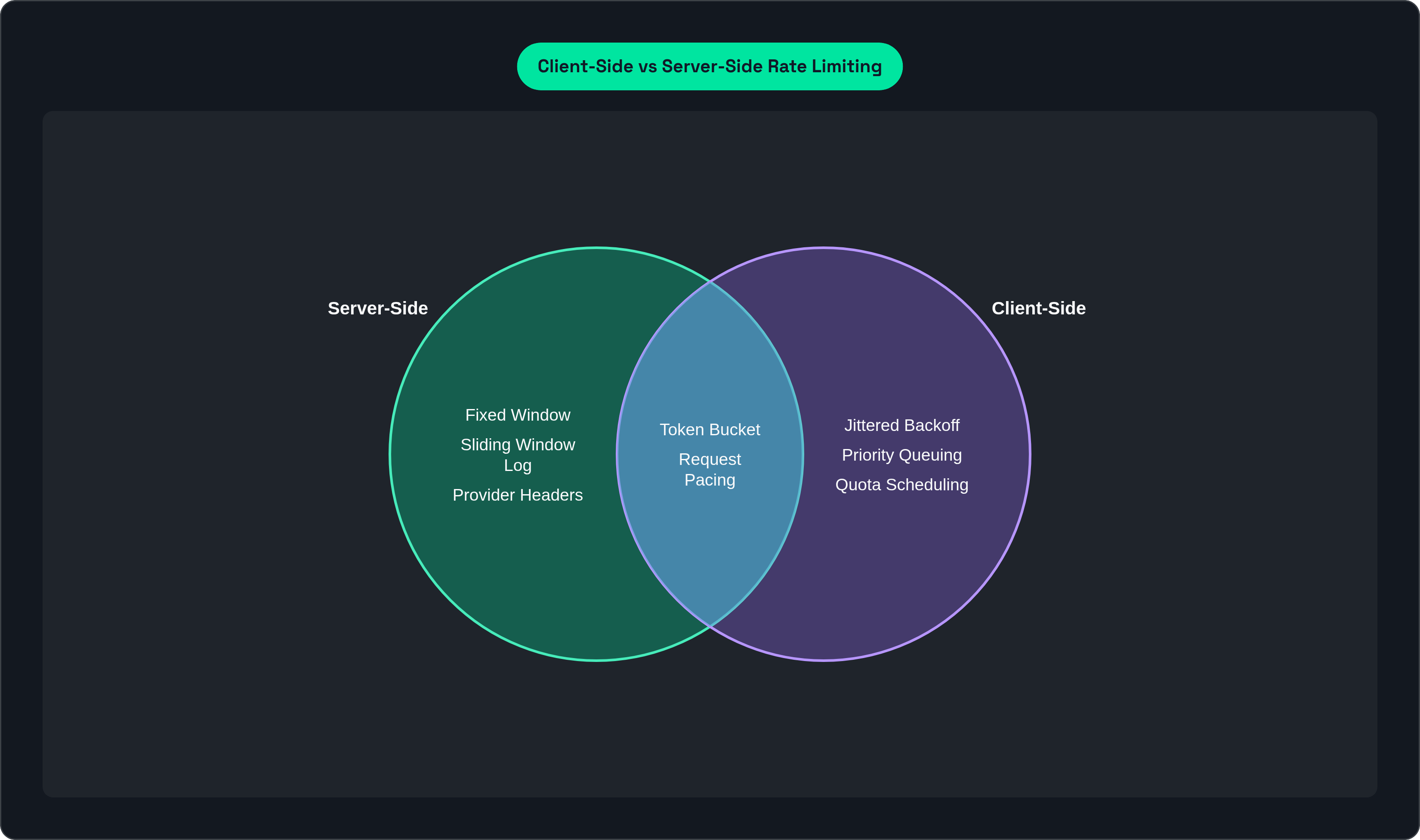
Enforce your own rate limit, below the provider's published limit, before a single request leaves your system. A 429 represents a request that already failed. By the time the status code arrives, you have consumed a request slot, incurred network cost, and, in an agentic context, potentially broken a reasoning step. The provider's enforcement is not your primary throttle signal; it is a fallback for when your own enforcement fails.
Setting internal request rates at 80 to 90 percent of the published limit provides headroom for measurement imprecision, clock skew between client and server, and legitimate bursts from concurrent workers that all read "capacity available" slightly before any of them has issued a request. The exact percentage matters less than the discipline of having a gap at all.
Mirror the provider's algorithm locally. Maintain a token bucket on the client side with parameters that approximate the provider's published limits. Each outbound request must acquire a token before it is issued. If no token is available, the request enters a queue; it does not get dropped. Dropped requests require full re-execution from whatever state the agent or pipeline was in when the request was issued. Queued requests resume from the queue, which is a fundamentally cheaper recovery path.
Bucket parameters should be updated dynamically. When provider response headers reveal actual remaining capacity, use that data to recalibrate the local bucket state. The local estimate and the server's actual count diverge over time, especially under concurrent load; header feedback closes that gap.
Not all search calls are equivalent. A user-facing interactive query blocking a response has fundamentally different urgency than a background batch enrichment job. A priority queue at the client layer with at least three tiers, interactive, normal, and bulk, means that when quota is constrained, low-priority requests are deferred to the back of the queue rather than dropped. This preserves the work while protecting latency-sensitive requests from contention with background load.
If your system routes requests across multiple API keys or multiple search providers, each key's bucket must be tracked independently. A shared counter across keys will systematically under-enforce: each key has its own upstream limit, and mixing counts produces a number that corresponds to no real enforcement boundary.
Quota-aware scheduling for agents and pipelines that run at volume
Monthly quota is not a hard wall you run into at the end of a bad month. At scale, it is a resource to be allocated deliberately, in advance, by workload type. A pipeline that front-loads search volume in the first week of a billing period may find itself without capacity for end-of-month processing that is business-critical. This is not hypothetical; it is the kind of incident that surfaces in retrospectives with titles like "why did the reporting pipeline go dark."
Three tiers serve most production systems. Interactive workloads are user-facing and latency-sensitive; they receive highest quota priority and are not deferred. Batch workloads, such as nightly enrichment pipelines or weekly research digests, are schedulable; they run during off-peak hours when RPM headroom is highest and quota consumption pressure is lowest. Background workloads, including speculative prefetching and index warming, carry the lowest priority and are the first to be shed when quota is constrained. The classification is not sophisticated in theory, but it requires discipline in implementation, because every team believes its batch job is urgent.
Track daily quota consumption against a linear baseline: monthly quota divided by days in the billing period. An alert threshold at 20 percent above baseline, triggered before exhaustion rather than after, gives operators time to respond with scheduling adjustments rather than incident responses. The automated extension is to reduce batch workload request rates programmatically when projected exhaustion falls within a defined threshold of days. The system throttles itself before it runs out, which is meaningfully different from the system running out and then throttling.
Systems serving multiple tenants on a shared provider key face a compounding problem. Without per-tenant quota allocation, a single runaway agent or bulk job from one tenant can exhaust the shared upstream quota, affecting every other tenant on the same key. Two-layer tracking is required: per-tenant allocation enforced at the application layer, and per-provider-key enforcement against the upstream limit. Tenant caps can be soft (warn and allow) or hard (block and return a 429-equivalent to the tenant), depending on the SLA commitments the platform has made. The choice between soft and hard caps is a product decision, not a technical one, but the infrastructure to enforce either must be built deliberately.
Caching search results to extend effective quota without sacrificing freshness
There is a real tension in caching search API results. The reason to use a search API in an agentic context is real-time grounding: the agent needs information that is current, not information that was current when the cache was populated. Naive caching defeats this entirely. But fetching fresh on every request regardless of query type treats all queries as equally volatile, which they are not, and that assumption is worth interrogating before you build your caching policy around it.
Queries about breaking news, financial prices, or current events may be stale within minutes. Queries about company backgrounds, product documentation, or research literature change on the scale of hours to days. Queries about historical facts, reference definitions, or stable entities change rarely if at all. Assigning a single TTL policy across all query types either over-caches volatile content or over-fetches stable content. Classification can be rule-based, using keyword detection to flag terms like "today," "latest," or ticker symbols as high-volatility signals, or model-assisted for higher fidelity at the cost of additional latency in the classification step.
Normalize queries before hashing: lowercase the text, strip punctuation, sort parameter order. The same query issued with minor syntactic variation should resolve to the same cache key. Include the provider and the requested result count in the key; the same query against a different provider, or the same query requesting a different number of results, is a different response. Semantic deduplication, using embeddings to identify queries with different surface forms but identical intent, is worthwhile at high request volumes but adds latency to the cache-lookup path. Apply it selectively.
Track cache hit rate alongside quota consumption. A decline in hit rate with steady query volume suggests either genuine query diversification, which is organic, or a cache invalidation bug, which requires investigation. Even modest hit rates on medium-volatility queries, such as documentation lookups or entity research, extend effective monthly quota meaningfully. The cache is not a workaround for quota constraints; it is a legitimate architectural layer that allows expensive compute to be applied where freshness is actually required.
Request batching and deduplication to reduce raw API call volume
Parallel agents present a deduplication challenge that single-threaded pipelines do not. Two agents pursuing different sub-goals within the same session may independently issue the same search query within seconds of each other, each consuming a request slot and contributing to quota burn for an identical result. In multi-branch pipelines, where the same initial query fans out to parallel reasoning paths, this duplication can be systematic rather than incidental.
The mitigation is an in-flight request registry at the client layer. Before issuing a search request, the client checks whether an identical query is already in flight. If it is, the second caller waits for the result of the first request rather than issuing a duplicate. This is distinct from caching: it applies to concurrent requests for the same content, not to repeated requests across time. At high parallelism, the reduction in raw API call volume can be substantial.
Some search APIs expose batch endpoints that accept multiple queries in a single HTTP request. Where available, batching amortizes per-request overhead and can reduce the total request count significantly for workloads that generate queries in bursts. The scheduling layer must accumulate queries over a short collection window, typically measured in tens of milliseconds, before dispatching a batch. The tradeoff is latency: the first query in a batch waits for the window to close before any of them are dispatched. For interactive workloads, that tradeoff is usually unacceptable. For batch and background workloads, it is often favorable.
What these layers share is a common logic: every 429 you receive is a problem your architecture failed to prevent. Client-side rate limiting, jittered retry, quota-aware scheduling, caching, and deduplication each address a distinct point of failure. The system that needs all of them is not an edge case; it is any system running agents at volume. The question is only whether you build the defense before the incident or during it.


