Web Search API Integration for AI Agents
Live web data replaces hallucination with auditable facts.

Grounding, in its precise technical sense, means constraining a model to answer only from supplied evidence rather than from its parametric memory. The model shifts roles: no longer an oracle drawing on internalized knowledge, but a reader and summarizer working from documents placed in its context window. That shift is less intuitive than it sounds. I spent an embarrassing amount of time treating it as a prompt engineering problem before recognizing that the retrieval architecture underneath was the harder constraint.
The basic loop works like this: a query arrives, the agent calls a search API, receives structured results, places them in the context window, and the model generates a response that cites those sources. Because the model cannot confabulate what it cannot find in context, grounding cuts hallucination more reliably than prompt engineering alone. Telling a model to "be accurate" does nothing about the fact that it doesn't know what it doesn't know. Replacing its knowledge with freshly retrieved evidence removes the opportunity for confabulation at the source.
Citations are not cosmetic in this architecture. When every claim traces to a fetched document, the verification chain becomes auditable, either by a human user or by a downstream agent in a multi-agent pipeline. That auditability is what separates trustworthy systems from merely confident ones, and the distinction matters in any domain where "confident but wrong" has real consequences.
For time-sensitive queries, live web data is the strongest grounding signal available. A page fetched two seconds ago cannot be stale by definition, which is categorically different from a vector database populated last week or a knowledge base refreshed monthly.
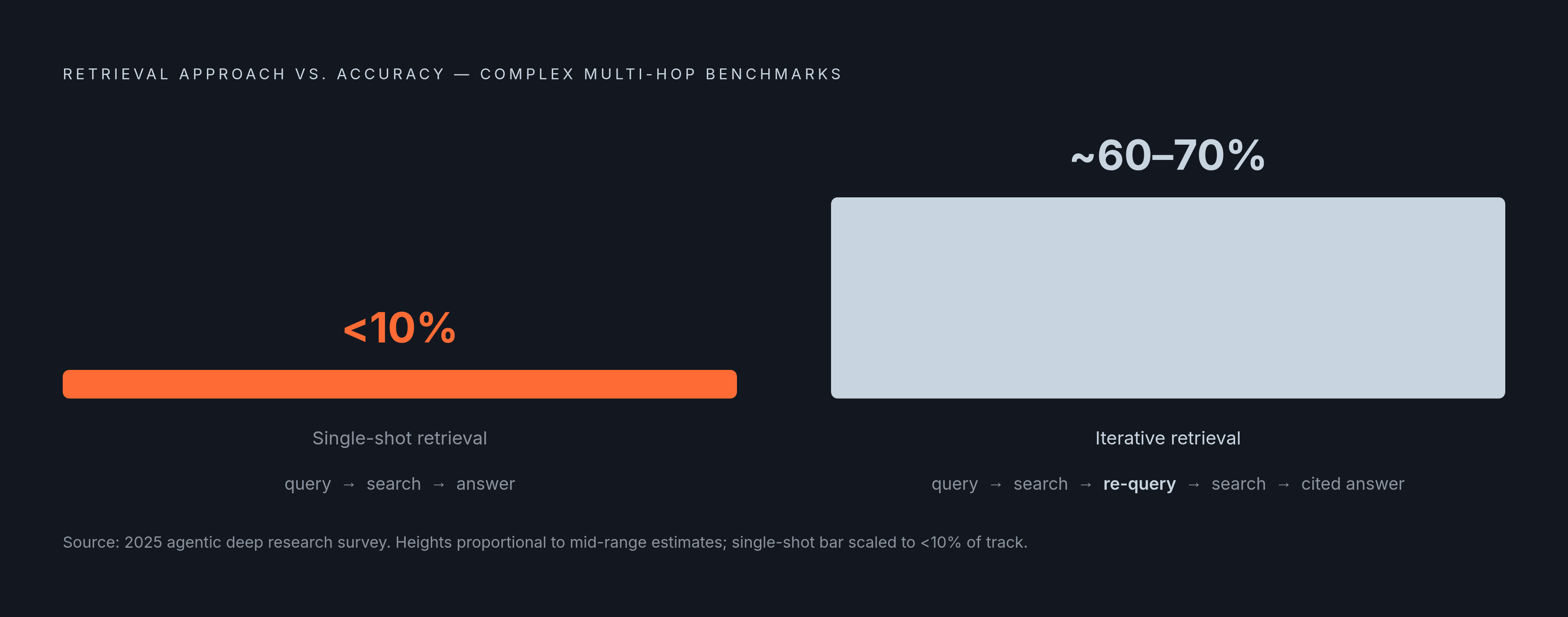
The architecture of the retrieval loop itself carries significant performance implications. Single-hop retrieval suffices for straightforward factual lookups; multi-hop retrieval, where the answer to a first search informs the construction of a second query, is necessary for complex, compound questions. A 2025 survey on agentic deep research found that standard language models using basic keyword search scored below 10% on complex multi-hop benchmarks, while systems built around iterative retrieval scored dramatically higher. At AI Engineer Europe 2026, Weaviate's Leonie Monigatti put the broader issue plainly: context engineering is roughly 80% agentic search, because stale context produces confident-sounding wrong answers. The failure mode isn't uncertainty. It's false certainty. Which raises a question worth sitting with: if the failure mode produces no visible signal of error, how do you detect it before it reaches a user?
What the market pressure behind this integration actually looks like
The agentic AI market was valued at roughly USD 7 to 7.5 billion in 2025. Multiple 2026 research estimates project it reaching somewhere between USD 139 and 199 billion by 2034. Those numbers describe not just a market but a pressure: organizations are making infrastructure decisions now that will either scale or collapse under that volume.
Gartner's 2025 data sharpened the trajectory: 40% of enterprise applications were projected to embed task-specific agents by 2026, up from under 5% in early 2025. McKinsey's data revealed the gap between ambition and execution. Only 23% of organizations had actually scaled an agentic system into production, while 39% were experimenting. Most agents were not shipping.
Gartner also flagged that over 40% of agentic AI projects risk cancellation by 2027 due to escalating costs, unclear business value, and inadequate governance. Search quality and reliability are directly implicated in all three failure modes. An agent that retrieves stale data costs more to correct, delivers less demonstrable value, and creates governance problems when it cites sources that no longer say what it claims they say. These aren't abstract risk categories; they're the specific failure modes that end pilot programs.
Two developments shaped the current market conditions directly. Microsoft retired its Bing Search APIs in August 2025, displacing a generation of developers who had built retrieval pipelines on that infrastructure. That displacement created real urgency, and it opened the market to a new cohort of providers who had designed their APIs specifically for agentic workloads rather than adapted consumer search infrastructure after the fact. Infrastructure choices made during a pilot become the choices maintaining uptime at enterprise volume. The teams who treat retrieval as a commodity decision tend to rediscover it as a critical dependency somewhere around their first production incident.
Why consumer search APIs fail under agentic workloads
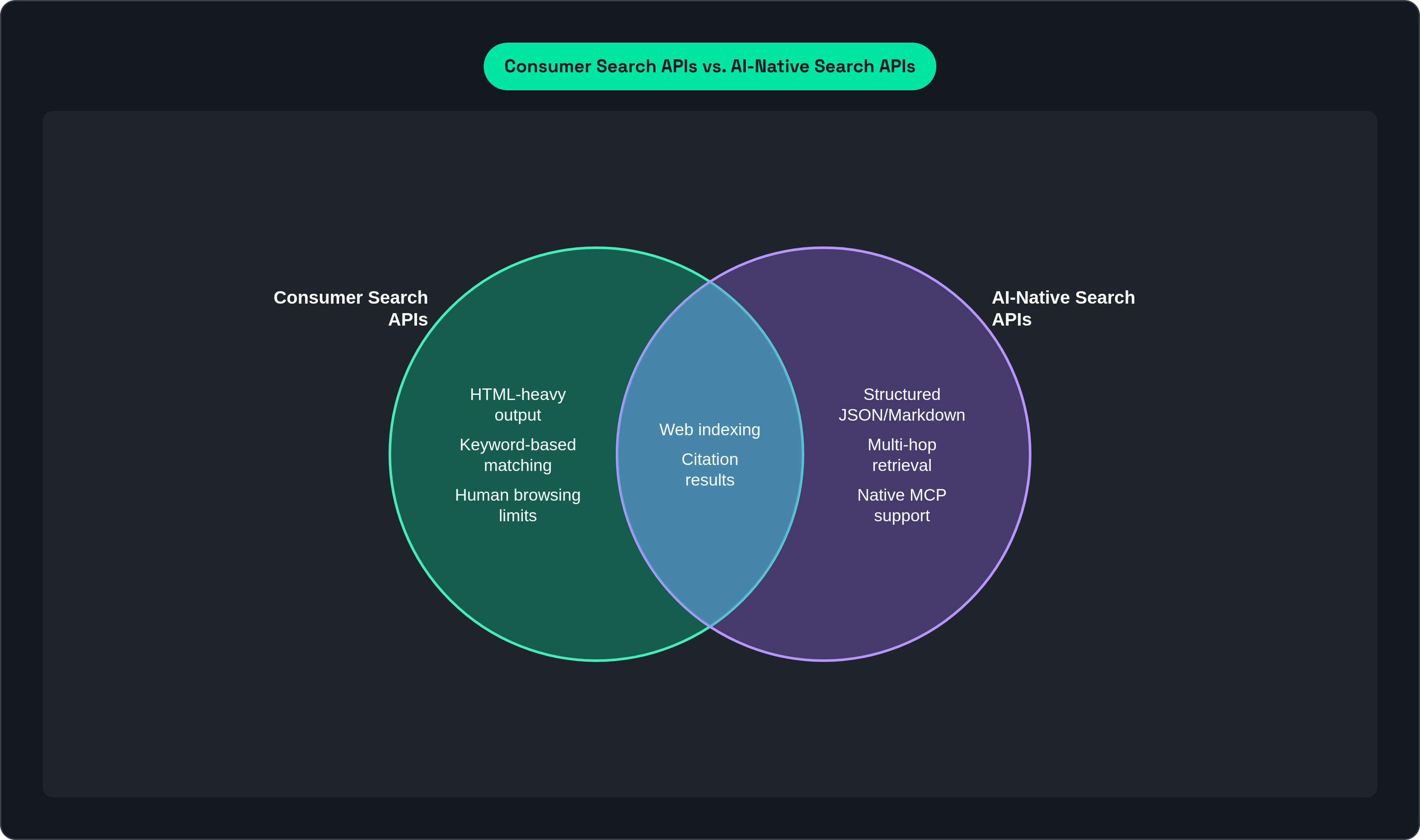
Traditional SERP APIs were designed for human browsers. Their output is HTML-heavy, their matching logic is keyword-based, and their response structure assumes a person will render the page, not a model that needs to parse and summarize content programmatically. The mismatch with agentic workloads is structural, not superficial, which means incremental patches don't fix it.
Three specific mismatches compound quickly in practice. First, output format: HTML optimized for rendering is verbose, tag-heavy, and requires preprocessing before it can enter a prompt. Agents need clean JSON or Markdown that slots directly into the context window without an intermediate extraction step. Every preprocessing step is both a failure opportunity and a latency source.
Second, latency profile. What is acceptable for a page load, roughly 500 milliseconds to a second, compounds across a multi-step reasoning loop. A 500-millisecond difference per call becomes five seconds across ten tool calls in a single agent run. At production scale, that difference separates a responsive agent from one that times out or exhausts its budget before completing a task.
Third, rate limits and throughput. Consumer APIs are sized for human browsing sessions, not for agents issuing dozens of calls per task, possibly in parallel across many concurrent users. Enterprise agentic workloads can spike in ways that consumer-tier infrastructure was never designed to absorb.
The snippet-versus-full-page problem is more consequential than it initially appears. Most search APIs return 100 to 200 words of extracted text per result by default: sufficient for a quick factual lookup, wholly insufficient for deep synthesis, document analysis, or RAG pipeline construction, where the model may need 2,000 to 10,000 words per source. Getting full-page content often requires either a separate parameter, a second API call, or a provider that handles extraction natively in the same response. Each additional call adds latency and cost, and those costs compound across thousands of agent runs.
Model Context Protocol warrants mention here. MCP has emerged as the integration standard for agentic systems, with support from Anthropic, OpenAI, Google, and Microsoft. APIs without native MCP support require custom tool wrappers, which start as engineering overhead and grow into maintenance liabilities.
The criteria that separate AI-native search APIs from the rest
Evaluating these APIs requires moving beyond headline accuracy numbers. The following criteria reflect what production agentic workloads actually demand, in rough order of how often they become the binding constraint.
Freshness. Can the API surface current information, or is it indexing content from weeks ago? For time-sensitive queries, the distinction is categorical, not a matter of degree.
Structured output. Does the response arrive in a format the model can consume without preprocessing? JSON and Markdown are the practical standards.
Citation architecture. Are sources attached to results in a way that lets the model attribute claims without hallucinating provenance? A citation that exists only in the model's parametric memory is not a citation; it is a confabulation with the appearance of attribution.
Latency under production load. Average latency is a poor metric for production systems. P99 latency, what happens on the slow tail at scale, determines whether agents succeed or time out during peak load.
Full-page retrieval. Is content extraction native to the search call, or does it require a separate endpoint? The cost and latency difference compounds significantly at scale.
Multi-step support. Does the API support iterative retrieval patterns, or does it assume every query resolves in a single call? The benchmark data on multi-hop performance makes this a primary concern, not a secondary one.
Security and data handling. Enterprise agents routinely process sensitive queries. Zero data retention and SOC 2 compliance should be baseline expectations, not premium features.
Framework integration. Native support for LangChain, LlamaIndex, Vercel AI SDK, and MCP reduces time-to-integration and eliminates custom wrapper maintenance.
Benchmark transparency. Providers should publish evaluation methodology and the datasets used, not just top-line accuracy numbers. Vendor benchmarks typically measure the combined search-plus-reasoning system, which can obscure retrieval quality in isolation. A high score on a provider's own benchmark is a starting point for investigation.
How the main API providers stack up against those criteria
You.com Web Search API was built specifically for AI agents and RAG pipelines. Its standard search endpoint returns structured snippets with citations from a single call. In You.com's 2025 API Benchmark Report, run across SimpleQA, FreshQA, and MS MARCO over more than 10,000 queries, the API scored 91.1% accuracy on SimpleQA and answered contemporary questions at four times the rate of competitors on FreshQA. Standard search results arrive in under 445 milliseconds. A native livecrawl parameter returns full-page Markdown in the same call, without a separate extraction step. A native MCP server exposes three tools: you-search, you-contents, and you-research. The API integrates directly with LangChain, LlamaIndex, Vercel AI SDK, and HuggingFace chat-ui. Zero data retention; SOC 2 certified; the company reports serving 57% of Fortune 500 companies across more than 3,000 customers. You.com received the AAAI 2026 Best Paper Award for peer-reviewed evaluation research. These benchmark numbers come from the vendor, so independent replication remains the appropriate next step before treating them as definitive.
Tavily has built strong native integrations with LangChain and LlamaIndex, which matters considerably for teams already operating within those frameworks. A searchdepth parameter provides a latency-versus-relevance trade-off across multiple tiers. An includeraw_content parameter retrieves full-page text, though as an add-on step. In Parallel's July 2026 web traversal benchmark, Tavily scored 79% accuracy at 156 cost per million tokens. It fits well for source-first discovery workflows, though cost per query rises meaningfully at advanced search depths.
Firecrawl combines web search and content extraction in a single API call, returning LLM-ready Markdown or structured JSON. It handles JavaScript-heavy sites natively and manages proxy infrastructure automatically. Sub-one-second delivery positions it for real-time workflows; the company reports fetching over 8 billion pages in two years of operation. Firecrawl is the strongest fit when content extraction is the primary need and search ranking is secondary: for agents that need to deeply process the content of specific pages rather than discover the best pages for a query, this specialization is a real advantage.
Parallel (Parallel Web Systems), founded by former Twitter CEO and CTO Parag Agrawal and valued at a reported $2 billion at its Series B, positions itself as the highest-accuracy option in the market. On its own July 2026 benchmark, its Task Ultra tier reached 70% accuracy at $300 per million tokens; Task Ultra8x reached 82% at $2,400 per million tokens. Both single-hop and multi-step deep research workflows are supported. These are vendor-run benchmarks without independent replication yet available. The cost profile is the most aggressive in the market, which makes Parallel either compelling for use cases where accuracy justifies the spend, or an easy way to overinvest without proportionate return.
One caution applies across all of these: published benchmark scores reflect the combined search-plus-reasoning system, not retrieval quality in isolation. Run evaluations against your own query distributions, latency budgets, and agent architectures before committing. No vendor benchmark will tell you how a provider performs on your specific query mix.
Integrating a web search API into an agent: the retrieval loop in practice
The basic integration pattern follows a consistent structure. The agent receives a task, determines a query, calls the search API as a registered tool, receives structured results, places them in the context window, and the model generates a cited response. The LLM decides when and how often to invoke the tool; the search API is registered as a callable function within the agent's tool schema.
Choosing between snippet mode and full-page mode should not be a static default. It should be a routing decision baked into the agent's logic. Snippet mode, returning roughly 100 to 200 words per result, is fast, token-efficient, and sufficient for factual lookup and news queries. Full-page mode, returning 2,000 to 10,000 words, is necessary for deep synthesis, document analysis, and RAG pipeline construction. A static default means either paying for full-page retrieval on simple queries or getting insufficient content on complex ones. Neither failure is obvious until you're looking at the bill or the quality metrics.
For agents built on Claude, Cursor, or any MCP-compatible framework, using an API with a native MCP server removes the need for custom tool wrappers entirely. The three-tool pattern, search for single-hop lookup, contents for full-page extraction, and research for synthesized multi-source answers, maps cleanly to the range of retrieval tasks most agents encounter.
Teams working within LangChain or LlamaIndex can drop an AI-native search provider into existing retriever abstractions with the interface staying the same and only the data source shifting, from a vector store to live web retrieval. That's a meaningful architectural simplification, though it can also obscure how substantially the underlying retrieval behavior has changed. Worth being deliberate about that swap.
Multi-step retrieval requires deliberate design. A complex query should trigger a second or third search call informed by what the first returned, not a single shot followed by synthesis. Server-side synthesis APIs, such as You.com's Research endpoint, offload query decomposition and multi-round retrieval to the API layer, letting the agent receive a single cited answer without orchestrating multiple calls itself. The trade-off is convenience and fewer calls against reduced visibility into intermediate steps. Some architectures benefit from that abstraction; others find it frustrating when something goes wrong and there's no obvious place to inspect. The teams I've seen struggle most with this are the ones who assumed server-side synthesis would make the loop transparent rather than opaque.
Latency management in production is less exciting than model selection and more consequential in practice. Explicit timeout budgets per tool call prevent a slow search response from blocking an entire agent run. Async and parallel calls allow the agent to issue multiple queries simultaneously where dependencies permit. Within a session, caching results for repeated identical queries preserves freshness where it matters, on time-sensitive data, without redundant calls for stable facts that will remain unchanged mid-run.
The accuracy and freshness trade-offs developers actually encounter in production
The gap between benchmark performance and production behavior is where agentic projects most frequently surprise their builders. A provider that performs well on a general benchmark may fail on the narrow, specialized query mix an enterprise agent actually handles. This is a property of how benchmarks work, not a critique of any particular vendor. It's also worth asking whether your own internal evaluation process shares the same blind spots as the benchmarks you're trying to move past.
Freshness is not binary, and production experience exposes this quickly. A provider that returns results from two hours ago may qualify as "fresh" on most published benchmarks but fail completely on live market data or breaking news queries. Teams need to characterize their own freshness requirements and test against them directly, rather than inferring from top-level scores.
The cost-accuracy relationship revealed by available benchmark data suggests diminishing returns at the high end. Doubling cost does not double accuracy. For most production workloads, the meaningful question is not "which provider is most accurate?" but "which provider clears our accuracy threshold at acceptable cost and latency?" These are different optimizations, and conflating them leads to expensive overbuilding.
Retrieval quality also degrades in ways that aggregate metrics obscure. An API might return excellent results for 90% of queries and systematically fail on a specific category, regulatory lookups or technical documentation, for instance, that happens to be central to the use case. This is why internal evaluation against a representative query sample, before committing to a provider, is the core of the selection process rather than a validation step you run afterward.
What I keep returning to, across all of these trade-offs, is that the architecture of the retrieval loop matters more than the choice of any single component. An iterative multi-hop loop with a mid-tier provider will outperform a single-shot call to a premium one on complex queries. Routing logic that selects snippet versus full-page retrieval based on query type will outperform a static default. Timeout budgets and async parallelism will maintain responsiveness that no provider's latency improvements can fully substitute for. The API is one input into a system, and the system is what ships.


