Web Content Extraction for AI Pipelines
Language models need cleaner web data than humans do, and most scrapers miss it.

General-purpose scraping tools were built around a different output requirement. The canonical use cases were price monitoring, competitive intelligence, data journalism: structured data that a person would inspect, filter, and act on. The animating question was "can I get this data off the page?" not "is this data in a form a machine learning system can consume without losing signal?"
Those are different questions, and the gap between them is where pipelines quietly fall apart. Navigation menus, sidebars, cookie consent banners, footer link clusters: all of these become tokens when a language model is the consumer. Attention spent on boilerplate is attention not spent on the passage that actually answers the user's query, and that tradeoff against the model's token budget surfaces as a measurable accuracy problem in evaluation, not a hypothetical one.
The JavaScript rendering gap is more insidious than most teams initially appreciate, often because the failure is invisible. A substantial portion of the modern web does not exist in the initial HTML response; content loads dynamically after JavaScript executes, and only a headless browser rendering that JavaScript will capture it. Scrapers that do not fully render JavaScript silently miss this content. The scraper returns a response, the pipeline continues, and the model answers from an incomplete picture of the page. You only discover the gap when a user asks about something that lived in the dynamic portion of the document, which is not the moment you want to discover it. I have seen this specific failure misattributed to prompt engineering for weeks before anyone thought to inspect the extraction output directly.
Pagination and infinite scroll compound this quietly. A scraper that stops at the first visible page of a forum thread, a search results listing, or a regulatory document index delivers a truncated corpus, and the truncation is flagged nowhere in the pipeline.
Dynamic paywalls and authentication gates add another layer. Many of the most valuable sources for enterprise AI pipelines, financial data repositories, research archives, regulatory databases, sit behind some form of access control. A tool that cannot negotiate authentication returns nothing, or worse, returns the login page's HTML, which then gets embedded as content. Either failure is operationally painful in different ways, and both are surprisingly common.
One distinction that gets collapsed early and causes problems later: extraction and discovery are not the same step, and they are not served by the same tools. Discovery is finding which URLs are worth extracting. Extraction is retrieving clean, usable content from those URLs. Both are required; both demand their own tooling and logic. Conflating them is one of the more common structural mistakes in early pipeline designs, and it tends to cause compounding problems at every subsequent stage.
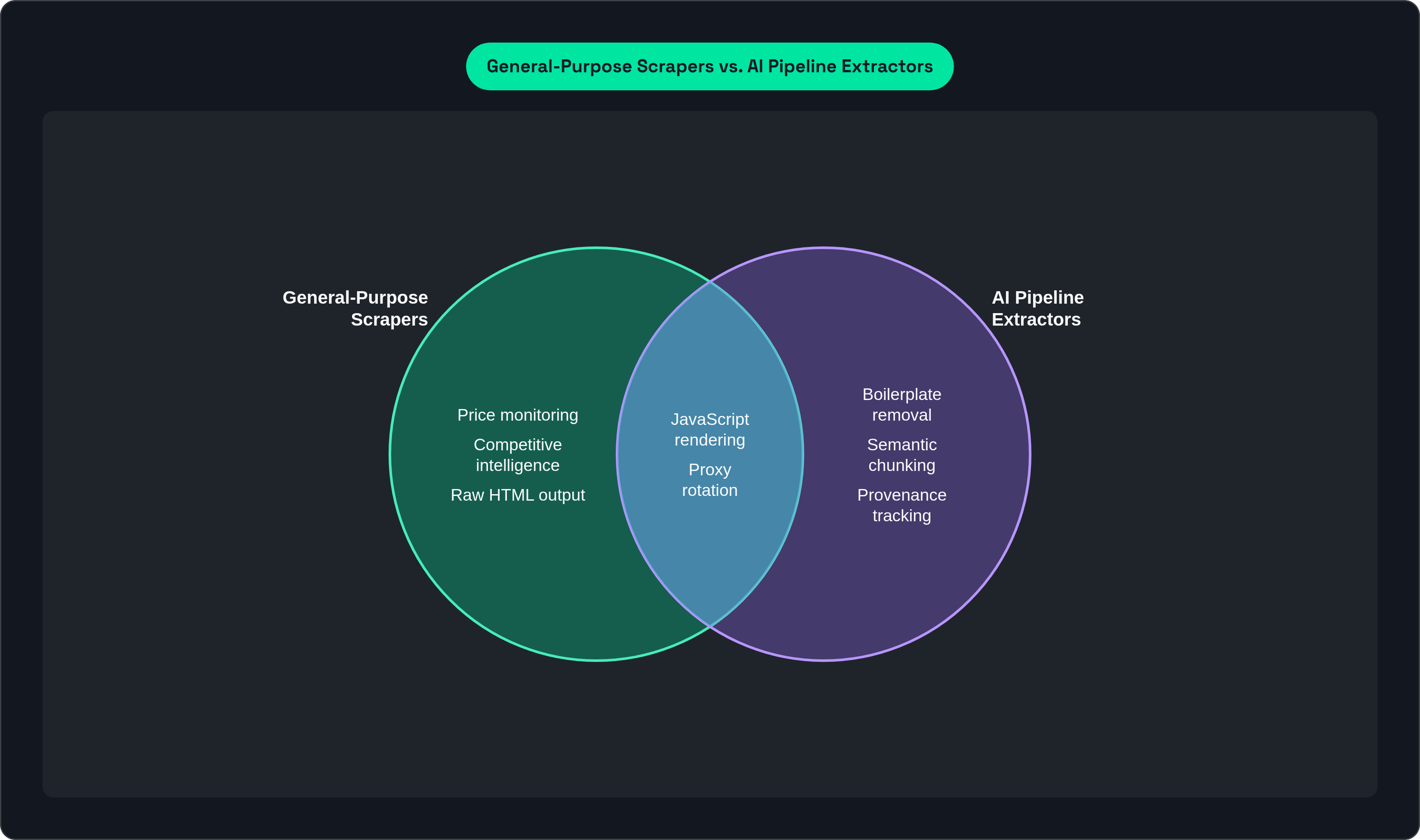
The specific requirements extraction must meet to serve an AI pipeline
The consumer in an AI pipeline is not a human reader. It is a language model, a retrieval layer, or an autonomous agent, and each has strict expectations about format, cleanliness, and currency. Content that would be perfectly readable to a person, boilerplate and all, wastes the model's attention budget, corrupts chunk boundaries, and degrades retrieval quality in a RAG pipeline in ways that can take weeks to diagnose correctly.
Several properties follow from this. They are not aspirational; they determine whether the pipeline produces useful output at all.
Clean structure. Headings are not cosmetic. In a properly built RAG pipeline, H1 and H2 boundaries serve as natural chunk delimiters; they tell the chunking layer where one distinct unit of meaning ends and another begins. Strip the heading structure, or flatten it into undifferentiated text, and the chunker has to guess. Guessing produces chunks that split ideas mid-argument and stitch unrelated concepts together, which in turn produces retrieval results that are semantically incoherent.
Tables present a related problem that is easy to underestimate until you try to build a financial research tool. Financial statements, comparison matrices, specification tables: these contain information encoded in the relationship between rows and columns. Flatten a table into prose and you destroy that relational structure. The model can read the resulting text, but it cannot reconstruct the table's logic from what remains.
Code blocks require their own handling. For developer documentation pipelines, a code example unwrapped from its delimiters and merged into surrounding prose is worse than useless. The model cannot distinguish it from natural language, and any agent attempting to use it programmatically will fail in ways that are particularly difficult to debug.
Noise removal. Boilerplate must be detected and stripped before content reaches the chunking stage. Post-hoc cleaning is structurally inferior because the chunker may have already incorporated the noise into chunk boundaries. Removing a navigation menu after chunking does not reconstitute the clean chunks that would have resulted from removing it beforehand. The sequence matters.
Deduplication at ingestion is equally critical, because near-duplicate embeddings cluster tightly in cosine similarity space and crowd out genuinely distinct content in retrieval results. Syndicated content, where the same article appears across dozens of publisher sites, is endemic to news and media pipelines. Without deduplication, the vector store fills with near-identical embeddings that crowd out genuine diversity in retrieval results, driving down the effective recall of the index. The model develops a kind of false confidence, returning the same information through multiple apparently independent sources that are, in fact, the same source.
Pre-filtering before extraction, dropping URL patterns that are structurally non-content pages, category pages, tag archives, video landing pages, before passing URLs to the extraction layer, is the primary lever for controlling both cost and pipeline throughput.
Freshness. The difficulty here is architectural rather than narrowly technical. A pipeline that ingested a regulatory document three weeks ago and has not re-ingested it since may be answering questions from an outdated text. Freshness is a property of the whole pipeline, not just the API call that fetches content. It requires continuous ingestion, a retrieval layer that can handle version conflicts, and a vector store that can update embeddings without a full re-index, alongside monitoring for schema drift in upstream sources.
Provenance. Source URL and retrieval timestamp must travel with extracted content through the entire pipeline. In finance, legal, and medical applications, an answer that cannot be traced to a specific source document and a specific moment in time is not trustworthy. Provenance needs to be built in from the start; retrofitting it later is painful and often incomplete.
How a production extraction pipeline is actually structured
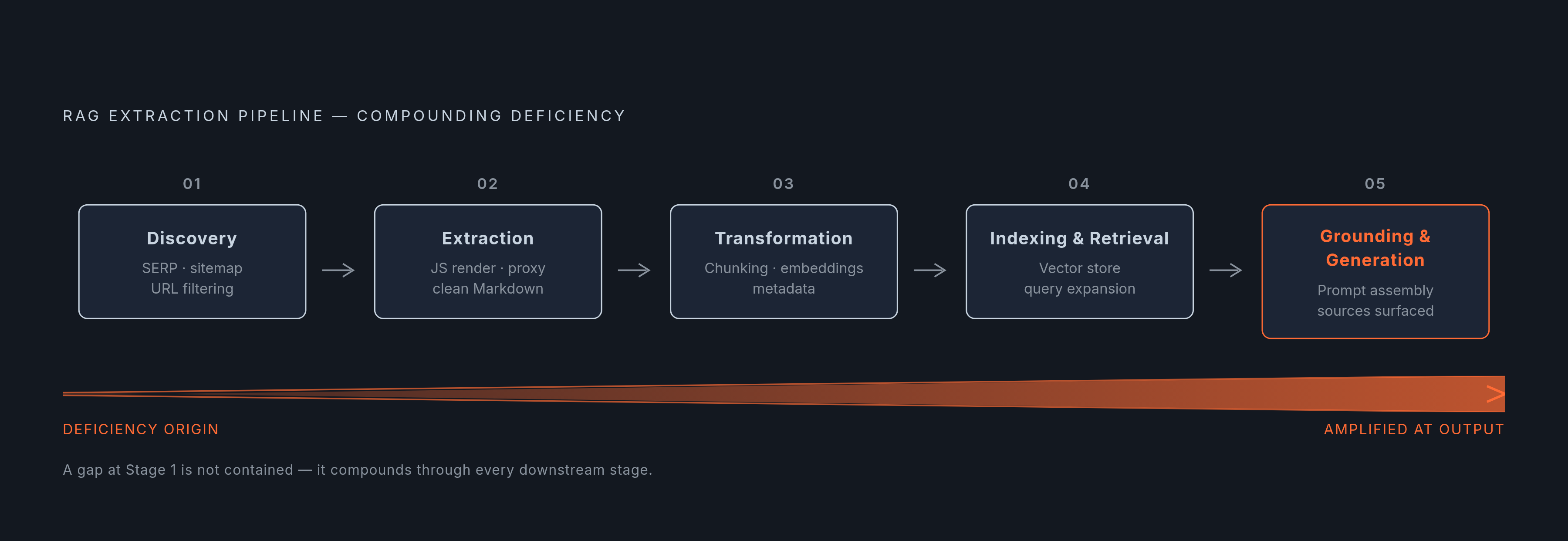
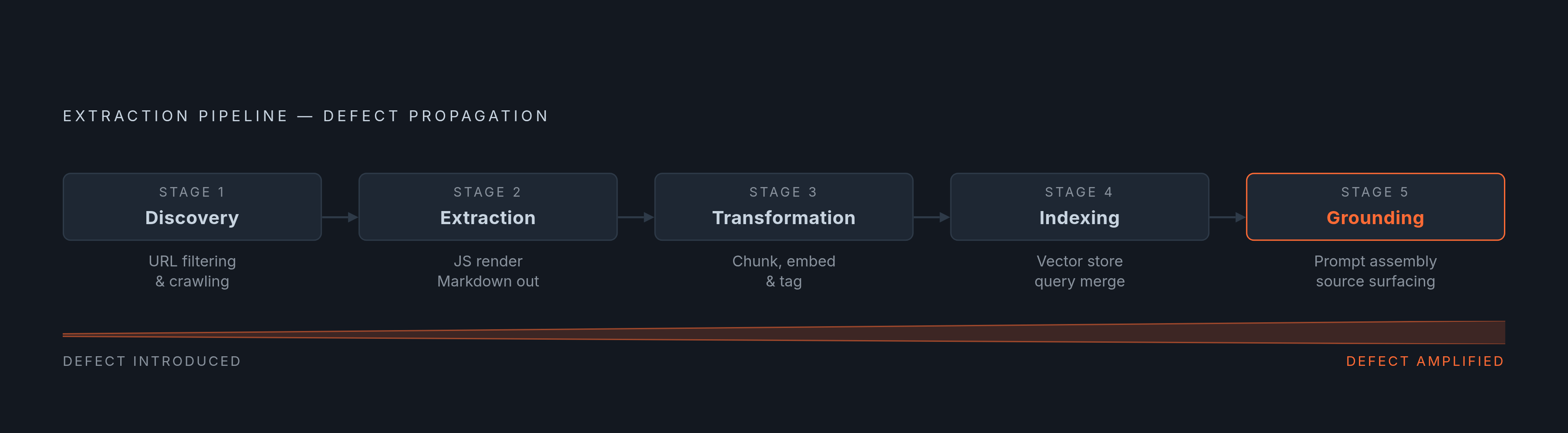
The pipeline has five stages. Each one surfaces the failures of the preceding one, which means a deficiency at stage one is amplified by the time it reaches stage five. That compounding relationship is what makes the extraction layer's quality so consequential, and it is what makes early shortcuts expensive to unwind.
Stage one: discovery. The job here is identifying which URLs are worth extracting, typically through some combination of SERP API queries to surface candidate pages, sitemap crawls to get comprehensive coverage of a target domain, and DOM parsing to pull links from content cards or listing pages. The key discipline is aggressive filtering: only URLs that pass structural and pattern-based filters should proceed to extraction. Deduplication against existing database entries should happen here too. Sending a URL to the extractor when you already have a recent version of that content in your index is pure waste, and at scale, that waste adds up faster than teams expect.
Stage two: extraction. This is where content is actually retrieved. JavaScript rendering is required for dynamically loaded pages. Proxy rotation and rate management matter at any meaningful volume; without them, IP blocking is a question of when, not if. The output target is clean, structured, LLM-ready content: Markdown or plain text with semantic structure preserved, boilerplate removed, and source metadata attached.
Stage three: transformation. Content that comes out of the extraction stage is not yet ready for the model. It needs to be chunked along semantic boundaries, not arbitrary character counts. Splitting at heading or paragraph boundaries produces chunks that preserve units of meaning. Splitting at a fixed character limit produces chunks that are sometimes coherent and sometimes not, depending entirely on where the limit falls relative to the content's structure. Embedding generation follows, and metadata, source URL, retrieval timestamp, domain, content type, must be attached to each chunk at this stage. If provenance is omitted here, it cannot be reliably surfaced later.
Stage four: indexing and retrieval. The vector store indexes embeddings for similarity search. Query expansion, sometimes implemented as a multi-query retrieval strategy, is one technique worth understanding here: decomposing a user's question into related sub-questions, running them in parallel against the index, then merging and deduplicating results. This improves recall by covering different facets of the original question that might have mapped to different parts of the corpus.
Stage five: grounding and generation. Retrieved chunks are assembled into a structured prompt. The model is constrained to respond from the provided context rather than its training data alone. Sources are surfaced in the output for auditability.
The compounding relationship between these stages is easy to dismiss when everything is working. A deficiency does not stay contained in stage two; it propagates forward through transformation, through indexing, through retrieval, and ultimately through the answer the user receives.
Where extraction breaks at scale and what that costs
Scale reveals failures that are invisible at demo volume. The prototype works; the production system degrades. What makes this particularly frustrating is that the specific failure modes tend to present as model problems rather than data problems, which leads teams to look in the wrong place and spend weeks optimizing prompts against fundamentally bad input.
IP blocking is the most obvious failure. Sites actively defend against high-volume extraction. Without managed proxy rotation and realistic request patterning, a scraper at scale will get blocked, and the failure can be silent: the pipeline continues running, receiving either error responses that get logged and dropped, or partial content that passes basic validation but is missing substantial portions of the page.
Schema drift is subtler and more dangerous. A target site redesigns its layout, invalidating the CSS selectors the extractor depended on. A selector-based extractor, one built against a specific HTML structure, starts returning empty results or garbage. The pipeline does not stop. Instead, it continues ingesting, writing bad data into the index. The problem surfaces when someone notices the model is answering incorrectly, which may be days or weeks after the drift began. By then, the contaminated data has often propagated widely enough that a targeted fix is insufficient.
Pagination gaps introduce silent incompleteness. An extractor that misses pages three through seven of a regulatory filing or an earnings transcript gives the model a partial document. The model answers from what it has and has no way of knowing what it is missing.
Rendering timeouts produce half-rendered content. JavaScript-heavy pages that do not complete rendering within a fixed window get returned in whatever state they were in when the timeout fired. The content looks like content, passes through the pipeline, and may be missing the dynamically loaded sections that contained the most relevant information.
What connects all of these failure modes is that the system does not crash. It continues producing answers without throwing errors the monitoring system catches. The answers are wrong, or incomplete, or outdated, and the wrongness is difficult to attribute because it presents exactly like a model output problem.
The enterprise stakes make this concrete. A 2025 McKinsey Global Institute report found that the vast majority of enterprise generative AI pilots delivered no measurable business impact. The models were largely capable; the data infrastructure was not. Extraction failures are a meaningful contributor to that gap, even when they are not named as the cause, precisely because the failure presents elsewhere in the stack.
In high-stakes domains, the cost is not merely operational. For a financial research agent, missing a critical filing due to a pagination gap is not an inconvenience. For a medical research assistant, missing a relevant study because a PDF did not render within the timeout window is a safety concern.
Streaming architectures address part of this. Rather than discovering bad data after it has propagated through the index, a streaming pipeline can validate content as it arrives and route failures for review before they contaminate downstream consumers. The architecture does not eliminate extraction failures, but it changes when they surface, which is a meaningful improvement.
How purpose-built extraction APIs differ from scraping libraries
The spectrum of tooling runs from maximum control with maximum maintenance burden to managed services that trade configuration flexibility for operational simplicity. Most teams start at the control end and migrate toward managed services after the first time schema drift burns them at an inopportune hour. It is a pattern consistent enough to be nearly predictable, and I have watched it repeat across organizations that were confident, at the outset, that they would be the exception.
At the raw end, HTTP clients paired with HTML parsers give you full control over every step. They also break immediately on JavaScript-heavy sites, require constant maintenance as target sites change, and offer no built-in solution for bot detection or proxy management. This approach makes sense for a narrow, stable target set with low volume. Scaled up, it becomes a maintenance problem that expands faster than the team maintaining it.
Headless browser automation handles JavaScript rendering but is compute-intensive, difficult to scale without substantial infrastructure investment, and still requires post-processing to get from raw rendered HTML to LLM-ready content. It solves the rendering problem without touching the noise problem.
Managed scraping platforms handle proxy rotation and rendering at scale but return raw or semi-processed HTML. The cleaning step still falls to the engineer, and for an AI pipeline, that cleaning step is not a small detail.
Purpose-built content and reader APIs are designed from the output backward. The output they are designed to produce is clean, structured, LLM-ready content: Markdown or plain text with semantic structure preserved, boilerplate stripped, and source metadata attached. The cleaning is not a post-processing step the engineer performs; it is baked into the API's function.
The practical differences matter in production. Boilerplate removal that happens inside the API call rather than in a post-processing step means the chunker receives clean input from the start. Output formatted for LLM consumption, with heading structure expressed in Markdown rather than raw HTML tags, means chunking logic can be simpler and more reliable. Latency matters here in a way that is easy to underestimate: an AI agent operating within a response window has a latency budget, and an extraction call that takes several seconds is a categorically different constraint than one that resolves in under a second.
The architecture that has converged in most production RAG pipelines uses a search or SERP API for discovery and a reader or content API for extraction. These are separate concerns handled by separate, specialized tools. Combining both functions in a single call is possible, but it limits the control available for filtering and deduplication at the discovery stage, which is precisely where aggressive filtering pays its largest dividend.
The role of freshness and how pipeline design determines it
Freshness sounds simple until you try to implement it at scale, at which point it becomes clear it is not really a feature but an architectural property. Features can be added late. Architectural properties generally cannot, and discovering this distinction during production is an unpleasant experience.
Consider the three ways a pipeline can be stale. First, the index contains embeddings that reflect a page as it existed weeks ago, and the live page has changed. Second, new pages published since the last crawl cycle are absent from the index entirely; the pipeline has no awareness of what it is missing. Third, an old and a new version of the same document both exist in the index, and the retrieval layer surfaces whichever has higher cosine similarity to the query, which may not be the more recent one.
Each failure mode has a different root cause and a different architectural response. Stale embeddings require a re-ingestion strategy that prioritizes high-change sources. Missing coverage requires a discovery mechanism that catches new content rather than only revisiting known URLs. Conflicting versions require either deduplication at ingestion or retrieval logic that can weight recency alongside semantic similarity.
Batch ingestion pipelines carry a structural lag. For some use cases, that lag is acceptable: a product documentation assistant that refreshes nightly probably meets its users' needs. A financial research agent that needs to answer questions about a filing published three hours ago does not have the luxury of a nightly batch cycle. Streaming architectures reduce this lag substantially, treating web content as a stream rather than a snapshot and making new content available to downstream consumers much closer to the moment it appears on the live web. The trade-off is architectural complexity, and it is a trade-off rather than a clear win.
Some pipelines handle freshness-sensitive queries by performing a live web search at query time rather than relying entirely on pre-ingested content. This trades latency for freshness. Whether that trade-off is appropriate depends on the latency budget available for that query type and how predictably the target content changes.
The market signal here is clarifying. The AI-ready content infrastructure market reached roughly $2.9 billion in 2025 and is projected to approach $4.1 billion by end of 2028, according to industry analyst estimates (Grand View Research, 2025). Enterprises are treating content freshness and quality as a funded infrastructure problem, not a configuration detail handled by whoever built the first prototype.
Domain-specific extraction requirements that change the engineering
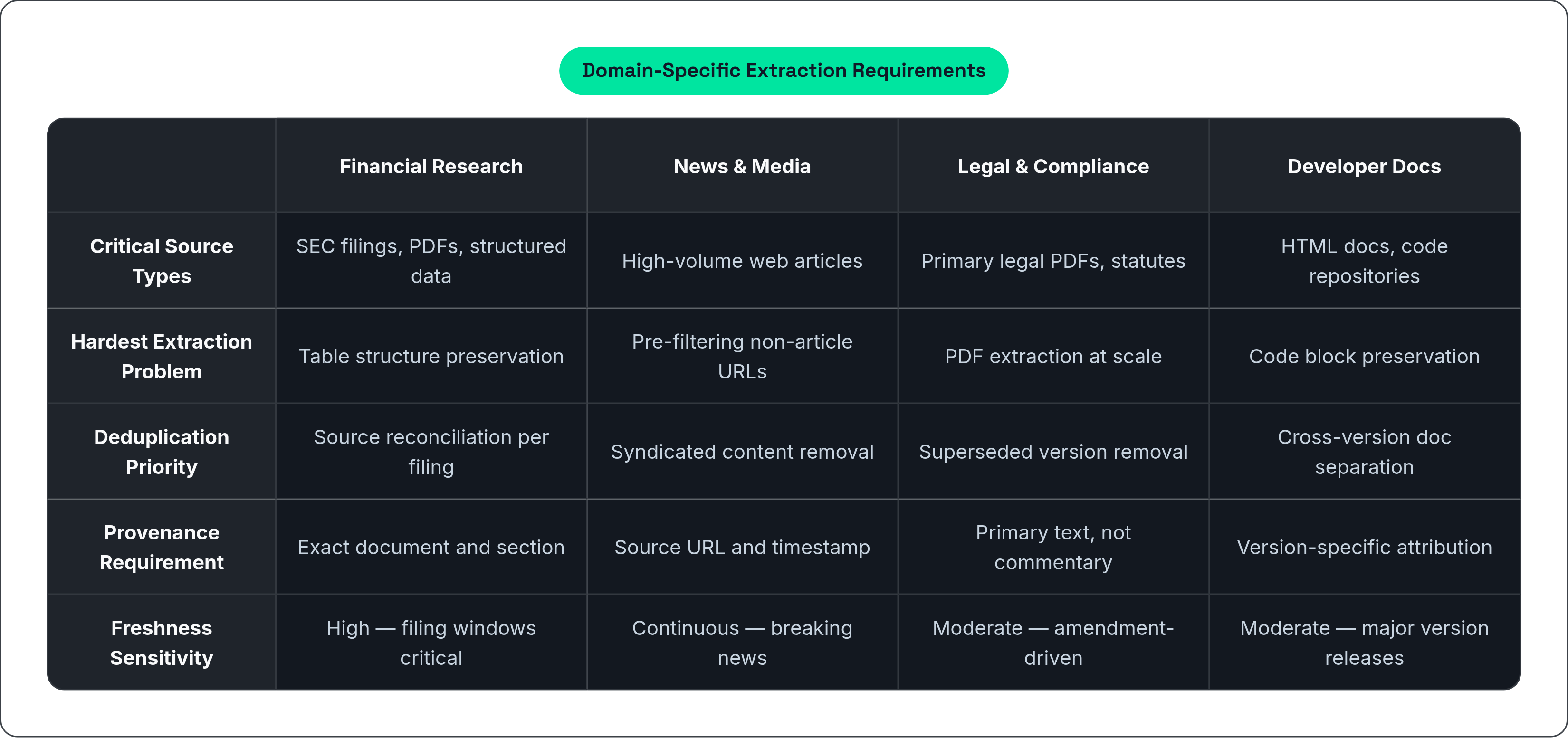
The extraction requirements for a given pipeline are downstream of what the pipeline is actually for. Different domains have different source types, different tolerance for error, and different definitions of what correct output looks like. Getting this right requires thinking about the domain before designing the pipeline, not after.
Financial research. The source mix is notably challenging: SEC filings, earnings call transcripts, compliance documents, regulatory rulebooks, often in a combination of HTML, PDF, and structured data formats. Table extraction is critical in a way it is not in most other domains. A financial statement is a table; flattening it into prose does not preserve the data, it destroys it. An extraction pipeline that cannot reliably extract tables from financial documents is not, in any useful sense, a financial research pipeline.
Source reconciliation requirements are also stricter. An answer citing a filing must be traceable to the exact document and the exact section within it. Approximate provenance is unacceptable for a workflow where the answer may drive a material decision. And latency matters at high-frequency moments: a pipeline that takes hours to ingest a freshly published 10-K is not a useful tool during the window when that filing matters most.
News and media monitoring. The challenge here is volume and noise ratio. Discovery at scale over news sources returns a high proportion of non-article URLs: category pages, tag archives, video landing pages, author profiles. Pre-filtering before extraction is the primary cost-control mechanism, because every URL that reaches the extractor costs compute. Aggressive pattern-based filtering at the discovery stage is central to making the pipeline economically viable, not an optimization applied later.
Deduplication at ingestion is also critical. Syndicated content is endemic to the news ecosystem. Without deduplication, the same story appears in the index dozens of times under different source URLs, creating an illusion of independent corroboration where none exists. A model that has indexed forty versions of the same Reuters story does not have forty sources; it has one source with a great deal of redundant weight.
Legal and compliance. Source authority matters differently here than in other domains. A pipeline that extracts a summary or commentary about a regulation, rather than the primary text of the regulation itself, introduces a compounding layer of interpretation risk: the model's answer becomes an interpretation of an interpretation, and the provenance chain obscures that.
PDF extraction is unavoidable. Primary legal documents, court decisions, regulatory guidance, statutory text, are predominantly PDFs. Versioning is a specific challenge: regulations and guidance documents are amended, and when an amendment is published, the pipeline must update the index to reflect the current version without retaining the superseded version as live knowledge. Most general-purpose ingestion architectures handle this poorly, and it is worth designing for that constraint explicitly rather than discovering it when a compliance team asks why the assistant is citing a regulation that was amended six months ago.
Developer documentation. Code block preservation is the central structural requirement. A code example stripped of its delimiters and merged into surrounding prose is not a code example; it is confusing text that an assistant will either misread or misrepresent. For a pipeline serving a developer assistant, this failure is immediately visible in the quality of the output.
Versioning is a distinct concern here as well, though it manifests differently. A library may have active documentation for multiple major versions simultaneously. A pipeline that conflates documentation for version 2.x and version 3.x of the same library produces an assistant that gives inconsistent, sometimes contradictory advice, particularly on API behavior that changed between versions.
Across all of these domains, the same relationship holds: the higher the stakes of a wrong answer, the stricter the requirements for structure, provenance, and freshness. The extraction layer carries the quality of everything built on top of it, and it needs to be treated that way from the beginning.