Latency Budgeting for Search-Augmented Agents
Allocate latency to every pipeline stage, not just the LLM.
Latency is the wrong thing to optimize when you do not know what you are optimizing against. That sentence took me an embarrassingly long time to internalize. Early in my work with retrieval-augmented systems, I watched teams spend weeks shaving milliseconds off LLM inference while their embedding calls ballooned quietly in the background and their rerankers consumed whatever headroom remained. The total turn time never moved. The sprint retrospectives were demoralizing. The problem was not effort; it was the absence of a framework that treated time as a budget, allocated to every stage, summing to a hard ceiling.
The 200ms perception threshold, documented in human-computer interaction research, is the point above which users register a pause as unnatural. That threshold does not apply only to the LLM call. It applies to the entire pipeline, from the moment a query arrives to the moment a response begins rendering. Embedding generation, vector search, reranking, LLM inference, and result assembly are each consuming time that cannot be recovered downstream. Every millisecond spent in one stage is permanently unavailable to the next.
The compounding problem is more severe in practice than it appears in architecture diagrams. A production agent does not make one LLM call per user turn; it commonly makes two to five, each potentially preceded by a tool call or retrieval operation. Each hop multiplies the exposure. The framing of "optimize LLM inference" addresses one term in a sum while leaving the others unmanaged. A latency budget, defined precisely as a time allocation per pipeline component that sums to a total turn time ceiling, is what actually ships on time. This article develops that framework component by component, grounded in the specific ceilings that different agent types impose.
How the ceiling changes depending on what the agent does
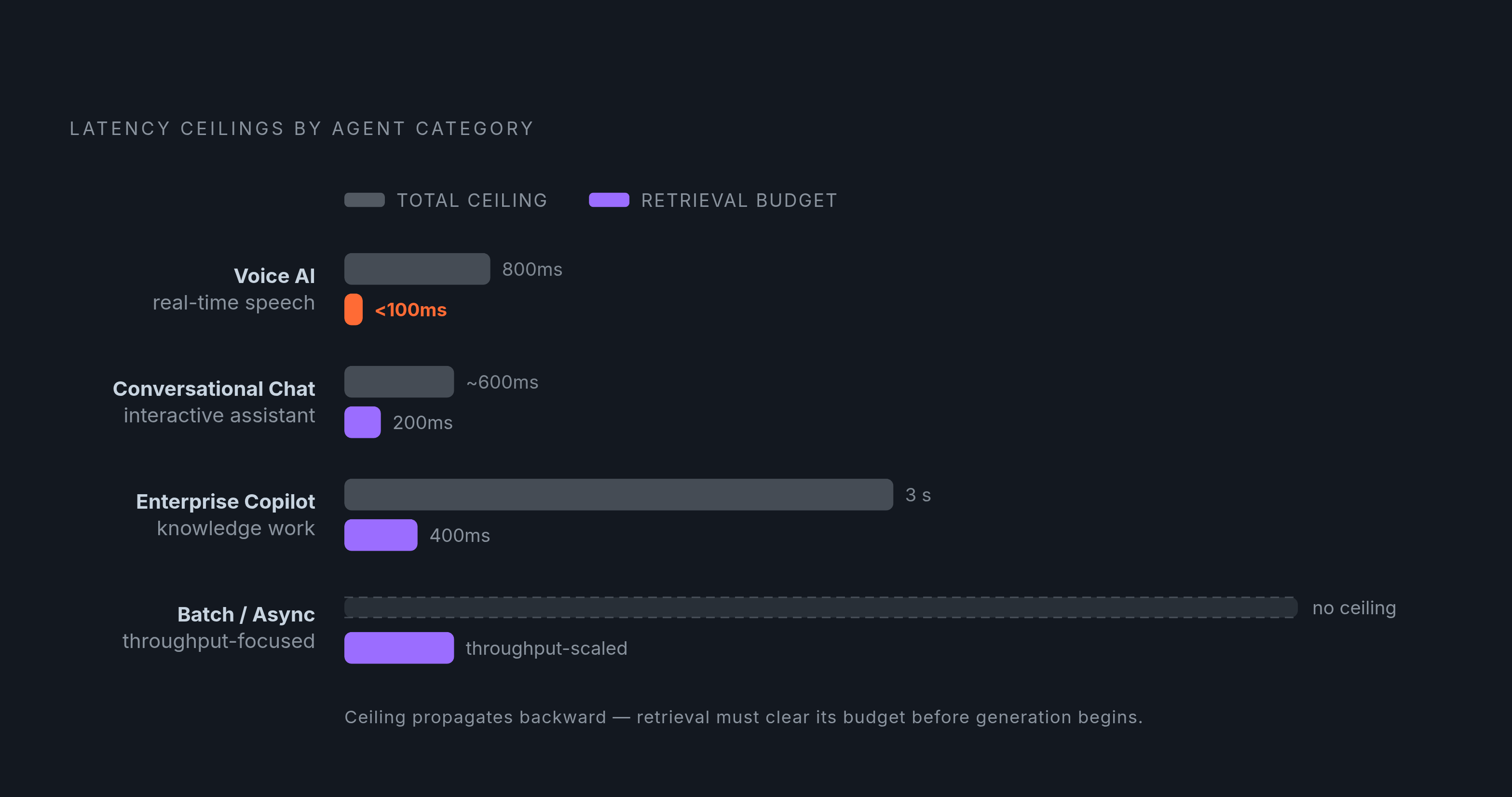
The ceiling is not a preference; it is an engineering constraint, and it propagates backward into every component allocation. Four agent categories define meaningfully different hard limits in production.
Voice AI agents operate against the tightest constraint. Total response time must stay near or below 800ms to feel synchronous in speech, which means retrieval in its entirety, including embedding, vector search, reranking, and result assembly, must complete in under 100ms. There is no room to negotiate.
Conversational chat agents have more room, but not as much as developers typically assume. A retrieval budget around 200ms preserves the interactive feel; exceed it consistently and users begin to disengage in ways that show up in session metrics before anyone files a bug report.
Enterprise copilots operate against a broader total window of roughly three seconds, which opens a retrieval budget near 400ms. That additional headroom is meaningful: it is enough to run a reranker, surface higher-quality results, and spend more carefully on context construction.
Batch and asynchronous workflows have no strict sub-second ceiling. Throughput and cost-per-query matter more than individual turn latency, which changes which optimization levers are worth pulling entirely.
The practical implication is sequentially simple and frequently ignored: classify the agent type before touching any optimization lever. A voice agent and an enterprise copilot can share the same retrieval stack; they cannot share the same budget. Optimizing a copilot pipeline to voice-agent tightness wastes engineering effort and often sacrifices result quality unnecessarily. Optimizing a voice pipeline to copilot tolerances ships a product that users experience as broken.
One additional category deserves acknowledgment here: multi-agent architectures, where one agent calls another in a sequential dependency chain. These architectures create a compounded ceiling that is harder than any single-agent category, because the output of one agent becomes the input deadline for the next, and traditional parallelization does not apply to dependent calls. This is a pattern worth flagging early, because the instrumentation decisions made in simpler pipelines determine whether teams can debug it later.
Breaking the retrieval stage into its own sub-budget
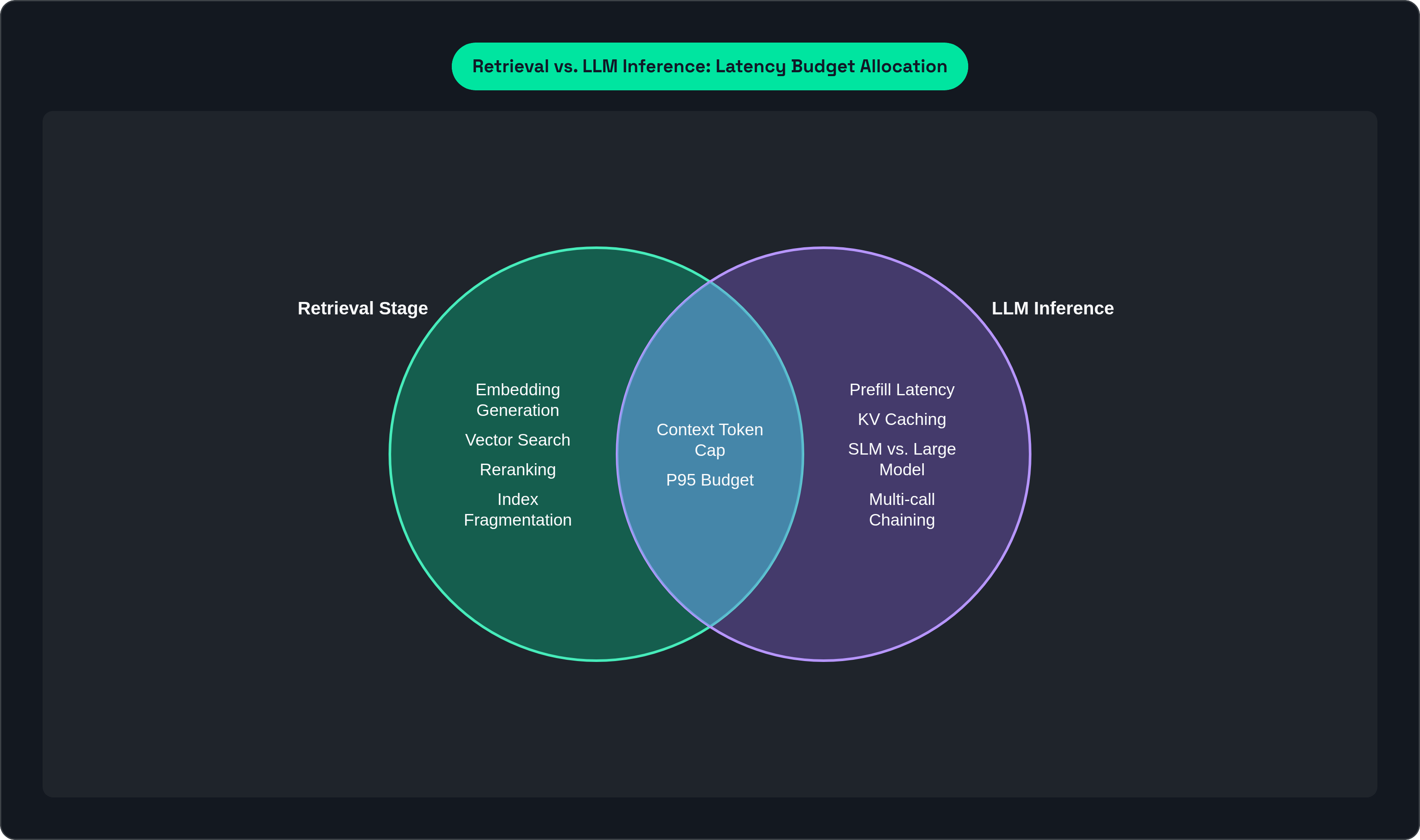
Retrieval is not a single operation. It is four operations, each with its own latency profile, and treating them as a monolithic block is where most retrieval budgets go wrong.
Embedding generation
Embedding generation is frequently treated as negligible, which is accurate for short, single queries and inaccurate for everything else. Long queries, batched inputs, and high-frequency agents accumulate embedding latency in ways that surface only under load. The primary lever is model deployment: a locally served embedding model eliminates network round-trip overhead; an API-hosted model trades that overhead for zero infrastructure maintenance. Neither is universally correct. The choice must be made against the retrieval sub-budget, not against abstract quality benchmarks.
Vector search
Vector search is where the retrieval budget is most commonly blown before reranking even begins. Production systems need similarity search completing well under 50ms, even across indices containing millions of embeddings. Overshoot that and there is nothing left for the stages that follow.
The silent killer here is index fragmentation. In production systems that are updated incrementally without regular maintenance, index fragmentation degrades search performance significantly, with some estimates placing the degradation in the range of 40 to 60 percent. Most teams do not monitor fragmentation directly; they see slower median latency and assume load. The degradation is invisible until you instrument at the span level, at which point it becomes obvious. The budget erosion it causes is not a spike; it is a slow drain that eventually makes previously acceptable P95 figures untenable.
Reranking
Reranking is the highest accuracy cost-per-millisecond operation in the retrieval stage. A cross-encoder reranker can consume as much time as the vector search itself, which means adding one can effectively double the retrieval stage cost. The budget trade-off is relatively clear: for voice agents and conversational chat agents where the ceiling is tight, reranking is not viable unless embedding and vector search leave extraordinary headroom. For enterprise copilots and research agents, result quality justifies the spend and the broader ceiling accommodates it.
Result assembly
Serialization and formatting are not free, and they become less free as output complexity grows. Building an LLM-ready payload with citations, metadata, structured snippets, and source attribution requires meaningful processing time. This is one of the concrete distinctions between AI-native search APIs, which return content already processed for LLM consumption, and traditional SERP APIs, which return raw metadata requiring a separate extraction layer. That extraction layer is a cost the developer owns, and it consumes retrieval budget that the API benchmark numbers do not include.
A team that cannot assign a target millisecond range to each of these four sub-stages before writing code is not ready to make retrieval architecture decisions. The allocations come first; the implementation follows from them.
Where context size becomes a latency variable inside the LLM call
As retrieved documents increase, LLM input length grows linearly. That growth has two direct latency consequences: prefill latency scales with token count, and cost scales with it as well. Context size is not a retrieval decision that happens to affect the LLM; it is a latency decision that must be made in coordination with the LLM inference budget.
Two failure modes emerge at opposite ends of the context dial. Under tight budgets, agents that do not compress aggressively enough overflow context limits, producing truncation or brittle reasoning failures that are difficult to diagnose because they manifest as quality problems, not as errors. Under relaxed budgets, agents that over-compress in the interest of speed erase evidence that research-critical queries depend on, a quality failure that looks like a latency win until a user catches a missing source.
Research into budget-aware context management for long-horizon search agents frames this explicitly: context management is not a retrieval concern alone but a latency constraint that must be resolved at the intersection of retrieval and inference allocation. Work evaluating inference-time token budgets across multiple benchmarks and budget levels shows aggregate gains from hard dual-budget protocols, but those gains are backbone- and dataset-dependent. They are not a universal fix, and teams that implement them without validating against their specific model and workload will be surprised by the variance.
The practical lever is a hard retrieved-token cap per query, sized against the LLM inference allocation in the budget rather than against abstract relevance. "Retrieve the top-k documents" is not a budget; it is a retrieval heuristic that will blow the inference allocation unpredictably depending on document length.
Small language models offer a structural answer to the inference budget problem. NVIDIA's 2025 position paper on SLMs reports that serving a 7B-parameter model is ten to thirty times cheaper in latency, energy, and computational cost than serving a model in the 70 to 175 billion parameter range. For schema-constrained and API-constrained agentic tasks, which describe a large fraction of production agent workloads, an SLM is often sufficient. The 2025 survey literature on SLMs for agentic systems broadly corroborates this, with the consistent caveat that task complexity and output format requirements determine the boundary below which smaller models hold.
The multi-call pipeline: where budgets break in practice
A realistic example clarifies where the theory meets production failure. Consider a RAG-powered customer support agent that processes a user query through two sequential LLM calls and two tool calls. At median conditions, the sequential total reaches nearly three seconds before any variance is added. If the two tool calls have no data dependency on each other, they can be parallelized. Doing so saves meaningful time on each individual turn, which is modest in isolation but material at scale and consequential in ceiling categories where a few hundred milliseconds separates an acceptable experience from an unacceptable one.
The coding assistant pattern illustrates where sequential dependencies are real versus assumed. A pipeline that reads the request, searches files, analyzes results, generates a plan, and then writes code has some genuinely sequential dependencies and some that are imposed by implementation convention rather than logic. The discipline is to audit every tool call dependency before assuming sequential execution is required. Teams that skip this audit are often leaving recoverable time on the table.
Two optimization mechanisms deserve specific mention for multi-call pipelines. KV caching stores and reuses unchanged prompt segments across calls within a session, reducing redundant computation on repeated or near-repeated inputs. Its value is highest in frequent or large batch jobs where shared context is substantial. Micro-batching, which groups requests into short windows of 50 to 100 milliseconds, amortizes model loading overhead while keeping individual responses within budget; it is appropriate for copilot and async workloads but not for voice, where the windowing delay itself would breach the ceiling.
Hardware acceleration via TPUs or dedicated inference chips such as AWS Inferentia represents the floor for well-optimized inference in best-in-class deployments, not a default. Teams operating at that level achieve average LLM response times in the 200 to 500ms range. Most teams are not there yet, which means the infrastructure lever is available but requires investment to access.
Why P95 is the right variance target and P50 is the wrong one
Most teams size their variance buffers against P50, the median, which is the single most misleading latency metric available. Production latency is not normally distributed. Retrieval spikes on cold cache. Reranking spikes on long queries. LLM inference spikes on high-token outputs. The median hides all of this.
If your P95 exceeds your ceiling, your users experience that failure on one in twenty requests. At meaningful production query volumes, one in twenty is not a tail event. It is a recurring user experience problem that does not appear in median dashboards and does not trigger alerts calibrated to P50.
Span-level tracing, broken down by pipeline stage, is the only way to know which component owns the P95 spike. Without it, optimization is directed by intuition rather than evidence, and intuition is reliably wrong about where latency hides in complex pipelines. Index fragmentation is the clearest example: its effect on search performance is significant but does not surface in median latency until it has already been eroding the tail for some time. Teams discover it in traces. They do not discover it in dashboards.
Caching strategy is a low-cost mechanism for protecting the tail specifically. A time-to-live window of five to fifteen minutes on frequent queries reduces the rate of cold retrieval calls and flattens the P95 spikes that cold cache generates. The investment is small; the effect on tail latency is disproportionate.
There is a longer-term reason to build span-level tracing infrastructure now, even for teams not yet operating multi-agent architectures. Sequential agent-calls-agent dependencies, where one agent's output becomes another's input, represent the frontier where traditional parallelization genuinely does not apply and where latency pathologies are hardest to diagnose. The instrumentation built to trace a simple RAG pipeline is the same instrumentation that makes those architectures debuggable when they arrive.
How search API choice affects the retrieval stage budget before any code is written
The build-versus-buy decision in the retrieval stage is made, often implicitly, before a line of production code is written. It is worth making it explicitly, because it determines which result assembly costs the developer owns and which the provider absorbs.
Traditional SERP APIs, including well-known options in the developer ecosystem, return raw metadata: titles, URLs, and short snippets. To make that output useful for an LLM, a developer must run a separate content extraction layer to retrieve and parse the full text of source documents. That layer consumes retrieval budget. The API latency benchmark does not include it.
AI-native search APIs return content already processed for LLM consumption. The result assembly sub-stage is handled at the provider level, and the developer receives structured, citation-ready content directly. The total retrieval stage cost is lower not because the underlying search is faster, but because a step has been moved off the developer's stack.
Latency varies meaningfully across providers. Tavily's response latency is relatively low, placing it near the boundary where interactive agent workloads remain viable. Other providers, including some that bundle search and synthesis, carry higher latency that limits their applicability in tight-ceiling categories.
Freshness versus semantic accuracy is a budget variable that is often treated as a quality concern rather than a latency concern. An embedding-based neural index excels at semantic similarity but may lag on recency for fast-moving domains. For agents operating in finance or medicine, a meaningful recall gap on recent filings or recent literature is a quality failure that no latency optimization can resolve. It forces additional retrieval turns, and additional turns cost more total time than a slightly slower but more accurate first retrieval.
The accuracy argument extends further. Benchmark data across thousands of queries spanning multiple domains shows accuracy gaps between the best and worst providers reaching dozens of percentage points. A fast provider with poor accuracy forces the pipeline to retrieve more and reason more to reach a correct answer, which can cost more total time and more LLM inference budget than a modestly slower but highly accurate provider on the first call. You.com's Research API posts accuracy figures in the low-to-mid 80s on research question-answering benchmarks and F1 scores in the low 90s in vendor studies, positioning it for research and copilot agents where accuracy-per-millisecond is the correct metric rather than raw speed alone.
Caching at the API level compounds the benefit for agents with repeated or similar queries across a session. A five-to-fifteen minute TTL recommendation for frequent queries directly protects the retrieval sub-budget from cold-call spikes, which otherwise appear as P95 problems that are expensive to diagnose.
Putting allocations on paper: a working budget template by agent type
The template format is consistent across agent types: explicit millisecond ranges for embedding, vector search, reranking, LLM inference per call, result assembly, and a variance buffer. The numbers must sum to the total ceiling for the category. Anything that does not fit is cut or restructured before any code is written.
Voice agent
The total ceiling near 800ms leaves almost no slack. Retrieval in its entirety must stay under 100ms, which eliminates reranking unless embedding and vector search are extraordinarily fast under load. LLM inference is a single call with a small context; an SLM is the preferred choice here both for latency and cost reasons. There is no variance buffer to spare: P95 must be explicitly tested against the full ceiling in staging, not inferred from P50 in development.
Conversational chat agent
The retrieval budget opens to near 200ms, and the broader turn time allows somewhat more inference headroom. Reranking becomes viable only if embedding and vector search together leave meaningful room. KV caching is high-value in this category because session queries are frequently near-repeated, and the session-level savings accumulate quickly.
Enterprise copilot
The 400ms retrieval ceiling and roughly three-second total window justify a full reranking pass. Result quality matters more in this category than in chat, and the budget accommodates it. Multi-call pipelines are likely, so a dependency audit for parallelizable tool calls should be standard practice. Span-level tracing is not optional: it is the only defensible way to explain in production why a given allocation is where it is.
Research and deep agent
There is no hard total ceiling here, but there is a per-turn budget and a per-session quality target. Iterative retrieval, search followed by reasoning followed by additional search, requires budgeting per turn rather than per query. The context token cap is the critical variable, set against the number of expected reasoning turns rather than against per-query relevance. Research APIs that expose effort tiers map naturally to this budget dial: higher effort means more searches, longer response time, and higher quality, and the developer can tune the dial against the task requirements rather than against a fixed ceiling.
The template is a starting point. Every allocation in it must be validated against P95 in a staging environment that approximates production traffic before it is treated as a production commitment. The variance section's lesson applies directly: the median will tell you the allocations hold; only the tail will tell you whether they actually do.


