Multi-Agent AI Architecture Design
Smaller, focused contexts produce more reliable outputs than enormous ones.
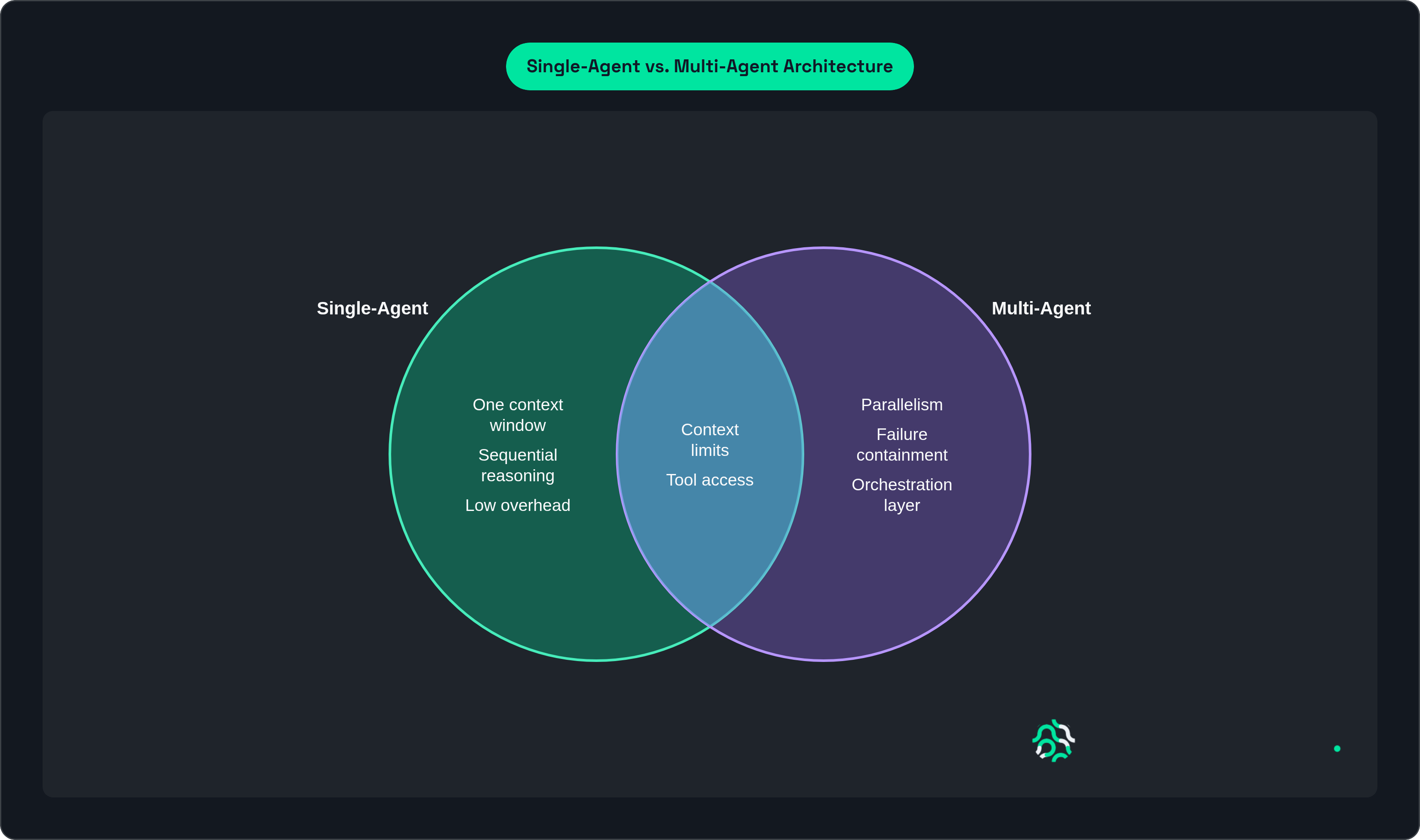
A single agent operates within one context window, executes one sequential thread of reasoning, and either finishes the task or fails trying. For narrow, well-scoped tasks, that is sufficient. For anything requiring parallelism, specialization, or sustained reasoning across large information volumes, it is structurally inadequate, and the gap between "sufficient" and "structurally inadequate" is where most enterprise deployments quietly collapse.
Multi-agent architecture distributes work across multiple specialized agents, each with a defined role and bounded scope, coordinated to accomplish what no single agent could do alone. That description sounds almost administrative until you confront what it actually changes.
Databricks found that model correctness begins to degrade around 32,000 tokens, well before the million-token context window limits that vendors advertise. The phenomenon has been termed "context rot": as the context window fills, the model's ability to reason reliably over its contents deteriorates. Distributing work across agents is, in part, a structural response to this. Smaller, focused contexts produce more reliable outputs than a single enormous one. I have watched teams discover this empirically, usually after a demo that worked perfectly at 10,000 tokens stops working at 80,000, and the debugging process teaches them what the architecture should have encoded from the start.
Going multi-agent changes four things simultaneously. Orchestration becomes an explicit responsibility: something must decide which agent runs, in what sequence, and with what inputs. Communication requires a shared protocol, because agents need to pass state, results, and instructions without each connection becoming a bespoke integration. Specialization becomes possible; each agent can be tuned, prompted, or equipped with tools appropriate to its specific domain. And the failure surface expands, because a failure in one agent can cascade through the system unless the design explicitly prevents it.
None of this means multi-agent is categorically superior. It introduces coordination overhead that single-agent setups avoid, and that overhead is not free. The architectural complexity is only warranted when the task requires parallelism, specialization, or work that exceeds what a single context window can handle reliably.
The four foundational architecture decisions every multi-agent design must make
Most multi-agent systems that stall made their foundational decisions implicitly. Defaults were accepted, assumptions were left unexamined, and the resulting architecture reflected no deliberate reasoning about the tradeoffs involved. The failure modes were predictable in retrospect, and frustrating in real time.
Orchestration: how work is assigned, sequenced, and coordinated across agents. Communication and state management: how agents share context, pass results, and maintain coherent understanding across turns and handoffs. Data access: how agents retrieve live, accurate information without creating retrieval bottlenecks or working with stale inputs. Failure containment: how the system degrades gracefully when something goes wrong, rather than propagating errors forward.
These are not independent decisions. The orchestration model shapes which communication patterns are feasible. The data access design determines where failures are most likely to originate. A choice made carelessly in one dimension creates constraints in all the others, and those constraints tend to surface at the worst possible moment, under production load, with a stakeholder watching.
Deloitte's 2025 research found 42% of organizations are still developing their agentic strategy roadmap, and 35% have no formal strategy at all. For the majority of organizations, these decisions are still ahead of them. Getting them right the first time is considerably less expensive than rebuilding after a failed deployment, though in my experience, that calculation rarely feels urgent until the rebuild is already underway.
Choosing an orchestration model: centralized, decentralized, and hybrid patterns
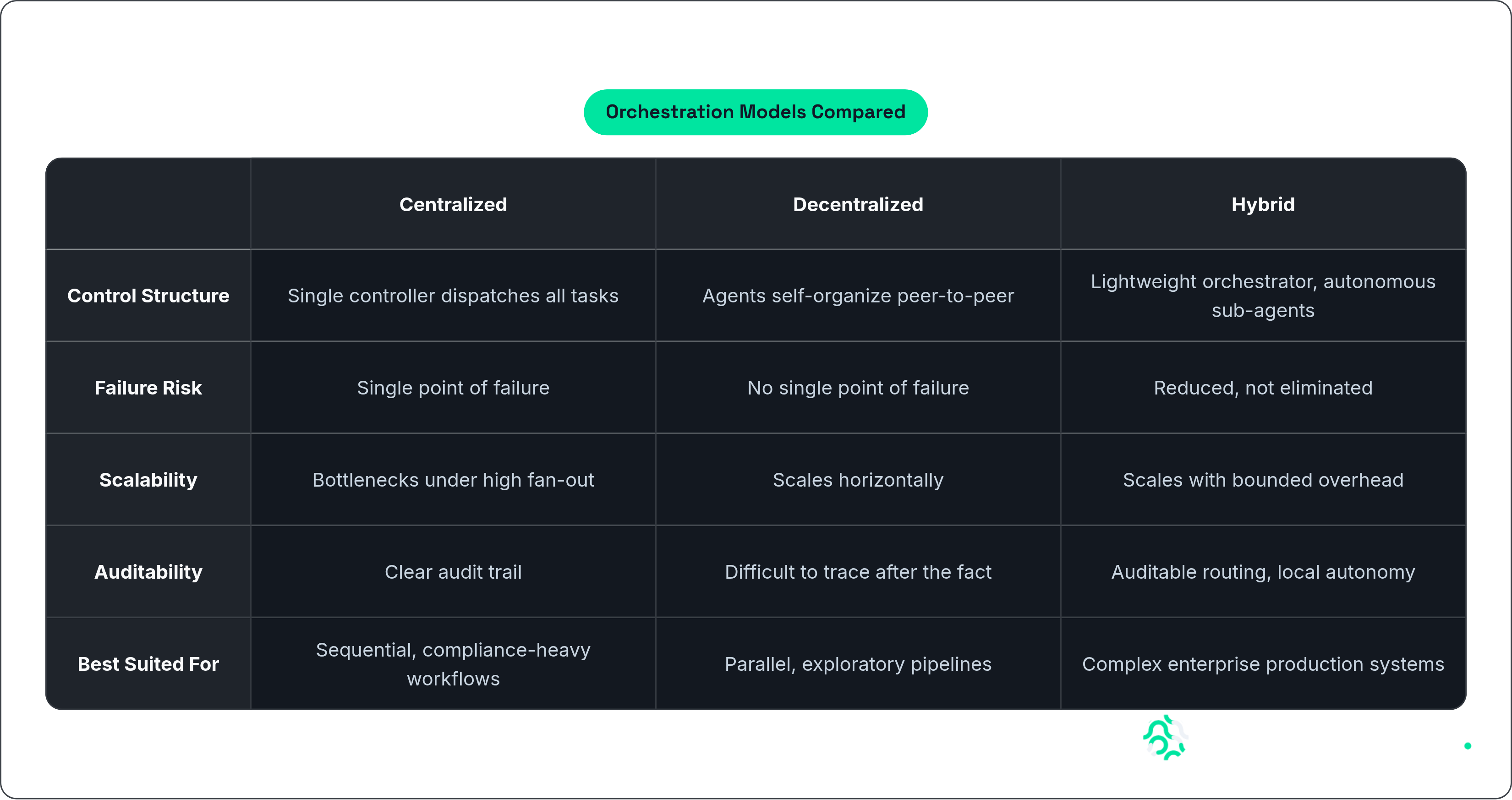
Centralized orchestration assigns control to a single controller agent that dispatches tasks, aggregates results, and manages sequencing. Its strengths are the obvious ones: predictable execution order, relatively straightforward auditability, and clear failure attribution when something goes wrong. A centralized model is well-suited to workflows with sequential dependencies, often modeled as a directed acyclic graph, and compliance requirements that demand a clear audit trail.
The weaknesses are equally obvious, though they tend to be underappreciated until they matter. The controller is a single point of failure. Under high parallelism and fan-out workloads, it becomes a bottleneck. Any system where the controller's capacity limits the throughput of the whole network will eventually reveal this constraint at scale, and it will do so at the moment when throughput most needs to expand.
Decentralized coordination, where agents communicate directly and self-organize without a central dispatcher, inverts that tradeoff. The architecture is resilient; there is no single point of failure, and it scales horizontally in ways a centralized model cannot. The cost is predictability. Emergent behavior in a peer-coordinated network is difficult to reason about in advance and difficult to audit after the fact. Loosely coupled, highly parallel workloads, like exploratory research pipelines or large-scale data processing jobs, are where this pattern earns its keep. For anything requiring a compliance trail, I would be cautious.
Hybrid models occupy the pragmatic middle: a lightweight orchestrator handles routing and sequencing while sub-agents operate with local autonomy. In practice, this is the most common pattern in production systems handling complex enterprise workflows, because it preserves the auditability of centralized dispatch without making the controller a throughput ceiling.
LangGraph exemplifies this pattern. It models the workflow as a state machine with nodes, edges, and conditional routing, enabling conditional decision-making, parallel execution, and persistent state management without requiring a monolithic controller. Klarna, Replit, and Elastic are among the organizations using it in production.
The critical question that applies to every orchestration model is this: who owns state, and what happens to in-flight work if the orchestrator fails? Most systems that cannot answer this question clearly have not finished designing their orchestration layer; they have only sketched it. I have seen this gap treated as a theoretical concern right up until a production failure made it concrete.
One additional complication is ubiquitous in enterprise contexts. Most enterprise agents still reach underlying systems through APIs and conventional data pipelines. Those integrations create bottlenecks that constrain autonomous capabilities regardless of how well the orchestration layer is designed. Orchestration decisions must account for the legacy integration surface, not pretend it does not exist.
How agents communicate and maintain shared state across a workflow
Before shared protocols existed, every agent-to-tool and agent-to-agent connection required a custom integration. As the number of agents in a system grows, the combinatorial complexity of those point-to-point integrations grows faster. This is the pre-standard problem, and anyone who has maintained a medium-sized integration surface understands viscerally why protocol standardization matters practically rather than merely aesthetically.
Model Context Protocol addresses the agent-to-tool and agent-to-data layer. Any MCP-compatible agent can discover and call any MCP server using a single protocol, eliminating the need for custom integrations at the tool layer. MCP crossed 97 million monthly downloads in 2025. Anthropic donated the protocol to the Linux Foundation at the end of 2025, establishing vendor-neutral governance. For enterprise adoption decisions, that governance structure matters: a protocol controlled by a single vendor carries different long-term risk than one maintained under open stewardship.
Agent2Agent addresses a different layer: direct coordination between agents across organizational or trust boundaries, enabling one company's agent to communicate with a partner's agent through a shared standard rather than a custom integration. MCP and A2A are complementary, not competing. MCP handles the tool and data layer; A2A handles the peer agent layer.
State management is a distinct concern from message passing, and conflating the two is a reliable path to a fragile system. Agents need persistent, shared state so that context survives across turns, agent handoffs, and failures. Stateless agents create context loss at handoff points, a failure mode that appears frequently in naive multi-agent implementations and is immediately visible to end users as coherence breakdowns, the agent equivalent of a customer service representative who has clearly never read the previous tickets.
The design principle follows from context rot: do not route the entire workflow history through a single agent's context window. Externalize state to a database or shared store, and pass each agent only the context required for its specific task. The state management layer carries history; the agent processes a bounded, relevant slice of it. That separation is simple to describe and, in my experience, underappreciated in early implementation.
Giving agents access to live information without creating data bottlenecks
The core design rule is simple to state and frequently violated in practice: separate data collection from agent execution. An agent should not trigger live web scraping or long retrieval tasks inline during its reasoning loop. Background pipelines should continuously update a data store; agents read ready data on demand. When agents pull data synchronously during reasoning, retrieval latency becomes reasoning latency, and the system's throughput ceiling becomes the retrieval system's throughput ceiling.
Two patterns handle the grounding problem for most use cases. Retrieval-Augmented Generation converts the agent's query to a dense vector embedding, retrieves matching documents from a vector database, and passes the results as context. RAG is essential when agents need proprietary data, recent events, or domain-specific knowledge not present in the model's training set. Live web search calls a search API at inference time to retrieve current source documents. It is necessary when freshness requirements exceed what a pre-populated index can satisfy.
The choice of retrieval tool is not cosmetic. But how does a poor retrieval result actually affect downstream reasoning? Search quality propagates through the entire reasoning chain: a poor retrieval result produces a poorly grounded intermediate output, which becomes a flawed input to the next agent in the pipeline, compounding errors downstream. Retrieval quality affects reasoning quality, token efficiency, and the reliability of autonomous decisions simultaneously.
For agentic use specifically, the relevant performance dimensions in a search API are precision and recall, not just relevance ranking; freshness, meaning the update latency from publication to searchability; response latency under load; and citation traceability, so agents can surface sources rather than hallucinate attribution.
Latency matters architecturally, not merely as a user experience consideration. Industry benchmarks target under 1.5 to 2.5 seconds for search response time. At the scale of a continuously operating agentic system, slow retrieval becomes a systemic throughput constraint. In high-stakes domains like finance, compliance, and healthcare, recall carries additional weight: a meaningful drop in recall can mean missing a critical filing or regulatory update, with consequences that propagate directly into downstream decisions.
McKinsey's data pipeline guidance applies without modification to agentic systems: build data pipelines once, with clear and common definitions, so that analytics tools, AI models, and agents all operate on the same understanding of the data. Separate pipelines per agent or per use case recreate the same fragmentation at the data layer that MCP was designed to eliminate at the tool layer.
Designing specialized agents for domain-specific tasks within a shared system
Different foundation models have meaningfully different strengths that map to different agent roles. The GPT family handles broad professional work, coding, research, and general orchestration effectively. The Claude family is well-suited to long-running agents, detailed instruction following, and computer use tasks. Gemini's strengths lie in multimodal understanding, search-grounded work, and large context scenarios. Grok is oriented toward real-time information and tool-driven reasoning. Selecting the right model for each role is part of specialization design, not a decision to defer until someone asks why the system is underperforming.
The organizing principle for specialization is task type, not user-facing feature. A research agent, a synthesis agent, an execution agent, and a validation agent produce a more maintainable architecture than a single agent attempting to do all four. Each agent's scope is bounded enough to test, debug, and reason about independently. When something fails, the failure is localized rather than dispersed through a monolithic context.
LlamaIndex's Agentic Document Workflows, introduced in 2025, extend this principle to document-intensive work, combining document processing, retrieval, structured outputs, and agentic orchestration into a reference pattern for contract analysis, regulatory compliance, research synthesis, and knowledge extraction. For enterprises with large unstructured data stores, this pattern resolves a practical problem that generic agent designs cannot handle cleanly.
In financial research, a multi-agent stack typically combines a live web context layer for current public sources and filings, a fundamentals layer for structured historical financial data, and a market data layer for prices. Each layer is served by a purpose-built tool or API. The architecture makes explicit what a general retrieval call obscures: different data types have different freshness requirements, different latency tolerances, and different quality criteria. Collapsing them into one retrieval call sacrifices precision across all of them.
Anthropic's 2026 Agentic Coding Trends Report found that developers use AI in roughly 60% of their work but can fully delegate only 0 to 20% of tasks. That gap is worth sitting with. It is also worth considering what it reveals about specialization design. Agents fail to earn delegation when their scope is too broad to be reliably predictable, and humans respond to unpredictability by supervising rather than delegating. A well-bounded agent with a clearly defined task type is one that a practitioner will eventually trust with autonomous execution. An agent whose scope is fuzzy will be supervised indefinitely, which rather defeats the purpose.
Containing failures: how to keep one agent's error from collapsing the whole system
In a tightly coupled multi-agent system, a bad retrieval result or a hallucinated intermediate output from one agent becomes an input to the next. Errors do not surface; they compound. By the time the failure is visible at the system boundary, it has passed through several layers of reasoning that treated the bad input as valid. Tracing it back is difficult. Preventing it from occurring in the first place is a design problem, not a debugging problem.
Bounded agent scope is the first containment mechanism. Each agent should operate on well-defined inputs and return structured outputs with explicit success and failure signals. Unvalidated intermediate state should not pass through the system unchecked; this sounds obvious until you look at how most early-stage multi-agent systems actually handle handoffs.
Checkpointing addresses the recovery dimension: persist state at defined intervals so a failed agent can be retried, idempotently, from the last valid checkpoint without replaying the entire workflow from the beginning. This is elementary in distributed systems design. It is frequently absent in multi-agent implementations because agentic frameworks obscure the need for it, wrapping enough complexity that the underlying requirement becomes invisible until a production failure makes it undeniable.
Human-in-the-loop gates belong at high-consequence steps, not as a general hedge against uncertainty. The LangChain reference implementation for EU regulatory research inserts human review at the anomaly detection stage, a concrete example of the principle: automated confidence is appropriate for routine decisions, and human judgment takes over where the cost of an error justifies the friction of review. Inserting human gates everywhere is its own failure mode; it signals that the system was not actually designed for the autonomy it was given.
Fallback routing allows the orchestrator to redirect to a simpler agent when a specialized one fails or returns low-confidence output, rather than propagating the failure forward as a valid result.
Observability is not optional and not a logging afterthought. You cannot contain what you cannot see. Logging at the agent level, capturing inputs, outputs, confidence signals, and execution metadata per agent per invocation, is a prerequisite for diagnosing cascade failures in production. Application-level logging is insufficient; it obscures the agent-level provenance of failures in precisely the way that makes debugging most expensive.
65% of companies have already automated workflows with agentic AI, which means failure containment is a live engineering concern in systems operating right now. Security and access control must be architectural from the start, not bolted on after deployment. Each agent should operate under the minimum permissions required for its task, consistent with the least-privilege principle. The blast radius of a compromised or malfunctioning agent scales directly with that agent's access scope, and in production, access scope tends to expand over time unless the architecture explicitly prevents it.
What a production-ready multi-agent system actually looks like end to end
A financial research multi-agent system is a useful reference pattern because it exercises all four foundational decisions simultaneously, under real performance requirements, in a domain where errors carry direct costs.
The orchestration model is hybrid. A routing orchestrator dispatches to specialized sub-agents handling live web research, structured data retrieval, synthesis, and citation validation. No single agent carries the full cognitive load; the controller's job is routing and sequencing, not reasoning. This distinction matters more under load than it does in testing.
Communication uses MCP for tool-level connections. Workflow persistence lives in a shared external state store, not in any agent's in-process memory. State survives agent handoffs and failures because it is never held only in one place. When an agent crashes mid-workflow in this architecture, the recovery is a retry from the last checkpoint. Without externalized state, that same crash is a full restart.
Data access is divided by freshness requirement. Live web search retrieves current filings, news, and public sources at inference time; historical fundamentals come from a licensed structured data source with different update characteristics; retrieval happens in background pipelines so agents read ready data rather than waiting for synchronous retrieval. The separation is how the system avoids retrieval latency becoming reasoning latency.
Failure containment involves structured output from each sub-agent with explicit confidence signals, a human-in-the-loop gate before final output delivery, and per-agent logging that captures enough provenance to diagnose a failure to its origin.
The citation requirement in this pattern is architectural, not cosmetic. Requiring agents to return source URLs with every claim closes the loop between retrieval and output. It enables downstream audit, supports compliance requirements, and is the primary mechanism for detecting hallucination at the system level. A system that produces conclusions without traceable provenance cannot be audited in a regulated context, cannot reliably detect hallucination, and cannot surface the moment it went wrong.
The You.com Finance Research API illustrates the data access and citation layers in concrete terms. It returns a JSON object with a markdown response, inline citation tags, and a sources array mapping every citation to a URL. That structure is what a well-designed agent consumes and passes forward to a synthesis layer without losing provenance. The data contract is explicit; the source trail is preserved.
LangGraph's state machine model maps cleanly to this architecture: nodes are agents, edges are conditional routing rules, and persistent state survives handoffs. The framework reinforces the architecture rather than requiring the architecture to work around framework constraints, which is the relationship you want.
Perplexity and Harvard research found that over half of all agent activity is cognitive work, including productivity workflows, learning, and research, performed by knowledge workers making roughly nine times more agentic queries than average users. These are not occasional queries. They are continuous, high-volume workloads where every architectural decision described above is tested under load in a way it is not for intermittent use. That context should inform how seriously the architecture is treated before the system goes live.
Where multi-agent architecture goes wrong in practice, and how to avoid it
The most common failure is not technical. It is the absence of deliberate decision-making at the architecture stage. Teams adopt a framework, accept its defaults, and discover six months later that the system's behavior under load reflects those defaults rather than any considered design. This is not a theoretical observation; it describes a pattern I have seen recur across organizations at different scales, in different domains, with different tools.
Orchestration is treated as a framework feature rather than a design decision. The result is usually a de facto centralized model that no one explicitly chose, with a controller that was never designed to be a controller and lacks the failure handling that role requires. The system works until it does not, and the diagnosis is complicated by the fact that nobody wrote down what the orchestration model was supposed to be.
State is held in-process. Agents pass context to each other directly rather than externalizing it. The system works in testing and fails in production when an agent crashes mid-workflow and takes its context with it. This is a predictable failure; it is also, in retrospect, obvious.
Data retrieval is synchronous and inline. The first time a retrieval call takes four seconds under load, it gets treated as a performance problem. It is an architecture problem. The distinction matters because performance problems get optimized; architecture problems get rebuilt.
Failure modes are handled reactively. There are no explicit success and failure signals from agents, no checkpoints, no fallback routing, and no per-agent observability. Debugging a cascading failure requires reconstructing what happened from application-level logs that were never designed to answer agent-level questions. The reconstruction is slow, expensive, and usually incomplete.
What connects these failures is not negligence. Most teams building multi-agent systems are thoughtful and capable. But what if each of these decisions had been made explicitly rather than inherited from a framework default? The issue is that each decision appears manageable in isolation and reveals its consequences only at scale, under load, or after a failure. The decision that needed to be made explicitly was deferred until the system was already in production. Frameworks are not responsible for the architectures built on top of them. That responsibility sits with the people who build them, and it does not diminish just because the framework made deferral easy.


