Agentic AI Architecture Examples Across Industries
Successful agentic AI depends on architecture choices, not model selection alone.
Picking a capable model, wiring it to some tools, and watching it work is responsible for a significant share of the production failures accumulating quietly inside enterprise AI programs right now. Gartner projects that 40% of enterprise applications will include task-specific AI agents by end of 2026, up from less than 5% in 2025. In the same breath, Gartner warns that over 40% of agentic AI projects will be canceled by end of 2027 due to escalating costs, unclear value, or inadequate risk controls. Only about 2% of organizations have reached full production scale. The gap between those numbers is not a model quality problem. It is an architecture problem.
The practitioners who have worked through enough failed deployments arrive at a humbling realization: the underlying model matters far less than the structural design governing how an agent observes, decides, executes, evaluates, and repeats. Three variables, in particular, determine which design will survive contact with production: how fresh the data must be, how much latency the decision can tolerate, and what tools the agent can actually reach. These are not preferences. They are hard limits imposed by regulators, customers, or the physics of the environment. Industries that ignore them do not get suboptimal agents; they get agents that fail in ways that are expensive, embarrassing, or dangerous.
What follows is an attempt to trace those constraints through six distinct industries and show, concretely, how they translate into specific architecture choices.
The Structural Patterns Available to Builders, and What Actually Distinguishes Them
Agentic architecture is the scaffolding around the model, not the model itself. By 2026, five principal patterns have found meaningful production use, and each makes a different tradeoff across cost, latency, reasoning depth, and error tolerance.
The simplest is the single-agent tool-use pattern: one model with a defined tool set, fast and cheap, appropriate for narrow and well-scoped tasks where the failure mode is reversible. At the other end of the complexity spectrum sits multi-agent collaboration, where multiple specialized agents work in parallel or sequence, peer-reviewing each other's outputs. The quality gains are real, but so is the cost: multi-agent systems consume roughly five times the tokens and take roughly three times as long as a single-agent tool-use approach. Choosing multi-agent where single-agent suffices is not caution; it is waste.
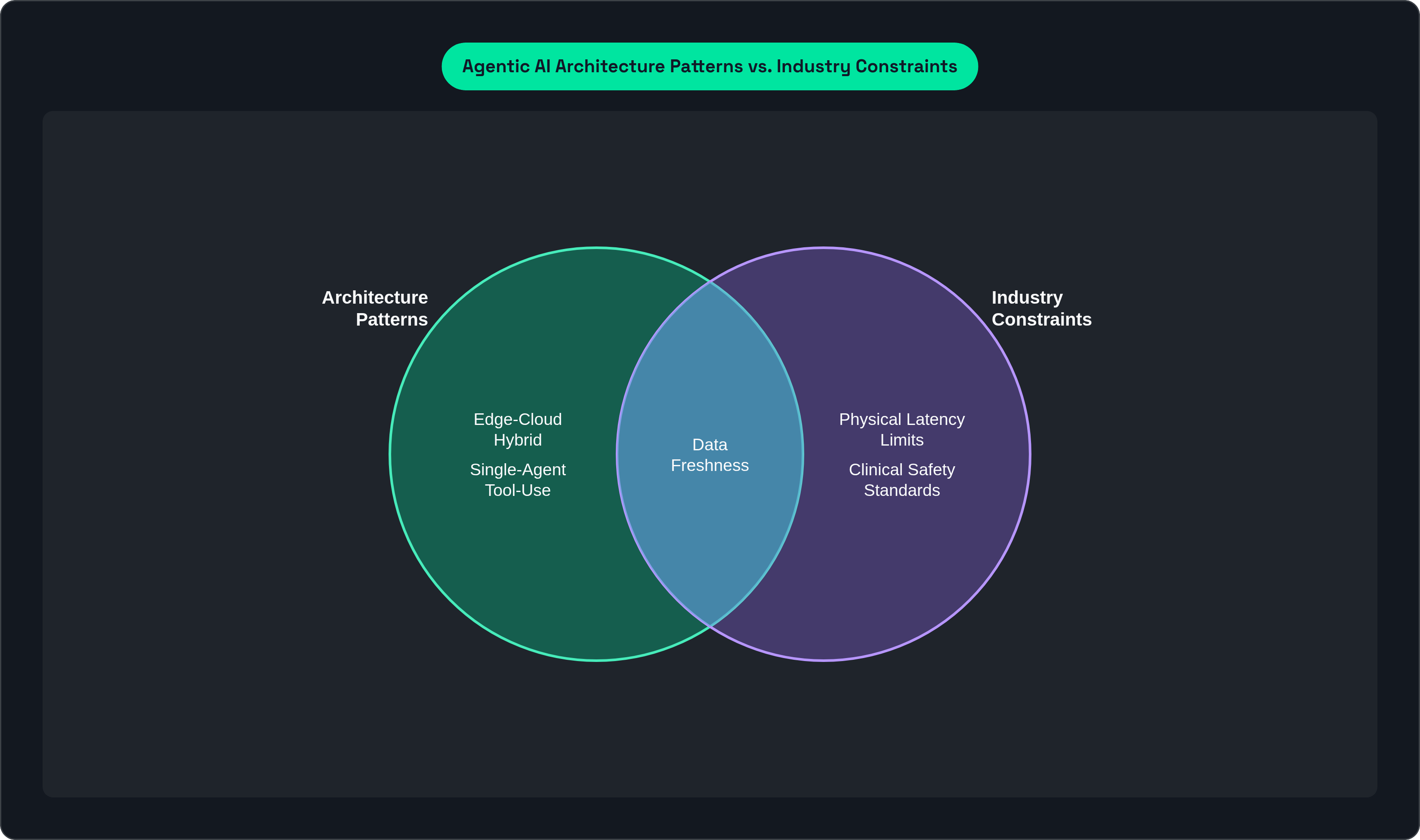
Between those poles sit the orchestrator-worker pattern, where a planner decomposes a goal and dispatches subtasks to specialist workers, separating reasoning from execution; the hierarchical state machine, where the system moves through explicit, sequenced states with defined exit criteria and failure routing; and the edge-cloud hybrid, where lightweight agents handle real-time decisions at the physical edge while complex reasoning offloads to cloud infrastructure.
Gartner recorded a surge of more than 1,400% in multi-agent system inquiries between early 2024 and mid-2025. The industry is clearly moving from single-agent pilots toward orchestrated specialist teams. Whether that move is appropriate in every case is a different question entirely.
Two infrastructure decisions cut across all patterns. First, real-time web grounding is not an optional enhancement; any agent acting on frozen training data will produce errors in dynamic domains, and in most production environments, domains are dynamic. Second, agentic RAG has replaced the static retrieve-once-then-generate pattern with a reasoning loop: the model decides what to retrieve, evaluates what it received, and re-queries if the result is insufficient. That loop is now the production default, not a research novelty.
Financial Services: Why Hierarchical State Machines Are Non-Negotiable
Finance combines two requirements that are individually demanding and jointly unforgiving: the need for complex, multi-step reasoning across live data sources, and the requirement that every decision be auditable and source-cited before it touches anything real. Simpler architectures can satisfy one of these requirements. The hierarchical state machine is the only pattern that reliably satisfies both.
Consider the operational context. Algorithmic trading now accounts for roughly 75% of all equity trading. Speed is a baseline expectation, not a differentiator. But a wrong autonomous trade in a poorly governed system does not fail quietly; it cascades. JPMorgan runs more than 450 agentic AI use cases in production daily. At that scale, ad hoc architectures simply break. What makes production viable is the enforcement mechanism that state machines provide: the agent cannot advance from one state to the next without satisfying explicit exit criteria, and failures route backward, not forward.
A representative production architecture in financial services moves through a data ingestion state, where the agent pulls live regulatory filings, market feeds, and earnings content via real-time search; an analysis state, where it reasons over retrieved content cross-referenced with internal policy; a compliance check state, where automated rule verification runs and failure returns the process to analysis rather than advancing it to execution; and, for high-value decisions, a human-in-the-loop gate that is a required architectural exit condition, not a UI suggestion.
The RAG implementation here carries particularly high stakes. Financial services is the largest RAG market segment by end user as of 2025. A meaningful drop in retrieval recall in this domain has a concrete cost: a missed SEC filing, an overlooked covenant breach, an undetected counterparty risk. That is not a metric to optimize in aggregate; it is a liability to prevent in every instance.
Industry benchmarks for financial services deployments in 2025 and 2026 show cost reductions of 25 to 45% and cycle time improvements near 60%, with a median time to positive ROI in the four-to-seven-month range, driven primarily by document processing and compliance monitoring. Vertical domain agents, designed with finance-specific retrieval scope and toolsets, outperform generalist models on narrow finance tasks. The architecture choice compounds the domain specificity benefit.
The practical implication for builders is sequencing: the compliance gate structure must be designed before any model is selected. The architecture is not a wrapper around the model. It is the constraint system within which the model operates.
Healthcare: Multi-Agent Collaboration Structured Around the Human-in-the-Loop Requirement
Healthcare shares finance's auditability requirement but adds a different kind of pressure: decisions affect individual patients, and the cost of a missed signal is clinical rather than financial. A wrong trade can be unwound. A wrong treatment recommendation cannot always be.
The multi-agent collaborative pattern dominates in clinical settings because the cognitive load of a single clinical decision is too distributed for one agent to manage well. Diagnosis support, drug interaction checking, patient history retrieval, and documentation each require different retrieval scopes, different reasoning modes, and different latency tolerances. A single agent asked to hold all of that context simultaneously will compress or drop something.
A representative production architecture sequences an intake agent that retrieves and summarizes patient history from EHR systems; a clinical reasoning agent that cross-references symptoms against current medical literature via real-time search; a specialized drug interaction agent querying live formulary and interaction databases; a documentation agent generating draft clinical notes; and an orchestrator coordinating the sequence, flagging conflicts between agent outputs, and routing to the human clinician. That last step is architecturally enforced: the agent cannot write to the EHR without physician sign-off. This is not a UI suggestion. It is a designed exit condition with no bypass.
Data freshness is acute in this domain. Clinical guidelines update; drug approvals change; treatment protocols evolve. An agent grounded in months-old training data gives outdated recommendations with full confidence. Real-time grounding is not a feature here; it is a patient safety requirement.
Research on standard RAG pipelines shows retrieval recall drops meaningfully on multi-turn queries. For clinical queries that involve multiple patient history turns, that degradation is not an accuracy metric to track. It is a patient safety issue to design against.
The five-times token cost and three-times latency of multi-agent over single-agent is acceptable in this context. The quality floor is set by clinical standards, not by cost optimization. Vertical domain agents like Abridge, built with healthcare-specific retrieval scope and tool access, outperform generalist models on narrow clinical tasks for the same reason they do in finance: specificity compounds the architectural benefit.
E-Commerce and Retail: Orchestrator-Worker Patterns Optimized for Real-Time Inventory and Pricing
The binding constraint in e-commerce is not auditability. It is staleness. A product recommendation based on inventory data that is hours old is not merely suboptimal; it actively damages trust when the recommended product is unavailable at the quoted price. A price-match decision grounded in yesterday's competitor data erodes margin or creates customer disputes. The architecture must make data freshness a structural guarantee, not a best-effort outcome.
Orchestrator-worker is the dominant pattern here. A central planner receives a system or user intent, dispatches specialized workers to inventory systems, competitor price feeds, logistics APIs, and promotion engines simultaneously, and synthesizes the parallel results. The workers do not need to collaborate or peer-review each other. They run in parallel and return results to the orchestrator. This is faster and cheaper than multi-agent peer review, which is appropriate because the tasks are structured and the failure modes are generally reversible.
The freshness requirements vary by worker type. Pricing agents need sub-minute data; stale price data creates margin erosion or customer trust damage. Inventory agents need event-driven triggers rather than scheduled polling. Recommendation agents need session-level context combined with live catalog state. The orchestrator coordinates agents running on different data freshness requirements, which is itself a non-trivial design problem.
Infrastructure benchmarks for web-grounded agents, including Browser Use's 89% success rate on the WebVoyager benchmark and Crawl4AI's ability to process content at significantly higher speeds than prior-generation tools, represent the current production ceiling for commercially deployed web agents. The August 2025 raise of $47 million by TinyFish, which builds agents for web-native commercial tasks including price tracking and competitive monitoring, reflects investor conviction that real-time grounded agents in retail are a durable category, not a novelty.
The architecture decision that separates mature e-commerce deployments from pilots is this: real-time web search is not a feature bolted onto the orchestrator. It is the data source that worker agents query at inference time. Without it, the orchestrator is coordinating stale inputs with precision and speed, which is worse than not coordinating at all.
Customer Service and Enterprise Support: Single-Agent Scope Discipline Before Multi-Agent Complexity
Klarna replaced the equivalent of 853 full-time employees with a single customer service AI agent. That figure has become the most cited production example in the industry, and it deserves to be examined not as a headline but as a structural argument: a well-scoped single-agent architecture outperformed the assumption that organizational scale requires architectural complexity.
The conditions that made single-agent viable at Klarna are worth enumerating carefully. The task domain was bounded: return status, order lookup, refund initiation, FAQ resolution. The failure mode was low-stakes and reversible; a wrong answer escalates to a human. Latency was a primary UX metric, and a multi-agent coordination loop adding perceptible delay would degrade the customer experience in a way that reduced, not enhanced, value.
The architectural failure mode in customer service is scope creep. Single agents that perform well on Tier 1 support get extended into Tier 2 and Tier 3 without architectural redesign. This is where single-agent deployments break. Ungoverned LLM chatbots operating outside their retrieval scope produce factual error rates in the 40 to 60% range. RAG, properly implemented with the agent retrieving from a current knowledge base rather than training data, reduces that rate to under 10%. The architectural requirement is that the retrieval pipeline connects to live product documentation; the error rate reduction is a consequence of that connection, not of model quality.
The production pattern for scaling beyond Tier 1 is modest by design: the single agent handles structured, repeatable intents; escalation logic routes complex or ambiguous queries to a specialist agent or human; a lightweight orchestrator manages the handoff. This is the minimum viable multi-agent addition. It is not a full collaborative system, and it should not be built as one.
The lesson for builders is uncomfortable if you arrived with an instinct toward complexity: start with the narrowest possible scope, enforce it architecturally, and add agent layers only when the task exceeds single-agent reasoning capacity. Most enterprise customer service deployments that failed did not fail because the model was insufficient. They failed because the scope was not enforced.
Manufacturing and Logistics: Edge-Cloud Hybrid Architecture Driven by Physical Latency Constraints
In manufacturing, the latency tolerance for a decision about a conveyor belt anomaly or a quality defect is measured in milliseconds. A cloud round-trip is not slow in this context; it is architecturally incompatible with the requirement. No amount of model optimization resolves a network latency constraint imposed by physical distance and communication overhead.
Edge-cloud hybrid architecture is the response to this constraint. Lightweight inference agents deployed on-device or at the facility edge handle real-time detection and immediate action without cloud dependency. Complex analytical reasoning, including root cause analysis, predictive maintenance modeling, and supply chain re-optimization, routes to cloud infrastructure where compute and data access are unconstrained by edge hardware.
The architectural split is clean in principle and requires discipline in practice. The edge agent monitors sensor streams, detects anomalies, and triggers immediate responses, including halting a line or flagging a defect, within the operational window. Its tool access is narrow by design: it acts on local sensor data and executes local responses. The cloud orchestrator receives edge events, runs multi-step analysis, coordinates across facilities, updates predictive models, and generates reports. Its tool access is broad: it queries supply chain databases, external logistics APIs, and live commodity pricing.
Predictive maintenance illustrates the two-layer value proposition clearly. Edge agents detect early-warning signals in equipment telemetry. Cloud agents correlate those signals across the equipment fleet and recommend maintenance scheduling that optimizes across cost, availability, and lead times. The edge layer operates on a time horizon of seconds; the cloud layer operates on a time horizon of weeks. They are solving different problems with different data sources, and conflating them into a single architecture introduces latency where immediacy is required and narrows analytical scope where breadth is required.
Data freshness works differently here than in retail. The edge agent does not need internet-fresh data; it needs real-time local sensor data. The cloud agent needs current external data, including parts pricing, shipping lead times, and regulatory updates. These are distinct freshness requirements routed to distinct architectural layers.
The governance challenge in manufacturing deployments is distinctly severe. Agents acting without human oversight in physical environments, where a wrong decision can halt production or damage equipment, represent the domain where governance maturity matters most. Deloitte's 2026 data showing that only one in five companies has mature AI governance is concerning in any context; in manufacturing edge deployments, it is the variable most likely to determine whether a deployment ends in a case study or an incident report.
Legal and Professional Services: Multi-Agent Peer Review as a Quality Enforcement Mechanism
Salesforce cut $5 million in legal costs through contract automation. That figure is a useful anchor not because it is exceptional but because it is representative of what structured, well-governed legal AI deployments produce when the quality enforcement mechanism is built into the architecture rather than bolted on afterward.
The quality failure mode in legal work is subtle. A wrong clause is not always obviously wrong; it may be technically present but contextually inapplicable. A cited precedent may be real but from the wrong jurisdiction. A regulatory requirement may be missing not because the agent hallucinated but because its retrieval scope did not extend to the relevant jurisdiction's current statute. These errors are not caught by a single agent reviewing its own output. They require independent verification.
The multi-agent peer-review pattern addresses this directly. A drafting agent generates contract language or legal analysis grounded in retrieved case law and regulatory text. A separate review agent independently retrieves and checks the drafting agent's sources, flags unsupported claims, and surfaces missing clauses. A synthesis orchestrator adjudicates conflicts between the two and routes unresolved issues to a human attorney.
Harvey, built specifically for legal work with domain-specific retrieval scope and tool access, outperforms generalist models on narrow legal tasks. The performance gap is not primarily a model capability difference; it is a retrieval scope and tool access difference. A generalist model asked a jurisdiction-specific contract question retrieves broadly and reasons over a noisy result set. A domain-specific agent retrieves from curated, current legal databases and reasons over a substantially cleaner input. The peer-review architecture then adds a second independent retrieval pass, which catches errors the drafting agent's retrieval missed.
The five-times token cost of multi-agent relative to single-agent is justified here by the asymmetry of consequences. A customer service error costs a support escalation. A legal error costs a contract dispute, a regulatory fine, or a malpractice claim. The quality floor is set by professional liability standards, and those standards do not negotiate on cost grounds.
What the legal services case illustrates, and what connects back to every industry examined here, is that architecture is a risk management decision before it is a performance optimization. The practitioners who have built and rebuilt these systems do not debate which LLM to start with. They start with the failure modes, work backward to the constraints, and select the pattern that makes the most important failure modes structurally impossible. Everything else follows from that sequence.