RAG vs LLM-Only Responses
RAG cuts hallucinations by up to 71% but still fails in specialized domains.

RAG inserts a retrieval step before generation. The model no longer answers solely from its weights; it answers from context retrieved specifically for the query and injected into the prompt. The standard pipeline moves through data ingestion and chunking, embedding and indexing, retrieval, and finally generation. Each stage is a potential failure point, which matters more than it sounds.
The architectural consequence that matters most: the answer is now a function of what was retrieved. That means it can be wrong for two distinct reasons, bad retrieval or bad generation, and those failure modes are diagnosed and remediated differently. Verifiability also becomes structurally possible. Because the answer is grounded in specific retrieved documents, those documents can be surfaced as citations, which is not a cosmetic feature in regulated industries.
Enterprise adoption reflects this shift. Nimbleway's RAG pipeline analysis found that enterprise AI designs using RAG grew from 31% to 51% of systems year-over-year, moving from experimental to standard faster than most infrastructure transitions at comparable complexity. That pace raises a harder question: if the architectural benefits are this legible, why do RAG systems still fail at rates that catch production teams off guard?
The measurable gap in hallucination rates
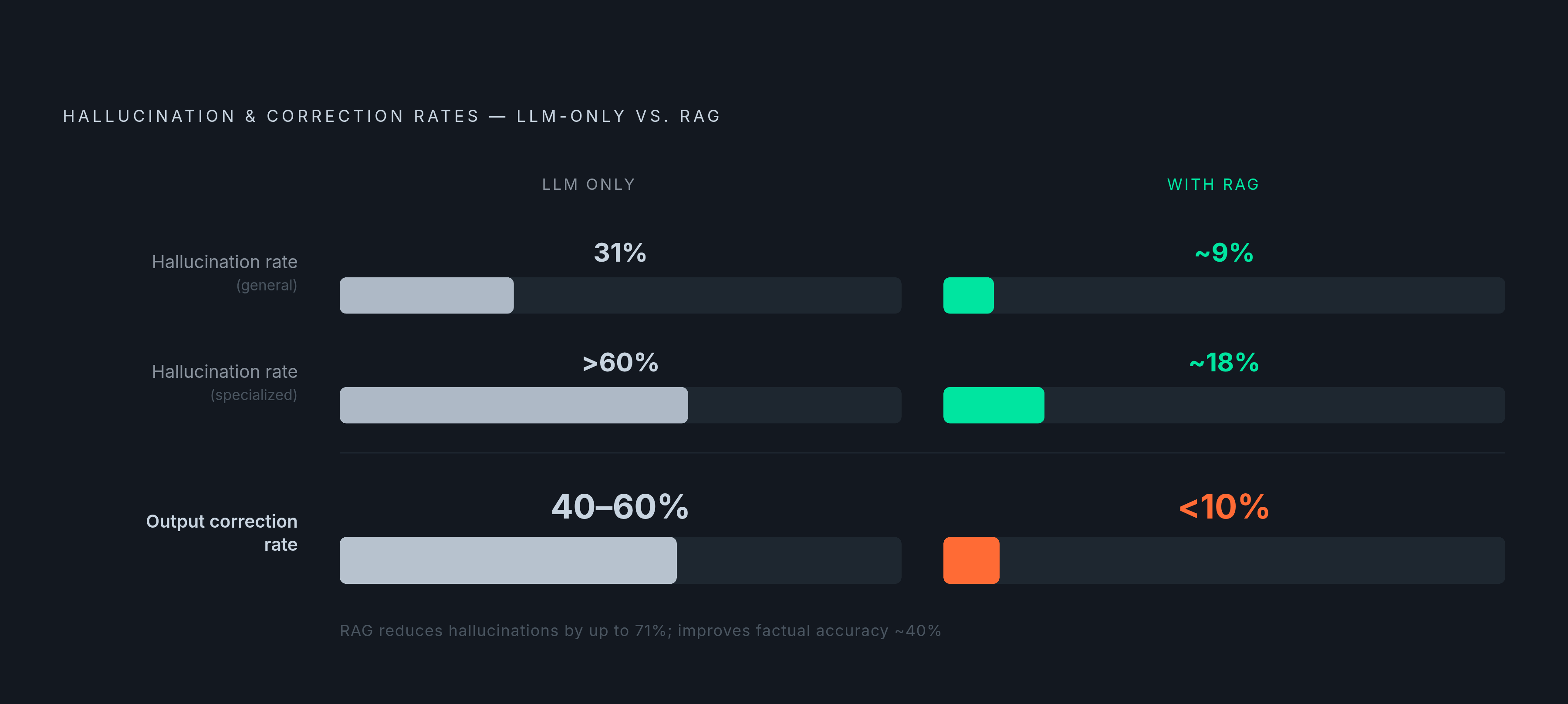
Peer-reviewed research finds hallucinations in roughly 31% of real-world LLM interactions, a figure that climbs above 60% in complex or specialized domains. Those are not anomalies; they are the baseline behavior of a system reasoning from parametric memory without grounding.
RAG's effect on that baseline is material. Properly implemented RAG reduces hallucinations by up to 71% and improves factual accuracy by roughly 40% compared to standalone LLMs, according to enterprise deployment analyses. In customer support deployments specifically, RAG-powered systems show roughly 35% fewer hallucinations than unaugmented counterparts. The correction rate for standard LLM responses, estimated at 40 to 60% of outputs requiring factual correction, drops below 10% with RAG, per Synvestable's enterprise RAG analysis.
A controlled study published on arXiv in 2026, running 300 QA questions across five LLMs, found that RAG consistently improves accuracy by 9 to 13 percentage points regardless of the base model used. That last detail is worth holding: the gain is architectural, not model-specific. McKinsey's 2025 AI Outlook corroborates the structure of that finding, reporting a 37% reduction in misinformation risk for companies integrating retrieval-augmented systems versus pure generative approaches.
I will admit the tightness of these numbers gave me pause when I first encountered them clustered together. Figures like 71%, 40%, and 37% appear across different methodologies and different vendors, and they do not always cite comparable baselines. The directional consensus is strong. The precision of any individual figure deserves more skepticism than the literature sometimes invites.
What these figures imply collectively: the improvement is real and reproducible, but it is not total. RAG does not eliminate hallucination. It relocates and reduces it.
Where RAG still fails and why
Galileo's 2025 Hallucination Index is the corrective to overconfident claims about RAG's reliability. Enterprise RAG systems still hallucinate at rates exceeding 10% on real-world queries; legal and medical domains push past 20%. Even top-tier models across 22 LLM configurations produce factual inconsistencies in 3 to 8% of responses under RAG conditions. Stanford research on advanced enterprise RAG tools found error rates between 17% and 33% in specialized domains like legal research.
The failure mode I keep returning to involves a scenario I have seen surface in compliance contexts more than once. A document indexed in mid-2024 states that a security certification is pending. A later document confirms it was achieved. Both remain in the vector store. Both are semantically similar enough to a compliance query that the retrieval step surfaces them together. The model encounters the contradiction and resolves it, not necessarily in the right direction. The user receives a confident, cited, apparently grounded answer that is wrong.
That outcome is, in some ways, harder to catch than an obvious hallucination. The citation gives it the appearance of verifiability. A user who trusts the sourcing has no obvious reason to dig further. I have watched this play out in review cycles where the cited document was technically accurate at the time of ingestion, and nobody thought to question whether the index had kept pace with reality.
The root cause is not architectural in any irreducible sense. RAG shifts the failure mode from model memory to retrieval quality. Stale indexes, poor chunking strategies, and conflicting documents in the corpus are not exotic edge cases; they are the ordinary condition of a corpus that has not been maintained with the same discipline as the model selection process. Teams that treat RAG as a one-time implementation tend to discover this at moments that are difficult to walk back.
When LLM-only responses are the right call
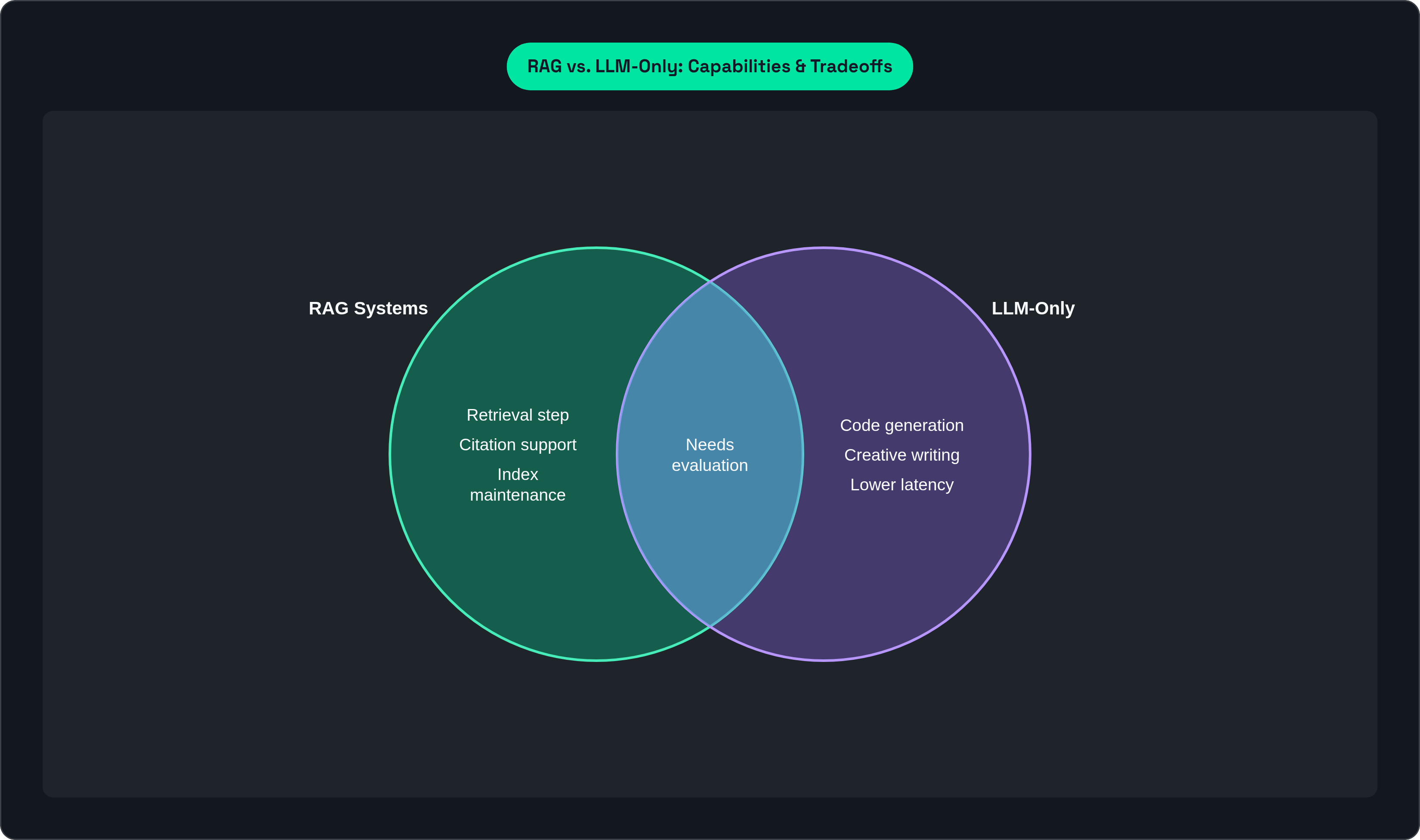
More often than the current discourse suggests. Code generation and debugging are the clearest examples: the model's training corpus is the relevant knowledge base, the problem is reasoning over stable syntactic and semantic structure, and retrieval adds round-trip latency without adding accuracy.
The same logic holds for summarization or transformation of text the user has already provided, creative generation where factual currency is not a requirement, and classification or extraction tasks operating on supplied data. In each case, the answer's correctness does not depend on information that post-dates the training cutoff or lives outside the training data.
Latency-sensitive applications compound this. If the query domain is stable and a retrieval round-trip costs the user experience meaningfully, the marginal accuracy gain may not justify the overhead.
There is also a subtler failure mode worth naming: teams that add retrieval to signal rigor rather than because the task requires it. Retrieval introduces its own error surface. If the answer follows from reasoning over supplied context or stable knowledge, adding a retrieval layer does not make the system more trustworthy; it adds a new way to be wrong without a corresponding accuracy benefit.
The decision clarifies when framed as a requirements question rather than a philosophical one. If the answer's correctness depends on information that post-dates the model's training or lives outside its training data, LLM-only is structurally unqualified for the task. If it does not, retrieval adds complexity without adding value.
The retrieval layer decision: vector stores versus live web search
Assuming retrieval is warranted, the next decision is what retrieval infrastructure to use. Two primary patterns dominate production systems and have distinct fitness profiles.
A vector database over a static corpus embeds and indexes a known document set. It is well-suited for stable, internal knowledge: product documentation, compliance archives, historical records with predictable update schedules. A live web search layer queries the open web at inference time, returning current information that cannot be pre-indexed. It is the right choice for rapidly changing facts and public information that needs to reflect today rather than last week's crawl.
Most production systems that need to answer questions about both private knowledge and the current world benefit from both patterns operating together. Hybrid retrieval, combining keyword and semantic search, now outperforms single-method pipelines for accuracy in noisy enterprise datasets and is emerging as the production standard. Research comparing agentic keyword search against vector-RAG approaches found that keyword search alone achieves over 90% of vector-RAG performance without requiring a standing vector database, which matters for teams weighing infrastructure cost against accuracy requirements.
The freshness problem with static vector stores is the direct mechanism behind the failure mode described in the previous section. A corpus re-embedded on a weekly schedule will drift, and that staleness window produces confident wrong answers rather than a theoretical risk. Data virtualization offers one alternative: querying live enterprise systems such as CRM, ERP, or real-time risk engines directly at inference, rather than relying on periodic ingestion, eliminates the staleness window, though it introduces latency and access-control complexities that require their own accounting.
One infrastructure shift reshaped this landscape materially. Microsoft retired the public Bing Search API in August 2025, following price increases of roughly three times the original entry-tier cost in 2023. That sequence accelerated developer migration toward purpose-built AI search providers, and the provider landscape shifted accordingly.
What purpose-built search APIs deliver that generic retrieval does not
APIs designed for human browsing return ranked URLs. APIs built for LLM grounding return extractive, long-form snippets ready to inject into prompts. The distinction is operational, not cosmetic.
The properties that distinguish AI-ready search infrastructure: real-time indexing, so answers reflect the current web rather than a days-old crawl; verifiable sourcing, so every claim can be traced to a URL and surfaced as a citation; low latency at scale, because retrieval cannot become the bottleneck in an agentic loop; and output format designed for LLM consumption, pre-chunked and relevance-ranked rather than raw HTML the model must parse.
The 2025 to 2026 provider landscape includes a few distinct positions worth understanding. Tavily is purpose-built for RAG pipelines, aggregating up to 20 sites per call using proprietary AI ranking. Perplexity's API handles NLU-heavy queries but returns summarized answers rather than raw retrievable context, which limits composability in custom pipelines where the source material, not an intermediate synthesis, is what the downstream generation step actually needs.
Evaluating any retrieval layer requires measuring what matters in production: faithfulness, whether the generated answer stays within what was retrieved; context precision, whether retrieved content was actually relevant to the query; context recall, whether retrieval surfaced enough of the useful material; and groundedness, whether each claim can be traced to a specific retrieved source. Published, reproducible accuracy scores on standard QA benchmarks are the only comparator that is not marketing. I would add one caution: benchmark performance and production performance diverge more in retrieval systems than in almost any other component, because the distribution of real user queries rarely resembles the distribution the benchmark was built on.
How Morgan Stanley's RAG deployment illustrates the architecture in production
The problem Morgan Stanley was solving was specific and representative of a broader class of enterprise use cases. Financial advisors needed fast access to a proprietary research corpus exceeding hundreds of thousands of documents. Manual searches regularly consumed thirty minutes or more per query. The information was internal, stable in structure, and high-value.
The architecture was a GPT-4-powered system using RAG to query the firm's internal document store, a direct application of the vector-store pattern to a stable, proprietary corpus. The results, drawn from Morgan Stanley's press releases and OpenAI's published case study, were unambiguous: advisor adoption reached near-universal levels in wealth management, document access jumped from a fraction to the vast majority of the available corpus, and query times fell from over thirty minutes to seconds.
What makes this instructive beyond the headline numbers is the fit between the architecture and the use case. The corpus is stable and proprietary, exactly the conditions under which a vector store is the right retrieval choice. Cited, grounded answers matter enormously in financial advice, so the structural verifiability RAG provides is not a bonus; it is a requirement. The adoption rate reflects what happens when the accuracy improvement is visible and consequential enough that users trust it. That trust dynamic is different from deployments where the improvement is real but invisible, where adoption tends to be more grudging and the organizational case harder to sustain.
The case study also has limits worth naming. Morgan Stanley's corpus is curated and internal. Production systems that need to answer questions about the current world, live market data, breaking regulatory guidance, recent filings, require a live web retrieval layer on top of the vector store. The architecture that works for a stable internal corpus is insufficient for queries whose answers change daily, and no amount of adoption success on the internal use case changes that boundary.
A practical framework for choosing between the two approaches
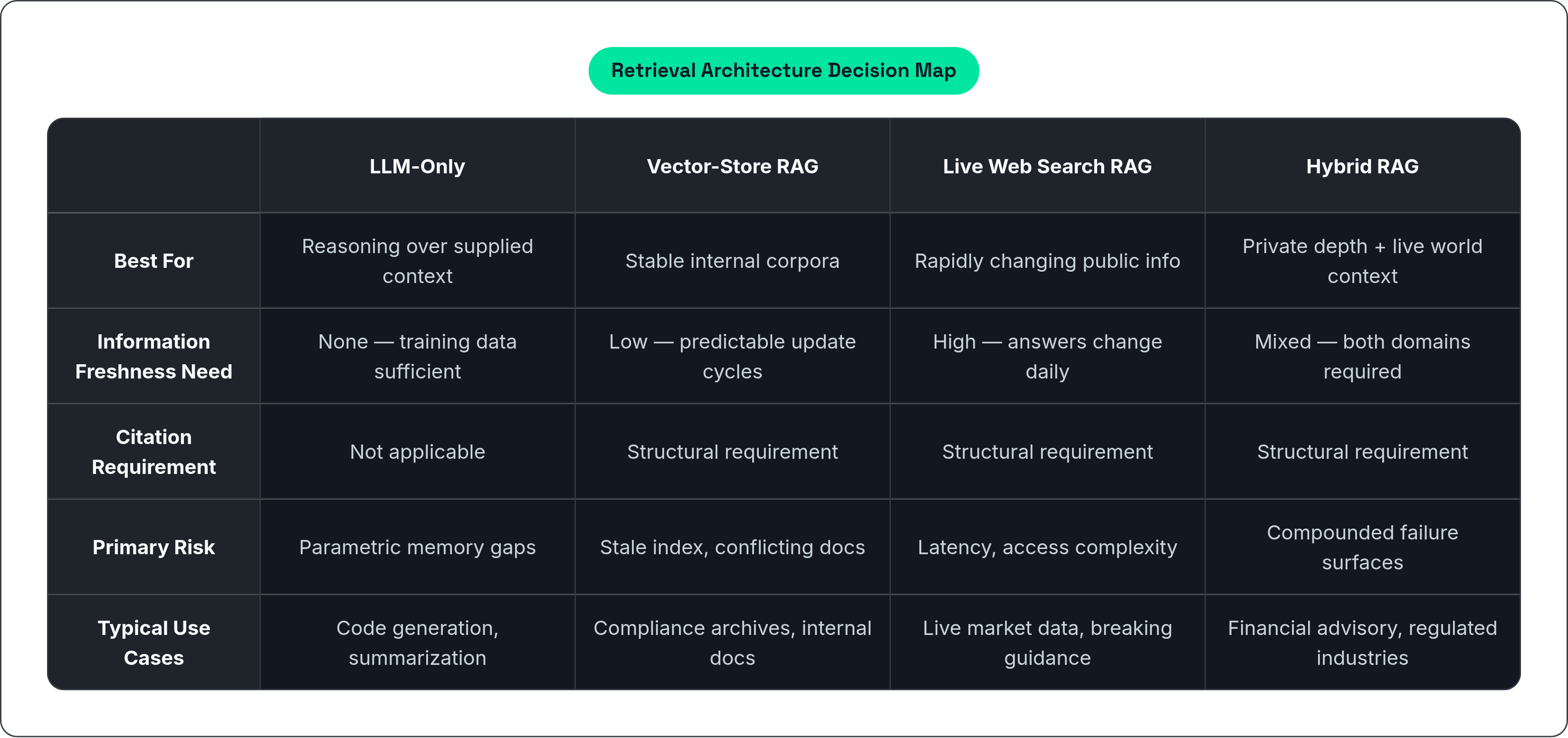
Five decision variables actually determine the right architecture: how old the information can be before the answer is wrong; whether the user needs to trace the answer to a source; whether the domain carries elevated operational or regulatory consequences for errors; whether the answer lives in public web content, private internal documents, or both; and what happens operationally if the output is inaccurate.
Running those variables against the available patterns produces a reasonably clear map. Stable knowledge tasks involving reasoning over supplied context are appropriate for LLM-only responses. Internal private corpora with stable update schedules and citation requirements call for vector-store RAG. Queries requiring current world knowledge from public sources call for live web search RAG. Use cases that need both private corpus depth and live world context call for a hybrid architecture combining both retrieval layers.
Several operational commitments follow from whichever pattern is chosen. RAG does not eliminate the need for evaluation; faithfulness, context precision, and groundedness should be tracked regardless of retrieval pattern, because the architecture changes the failure modes without removing them. Index maintenance is not optional. The stale-document failure mode described earlier is a maintenance failure, not an architecture failure, and freshness discipline is part of what RAG accuracy actually costs in practice.
The 9 to 13 percentage point accuracy gain RAG delivers across base models, as documented in the arXiv controlled study, means the choice of a stronger base model does not substitute for the choice of the right retrieval architecture. These are independent decisions. Teams that conflate them tend to find out the expensive way: capable models producing confidently wrong answers from stale indexes, at a moment when the cost of that error is no longer abstract.


