Real-Time Web Data vs Static Knowledge in Agent Pipelines
Agents stumble when knowledge is stale, not when reasoning fails.
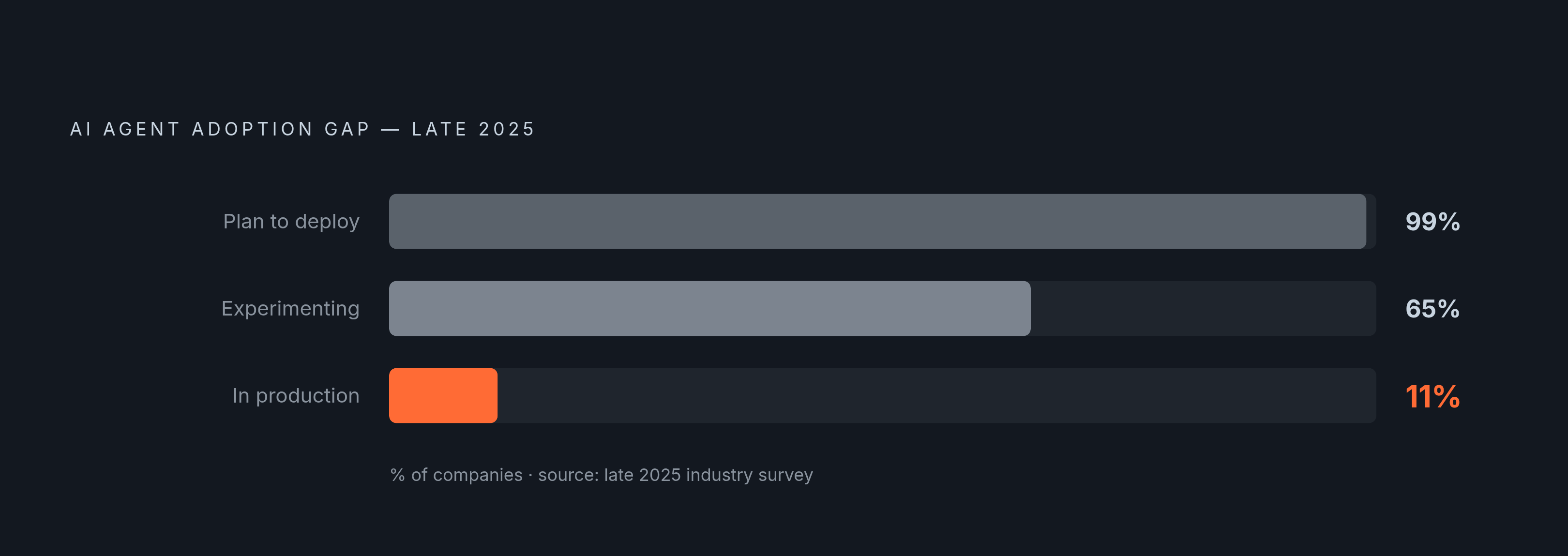
Nearly two-thirds of companies were experimenting with AI agents in late 2025, according to MIT Technology Review, yet only 11 percent had systems running in production, per Deloitte's 2025 Emerging Technology Trends study. That gap is not skepticism. Deloitte found that 99 percent of those same organizations planned to move agents into production; the bottleneck was data architecture.
The friction is specific. Forty-eight percent of organizations cited data searchability and reusability as their top barrier, and 20 percent admitted their own data simply was not ready. These are not complaints about infrastructure immaturity in the abstract. They describe organizations that have built agents capable of reasoning, planning, and executing multi-step tasks, but that cannot reliably feed those agents accurate information about the current state of the world. The reasoning layer works. The knowledge layer does not.
The market trajectory makes this urgent. The global AI agents market was projected at $7.63 billion in 2025 and is expected to reach $182.97 billion by 2033, a compound annual growth rate above 49 percent. Gartner projected that 40 percent of enterprise applications would be integrated with task-specific agents by the end of 2026, while also warning that more than 40 percent of agentic AI projects would be canceled by end of 2027. Those two projections, read together, describe a market simultaneously accelerating and culling. The cancellation risk maps directly onto what Deloitte surfaces: agents that cannot reliably answer questions about the current world cannot be trusted with consequential decisions, and organizations discover this either in staging or, worse, in production.
Where static knowledge breaks first: the three structural failure points
Practitioners often conflate two distinct categories of knowledge failure, and that conflation reliably produces solutions aimed at the wrong problem.
One category is hard cutoff failure: any fact, event, or entity that postdates training simply does not exist for the model. Ask a model with a mid-2024 cutoff about a regulatory change that took effect in early 2025 and it will not hedge; it will answer using the prior regulatory state with the same surface confidence it projects on everything else. The model cannot signal uncertainty about what it does not know exists. That epistemological gap is invisible from inside the model itself.
The other category is drift failure: things the model did know that have since changed. Prices, executive leadership, product versions, security advisories, legal standards. The model holds a snapshot from training; the world has updated. The answer is not missing information, it is confidently wrong information, which is harder to catch precisely because it sounds authoritative.
Failure Point 1: The cutoff gap
High-risk domains here include regulatory changes, product releases, executive transitions, security vulnerability disclosures, and market conditions. The cost of acting on stale information in these domains is not embarrassment; it is operational disqualification. An agent routing a compliance question to a regulatory framework that no longer governs the domain, or flagging a security patch as unresolved when it has been deployed for six months, produces outputs that create liability rather than value.
The deeper problem remains epistemological. A model that encounters a question about something it was never trained on cannot distinguish between "I know this" and "I am pattern-completing from adjacent training data." Both produce the same confident output. No internal alarm exists.
Failure Point 2: The ETL latency gap
Teams that recognize the cutoff problem often respond by augmenting their models with batch-refreshed data, running ETL pipelines on a schedule. This reduces the cutoff gap but introduces its own staleness. A four-hour ETL cycle means an agent operates on data that is, on average, two hours old at any given moment. For fast-moving inputs, pricing, news, market signals, intraday regulatory filings, two hours is not fresh by the standards of the task. That latency is a structural property of the batch approach, not a configuration problem you can tune away.
Latency also compounds across the full pipeline. Retrieval has latency. Index refresh has latency. Inference has latency. Each step adds distance between the world-as-it-is and the context the model actually reasons from. Response times above three seconds correlate with a 21 percent higher agent failure rate, and that figure compounds across multi-step chains. A four-step pipeline where each step approaches the failure threshold does not have a four-percent failure rate; it has a cumulative one.
Failure Point 3: Context degradation at depth
The intuitive response to both failures above is to retrieve more context and inject it. This works to a point.
A Databricks study found model correctness degrades around 32,000 tokens, well before the million-token context windows vendors advertise. Engineers have started calling this "context rot." Injecting large volumes of retrieved content can degrade answer quality even when the content is accurate, because the model attends to some portions of the context window more reliably than others. Long contexts dilute signal rather than amplifying it.
The fix to stale knowledge, then, is not more context. Precision and freshness matter more.
What RAG solves and where it still falls short
Retrieval-Augmented Generation addresses the cutoff gap directly. Instead of relying on training data alone, the model retrieves relevant documents at query time and uses them as context, grounding its answer in specific, current, or proprietary material it was never trained on. Enterprise adoption has grown sharply; recent industry surveys put RAG use in enterprise AI systems at 51 percent, up from 31 percent the prior year.
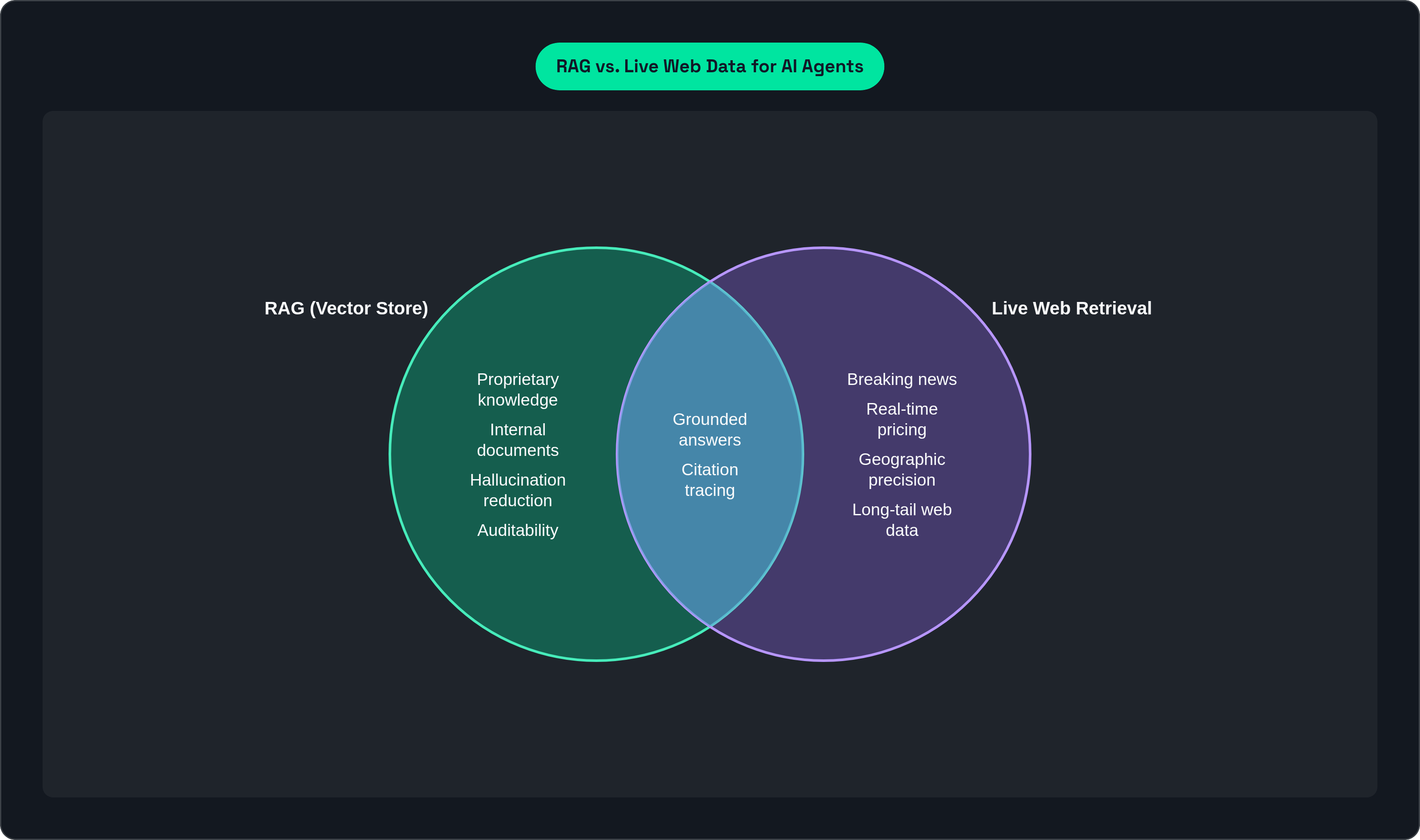
RAG handles several real problems well. It enables proprietary knowledge, internal wikis, product documentation, support ticket histories, to inform model responses without retraining. It reduces hallucination on in-domain questions when the retrieval corpus is accurate and current. It gives answers a traceable source, which matters for auditability in regulated deployments.
But RAG does not solve the live-world-knowledge problem, and conflating the two is a common and expensive mistake. I have watched teams invest heavily in vector store infrastructure, ship what looked like a working system, and then discover in production that the corpus they so carefully indexed was already six months stale on the questions users actually asked.
A vector store is only as fresh as its last indexing run. RAG on a stale corpus inherits the ETL latency problem; the architecture is sophisticated, but the underlying data is not current. Private document retrieval also cannot cover world knowledge: news, pricing, regulatory updates published in the last several hours, competitor moves, or any signal that lives on the open web and was never ingested into a curated corpus.
There is a subtler failure mode as well. Standard LLMs using basic keyword search score below 10 percent on complex multi-hop research benchmarks, according to a 2025 agentic deep research survey. Retrieval architecture is not a detail; it determines whether the agent can reason across sources at all, not merely whether it can surface a single relevant document.
RAG is necessary but not sufficient. It solves the proprietary knowledge problem and leaves the live-world-knowledge problem largely unaddressed.
How live web data fills the gap RAG leaves open
A vector store gives an LLM a snapshot of a moment in time. Live web data gives it a continuously updated view of reality. The operational gap between those two things is where most production failures I have seen actually originate.
Live web retrieval covers categories of information a static corpus structurally cannot: current pricing, availability, and inventory; breaking news and recent events; regulatory or policy changes posted within the last several hours; long-tail or unindexed information that never made it into a curated corpus. It also handles geographic precision. Prices, availability, and local market signals differ by region in ways a centralized corpus cannot capture.
The search-first pipeline pattern mirrors RAG structurally but changes the retrieval layer entirely. A query arrives, a search API is called immediately, live results are injected into the prompt, and the model generates a response grounded in real-time context. The corpus is the live web rather than a static index.
Calibration matters here more than teams often realize. Three to five results is the effective range for most queries; fewer than three risks missing the best available answer, and more than seven adds token overhead without proportional quality gain, which circles back to the context degradation problem above. For complex multi-part questions, query expansion, running two or three searches for different aspects of a question and combining the top results, consistently outperforms a single broad search.
The production model most teams eventually converge on is a hybrid: a vector store for private, stable knowledge, and a live web search API for world knowledge. Each layer does the job it is suited for, and the boundary between them deserves more deliberate design than it usually receives.
The three pipeline architectures for integrating live web data
Every live web grounding pipeline shares the same skeleton: translate the query into a search, retrieve full content from the top results, inject that content into the prompt before generation. The architectures differ in when and how they trigger that skeleton, and those differences have real consequences for latency, reliability, and task fit.
Architecture 1: Search-first
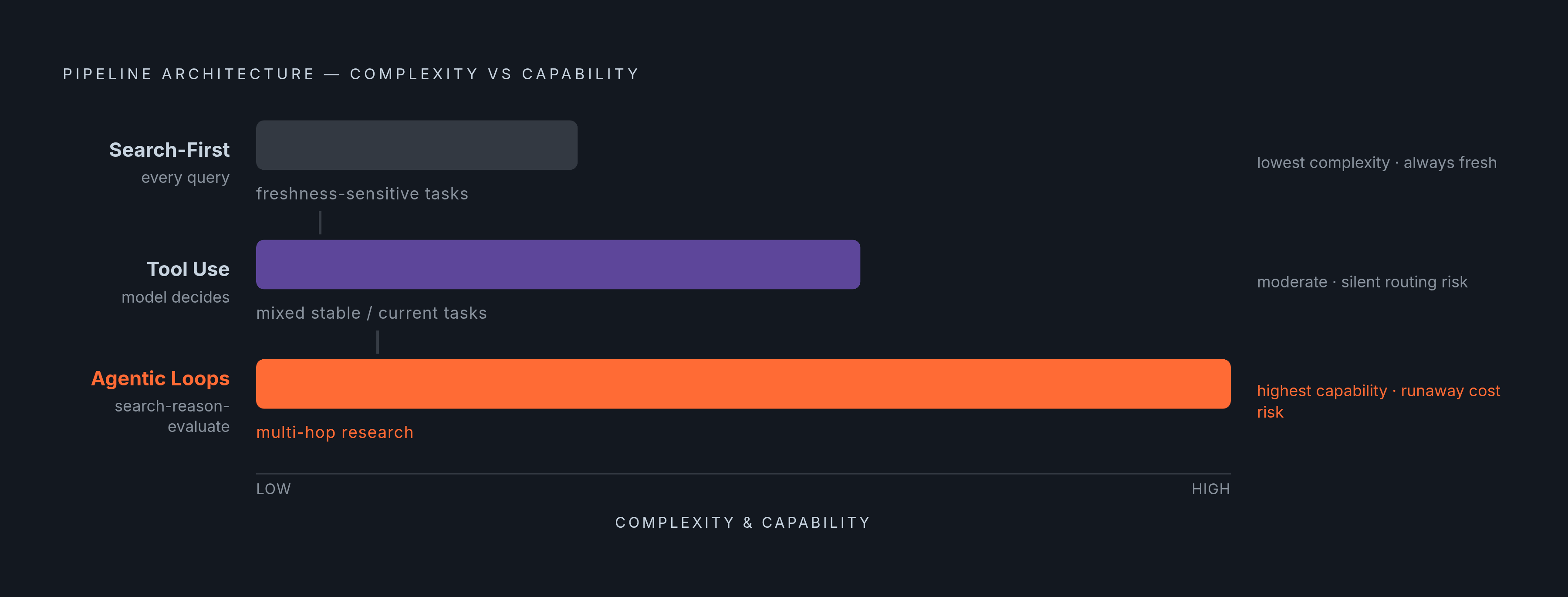
The simplest pattern: every query triggers a search API call before the model generates anything. This fits question-answering agents where freshness matters on every turn, where you cannot predict which queries will touch current-world information and the cost of getting a stale answer exceeds the cost of the additional latency.
The tradeoff is waste on stable queries. For tasks where the answer does not change, the API call adds time and cost without improving accuracy. Search-first is the right pattern for freshness-sensitive tasks and the wrong pattern if applied universally.
Architecture 2: Tool use
Here the model decides when to call the search tool, routing to live web retrieval only when it detects a freshness-sensitive question. This suits general-purpose agents that mix stable-knowledge and current-knowledge tasks.
The routing reliability problem, though, is serious enough to deserve direct attention rather than a footnote. The model must correctly identify when its own training data is stale, which is precisely what it is poorly equipped to do. A model that does not know a regulation has changed cannot reliably route that question to a live search. Tool-use architectures need fallback logic and, ideally, explicit signals about which query types require freshness checks. Without that, the architecture creates a category of silent failures that are difficult to detect in production, the worst kind.
Architecture 3: Agentic loops
The agent searches, reasons over the results, decides whether the evidence is sufficient, and searches again if not. The 2025 agentic deep research survey found that systems built around iterative retrieval score dramatically higher on complex multi-hop research benchmarks than single-shot keyword search. This pattern suits deep research tasks, financial analysis, competitive intelligence: anywhere a single search cannot surface the full picture because the picture is assembled from multiple, partially overlapping sources.
The tradeoffs are genuine. This is the highest-complexity, highest-latency pattern, and it requires careful loop termination logic. An agent that iterates without a clear stopping condition can spend more time searching than the task warrants, at real cost.
The integration layer
Anthropic's Model Context Protocol (MCP) is worth attention as an emerging infrastructure standard. MCP provides models with a consistent interface to external data sources, removing the need to build custom connectors for every tool or data provider. Whether it becomes the dominant integration standard remains to be seen, but the problem it addresses, brittle, bespoke connectors for each external source, is real and widely encountered in production deployments. Teams that have hit that wall know exactly how much engineering time disappears into connector maintenance.
How to measure whether grounding is actually working
The gap between pilot and production persists partly because teams lack honest measurement. A pipeline that performs well in demo conditions may degrade significantly on precisely the stale-knowledge tasks it was built to fix, and without defined metrics, that degradation is invisible until it surfaces as a failure in front of a real user.
Google DeepMind's FACTS Benchmark Suite, published in 2025, evaluates across three slices: Parametric (internal knowledge accuracy), Search (retrieval and synthesis), and Grounding v2 (answer grounded in prompt context). The top-performing model in that evaluation, Gemini 3 Pro, scored 68.8 percent overall. Every evaluated model, under the best current infrastructure, remains below 70 percent accuracy. That ceiling is consequential for anyone making production deployment decisions, and the Search slice is the most operationally relevant for agent pipelines; it measures directly whether the model uses retrieved results rather than falling back on training data.
SeekBench, also from 2025, surfaces a subtler problem: reinforcement learning training improves answer accuracy but not evidence-grounded reasoning. Agents can produce correct-sounding answers without the reasoning being traceable to any retrieved evidence. In regulated domains, that distinction is not a quality nicety; auditability is a structural requirement, and a system that produces the right answer for untraceable reasons fails the requirement regardless.
Benchmark scores require scrutiny before being used as procurement signals. They predict production performance only when the benchmark tests tasks similar to the actual use case, the test set is clean of training data overlap, and the benchmark has not saturated to where scores cluster near the ceiling. The GSM8K contamination study is instructive: accuracy dropped by up to 13 percent when contaminated examples were removed. A headline benchmark score is a signal, not a specification.
In production, the metrics that matter are task-specific. Freshness rate: what share of answers draw on sources dated within the required window for that task. Citation traceability: whether every factual claim can be traced to a retrieved source. Failure mode distribution: whether failures concentrate in cutoff gaps, ETL latency gaps, or context degradation, because each failure type requires a different fix. Treating all grounding failures as equivalent is how teams end up building solutions that address none of them.
Choosing the right infrastructure for time-sensitive agent tasks
Not every agent task requires live web data, and treating it as a universal default is as mistaken as ignoring it entirely. The choice should follow the staleness tolerance of the task, which sounds obvious until you realize most teams have never formally established what that tolerance is.
Stable, proprietary knowledge, internal documents, product specifications, support history, is well served by vector store RAG. Slow-changing world knowledge, general concepts, historical facts, well-established procedures, may be adequately served by training data with periodic RAG refresh. Fast-changing world knowledge, news, pricing, regulations, market data, competitive intelligence, requires live web grounding. For that last category, live retrieval is not a feature enhancement; it is a structural requirement.
Financial and regulated domains present the sharpest case. Wolters Kluwer projected a more than 600 percent increase in finance teams using agentic AI in 2026. In financial research, an unverifiable or uncited output is not merely low quality; it is operationally unusable. The architecture implication is direct: finance agents need live web data plus citation infrastructure, not just retrieval as a concept.
Latency deserves treatment as a reliability concern, not merely a user experience one. The 21 percent higher failure rate above three seconds means trading accuracy for speed does not preserve pipeline quality; it degrades it. Speed and accuracy are not opposing variables to balance; they are joint requirements, which constrains the solution space considerably.
The Microsoft Bing Search API retirement in August 2025 was a practical forcing function for many teams. Pipelines built on Bing required migration, and that migration created a genuine evaluation moment. The right evaluation criterion for a replacement is benchmark performance on the specific task types the agent handles, not feature lists or vendor claims. Benchmark results that are publicly reported, reproducible, and interrogable for contamination and saturation are more reliable procurement signals than anything a vendor self-reports.
The teams closing the gap between experimentation and production are, by and large, the ones who have stopped treating grounding failures as generic quality problems and started asking which failure type they are actually looking at. Map each agent task to a staleness tolerance expressed in concrete time units. Identify which tasks involve world knowledge versus proprietary knowledge. Select the pipeline architecture based on task complexity and acceptable latency. Establish production measurement before declaring the system ready for consequential decisions. That sequence is not a framework; it is hard-won operational practice.


