Agentic Architecture Patterns for Search-Driven Systems
Make search foundational to agent design, not an optional tool bolted on when freshness matters.

The distinction is not about whether a search tool exists in the stack; it is about where search sits in the agent's cognitive architecture, and that confusion has a way of becoming expensive in production, rarely before.
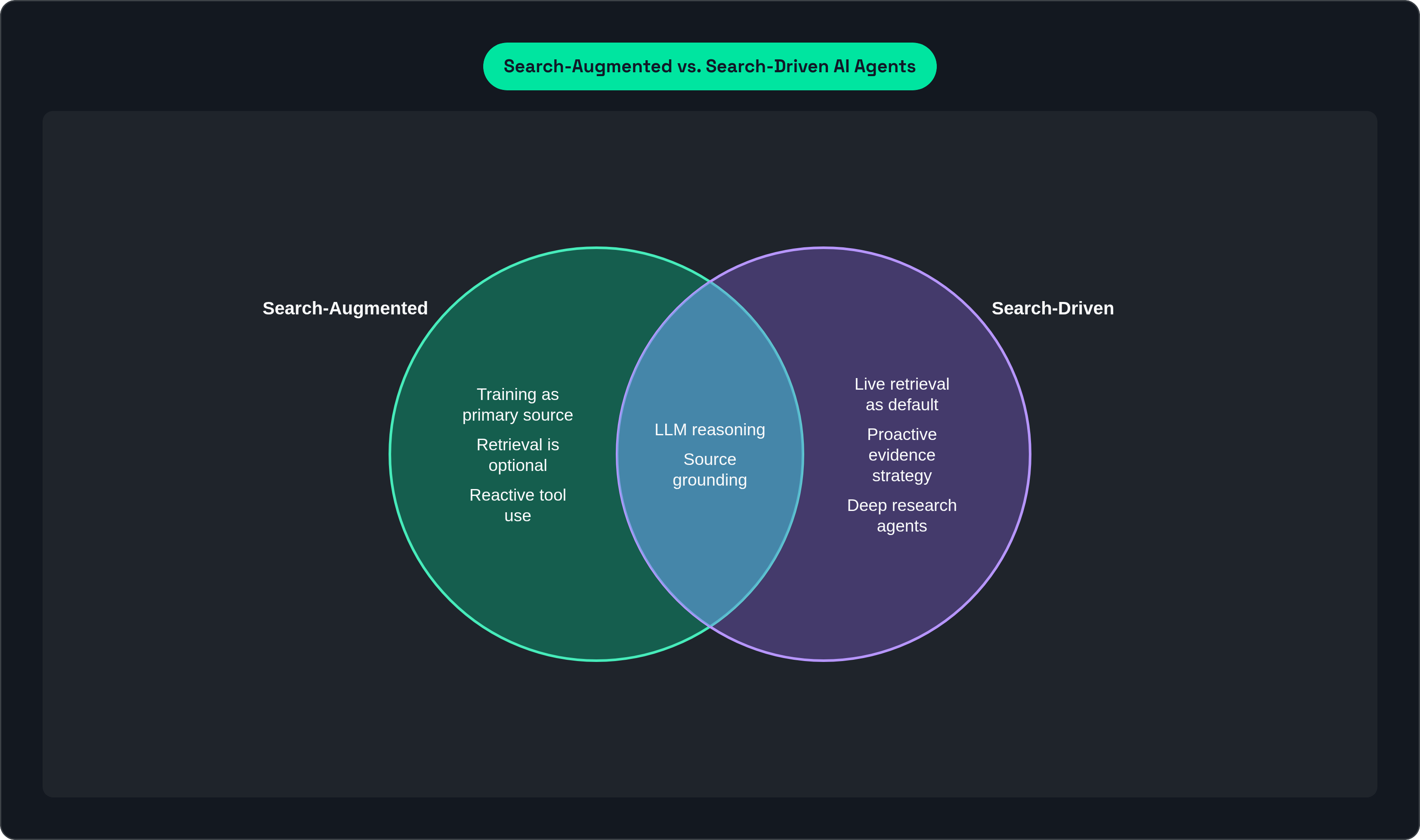
A search-augmented system, often called a retrieval-augmented generation (RAG) setup, is an LLM that can invoke a search tool when it decides one is needed. Search is available but peripheral; training memory remains the primary epistemic substrate. The model generates and occasionally retrieves, filling gaps it recognizes as gaps. The problem is that LLMs are notoriously unreliable at recognizing what they do not know. They will confidently synthesize from stale training data when no retrieval trigger fires, because nothing in the architecture compels retrieval as the default. This is not a model quality problem. It is structural.
A search-driven system inverts this. Planning, evidence accumulation, and answer formation all flow through live retrieval. The model's training knowledge becomes the reasoning scaffold; retrieved content becomes the epistemic ground. That inversion matters most in precisely the tasks where agents are commercially interesting: monitoring competitive landscapes, synthesizing regulatory filings, tracking fast-moving financial events. These are freshness-sensitive tasks where training data has a known, bounded shelf life, constrained by a hard knowledge cutoff.
At the far end of this spectrum sit what practitioners now call deep research agents: systems that search, read, cross-check, and synthesize across hundreds of sources without human input between steps. That is architecturally achievable, but it requires explicit patterns for query construction, retrieval iteration, source reconciliation, and tool coordination. Adding a search tool to a ReAct loop is not sufficient. Teams that discover this in production rather than in design tend to discover it at considerable cost.
Gartner warned in June 2025 that over 40% of agentic AI projects will be canceled by end of 2027, driven by escalating costs, unclear value, and inadequate risk controls. Only 2% of organizations have reached full production scale with agents. Those numbers describe a specific failure mode: teams building search-augmented systems for tasks that required search-driven architectures. That raises an important question — if the distinction is this consequential, why do so many teams miss it until they are already in production?
Query Planning: How an Agent Decides What to Ask Before It Searches
The naive path is obvious in retrospect. Submit the user's question, verbatim, to a search API. Results come back shaped for that exact phrasing. For narrow, well-formed questions, this works. For compound questions where evidence is distributed across source types, or where answering correctly requires synthesizing across distinct intents, it is a structural failure that downstream prompting cannot fully correct.
Consider: "How have rising interest rates affected commercial real estate valuations in secondary markets over the last 18 months, and which REITs are most exposed?" A naive agent submits something close to that sentence to a search API and retrieves documents optimized for the surface phrasing. The evidence set may be tonally coherent but systematically incomplete. It conflates primary and secondary markets. It surfaces analytical commentary rather than the underlying filing data the synthesis actually requires. The sub-question about specific REIT exposure is either underserved or missed entirely. But what if the query had been decomposed before it ever reached the search layer?
Query planning addresses this before any retrieval call fires. The plan-and-solve pattern, which structures decomposition prior to execution, forces the agent to break a compound question into sub-queries with distinct intents through query decomposition, select the appropriate query type for each, and sequence them so earlier results can inform later ones. That interest rate question decomposes into at least four distinct sub-queries: one semantic for analytical context, one keyword-structured for recent REIT filings, one hybrid search for secondary market price data, one focused on specific ticker exposure. Each sub-query requires a different retrieval strategy. Treating them as one query loses the signal embedded in that distinction.
The underlying shift is architectural. Query planning moves search from reactive tool use, where the agent searches when prompted, to proactive evidence strategy, where the agent decides what evidence architecture the question requires before touching the search layer. Different things, different performance characteristics, different failure modes at scale.
Where this pattern adds friction without proportional payoff is the narrow factual lookup. If someone asks what the federal funds rate is today, decomposition is waste: one well-formed query, one retrieval call, one grounded output. Over-engineering here burns tokens and latency for no accuracy gain, and that cost compounds quickly. The first gate is recognizing which problem type is actually in front of you.
Iterative Retrieval: When One Search Round Is Structurally Insufficient
First-round results define a problem's space; they do not fill it reliably, and understanding why requires thinking geometrically rather than blaming API quality.
A single retrieval call returns a bounded set of results, filtered by query phrasing, index depth, and recency weighting. For tasks where evidence is distributed or contradictory, or where early results reveal sub-questions the original plan did not anticipate, a single round hits a ceiling that is inherent to how retrieval works at a systems level. Not a prompting failure. Not a model capability issue.
The reflection pattern, applied to retrieval, inserts a quality gate between rounds. After the first round, the agent does not proceed immediately to synthesis. It critiques its accumulated evidence: What gaps remain? Where do sources contradict each other? What claims are unsupported by anything retrieved so far? Only if the evidence set clears an explicit threshold does the agent proceed. If not, it generates targeted re-queries for the specific gaps identified.
Three things must be true for this to work in practice. First, a state object that tracks what has been retrieved, what gaps remain, and what contradictions exist, often backed by a vector database for efficient similarity lookups across retrieved passages. Not a list of URLs: a structured record of evidence coverage relative to the query plan. Second, a re-query decision function with explicit criteria, because the failure mode is loose criteria. If the reflection step asks only whether any gaps remain, the answer is almost always yes, and the loop runs indefinitely. The criteria must specify a threshold for sufficiency, not merely a condition for continuation. Third, a hard ceiling on rounds, because costs and latency that are not explicitly bounded tend not to stay bounded.
For high-stakes domains, the recall argument is not abstract. In finance or clinical research, a missed filing or a contradicted study finding is not an acceptable margin. Iterative retrieval is the architectural mechanism for closing recall gaps that a single round would leave open, and the cost of an additional retrieval round is almost always lower than the cost of a material omission in the output.
One detail that consistently gets underweighted in iterative loops: deduplication. Without explicit deduplication logic, popular sources dominate multiple rounds. The evidence set becomes redundant rather than complementary. Synthesis over-indexes on a narrow slice of the available source landscape. The loop runs; the coverage does not actually improve. I spent three retrieval rounds on one system before realizing we were circling the same five sources, generating convincing-looking evidence breadth while the actual query plan gaps went unaddressed. The deduplication logic had been a placeholder since the first sprint and nobody had gone back to it.
Source Grounding: Making Retrieved Evidence the Agent's Epistemic Anchor
Retrieval quality and output quality are not the same variable; an agent can retrieve excellent sources and still produce a hallucinated synthesis if the architecture does not enforce discipline at the synthesis step.
The failure mode is specific. Without structural constraints, the LLM blends retrieved content with training memory during synthesis, producing what the field calls hallucination. At inference time, the model does not cleanly distinguish between "I retrieved this" and "I know this from training"; both feel like available knowledge. The result is an output that is partially cited and partially fabricated, with no signal to the user about which parts are which. In regulated domains, that is a liability issue rather than merely a quality concern. It is also worth considering what this means for teams not yet in regulated verticals — the absence of a compliance deadline does not change the underlying failure mode; it only delays when it becomes visible.
Source grounding, as an architectural pattern, addresses this through enforcement rather than prompting. Each claim in the output must map to a specific retrieved passage with a URL and retrieval timestamp. The synthesis step operates only on retrieved context, constrained architecturally, not merely instructed. And citation trails are preserved in the response object rather than stripped at output formatting, so downstream systems and human reviewers can audit source provenance across the full retrieval chain.
Regulated domains, including healthcare, legal practice, and financial services, have pushed farthest toward what researchers categorize as symbolic or highly constrained orchestration architectures, precisely because source provenance must be auditable by external parties. The Springer Nature taxonomy of agentic system architectures identifies this constraint as the defining structural preference for domains where the difference between a cited fact and a plausible-sounding fabrication carries regulatory consequence.
For teams not yet operating in regulated verticals, the principle still holds, though the reasoning sounds less urgent until it isn't. Agent systems designed with built-in decision traceability, where every autonomous action is logged, auditable, and explainable, are more defensible when something goes wrong. The temptation to defer source grounding for lower-stakes use cases usually sounds like "we're not in a regulated space." That reasoning tends to feel less convincing the first time a sourcing error reaches a client and you are trying to reconstruct where the output actually came from.
Tool Orchestration: Coordinating Search with the Other Capabilities an Agent Needs
Search rarely operates alone in a production system. A competitive intelligence agent might combine web search with a structured financial data API, a content extraction layer for paywalled documents, a code execution environment for data transformation, and a memory store for session context. The orchestration pattern that coordinates these tools is as consequential as the retrieval pattern itself, sometimes more so.
Two models dominate in practice. Single-agent orchestration places one LLM in the position of selecting and sequencing tools from a defined set. Simpler to debug, easier to constrain, lower coordination overhead. For tasks with a bounded tool set and sequential logic, it is frequently the right call. Multi-agent orchestration distributes discrete functions across specialized sub-agents: one for search, one for extraction, one for synthesis, with an orchestrator managing routing and aggregation across the agentic AI system. It scales to complex workflows, but it introduces coordination failure modes that do not exist in the single-agent model, including contradictory outputs from sub-agents and routing errors at the orchestrator level that can be genuinely difficult to trace in production.
LangGraph's state-machine model structures agents as nodes and edges with conditional routing rather than linear chains, and it is the architectural approach best suited to agents requiring conditional tool selection across multiple steps. The value is that conditional routing is explicit and inspectable; it does not emerge from the LLM's in-context reasoning, which means it can be tested, traced, and modified without touching the model. That property matters when something breaks at 2 a.m. and you need to know whether the failure is in the routing logic or the tool call.
The orchestration choice should follow the task. Narrow factual queries fit single-agent tool use. Multi-source research synthesis with financial data cross-referencing fits multi-agent pipelines. Building multi-agent complexity because the capability exists, then discovering the coordination overhead exceeds the value delivered, is a specific and predictable path into Gartner's cancellation statistics.
One failure mode specific to search-driven orchestration deserves direct attention: search becomes a default fallback for every sub-agent, even when cached data or structured API responses would be faster and more reliable. When tool selection logic is left emergent, search becomes a universal crutch. Latency accumulates across all sub-agents simultaneously. Cost spirals before the synthesis step even begins. Tool selection must be explicit.
How the Infrastructure Layer Shapes Which Patterns Are Actually Achievable
Architecture diagrams are plans; what gets built is constrained by the infrastructure layer underneath, and this particular gap has a tendency to surface late in projects, always at significant cost.
Traditional SERP APIs return raw metadata: titles, URLs, short snippets. Before that content can meaningfully reach an LLM, it requires a separate extraction layer, HTML parsing, content cleaning, and format normalization. That is not insurmountable, but it is plumbing that sits between the query plan and the synthesis step, adding latency, error surface, and maintenance burden that compounds across an iterative retrieval loop. AI-native search APIs return content already processed for LLM consumption, enabling query-plan-to-synthesis pipelines without the intermediate layer. For iterative retrieval specifically, where each round depends on the previous round's output, that difference changes the feasibility calculus in ways that are not obvious until you are three sprints in and the loop is slower than the stakeholders expected.
Latency is an architectural input, not a performance footnote to address at optimization time. Iterative retrieval loops multiply per-call latency. Multi-agent pipelines multiply it further. An API that adds meaningful latency per call makes a three-round retrieval loop expensive before any LLM compute cost is counted. The practical question is not whether the API is fast in isolation but whether its latency characteristics are compatible with the pattern the task requires, under production load, at tail percentiles.
The Microsoft Bing API shutdown in August 2025 pushed a large number of developers onto alternative search providers in a compressed timeframe. That event made concrete something experienced builders already knew: architecture is tightly coupled to the underlying search layer. What feels like a vendor choice is actually an architectural decision with downstream consequences for which patterns a team can reliably implement.
Several infrastructure properties are load-bearing when evaluating search providers against these patterns. Does the API return clean, LLM-ready content or raw metadata requiring additional processing? Does it support semantic and neural retrieval for exploratory sub-queries, not just keyword matching? Are source citations and timestamps embedded in the response object so the grounding layer can use them directly? Is iterative retrieval a native capability, or must it be built entirely by the developer? Most vendor-published benchmarks are self-reported and task-specific. AIMultiple's evaluation across a large sample of real-world AI and LLM queries found that top-tier search API providers were statistically close to each other in performance, while the gap between top-tier and lower-tier providers was meaningful. Third-party evaluations are more reliable than vendor documentation for understanding where those gaps actually sit.
Matching Pattern Combinations to Problem Types: A Decision Framework
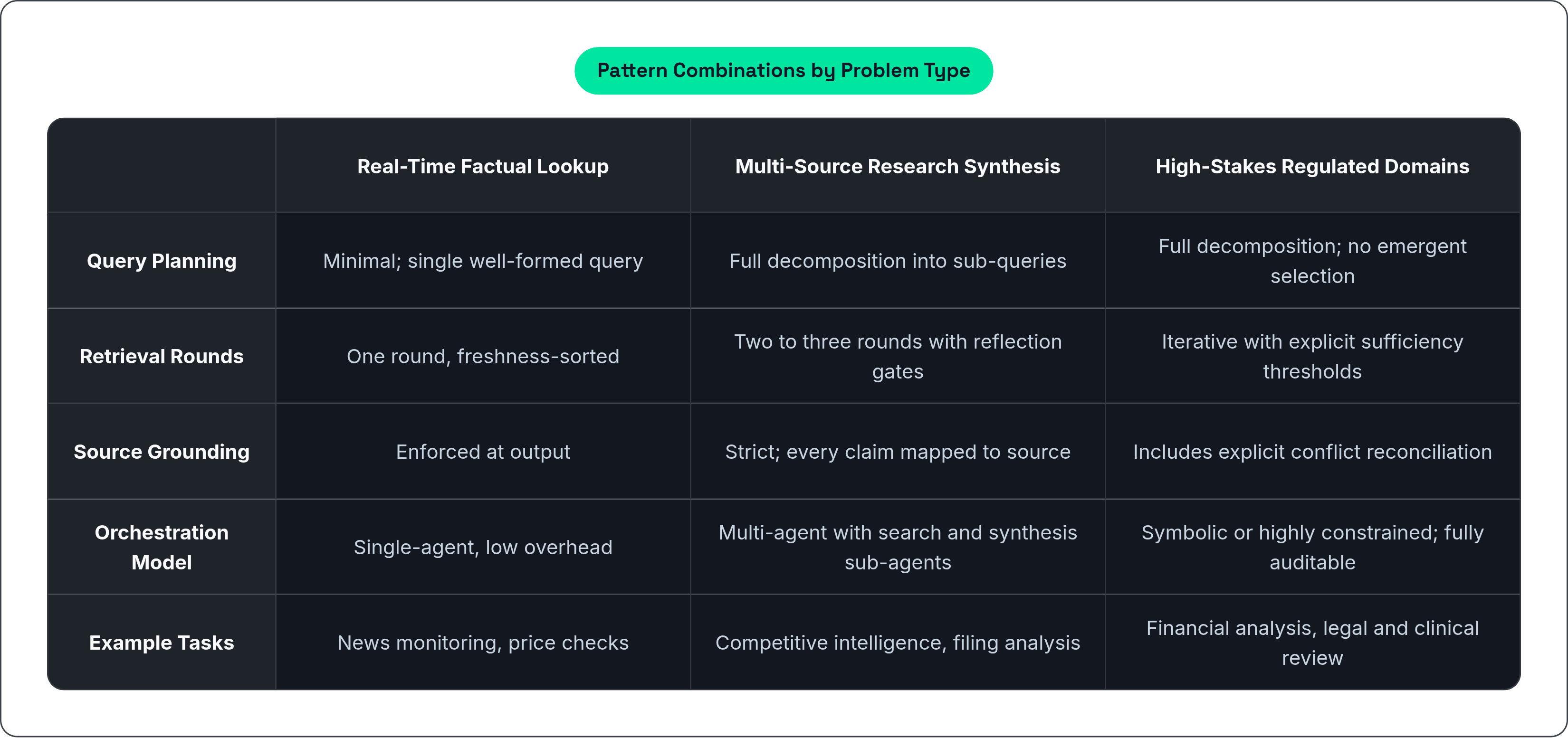
No single pattern is universally correct. Task type, domain risk level, latency budget, and data freshness requirement together determine which combination is appropriate. Getting this mapping wrong is where architectural sophistication becomes architectural overhead.
For real-time factual lookup, including news monitoring, price checks, and event tracking, the appropriate combination is deliberately lean. Minimal query planning, because a single well-formed query is usually sufficient. One retrieval round with freshness-sorted results. Grounding enforced at output. Single-agent tool use with low orchestration overhead. Synthesis across conflicting sources is not the task; accuracy and speed are.
For multi-source research synthesis, encompassing competitive intelligence, investment research, and regulatory filing analysis, the pattern set expands substantially. Full query planning with sub-query decomposition. Two to three iterative retrieval rounds with reflection gates between them. Strict source grounding with citation preservation, every claim mapped to a specific source. Multi-agent orchestration with dedicated search and synthesis sub-agents. The complexity is warranted because the evidence architecture the task requires cannot be achieved with a simpler pattern set.
For high-stakes regulated domains, including financial analysis, legal research, and clinical evidence review, the constraints tighten further. Symbolic or highly constrained orchestration is required; emergent tool selection is architecturally unacceptable when auditability is a compliance requirement. Source grounding must include explicit conflict reconciliation: when retrieved sources contradict each other, that contradiction must surface in the output rather than be silently resolved by the LLM's synthesis reasoning. Every retrieval call, source used, and synthesis step must be logged. Outputs that cannot be traced to verifiable sources have no place in serious research workflows in these verticals.
The practical filter across all three tiers is match, not sophistication. A multi-agent deep-research architecture applied to a problem that needed a single-round lookup drives exactly the cost escalation that makes a project difficult to justify at the end of a budget cycle. A single-agent lookup architecture applied to a regulated multi-source synthesis problem produces outputs that cannot survive compliance review.
Gartner's projection on cancellations points directly at this dynamic. Pattern mismatch, not model capability, is frequently the proximate cause. The patterns themselves are documented; recognizing which one the problem actually requires is harder than it looks, and that gap is where most projects quietly fail. The failures I have seen rarely arrive as dramatic collapses. They accumulate: one reasonable-seeming shortcut, then another, the second one easier to rationalize because the first one mostly worked, until the compounded shortcuts have produced something that cannot be unwound without starting over. By then, the team has usually spent two quarters explaining to stakeholders why the system is not performing the way the architecture diagram suggested it would.