Knowledge Cutoff Limitations and Real-Time Retrieval Solutions
Models fabricate answers on recent topics unless systems actively retrieve live information.
A large language model's training cutoff is the direct, unavoidable result of how these models get built. It's the direct, unavoidable result of how these models get built, and every app built on top of one inherits the same blind spot: nothing past that date exists unless something else feeds it in. This piece looks at what that blind spot actually breaks, and what fixes it (and what doesn't).
The two failure modes a cutoff creates: information gaps and hallucination
A model hits a wall in one of two ways once a question strays past its cutoff. Sometimes it just admits defeat, or gives a half answer, because the facts it needs were never in the training set. Call that the information gap. The other failure mode does more damage: the model doesn't know it's missing anything, so it makes something up, fluently, confidently, with zero hedging. That's hallucination, and it's the dangerous one, because it looks exactly like a correct answer until someone checks.
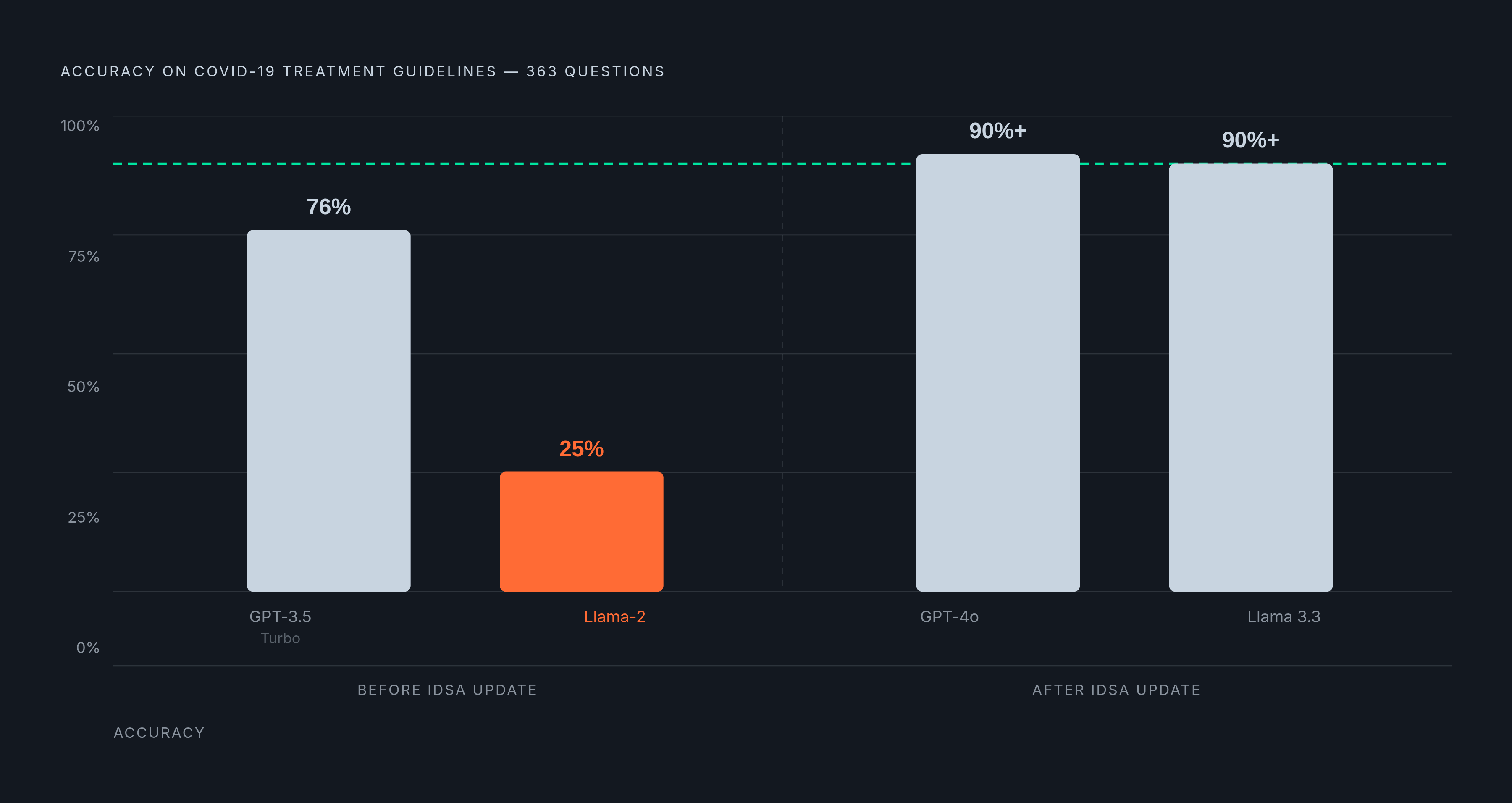
Oregon State University researchers put numbers to this in a study on medical guidance, building a 363-question benchmark from two versions of IDSA's COVID-19 treatment guidelines. Models trained before the newer guideline shipped fell apart on it: GPT-3.5-Turbo scored 76.03%, and Llama-2 came in at just 25.26%. Models trained after the update, GPT-4o and Llama 3.3, both cleared 90%. A clinician might reasonably lean on a tool scoring 90%. One scoring 25.26% is quietly dangerous, and that gap is the whole argument for treating recency as a safety property, not a nice-to-have feature bolted on after the fact.
It also doesn't work the way people assume, where one cutoff date covers a model evenly across every subject it knows. Research out of the University of Łódź, led by Pęzik and colleagues, found that a model's effective cutoff shifts by topic, because training data coverage isn't uniform. A model can be current on programming frameworks and stale on tax law, both under the same published date on the same model card. Treating that printed date as gospel is its own quiet risk, since it was never a guarantee to begin with, just a simplification.
Where does this actually bite? Pricing pages, product features, who's ahead in a competitive market, legal and regulatory changes, financial data, clinical guidelines, sports scores, anything that moves. A model answering from its trained-in memory (call it parametric memory) has no flag for its own uncertainty, and this lack of a flag is the mechanism that produces all of it. It just answers. There's no built-in "I'm not sure about this," because the model has no way of knowing what it doesn't know.
How reported cutoff dates vary across the models developers use
Cutoff dates aren't fixed reference points. They shift every time a vendor ships a new version, so anyone building on top of a model needs to keep checking the model card rather than trusting last quarter's number.
Here's roughly where things stand across models in common use as of mid-2026. GPT-4o carries an October 2023 cutoff and is still deployed widely in production API integrations, one of the oldest cutoffs still doing real commercial work. GPT-5, retired from ChatGPT in February 2026, reportedly had a September 2024 cutoff per Wikipedia, while GPT-5.5 moved that up to December 2025 according to OpenAI's own API documentation. Claude Sonnet 4.6 splits the difference in an interesting way: Anthropic states its reliable knowledge extends through August 2025, but its training data actually runs through January 2026, and the company draws a clear line between the two instead of collapsing them into one number.
Gemini 3 and 3.1 carry a January 2025 parametric cutoff for the family, but Google's own model card for Gemini 3.7 Flash includes an unusually candid caveat: the stated March 2026 cutoff "does not apply evenly," and users "may experience the model's knowledge is limited to January 2025" depending on the domain. Llama 4 is at an August 2024 cutoff per Wikipedia.
Anthropic's two-date approach, reliable cutoff versus training data cutoff, is the most honest framing on the market right now, and every other vendor should get held to it. Publishing one date instead of two isn't a neutral choice. It overstates how current a model actually is on any topic that isn't the one it happens to be strongest on, and Gemini's own admission of uneven domain coverage proves the point from inside the industry, not from outside critics.
What does this mean for someone actually shipping a product? An application still running on GPT-4o in 2026 is reasoning from a snapshot of the world that's nearly three years stale. Every query touching anything recent inherits that gap, and it compounds. Ask about a product launched last month, and the model either invents an answer or draws a blank, neither of which a user should have to put up with from a system they're paying to depend on.
Retrieval is not just a supplement, it is the structural fix
Retrieval-augmented generation, RAG for short, runs on a fairly simple mechanism. Before the model writes anything, the system pulls relevant documents from a live, external index, drops those documents into the context window next to the user's prompt, and the model generates its answer from that material instead of relying purely on what it memorized during training.
That fixes both failure modes from the section above, directly, not incidentally. The information gap closes because live retrieval surfaces facts that postdate training entirely, things the model never had a chance to learn in the first place. Hallucination drops too, because an answer grounded in retrieved, citable documents gives the model something real to work from, rather than a blank space it has to fill in with a guess that merely sounds plausible.
But retrieval isn't a complete cure, and pretending otherwise does developers no favors. Retrieval can't fully compensate for an outdated cutoff, because the model's baseline reasoning and its assumptions about the world stay anchored to whatever it learned during training. Even with browsing switched on, the model's parametric memory still shapes how it reads and weighs whatever it retrieves. Retrieval fixes the facts. It does nothing to fix the lens the model uses to interpret them, and that distinction gets lost in most pitches for RAG as a total solution.
RAG is the dominant architecture right now, but treating it as the finish line is the mistake most teams make. Agentic or contextual memory is emerging as the next layer: systems that hold information across a session, adjust based on feedback, and carry state forward instead of starting fresh every time. The section on agentic systems below goes deeper into that shift, and it changes what "retrieval" even means going forward.
Swapping the model changes output quality less than people assume; the retrieval layer is what actually moves the needle. A strong model paired with a thin, stale index still produces thin, stale answers, and no amount of parameter count fixes that.
Retrieval behavior differences across platforms (and why it is not always on)
Two fundamentally different approaches to retrieval exist in production today, and mixing them up leads to bad assumptions about what a given AI product is actually doing under the hood.
Perplexity is retrieval-native by design. It runs a live retrieval pipeline on essentially every query, built on a distributed index (Vespa AI) with real-time web crawling, so the model's training cutoff barely matters to the end user because the system routes around it automatically, every single time. Perplexity reported around 22 million monthly active users and roughly 780 million processed queries in May 2025 alone, a scale that shows how central always-on retrieval is to the product itself.
ChatGPT, Claude, Gemini, and Copilot take a different path: web search exists as a tool, but it doesn't fire on every query. A meaningful share of responses still comes straight from parametric memory, no retrieval involved at all. Copilot has a particularly sharp edge case here: its web grounding runs through Bing, and it's turned off by default in US government cloud deployments (GCC and DoD). Those instances run entirely on parametric memory unless someone actively reconfigures them, which makes that a genuinely high-stakes setting for any enterprise IT team managing a government deployment.
Gemini has a natural retrieval path through Google's own search infrastructure via Search Grounding, but activation is contextual and doesn't automatically fire on every prompt. Grok is something of a partial exception: it leans on live retrieval from X and the broader web, which makes its training cutoff a less decisive factor than it is for models without a native search connection.
So what does this mean in practice? Retrieval behavior in any API integration comes down to how the query gets routed, which tools are switched on, and how the system is configured on the developer's end. Nobody building on top of these models should assume retrieval is active by default. That assumption has to get checked, tool by tool, deployment by deployment, because the default answer is usually no.
There's also a tell in how these answers present themselves. Parametric responses come out fluent and unhedged, with no signal that anything might be shaky. Retrieved responses tend to carry attribution language, phrases like "according to recent sources" or "based on search results," and that phrasing gives readers the only visible clue about how much to trust what they're looking at.
What the Bing Search API retirement reveals about search infrastructure dependencies
Microsoft retired the Bing Search API on August 11, 2025. The announcement landed on May 15, 2025, giving developers roughly three months to migrate everything built on top of it, a tight window for a lot of production systems that had treated the API as permanent infrastructure.
Every sub-API under the Bing Search umbrella went dark the same day: Web Search, Image Search, News Search, Video Search, Autosuggest, Spell Check, Entity Search, Visual Search, and Custom Search, gone all at once. Microsoft's official replacement, Grounding with Bing Search inside Azure AI Foundry, isn't a like-for-like swap. It returns LLM-grounded chunks instead of raw search results, requires setting up an Azure AI Agent project, and lists at $35 per 1,000 calls, a 40 to 483% price jump over the old tiers depending on which plan a developer was previously running.
That's more than a pricing change. It's an architectural shift. Developers lose direct access to raw search results and get, in exchange, a managed grounding feature that only really works if the rest of the stack already lives on Azure.
The pattern here is bigger than one retirement notice. Large platform providers are stepping back from open, developer-accessible search APIs, and that retreat is opening space for purpose-built providers designed from the ground up for AI agent workloads, rather than adapted from an older, human-facing search product. That gap is structural. It's the whole reason dependency risk deserves more attention than it gets: any application routing its retrieval through a single provider inherits every decision that provider makes going forward, whether that's a pricing change, an architecture pivot, or a deprecation notice with a three-month clock attached to it.
How agentic systems push retrieval beyond single-shot RAG
Standard RAG follows a fixed rhythm: retrieve once, generate once. That works fine for a simple factual lookup. It falls apart the moment a task needs several steps of reasoning strung together, because nothing in the system notices it needs more information and goes to get it.
Agentic RAG changes that rhythm. The model plans out what it actually needs, calls external tools to get it, and reasons through whatever comes back; if that's not enough, it goes and retrieves again. It's iterative instead of single-pass, and the performance difference isn't subtle. A 2025 survey on agentic deep research found that standard LLMs relying on basic keyword search scored below 10% on complex, multi-hop research benchmarks, the kind of task that requires chaining several pieces of information together across sources. Systems built around iterative retrieval scored dramatically higher on the same tasks.
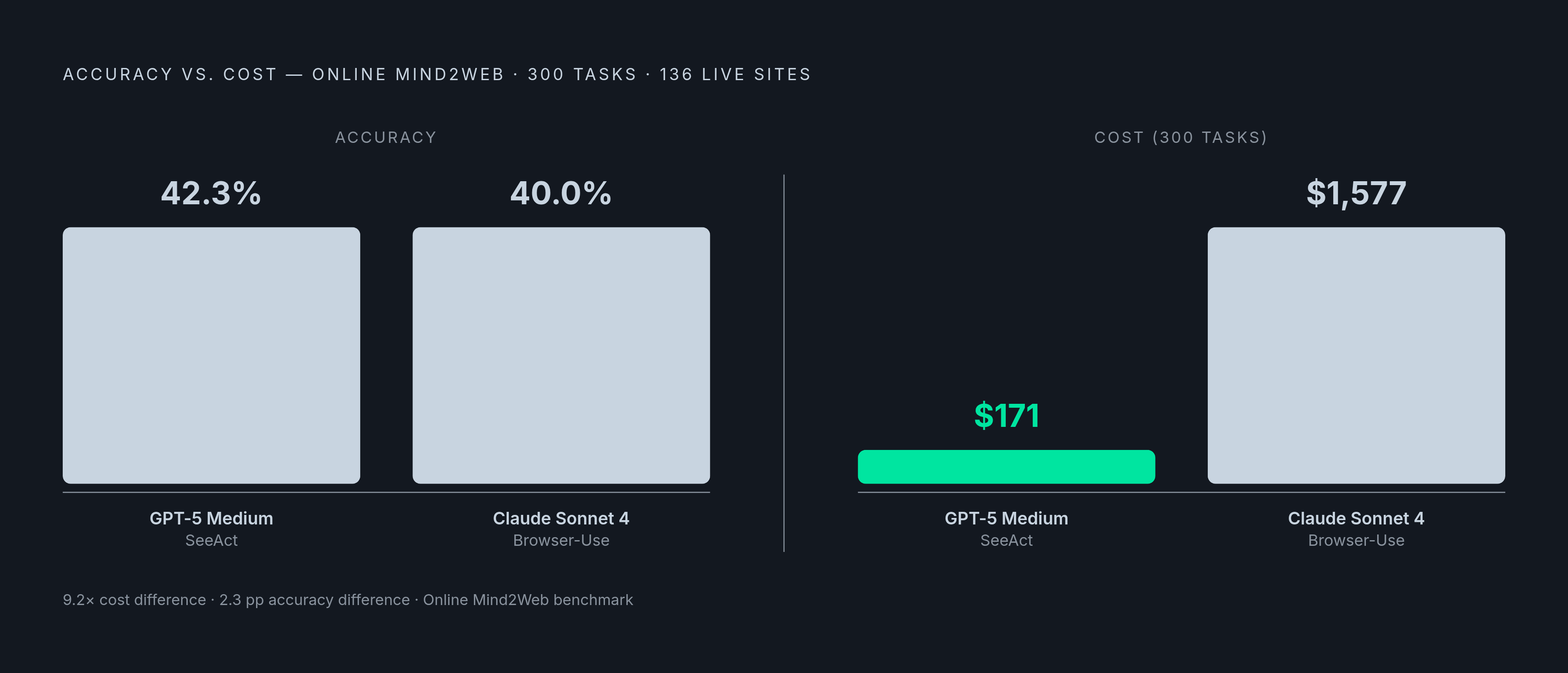
The Online Mind2Web benchmark gives a useful window into what this looks like in practice: it evaluates agents navigating 300 verified tasks across 136 live websites, a decent proxy for how messy real-world agentic retrieval gets. GPT-5 Medium, tested in August 2025 using the SeeAct scaffold, hit 42.3% accuracy at a cost of $171.07. Claude Sonnet 4, tested in May 2025 with Browser-Use, landed at 40.0% accuracy but cost $1,577.26 to run, more than nine times as much for a slightly lower score. Anyone picking a stack on model reputation alone should find this uncomfortable: the scaffold wrapped around a model can matter as much as the model itself, and cost-per-accuracy is a variable teams skip far too often.
The market is betting heavily on this direction. Agentic RAG is projected to grow at an explosive multiple over the coming decade, a trajectory that tracks how fast enterprise demand for adaptive, multi-step retrieval is scaling. The next layer sitting on top of agentic RAG is long-term contextual memory: systems that carry information across sessions instead of forgetting everything the moment a conversation ends, that adjust based on feedback rather than repeating the same mistake indefinitely. By 2026, that's shifting from an experimental feature into something closer to a baseline expectation for any serious agentic deployment.
Benchmarks that reveal the real performance gap between retrieval providers
None of this matters if the retrieval layer itself is weak, because a strong model paired with poor retrieval infrastructure still produces poor answers. Retrieval quality is the data layer everything else sits on top of, and there's a real, measurable gap between providers on this front, one that appears in published numbers instead of marketing pages.
A handful of benchmark frameworks show where that gap shows up in system performance. FreshQA runs 600 time-sensitive questions, built specifically to test how well a system handles information that lives past a training cutoff. SimpleQA covers 4,326 factual questions with unambiguous correct answers, a cleaner test of raw factual precision. Domain-specific sets exist too: a Finance Benchmark with 120 queries pulled from SEC filings, market data, and macroeconomic indicators; an Economics Benchmark with 100 analyst-style questions on policy and macro trends; and MedAgent, which runs 562 complex clinical and medical queries in a domain where stale information isn't just inconvenient, it's genuinely unsafe. HLE (Humanity's Last Exam) gets used by Parallel AI for cross-provider comparison, and Long-form research benchmarks get used by Valyu.
On HLE, Parallel AI scored 47%, Perplexity scored 30%, and Tavily scored 21%, a spread wide enough that switching providers can shift results by that same margin. Valyu posts competitive scores on long-form research benchmarks. You.com's Research API has claimed top spots on research-focused benchmarks since its launch, though newer models have since caught up and passed it, and its Finance Research API ranks highly on financial search benchmarks, making it the only provider in this set with published top rankings across both a general research benchmark and a financial one.
An independent evaluation went further, benchmarking multiple search APIs across 100 real-world AI and LLM queries, scoring 4,000 retrieved results with an LLM judge assessing relevance, quality, noise, and source type. Reading that methodology before choosing a provider changes which provider looks best, because a single percentage rarely tells the whole story. Providers willing to publish results on standardized, reproducible benchmarks are making claims that can be checked and falsified. Providers that don't publish anything are asking developers to take marketing copy on faith, and that's a fundamentally different kind of trust to extend, one that stops holding up the moment a system breaks in production and someone has to figure out why.
The retrieval API landscape developers are choosing from after Bing's exit
With Bing's Search API gone, developers are choosing among a newer set of providers, each built with a different emphasis, and the choice a team makes determines the results quality, cost, and integration effort it ends up living with.
You.com runs a suite built specifically for AI systems and agents from the ground up, offering a Web Search API, a Contents API, an Answer API, a Research API, and a Finance Research API. It holds benchmark leadership on DeepSearchQA through its Research API and on FinSearchComp through its Finance Research API, runs at 300ms p99 latency, maintains documented data handling policies, carries SOC2 certification, and counts DuckDuckGo, Alibaba, and Amazon among its clients. It's a credible option because those benchmark claims are published and checkable, not because of how the product gets marketed.
Valyu takes a different angle, combining real-time web content with access to proprietary sources, giving unified access to a range of specialized databases through a single call. Its API supports common developer languages and REST-based access, and its enterprise tier includes enhanced security and compliance features, which fits finance, science, and R&D-heavy workloads better than a general-purpose search API would.
Parallel AI, officially Parallel Web Systems, is a newer entrant building web infrastructure specifically for AI agents rather than retrofitting older search tech, on the argument that existing search infrastructure was never designed with AI as its primary user. It raised a substantial Series A in early 2025 on that thesis. Tavily rounds out the field, offering a web search and extraction API built specifically for AI agent integration, delivering structured, ready-to-use data rather than raw pages a model has to parse itself.
The model was never the whole equation, and every section above keeps circling back to why. A frontier model reasoning from a stale, single-shot retrieval call will still lose to a smaller model backed by a live, well-indexed retrieval layer, because freshness and grounding are what keep an AI system honest about what it actually knows.


