LLM Knowledge Cutoff Problems in Production
Models confident in outdated information erode trust silently in production.
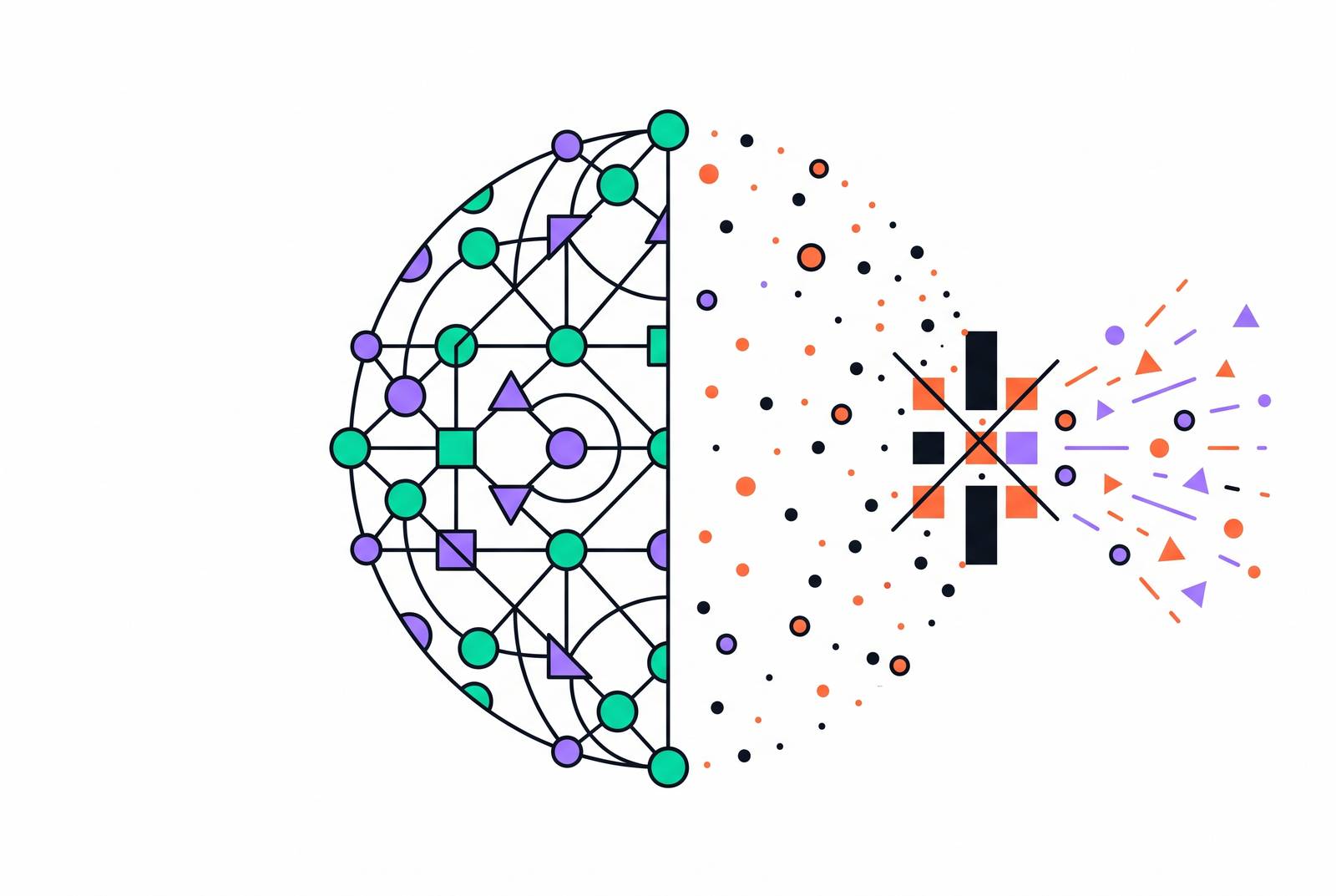
A knowledge cutoff is not a footnote in a model card. It is the starting point of a gap that widens every single day a model stays in production, and by the time most teams notice, the gap has already cost them something: a wrong quote, a broken API call, a compliance answer that describes a rule that no longer exists.
What temporal staleness looks like when it reaches production
Here's the mechanical issue: a model does not throw an error when it doesn't know something current. It interpolates from whatever pattern sits closest in its training distribution and hands back an answer that reads just fine. Latency looks normal. The schema validates. The session completes. Nothing in the standard dashboard tells anyone that the answer was true eighteen months ago and false today.
Pricing is the easiest place to watch this happen. A model cites a SaaS tier that changed three release cycles back, and a rep repeats it to a customer who then gets quoted the wrong number. Developer tools carry a sharper version of the same failure: an AI coding assistant references an API endpoint that has since been deprecated and removed, and the developer ships against a function signature that no longer exists. That's not hallucination in the usual sense. The model recalled something accurately. It just recalled something that stopped being true.
Regulatory and legal domains raise the stakes further. Labor law, tax code, GDPR amendments, all of it shifts on a calendar the model has no visibility into past its cutoff. An organization asking about compliance requirements gets an answer delivered with total confidence, describing a regime that has since been amended. Security advisories follow the same shape: a model recommends a library version later found to carry a critical vulnerability, or walks through an architecture pattern that got deprecated after a breach made it a known bad idea.
Multi-step agents make this worse, not better. One stale assumption made three steps into a chain does not just produce one wrong answer, it produces a confidently wrong conclusion built on top of it, and this load-bearing error causes the intermediate steps to fail to flag it. In post-mortems, teams have started describing what amounts to a "ninety-day cliff": strong early results, followed by a slow, quiet erosion of trust as the model's frozen snapshot drifts further from the world it's being asked about.
Why staleness is harder to catch than hallucination
Hallucination and staleness fail in opposite directions, and that difference is exactly why staleness survives longer in production. Hallucination is noisy. The model fabricates a number that was never true, and because the error is random, it shows up inconsistently: sometimes too high, sometimes too low, sometimes wildly off in a way a reviewer catches on sight.
Staleness doesn't behave that way. It's systematic and it points in one direction: the model reports something that was genuinely true at a specific point in the past, and does so with the same confidence it would use for something true right now. If a model reports last year's pricing every single time someone asks, there's no variance to catch. The output looks internally consistent because it is internally consistent, just consistently wrong for the present moment.
Testing on temporal reasoning backs this up. Benchmarks built around dynamic, time-sensitive environments have found that models struggle to account for elapsed real-world time even when a timestamp is handed to them directly, a pattern researchers have called temporal blindness. No model in that kind of test cleared roughly two-thirds alignment, even with the date sitting right there in context. Left uncalibrated, models tend to fail in one of two ways: they lean too hard on stale context and skip the tool call that would have fetched something current, or they re-fetch information that hasn't changed in years, burning latency and cost for no gain.
The Federal Reserve's own 2025 look at how well LLMs track macroeconomic information found that accuracy didn't fall off a cliff at the cutoff date. It degraded gradually as queries approached that boundary, and got measurably worse for anything after it. No alarm fires at that threshold. Monitoring shows a valid response, a valid schema, latency inside the SLO, and absolutely nothing that flags a problem, because the problem doesn't live in any metric a standard dashboard was built to catch.
Where to instrument for staleness before users find it first
So where does a team actually look? Three surfaces, each catching something the others miss.
Query-level detection comes first, and it's the cheapest to build. Certain words reliably flag a temporally sensitive request: "current," "latest," "now," "today." Route those at the point of intake toward retrieval-augmented generation instead of letting the model answer from parametric memory alone.
Output-level detection comes next: run a classifier over the response before a user ever sees it, checking whether cited facts, version numbers, prices, or dates fall inside a plausible recency window for that domain. What counts as "recent" is not the same everywhere. News and market data need a freshness window measured in hours. Regulatory information needs something closer to a day or two. Technical documentation can tolerate a window stretching to thirty days without much risk. Setting one freshness threshold across all three is a mismatch waiting to produce a false sense of safety somewhere.
Behavioral monitoring is the third surface, and it's the one teams skip most often. Did the user correct the model? Rephrase the question? Abandon the session right after a specific kind of answer? Those signals reveal staleness that a classifier sitting on the output alone would never catch, because the classifier only sees what the model said, not what the user did in response to it.
None of this holds still. Benchmarks and internal thresholds need re-running quarterly, or immediately after any major model swap, infrastructure change, or org shift, because a single new model version can move accuracy meaningfully in either direction. Even the strongest models are around 70% accuracy on enterprise tool-use benchmarks today. That's the ceiling teams are actually working with, and the right response is building a gold-standard evaluation set specific to the domain, then setting the bar higher wherever an error could touch compliance or a customer-facing decision.
Why prompt tricks and model swaps do not close the gap structurally
Putting today's date into the system prompt is a popular fix, and it does something real: it anchors the model's reasoning to the present moment and cuts down on some confusion about elapsed time. But telling a model what today's date is doesn't hand it information about what happened between its cutoff and today. Knowing the date doesn't create knowledge of the news.
Swapping to a newer model helps, temporarily, and then the same clock starts running again. As of September 2026, Claude Opus 5 carries a cutoff of May 2026, Gemini 3.7 Flash is March 2026, and GPT-5.6 Sol is February 16, 2026. Meanwhile GPT-4o, with an October 2023 cutoff, is still live inside plenty of third-party integrations that nobody has gotten around to upgrading. Even the stated cutoff isn't always reliable: Gemini 3.1 Pro and Gemini 3.5 Flash both list January 2025 in official Google documentation, despite 3.1 Pro shipping in February 2026 and 3.5 Flash in May 2026. Release cadence varies by provider, too. OpenAI ships new models every one to three months, Anthropic updates each generation on its own schedule, Google ships several times a year, and Meta hasn't updated Llama since April 2025. Even the fastest of those cadences leaves a gap that grows every day between releases.
Fine-tuning doesn't touch this problem either, because fine-tuning shapes how a model reasons about a domain's language and structure, not what it knows about that domain's present state. Fine-tune a model on legal terminology and it will sound more fluent in legal terminology. It will still hallucinate last Thursday's ruling with total confidence.
RAG looks like the fix until its own limitation appears in the knowledge base's currency: a knowledge base is only as current as the last time someone ran the ingestion pipeline. A regulatory change from last week sits outside that corpus until a human manually updates it, which means RAG built on a static index inherits the exact same structural problem it was built to solve, just with a shorter half-life.
That's the actual condition here, and it's worth stating plainly: no static artifact, whether it's frozen model weights or a snapshot sitting in a vector database, can keep pace with a world that keeps moving after the snapshot was taken.
How real-time retrieval grounding resolves what static knowledge cannot
Grounding works differently. It injects verified, real-time web content into the model's prompt at the moment of the query, so the model reasons over what's true right now instead of what was true when it was trained. The model reads fresh context, pulled at query time, and answers from that context rather than from memory.
This is not the same lever as fine-tuning, which changes reasoning style rather than knowledge currency, and it's not the same as static RAG, which is only ever as fresh as the last ingestion run. On benchmarks including SimpleQA and FRAMES, web-grounded models have shown factual accuracy gains in the range of 25 to 40 percentage points over their ungrounded counterparts, holding up across different query types and domains rather than showing up in one narrow case.
Three patterns handle the integration, and each trades off control, latency, and complexity differently. Search-first pipelines call a search API before generation runs, every time, with no exception. That's the simplest to build and the easiest to reason about, at the cost of paying for a search call even when the query didn't need one. Tool-use hands the decision to the model itself, letting it decide when a query's signals warrant a search call, which is more efficient but depends on the model's tool-calling behavior being reliable enough to trust. Agentic loops go furthest, running multi-step retrieval and synthesis for research-depth queries, at the highest cost and latency of the three.
Getting citations right matters as much as getting the search call right. Passing source URLs and publication dates as structured metadata fields, never folded into prose, keeps the model treating them as external references it's citing rather than patterns it's generating from memory. That distinction gets enforced at the retrieval layer, using something like LangChain's Document schema or LlamaIndex's node metadata fields, so a citation in the output actually traces back to a real fetched source instead of a plausible-looking string the model invented. Stripping HTML down to clean markdown before it ever reaches the model also cuts agent token counts substantially, which matters directly for cost and for how much of the context window is left for actual reasoning.
The assumptions that ground all of this keep shifting, too. Microsoft shut down Bing's Search APIs in August 2025, which pushed a large number of developers onto independent search providers overnight. A standardized protocol for connecting agents to external tools reached wide adoption by early 2025, months ahead of that Bing shutdown, giving agents a standard way to reach external tools just as one major provider was closing a door. Cloudflare began blocking AI crawlers by default across a meaningful share of the web starting July 1, 2025, and rolled out a pay-per-crawl marketplace alongside it. None of this is settled infrastructure. It's a layer still being built, which is exactly why managed search APIs exist to absorb that complexity rather than leaving each team to rebuild it from scratch.
How to evaluate search API options on the metrics that matter in production
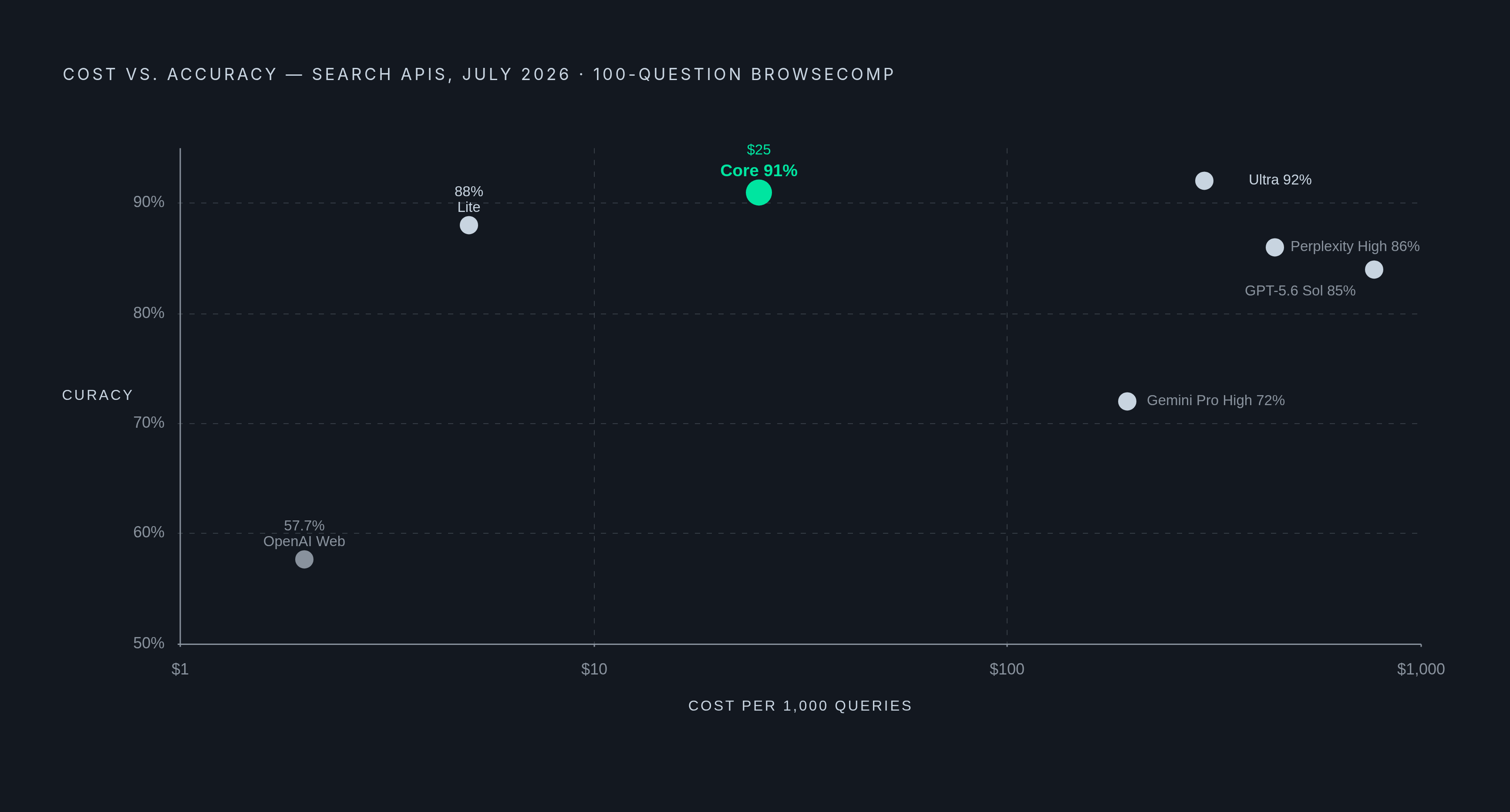
Accuracy alone is the wrong axis to optimize. A grounding setup that nails 92% accuracy at a price that doesn't scale to production query volume is not a production setup, it's a demo. The metric that actually matters is the cost-accuracy frontier: what accuracy is achievable at what price, per thousand queries, at the volume the system actually runs.
Benchmark data from Parallel AI, running a fixed 100-question BrowseComp subset in July 2026, lays this out clearly. Parallel Lite hit 88% accuracy at $5 per 1,000 queries. Parallel Core reached 91% at $25 per 1,000. Parallel Ultra topped out at 92%, but at $300 per 1,000, a price jump that buys one more point of accuracy over Core. Compare that to Perplexity High at $441.50 per 1,000 queries for 86% accuracy, or GPT-5.6 Sol PTC Max at $791.10 per 1,000 for 85%. Gemini 3.1 Pro High landed at $194.40 per 1,000 for 72% accuracy, and OpenAI's own web search tool came in at 57.7% on the same suite. Higher price tag does not reliably track with higher accuracy on this particular benchmark, which is exactly the kind of thing a team only learns by running the comparison rather than assuming it.
The Artificial Analysis Search Index, with its most recent data from September 2026, takes a wider view, benchmarking 20 search API products across 10 providers on DeepSearchQA, BrowseComp, and AA-Omniscience. That cross-benchmark spread matters because different providers optimize for different retrieval strengths. You.com's Research API holds the top position on DeepSearchQA in that index, and its Finance Research API ranks first on FinSearchComp's T2 simple historical lookup sub-task, both published results rather than claims made in a pitch deck.
Web access itself varies by model, and that shapes which grounding pattern makes sense for a given stack. Perplexity runs with always-on web search built in. Gemini and Grok offer always-on web search as well, each with their own approach to surfacing real-time resultst on-demand or opt-in. ChatGPT and Copilot run it on-demand as well. Claude offers it on-demand through built-in tool use. Llama and other open-weight models typically have no web access at all without an external integration bolted on. None of that is a ranking, it's just a map of where the wiring already exists and where a team has to build it.
Published benchmarks measure general retrieval quality, and general retrieval quality is not the same thing as accuracy on a specific compliance workflow or a finance-specific lookup. The only way to know how a provider performs on a team's actual domain is running an eval against a gold-standard dataset built for that domain, and re-running it quarterly, or right after any model update, infrastructure change, or integration redesign, since a single provider-side update can shift accuracy, latency, and cost-per-query all at once.
What grounding infrastructure looks like in working production systems
The 2025 enterprise numbers on this are stark: the overwhelming majority of enterprise GenAI pilots, on the order of 95%, delivered no measurable impact on the P&L that year, according to Fivetran's analysis of AI infrastructure architecture. The models involved were not weak. The infrastructure that supported them, the retrieval layer, the ingestion pipeline, the data plumbing that was supposed to keep the model grounded in something current, simply had not kept pace, and that failure produced the gap the model could not close on its own. Most of the enterprise AI failures across 2023 to 2025 trace back to that same architectural mismatch rather than to any deficiency in the model itself, which points the fix toward the data and retrieval layer, not toward yet another model swap.
Concrete numbers back up what "working" looks like at the infrastructure level. Firecrawl's pipeline runs a Search endpoint averaging 1.5 seconds and a Scrape endpoint at 2.6 seconds, latencies that make grounding viable inside a normal request cycle rather than turning every query into a multi-second wait. Credal runs enterprise AI agents processing over 6 million URLs monthly through its pipeline. Dust, running at a substantial annual recurring revenue with weekly AI adoption above 70% among its users, operates a self-hosted web-browsing integration inside its enterprise agents rather than treating grounding as an afterthought bolted onto a chatbot.
Financial services offers maybe the sharpest test case, since the cost of a stale fact in that domain is measured in dollars, not just user frustration. Walleye Capital is running financial agent workflows in production, and Walleye has reported that its entire 400-person hedge fund runs on Claude Code. That kind of adoption only holds up when the grounding underneath it is current, not just capable, and stale grounding produces the outdated answers that make query-level detection, flagging words like "current," "latest," or "today" and routing them straight to real-time retrieval, standard practice rather than an optional add-on. Enterprise teams lean on web search APIs, among them You.com, to inject fresh, cited data into agent pipelines at the moment of the query, sidestepping stale answers structurally rather than trying to catch them after the fact. That's the actual shape of the fix: not a smarter prompt, not a newer model, but an architecture that treats "current" as something fetched at query time, not something baked into weights and hoped to still be true.