Real-Time Web Grounding Architectures for LLMs
LLMs need fresh data at runtime to avoid confident hallucinations about recent changes.

Large language models freeze the moment training ends. Everything after that cutoff date, a pricing update, a renamed API, a superseded regulation, simply doesn't exist for the model, and the model has no way of knowing what it doesn't know. This is the core problem real-time web grounding architecture is built to solve, and understanding why it takes an architecture (not a single API call) is what separates systems that hold up under production traffic from demos that fall apart on the second query.
The failure mode here is quieter than most people expect. A model doesn't answer a stale question with a hedge or a shrug. It answers with full confidence, using whatever pattern it memorized during training, and nothing in the tone or structure of the output signals that the fact it relied on expired months ago. A concrete version of this: ask a coding assistant to write code using a class from the Vercel AI SDK. If the model trained before version 6 shipped, it returns the old class name, renamed months earlier. The code it writes is clean. It's type-safe. It compiles, and it's also wrong, with no warning attached to tell a developer that. It's also wrong, and there's no warning attached to tell a developer that.
Grounding fixes this by changing what the model is asked to do at inference time. Instead of pattern-matching from memory, the model reads retrieved documents, fetched fresh, and summarizes what's actually in them. That's a different job than the one a base model performs by default, and it differs from fine-tuning in a specific way, because the two get conflated constantly. Fine-tuning changes how a model reasons, its habits, its style, its internal weights. Grounding changes what the model knows at the moment a specific query comes in. One is a training-time intervention. The other is a runtime one. They solve different problems, and a system that needs both will fail if it only builds one.
The scale of the mandate here removes it from luxury territory. Gartner's 2025 forecasts put more than 80% of enterprises on track to have generative AI APIs or applications in production, with task-specific AI agents appearing in 40% of enterprise applications by the end of 2026, up from under 5% in 2025. But Gartner also expects over 40% of agentic projects to get canceled by the end of 2027, and the reason won't be that the models weren't smart enough. It'll be reliability. Grounding on fresh data doesn't just make an answer more likely to be right, it makes the answer checkable, which is a different and arguably more important property when a business is deciding whether to trust an agent with a customer-facing task.
None of this is one technique. It's a layered pipeline, detection, retrieval, injection, generation, and (ideally) verification, and each layer breaks in its own specific way. Understanding all five is the actual subject of this piece.
What breaks at each stage of the four-layer grounding pipeline
Picture the grounding pipeline as a loop rather than a single step: detect, retrieve, inject with provenance, generate with citations, and, where the system allows for it, verify. Each stage depends on the one before it, which means the weakest layer sets the ceiling for the whole system. A perfect retrieval step feeding a generation step with no citation discipline still produces an ungroundable answer.
Detection comes first, and it's easy to get lazy here. Not every query needs a live search call. A question about the boiling point of water doesn't need retrieval; a question about "the current Vercel AI SDK version" does. Good detection routes only the queries that actually need fresh information, using signals like time-sensitive words ("today," "latest," "current"), named entities tied to recent events, prices, version numbers, or fast-moving domains like crypto or breaking news. Fetching for every query wastes both latency and token budget. In practice, a lightweight classifier or a few-shot prompt handles this routing well enough for most workloads.
Retrieval is really two separate moves, and conflating them causes a lot of the messiest failures in production systems. The first move is find: hit a search endpoint, reshape the user's raw question into something closer to an actual search query, and pull back a set of results with titles and URLs. The second move is fetch: take the URLs worth reading, pull the full page, and convert it into clean text a model can actually use. Doing either one poorly means the model ends up grounding its answer on navigation menus, cookie consent banners, and ad copy instead of the substance of the page.
That fetch step has a token-bloat problem baked into it. Raw HTML is full of tags, inline scripts, and boilerplate that add nothing to an answer but eat context window space. Converting fetched pages to Markdown before they hit the prompt keeps things lean, per joinmassive.com (2026), this conversion step can cut agent token counts substantially, often by more than half. That's not a minor efficiency gain. At scale, it's the difference between a retrieval call that fits comfortably in context and one that crowds out the actual question.
The open web's pushback against automated fetching is creating a separate infrastructure problem, and it's getting worse, not better. The open web is actively pushing back against automated fetching. Per joinmassive.com (2026), Cloudflare began blocking AI crawlers by default across a meaningful share of the web starting in July 2025, and launched a pay-per-crawl marketplace around the same time. Naive fetchers built on plain datacenter IPs run into these walls constantly. Vendor testing cited by joinmassive.com found residential-proxy routing reaching protected pages at something like 85 to 99% success, versus 20 to 40% for datacenter IPs, but that figure is vendor-reported, not independently audited, so treat it as directional rather than definitive.
Once content is fetched, it has to go into the prompt with enough structure that the model can trace every claim back to where it came from. This is the injection step, and provenance has to survive it intact. Drop the source attribution here, and there's no way to reconstruct citations later, no matter how good the generation step is downstream.
Generation is where the model finally does its actual job: read the evidence, summarize it, and produce an answer with citations attached. That citation isn't decoration. It's the output contract, and it's also the only thing that makes the next stage, verification, possible at all. Verification is the layer most demos skip entirely, checking generated output against the sources it claims to cite, catching cases where the model still hallucinated despite having the right material in front of it. Most production failures trace straight back to a missing verification step, not a missing retrieval step.
Grounding is an architecture question, not a prompt-engineering trick: telling a model "only use verified facts" in a system prompt does nothing if there's no pipeline actually feeding it verified facts to use. Telling a model "only use verified facts" in a system prompt does nothing if there's no pipeline actually feeding it verified facts to use.
When each of the three pipeline patterns (search-first, tool-use, and agentic loops) fits
Once a system has live search infrastructure in place, there are really three ways to wire it into an LLM pipeline, and each one trades off control, latency, and complexity differently. Picking the wrong one for a given workload is a common, avoidable mistake.
Search-first is the simplest pattern. A user's query triggers a search call immediately, before the model generates anything, and the results get folded into the prompt. Structurally, this looks a lot like traditional RAG, except the context comes from a live search index instead of a static vector store built ahead of time. It works well for single-turn questions where freshness genuinely matters and the system can absorb one retrieval round-trip's worth of latency. The failure mode is obvious once stated: if the search call is slow, the whole response is slow, and because there's no iteration built in, a mediocre first retrieval just produces a mediocre answer with no chance to recover.
Tool-use, sometimes called function-calling, hands the decision of when to search over to the model itself. Rather than always fetching, the model looks at the query and decides whether it needs outside information before responding, which effectively delegates the detection layer described above to the model's own reasoning rather than a separate router. This fits mixed workloads well, where some fraction of queries need fresh data and the rest don't, since it avoids paying the latency cost of a search call on every single request. But it introduces a debugging problem that's genuinely harder than it sounds: when a model quietly decides not to search and gives a stale answer, tracing why is a lot messier than debugging a deterministic router that either fires or doesn't.
Agentic loops go further still. Instead of one retrieval pass, an agent runs multiple rounds, adjusting its queries based on what it's learned so far, iterating until it judges the evidence sufficient to actually answer the question. This pattern draws on research lineage that includes frameworks enabling concurrent browsing and multi-step planning, and it traces back conceptually to early work like WebGPT, which demonstrated treating a browser as a tool a model could operate directly, and subsequent benchmark efforts aimed at evaluating exactly this kind of browsing agent. Agentic loops fit research-heavy tasks, multi-hop questions, anything where the correct retrieval path can't be known in advance. The cost is compounding: latency stacks up across each hop, token spend stacks up alongside it, and a loop with no clear termination condition can, in principle, keep going indefinitely without ever converging on an answer.
Standard RAG falls short here too. A pre-indexed vector store has an indexing lag baked into it structurally, it simply cannot answer a question about something that happened ten minutes ago, because nothing that recent has been indexed yet. Live web retrieval closes that gap, but it trades away the simplicity of a static, pre-processed index for the operational complexity of live infrastructure that has to work correctly on every call.
The pattern chosen upstream shapes exactly what's demanded of the search API sitting underneath it. Search-first pipelines mostly need speed and clean snippet quality, since there's no second chance to fix a bad result. Agentic loops need something closer to research depth: full content, coherence across multiple linked queries, and ideally fewer round trips per task, since every extra hop adds cost and latency that compounds across a long session.
Why bundling search inside the reasoning model creates hidden coupling that breaks in production
Plenty of models and platforms now ship native search grounding as a built-in feature. It looks great in a demo. Ask a question, the model quietly searches, the answer comes back with sources attached, no configuration required. The trouble becomes visible later, once that convenience has to survive contact with a real production system with cost constraints, latency budgets, and downstream code expecting a specific output shape.
Research published as arXiv:2606.18947 (Boateng et al., June 17, 2026) lays out why. Native grounding bundles a long list of decisions, retrieval policy, which provider handles the search, how evidence gets folded into context, cost, latency, and generation behavior, behind a single opaque boundary controlled entirely by the model provider. That means none of those decisions can be inspected, tuned, swapped out, or reused independently. If the provider changes how their built-in search works, or moves pricing, the system relying on it just has to absorb whatever changed.
The paper names a specific symptom of this coupling: Search-Induced Verbosity. When search is bundled into the reasoning model, that model tends to generate longer, less structured output, and that shift breaks strict output contracts that downstream systems were built to depend on. A system expecting a short, structured JSON response suddenly gets a longer, chattier one, and code built around the old shape starts failing in ways that have nothing to do with the accuracy of the underlying facts.
The paper's proposed fix is Decoupled Search Grounding, DSG for short: a vendor-agnostic boundary that pulls grounding out of the reasoning model entirely and routes it through an MCP-compatible gateway instead. That gateway exposes, as controls a team can actually tune, provider routing, source-aware context rendering, configured fallback behavior, control over how deep retrieval goes, and both exact and semantic caching.
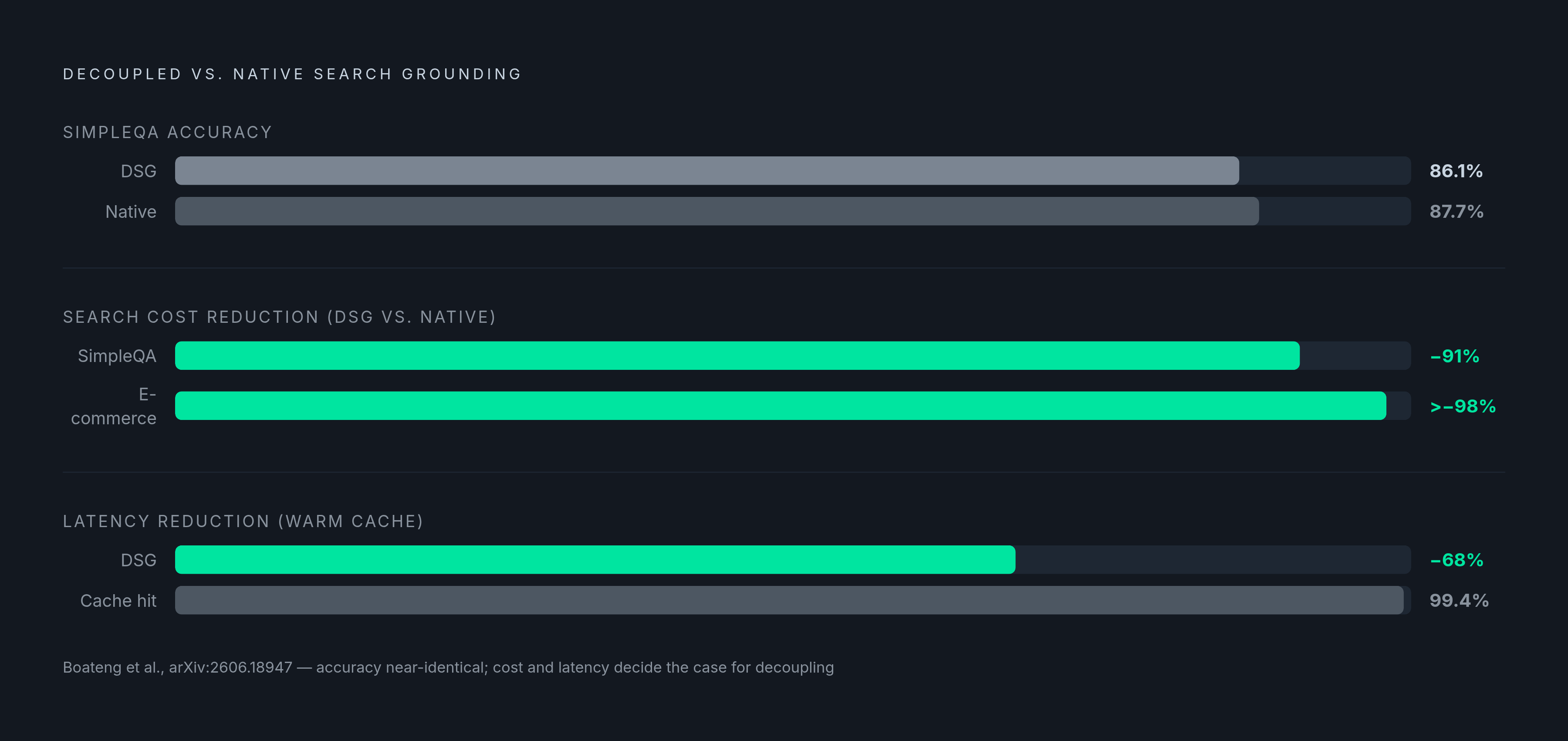
The results, tested across five frontier models on SimpleQA, FreshQA, and HotpotQA, show the following. Native search still wins on FreshQA, the benchmark built specifically around recency-sensitive questions, leading on that dimension. But on SimpleQA, DSG landed at 86.1% accuracy against native search's 87.7%, nearly matched, while cutting search cost by 91%. The warm-cache hit rate came in at 99.4%, and latency dropped 68% once the cache was warm. On a large-scale e-commerce query-understanding workload, DSG matched or slightly beat native-search accuracy while cutting search cost by over 98%.
What that adds up to: real-time grounding works best as an interface boundary a team can tune and optimize, not a fixed feature baked permanently into a model. Whoever owns that boundary controls cost, latency, and provider choice independently of whatever the underlying model does in its next update. The MCP compatibility matters here in a very practical sense: switching providers, or changing how deep retrieval goes, doesn't require redeploying the model at all. That's the developer-freedom argument, made concrete rather than aspirational.
Once a team decides to own that boundary rather than lease it from a model provider, the next question is what actually sits behind it. That's a real engineering decision, and it depends heavily on which provider category fits the workload.
Provider categories in the search API landscape for AI agents in 2026
Search APIs built for AI agents split into four rough categories, and knowing which bucket a provider falls into says a lot about what it'll be good at before even reading a benchmark. Traditional search APIs return a curated subset of results and integrate simply, but don't do much beyond that. SERP APIs go further, offering structured, fairly complete access to search engine results pages, titles, URLs, snippets, ranking position, which is metadata-rich but not ready to feed a model without extra processing. LLM-native search APIs skip that gap: they return results already re-ranked or summarized specifically for model consumption, with extraction built into the response itself. Built-in web search tools bundled into LLMs sit at the convenient end of the spectrum, but they hand back condensed results with limited visibility into which sources were actually used or how the model reasoned over them.
A SERP API hands a team metadata and expects them to build the parsing layer themselves. An AI-native API hands back content that's already model-ready. That's the real fork in the road when picking infrastructure, not price or brand name.
A handful of named providers define this landscape in 2026, each optimized for a different shape of workload.
Tavily built its API specifically for RAG pipelines, aggregating results from up to 20 sites in a single call using its own AI ranking layer. It claims 99.99% uptime, 180ms p50 latency, a substantial volume of monthly requests, and a developer base of more than one million. Its free tier covers around 1,000 searches a month, and it integrates into LangChain with no extra configuration required. Tavily raised a sizable Series A in late 2025 and later joined forces with Nebius. One known limitation: its Advanced and Research tiers can take five seconds or more to respond, which creates real bottlenecks for agentic workflows running under a tight latency budget.
Perplexity Sonar takes a different approach entirely, combining web search and LLM synthesis into a single API call and returning a fully synthesized, cited answer rather than raw search results. That's convenient when a team wants a ready-made answer and doesn't need much control, but it comes at the cost of visibility, there's limited insight into exactly which sources fed the answer or how the reasoning got there.
Parallel Search targets multi-hop agent workloads directly. Its Advanced tier spends roughly three seconds at p50 querying, reranking, and compressing across general and specialized indexes, resolving more information per call so agents need fewer round trips overall. In BrowseComp testing from April 2026, Parallel Basic scored 53% against Tavily's 42%. A separate July 2026 benchmark of Turbo-tier models found Parallel Turbo scoring 51% on BrowseComp at a median latency of 216 milliseconds. On multi-hop, search-only tasks specifically, Parallel Basic led on F1 score at 50.2%.
Firecrawl covers the full path from discovery to usable context in one system: search, full-page retrieval, structured data extraction, document parsing, and interaction with dynamic sites, spread across scrape, crawl, map, search, interact, and parse endpoints. It also exposes an MCP server compatible with Claude, Cursor, and similar agent clients. In an AIMultiple benchmark covering 100 real-world AI and LLM queries across eight APIs, Firecrawl scored 14.58 overall and posted the highest mean relevance score at 4.30 out of 5, performing especially well on deep content retrieval tasks.
Valyu takes a domain-specialized approach, folding web search together with sources like PubMed (a vast library of papers), SEC filings, arXiv (a couple million-plus preprints), clinical trial registries, and patent databases, all behind one unified API. That makes it a strong option specifically for agents working in finance, healthcare, legal, or academic research, where general web search alone misses the depth those fields need.
fastCRW optimizes for one thing: speed. In public benchmark testing, it posted competitive latency in testing against Tavily and Firecrawl.
Oxylabs and Bright Data are at the enterprise end of the spectrum, built for teams with compliance and scale requirements that go beyond what a single lightweight API can handle. Oxylabs offers a spread of distinct products, a range of data-collection and scraping products, including endpoints suited to agentic retrieval workloads. Pricing carries a $499 per-product monthly minimum. Bright Data runs on a similar per-product commitment model, starting at $499 a month, backed by a sprawling proxy network numbering in the hundreds of millions of IPs, built to absorb the reliability and scale demands that break lighter APIs entirely. Neither is really built for getting live content into a prompt quickly today. Both are built for high-volume enterprise data feeds that justify the commitment.
Purpose-built search APIs like You.com offers search API products targeting retrieval use cases in this piece, reshaping a user's intent into a live query, and converting fetched pages into clean, model-ready text, at the scale and speed that production agent traffic actually demands, without the token bloat and infrastructure brittleness that plague naive, homegrown fetching pipelines.
The providers above split roughly along the lines this piece has walked through: some optimize for raw latency, some for research depth, some for domain specialization, some for enterprise scale and compliance. None of them is universally correct. The right choice depends on which of the three pipeline patterns, search-first, tool-use, or agentic loop, a system is actually built around, and which layer of the grounding pipeline is under the most strain. That's the question to ask before picking a provider, not after.