Citation and Source Attribution in LLM Responses
LLMs excel at citations that look correct while claiming things their sources never said.
A citation that looks perfect can still be wrong. LLMs have gotten good at producing citations that pass every surface check, real links, plausible sources, right general topic, while the underlying claim has nothing to do with what the source actually says. The old mental model, that a bad citation is a broken link or an invented paper title, no longer describes the threat that matters. What matters now is quieter than that, and far harder to catch.
Consider a legal RAG system that returns a citation with a groundedness score of 0.94. The formatting is clean, the case name looks right, the pincite is there. The case does not exist. futureagi.com documents this exact pattern, a high-confidence hallucinated citation slipping past automated checks, and illustrates how this pattern could lead to sanctions motions. The score said trust this. It was measuring the wrong thing.
That gap, between what a citation looks like and what it actually verifies, is what this piece works through. Citation quality breaks into three properties stacked on top of each other, and most evaluation pipelines only check the cheap ones. Whether any of it means anything comes down to the most expensive layer, the one most teams skip. Teams that average their citation scores into a single number are choosing not to see their worst failure.
The three layers where citation quality lives
A citation clears three separate gates. Each tests something different. Each costs something different to check.
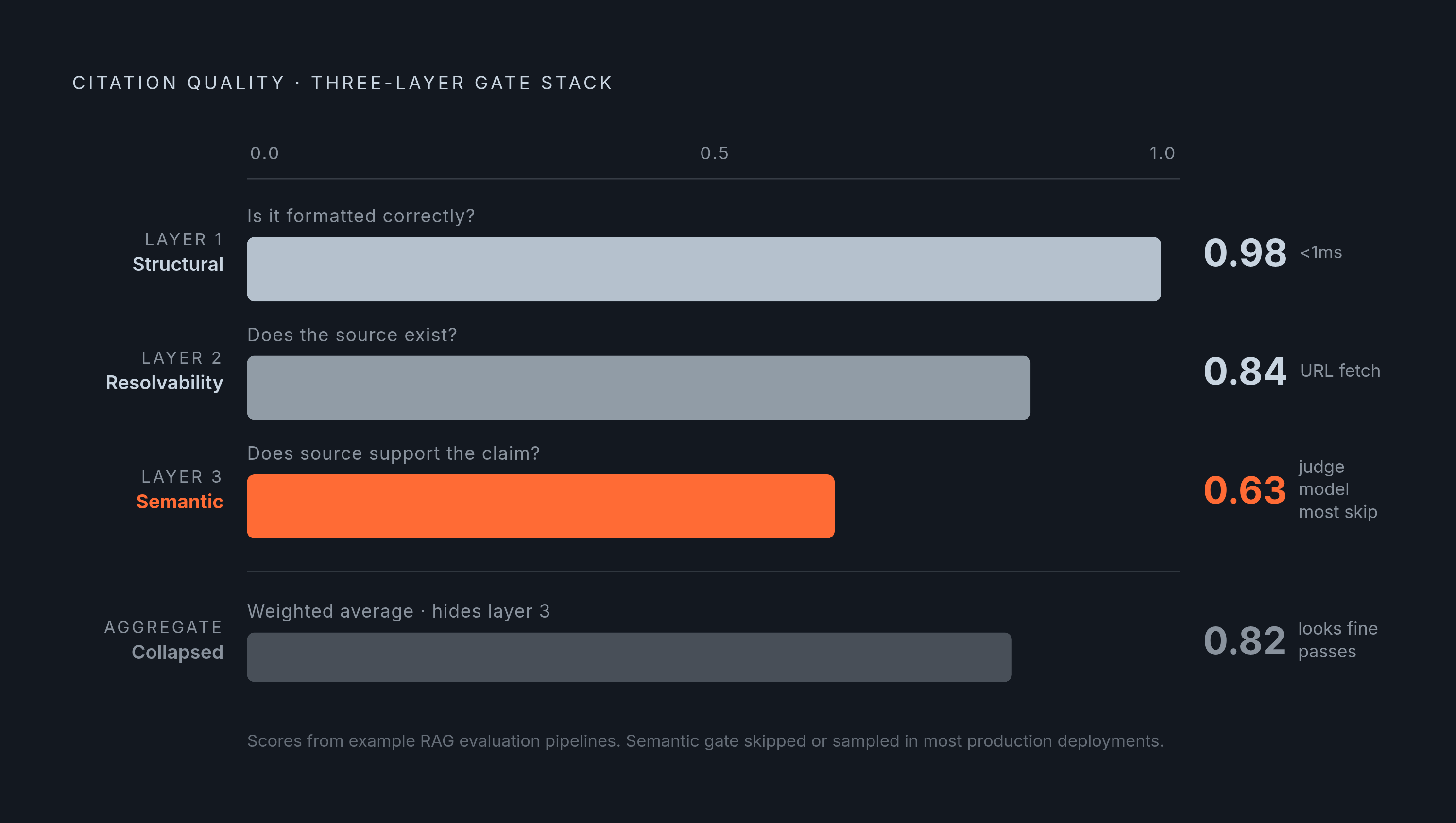
The first is structural: did the model produce something shaped like a citation, formatted the way the system expects? This runs in under a millisecond on every call, because there's no reason not to run it. But it verifies nothing except formatting. A model can nail structural compliance nearly all the time and still be feeding a courtroom fake case law.
The second is resolvability. Does the citation point somewhere real? A registry lookup or a URL fetch answers this cheaply, and it catches the classic hallucination, including the invented paper, the fabricated identifier, and the source that flatly doesn't exist. Most people's idea of a "bad citation" stops here, because it's the easiest thing to fix. That ease is why teams over-index on it and stop looking further.
The third gate is semantic, and it's the one that costs real money to check properly. Does the source actually say what the model claims it says? Answering that means breaking a response into atomic claims and checking each one against the retrieved content with a calibrated judge model. Future AGI's framework describes production systems scoring 0.94 on groundedness while landing at 0.61 on alignment: the citation looks solid, but the claim and the source don't match. Semantic checking is expensive enough that most pipelines sample it, running against a sampled fraction of traffic instead of every call.
The damage happens when structural at 0.98, resolvability at 0.84, and semantic at 0.63 are collapsed into one aggregate, and a team sees 0.82 and ships it. Collapse three scores at very different levels into one aggregate, and a team sees a passing number and ships it. Splitting the three apart shows that one of them is obviously on fire. Averaging citation quality into a single score is a way of hiding the exact failure that costs the most, and it's the habit worth breaking first.
Where fabrication happens: hallucination, misattribution, and source concentration
The resolvability layer, fabricated references outright, has a well-documented track record. Early GPT-3.5 evaluations found that of 102 references checked, only 74.5% existed; the rest were invented. GPT-4 pulled fabrication down to roughly 10% on general queries, a real improvement, though still a rate no regulated workflow should tolerate. In one medical knowledge task, GPT-4 supplied a citation for every answer when asked, yet only 43.3% of those citations were accurate. Research measuring citation hallucination rates across commercially deployed models finds a wide spread, suggesting that which model you use matters nearly as much as which prompt you write.
Fabrication is the easy failure to talk about, because it's binary: the source exists or it doesn't. Misattribution is worse, and it hides inside sources that exist and check out cleanly. An audit by Oumi and The New York Times, covering 4,326 Google searches, found AI Overviews factually correct about 91% of the time. That sounds solid, until roughly half of those overviews turn out to contain claims the cited source didn't actually support. The link resolved. The domain was legitimate. The claim was still unearned. Onweller et al. found the same pattern in miniature: link validity above 94%, topical relevance above 80%, and factual accuracy between 39% and 77% depending on the model. The first two numbers create the appearance of reliability. The third is the one that should set the price of trust, and it's rarely the number anyone reports.
Where citations come from in the first place is a failure mode that doesn't even get filed under accuracy, though it probably should. Across 680 million citations analyzed, the top 15 domains account for 68% of total citation share. Reddit alone makes up something like 40% of all AI citations, and Reddit and Facebook rank among the most-cited sources despite being, by almost any traditional measure, among the least authoritative. A citation can be structurally sound, resolvable, and semantically accurate, and still be drawing from a shallow, concentrated well of sources. Treat that concentration as an authority problem, not a coverage statistic, because a coverage statistic doesn't explain why a forum thread outranks a peer-reviewed source in a model's citation habits.
Adding more retrieval makes factual accuracy worse, not better
When citations go wrong, the instinct is to retrieve more. More sources, more cross-referencing, more grounding material. It feels right. It's also backwards: a citation problem rooted in verification does not get fixed by volume, and the data on this is not subtle.
Onweller et al. scaled tool calls from 2 up to 150 across two frontier models and tracked Fact Check accuracy the entire way. Accuracy dropped, on average, by roughly 42%. Not flat, not noisy, but down, consistently, as retrieval volume climbed. The researchers call it an information overload effect. Flood the context window with enough retrieved material and the model's ability to attach the right source to the right claim degrades, simply because there's more surface area for a source-claim mismatch to slip through unnoticed.
Anyone building a deep-research agent that markets itself on doing "more" search should sit with that finding for a minute. Higher effort tiers, more tool calls, deeper crawling, none of it is a free win for citation accuracy, and some of it actively works against it. The baseline going in is already lower than most teams assume. Fewer than half of the open-source models Onweller et al. Fewer than half of the open-source models Onweller et al. tested could even produce a cited report correctly in a one-shot setting, before anyone starts stress-testing search depth.
So what does scale actually buy, if not accuracy? Coverage, maybe. Recall, possibly. Not verification, and verification is the entire reason citations exist. Retrieval depth without matching validation depth is volume dressed up as rigor.
What the current evaluation frameworks can and cannot verify
The benchmark landscape has grown fast, and each entry tests something real, just not the same thing as the others. AttributionBench (Li et al., 2024) frames citation checking as binary classification: attributed or not. CiteME (Press et al., 2024) tests citation matching. CiteEval (Xu et al., 2025) evaluates source attribution against a set of stated principles. Other recent work focuses specifically on fabricated references in scientific writing.
None of them closes the loop end to end on its own. Onweller et al. point to three specific gaps that persist across the field. No framework combines citation extraction with a check spanning URL accessibility, topical relevance, and factual accuracy all at once. No study runs a systematic comparison across major providers specifically in deep-research settings. And until Onweller's own ablation work, nobody had tested how search depth interacts with citation quality, the exact relationship covered above.
Onweller et al.'s own contribution is a reproducible AST parser that extracts inline citations from LLM-generated Markdown reports at scale, then retrieves the actual cited content so an evaluator can judge each citation against its real source, not against a proxy or an assumption. Going and fetching what the citation actually points to is what separates this work from earlier benchmarks.
A separate effort, CiteGuard (Choi, Guo, Fung, Wang, presented at ACL 2026 in San Diego this July), reframes the question. Rather than asking whether a citation is technically correct, it asks whether the citation matches what a human author would have cited for the same claim, a standard the paper calls citation attribution alignment. Using a retrieval-aware agent framework, CiteGuard reaches 68.1% accuracy on CiteME, a 10-point jump over the prior baseline and close to the human benchmark of 69.2%. Closing that final gap turns a system that catches obvious fabrications into one that reasons about citations the way a careful human editor would.
Using an LLM to judge another LLM's citations isn't a clean fix either. LLM judges flag citations that look wrong, but they routinely reject citations that are actually correct, especially in domains requiring specialized knowledge the judge model was never trained deeply on. Recall in some of these setups drops as low as 16 to 17%. One model, used alone as the judge, is not ready to be the only gate standing between a claim and a reader.
Strong benchmark performance still doesn't guarantee production performance. Analysis of enterprise agentic AI systems shows something like a 37% gap between lab benchmark scores and how they actually perform once deployed. A framework tuned against a clean research benchmark is not the same thing as one proven against messy production traffic, with real users, real latency pressure, and real incentives to skip the expensive checks whenever nobody's watching.
How grounding architecture addresses citation failure at the infrastructure level
Citation reliability gets decided mostly before the model ever writes a sentence. It's decided by what gets retrieved, how that material is structured on the way in, and whether the source's origin survives the pipeline intact. Fix the retrieval and structuring layer, and the model has a fighting chance. If it's left broken, no amount of prompt engineering downstream saves the citation, which is the point most teams get backwards when they try to patch citation failure with better instructions instead of better plumbing.
The standard retrieval-augmented generation pattern is familiar: pull current documents through a web data API, hand them to the model as context, instruct it to cite the source URL inline. Where teams actually fail is skipping the step of preserving the origin URL on every extracted record through the entire pipeline, not just at the retrieval step. That preserved link is what gives a compliance or risk team an actual audit trail back to the raw source later, instead of a citation they have to take on faith.
Grounding APIs go a step further than plain retrieval. Rather than handing the model raw content and hoping it cites correctly, they return structured, already-cited evidence, which removes the inference step between retrieval and generation where hallucination tends to appear. A model trained on a static snapshot of the internet cannot accurately cite something that happened after its training cutoff, no matter how carefully it's prompted. Microsoft's Web IQ, introduced at Build 2026 in June, was built around this exact problem, delivering structured, cited web evidence in 164 milliseconds, designed from the ground up for AI inference rather than for rendering a human-facing search results page. That points to the same shift: citation handling is moving from something a prompt engineer bolts on with careful wording to something the platform guarantees by design.
For agentic pipelines, the two-step pattern matters: a Search API to locate relevant links, followed by a separate Contents or Reader API to extract clean, LLM-ready text while keeping provenance attached. Search and extraction have genuinely different accuracy and latency profiles, and collapsing them into one step tends to degrade both.
Ungrounded models commonly hallucinate on factual queries at rates somewhere in the 15 to 25% range. Web-grounded systems gain 25 to 40 percentage points in factual accuracy over their ungrounded counterparts, close to the gap between a system worth trusting and one that isn't.
One more piece belongs here, and it has less to do with the model than with governance: data lineage. Every dataset feeding these systems should carry metadata describing where it came from, what transformations touched it, and which downstream models consume it. In regulated environments, that traceability is increasingly treated as a compliance requirement in its own right.
The cost of citation failure in financial and regulated contexts
Financial research is close to the highest-stakes environment for citation accuracy running in production today. Outputs here feed investment decisions, compliance filings, and regulatory disclosures. In that setting, an unverifiable citation is a liability with a dollar figure attached, not an abstraction.
The specific failure mode financial AI runs into is staleness, a nastier variant of the resolvability trap covered earlier. A model working from training-cutoff knowledge can cite a filing that's since been superseded, quote fundamentals that were later restated, or reference pre-revision earnings numbers, and every part of that citation resolves cleanly. The link works. The document exists. The data inside it is simply outdated relative to what's actually current. That's a resolvability pass masking a semantic failure of an arguably more dangerous kind, because the number looks authoritative right up until someone checks it against a more recent filing.
Financial research stacks need capabilities general-purpose retrieval was never built for. Two sources might report different EPS figures for the same quarter, and something has to reconcile that conflict instead of picking one at random. A workable system needs a single layer combining live web intelligence with licensed structured data, SEC filings, fundamentals, earnings transcripts, macroeconomic series, returned through one cited call rather than stitched together from five disconnected tools. Every citation needs to map to a URL sitting right in the response object, so a compliance reviewer has a direct path to check without doing detective work first.
A few platforms have built specifically around this problem. Hebbia uses NLP and a multi-agent system to pull insights out of dense financial documents, tying every output back to specific cited sources, and it handles genuinely hard multi-document work, like comparing covenant language across a set of management commentary letters. AlphaSense has built a 15-year track record serving finance clients, backed by an exclusive research library spanning broker research, expert call transcripts, SEC filings, event transcripts, and breaking news, though the space isn't standing still, and competitors keep pushing new dimensions into automated analysis and workflow automation.
You.com's Finance Research API takes a related but distinct approach and layered with licensed structured data from providers including S&P Global. It pulls together SEC filings, fundamentals, earnings data, and macro series from sources like FRED, BLS, BEA, Eurostat, the World Bank, IMF, OECD, and EIA into one retrieval call, and returns a JSON object pairing a markdown response with inline citation tags and a sources array mapping every citation back to a URL. On FinSearchComp's historical lookup benchmark (the T2 test), it scores 87.29% at $110 per 1,000 queries on the Deep tier, more than 14 points ahead of the next-best system at any price point tested.
The lesson generalizes past any one vendor. Financial-grade citation can't be bolted onto a general-purpose retrieval stack as an afterthought. Reconciling conflicting sources has to be a first-class part of the architecture from the start.
What a citation-trustworthy AI system requires from its infrastructure
Citation failure is a systems problem, stacked across three layers, and each layer needs its own fix rather than a shared one. That's the position this piece keeps circling back to, because it's the one thing the evidence above doesn't leave much room to dispute.
Structural compliance needs to come from the API itself. Resolvability needs a deterministic join between what the model claims it cited and what's actually sitting in the retrieval log; taking the model's word for its own citation defeats the point of checking. Semantic accuracy decides whether a claim and its source agree, and it has to run per claim rather than per answer. Atomic decomposition is the only method that catches the failure mode sitting at the center of this entire piece, where a real document and a plausible topic accompany a claim the source never actually made. That's the exact pattern behind the 0.61 alignment scores turning up across 2026 production traffic.
That semantic layer is also the expensive one, so most systems still treat it as a sampling exercise instead of something run on every response. Making it viable at full scale, not just on 10 to 20% of traffic, is arguably the real frontier of this field right now. You.com's Research API and was built specifically for agents that need grounded, cited answers, is one example of infrastructure aimed at closing that exact gap, optimizing for latency and semantic accuracy together instead of treating one as the cost of the other.
None of this makes citation a solved problem. It makes it a legible one: three layers, three different costs, three different failure signatures, instead of one aggregate score standing in for all of it. That legibility is the actual prerequisite for trust. A citation that looks right is not the same thing as a citation that is right, and until evaluation and infrastructure both treat those as separate claims, the gap between them keeps costing exactly the people who trusted the citation most.