Data Freshness Requirements by AI Use Case
Different AI decisions demand different data freshness, and building the wrong tier wastes money.

Production AI agents in 2026 are not just answering questions. They're buying advertising inventory, adjusting dynamic pricing, approving transactions, routing support tickets, and doing it on a schedule that has no room for "close enough." When an agent acts on stale data, the failure is a financial loss, or a compliance problem, or both. It's a financial loss, or a compliance problem, or both.
Somewhere around 30 to 40% of user queries need information more recent than the typical training data cutoff, which is a large enough share that "just use the model" stopped being a viable design choice a while back. A NAACL paper found retrieval-augmented generation cut hallucination in structured outputs by 40 to 71% compared to relying on model weights alone. That's a real gain, but it only holds if the retrieval layer feeds the model something fresher than what it already knew. The instinct most developers reach for first is "make it real-time." That instinct is usually wrong, or at least imprecise, because real-time is a range of specs rather than a single one. It's a range of tolerances that depend entirely on what the agent is deciding, and building the wrong tier is where the money gets wasted.
What determines which of the five freshness classes a use case belongs to
The goal is to make sure each answer draws on information fresh enough for the decision riding on it. It's to make sure each answer draws on information fresh enough for the decision riding on it. A fraud-detection agent and a documentation assistant have wildly different needs, and treating them the same is how budgets get burned in one direction and compliance risk piles up in the other.
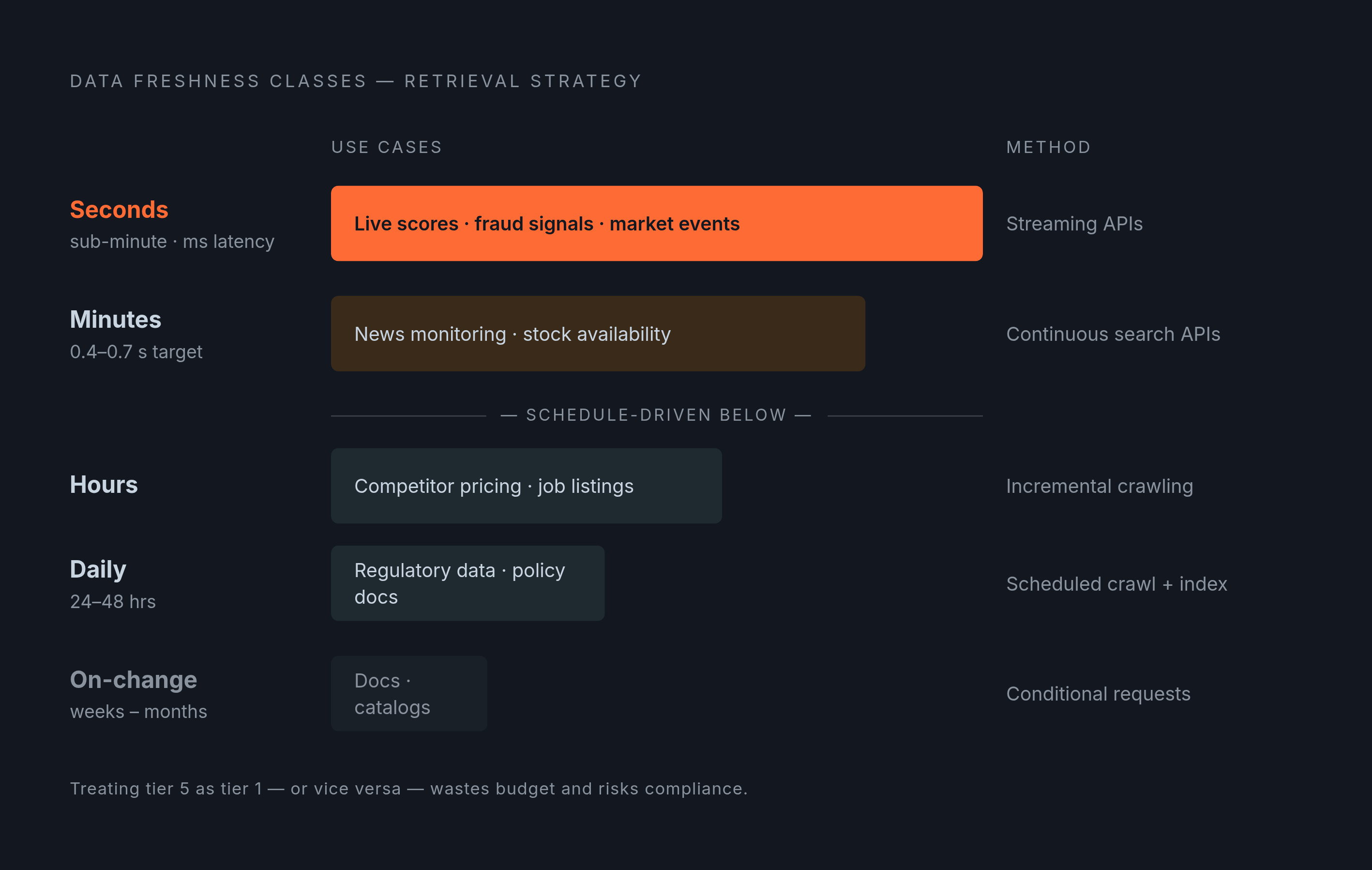
The variable that actually determines the tier is how fast the underlying domain changes. It's how fast the underlying domain changes. A stock price moves every second; a company's refund policy might not move for six months. Five classes cover most of what shows up in production:
Seconds to sub-minute: live scores, market events, outage detection, fraud signals. This tier demands streaming APIs or live search, and latency gets measured in milliseconds, not seconds.
Minutes: news monitoring, stock availability. A search API or a frequent scheduled retrieval job handles this reasonably well.
Hours: competitor pricing, job listings, price monitoring. Incremental crawling is the standard approach here.
Daily, or 24 to 48 hours: regulatory data, policy documents, industry intelligence, competitor content. Scheduled crawl and indexing jobs fit this tier.
On change, which can mean anywhere from a week to a month: documentation, product catalogs, technical references. This one runs on conditional requests and change detection.
Two failure modes sit on either side of this framework. Over-engineer, and a team builds streaming infrastructure for a data source that updates monthly, which wastes both budget and complexity for no measurable gain. Under-engineer, and a fraud-signal agent gets treated like a documentation bot, producing exactly the kind of financial exposure described above.
The "on change" class deserves its own callout, because it gets folded into "daily" more often than it should. The two aren't the same thing architecturally. Daily is a schedule; on-change is a trigger. One runs regardless of whether anything happened; the other only fires when something actually did. That difference is the whole point of this table: it functions not as a lookup chart to memorize but as a way of reasoning through a use case that hasn't been seen before, figuring out, from the rate of change alone, which bucket it belongs in.
Sub-second and minute-level freshness: what these use cases demand from infrastructure
Live market events, unusual options activity alerts, fraud signal detection, live sports scores, real-time outage monitoring: all of these are at the sharpest edge of the freshness spectrum, and all of them break if the data pipeline even blinks.
At this tier, the requirement is a streaming API. For financial market events specifically, feeds delivered over a persistent streaming connection (one vendor's, for instance) deliver latency typically under 10 milliseconds from the exchange itself. That number matters because it sets the ceiling for how "sub-second" a sub-second use case can actually be. Polling an index, even a fast one, introduces lag, and lag at this tier carries real costs. It's the difference between catching an event and missing it entirely.
Sub-second freshness is primarily a data streaming problem. It's a data streaming problem. An agent operating at this tier needs an event subscription. That's a different mental model for a lot of engineering teams, because most of the AI tooling conversation over the past few years has centered on retrieval, on searching an index and getting back the best match. At the sub-second tier, there's no index to search fast enough. The agent has to sit on the stream and react.
What does that mean for how the agent itself gets built? It needs to be stateless, or at least capable of processing an incoming event without pausing for a full retrieval cycle. And the failure mode changes shape too. It's no longer "the agent gave a wrong answer." It's "the agent missed the event" or "the agent triggered on a stale signal." Tolerance for retrieval latency, at this tier, is close to zero.
Step down to the minutes tier, and the picture loosens a little. News monitoring and stock availability checks are where managed search APIs actually become workable, but only the ones that index continuously rather than in batches. Proxyway's search API report found index-based APIs returning results in under 0.4 seconds, while real-time crawling APIs averaged 0.6 to 0.7 seconds. Either approach can work at the minutes tier. But the choice between them raises cost and architecture consequences once the system is in production and someone's paying the API bill every month.
Hourly freshness: competitor pricing, market intelligence, and the agents that must act on them
Competitor price monitoring, job listings, product availability, market intelligence pipelines: this is the tier where the gap between "reading" data and "acting" on it gets uncomfortably narrow. Agents in 2026 don't just surface pricing information for a human to review. They adjust dynamic pricing themselves, they make purchasing decisions, and a price that's six hours stale is a decision input that could cost real money at that point. It's a decision input that could cost real money.
So what does retrieval look like at the hourly tier? Two broad options, each with its own tradeoff. Incremental crawling works well when the target sources are known and stable, though it comes with its own overhead: managing crawl scope, rendering pages heavy with client-side scripting, deduplicating near-identical content, and keeping refresh schedules honest. Managed web data platforms take a different approach, abstracting away the anti-bot infrastructure that's become table stakes for scraping anything commercially valuable.
And commercially valuable pages are exactly where the fight is happening. F5 Labs' 2026 Advanced Persistent Bot Report found that scrapers still account for 10.2% of all global web traffic even after mitigation efforts. Break that down by industry and it gets sharper: fashion sees 53% of its traffic from scrapers, hospitality 49%, healthcare 34%. The sources most relevant to pricing intelligence are, unsurprisingly, the same sources getting hit hardest by automated defenses. Cloudflare's ML-based crawler detection now reads behavioral signals like cursor movement, scroll timing, and focus or visibility changes on the page. Rotating IP addresses alone doesn't clear that bar anymore. Whatever's doing the fetching has to simulate something close to a real browsing session, at scale, continuously.
That's where the build-versus-buy math gets clean. Building and maintaining reliable hourly crawl infrastructure against actively defended sources is a real engineering commitment, not a weekend project, and it doesn't stop being one after launch. The freshness requirement at this tier is a recurring cost line that has to be weighed against what a managed platform charges to solve the same problem. It's a recurring cost line that has to be weighed against what a managed platform charges to solve the same problem.
Daily and on-change freshness: regulatory research, policy monitoring, and documentation agents
Regulatory document monitoring, policy verification, compliance research, product documentation agents, technical reference assistants: none of these need to know something the second it happens. But all of them need to know it within a window that matches how often the underlying source actually changes, and getting that window wrong carries real consequences.
The 24 to 48 hour tier fits regulatory data and policy documents reasonably well. These sources move slowly, but when they move, the stakes are high. A support agent quoting a refund policy that has since changed introduces real risk. It's the kind of problem that can surface in an audit rather than a customer complaint.
On-change retrieval is a genuinely different mechanism from daily scheduling, not just a slower version of it. It runs on conditional HTTP requests and change detection rather than a fixed interval, which means the system only re-ingests a page when that page has actually updated. That saves compute, sure, but the bigger advantage is architectural: a documentation site or a product catalog might sit untouched for an extended period and then get revised multiple times in quick succession. A fixed daily crawl either wastes cycles during the quiet weeks or misses the burst when it matters.
A source registry, the kind of table that tracks what's being ingested and how, should carry a refresh frequency field alongside a change-detection method for each entry. That single design choice is what separates a policy document, which belongs in the on-change bucket, from a news feed, which belongs in minutes. And the failure modes here aren't symmetrical. Crawling regulatory filings every hour burns budget for no benefit, since the content isn't moving that fast. Crawling weekly when the underlying policy updates every few days is the one that actually hurts, because it produces exactly the compliance exposure this tier exists to prevent.
How MCP standardization and native vector support changed the infrastructure calculus in 2026
Two structural shifts made freshness-aware agent infrastructure something a team could actually build in 2026, rather than something only a handful of well-funded labs could pull off.
The first is MCP. Before it, wiring an agent to a data source meant a custom integration for every combination of agent framework and source, which is exactly the kind of work that multiplies badly as a system grows. MCP standardized that connection. Any MCP-compatible agent can now talk to any MCP server without bespoke glue code in between. That has a quiet but important consequence: the integration layer stopped being the differentiator. What separates one data source from another now is quality and freshness, not whether someone managed to wire it up correctly.
The second shift is vector support becoming a default feature rather than a separate purchase. In 2024, a team that needed semantic retrieval typically had to bolt on a standalone vector database, which meant another system to run, monitor, and keep in sync with everything else. By 2026, mature streaming databases ship with native vector support built in. The architecture needed for freshness-aware semantic retrieval doesn't require stitching two systems together anymore. It's closer to a single decision than a systems-integration project.
Put together, these two shifts mean a developer can pick a data source based on its freshness profile and accuracy, and trust that the plumbing won't be the bottleneck. The production stack that's emerged around this typically separates concerns across multiple layers: a source of truth store, a streaming layer that keeps derived views current, a serving layer that agents actually query, and a vector layer for semantic retrieval. Agents shouldn't be hitting the transactional layer directly for context enrichment. Doing that tends to degrade the performance of whatever operational application depends on that database, since it was never built to handle that kind of query traffic.
None of this is about which database brand wins. The infrastructure preconditions for building freshness-tiered systems are now widely available, which means the five-class framework from earlier in this piece has become a practical reality. It's buildable with tools that already exist off the shelf.
The production readiness gap: why freshness tier mismatches are where agentic projects fail
Gartner projects that more than 40% of agentic AI projects will be canceled by the end of 2027, despite enterprise adoption moving fast in the other direction. That's a striking number, and it raises the question of what's actually driving it before assuming the answer is "the models aren't good enough yet.""
The model is rarely the problem. The infrastructure around it is, and specifically the systems responsible for how an agent accesses data and how fresh that data actually is. A prototype agent gets built using whatever data happens to be available, static training data, cached web results, a batch-refreshed database that gets updated once a week because that was easy to set up. It works fine in a demo. Then it goes to production, where it needs data that reflects the current state of the world at that moment. That gap between prototype-grade freshness and production-grade freshness is exactly where agents start producing outputs nobody can trust. And an agent running on stale or poorly structured inputs will produce unreliable outputs no matter how carefully the rest of the stack was designed.
One pattern that's become something like a production baseline is dual-engine retrieval, splitting discovery from extraction into two distinct steps. A search-results discovery API discovers relevant URLs first; in SearchCans' credit model, that step costs 1 credit. A separate Reader API then extracts clean, LLM-ready Markdown from whichever URLs got selected, at 2 credits. Splitting the two lets a team tune freshness at the discovery layer, deciding how often to search, independently of the extraction layer, which only matters once a URL has actually been chosen. High-throughput agentic workloads built on this pattern can run up to 113 parallel lanes at once, which matters when the question isn't "can this fetch one page fresh" but "can this fetch a thousand pages fresh, continuously."
Agentic web search and deep research also need to be separated, because the freshness math is different for each. Agentic search runs a handful of targeted queries against a handful of pages and synthesizes quickly, which fits naturally with sub-hour freshness needs. Deep research runs hundreds of queries across dozens of pages with iterative refinement, and because that synthesis process takes real time regardless, it can tolerate data that's a little older at each individual step without the final output suffering for it.
The Gartner figure is a warning about a specific, preventable category of failure: teams that never asked which freshness tier their use case belonged to, and built accordingly. It's a warning about a specific, preventable category of failure: teams that never asked which freshness tier their use case belonged to, and built accordingly.
Evaluating search and research APIs against freshness requirements: what the benchmarks reveal
Benchmark scores are useful, but they're not the whole story, and treating them like the whole story is its own kind of freshness-tier mistake. A substantial gap has been observed between lab benchmark scores and real-world deployment performance in enterprise agentic AI, alongside cost variation as high as 50x for tools posting similar accuracy numbers. That gap means a benchmark result is a starting point for evaluation.
Precision and recall matter differently depending on which tier a use case is in. In high-stakes, lower-freshness domains like finance, medicine, or regulatory research, a 10% drop in recall could mean missing a critical filing or a load-bearing research paper, so prioritizing recall over shaving a few hundred milliseconds off latency preserves those critical results. Flip that around for sub-minute freshness use cases, where a fast partial answer generally beats a slow, complete one, and latency starts outweighing comprehensiveness.
A handful of providers illustrate how this plays out across the tiers. You.com's Finance Research API has posted strong results on financial search benchmarks, and its Finance Research API ranks first on FinSearchComp T2 for simple historical lookup, positioning it toward multi-step synthesis workflows where source reconciliation and citation accuracy shape whether the output holds up, even at the cost of the last few hundred milliseconds. That makes it a reasonable fit for the daily and on-change tiers covered earlier in this piece, particularly for financial and regulatory research where getting the citation right outweighs getting the answer instantly.
Linkup reports a 94% F-score on Verified SimpleQA, and its Flash mode returns web evidence in under 250 milliseconds at the median, measured client-side, aimed squarely at grounding agents inside latency budgets that web search didn't used to fit into. It carries SOC 2 Type II certification, with a zero data retention option available.
Tavily was built specifically for RAG pipelines, aggregating results from up to 20 sites per call with its own automated ranking layer, which suits it to the hourly-to-daily range where synthesis depth carries more weight than raw speed.
At the minutes tier specifically, where continuous indexing rather than batch updates is what separates a workable tool from an unreliable one, real-time web search APIs are built to close that gap directly, with index-based options returning results in under 0.4 seconds without having to stand up their own streaming infrastructure from scratch. That's the same tradeoff this piece has circled back to repeatedly: freshness is a spectrum, and the right tool is the one whose latency and recall profile actually matches the tier the use case lives in, not the one with the highest score on a leaderboard that may not be measuring the right thing. It's a spectrum, and the right tool is the one whose latency and recall profile actually matches the tier the use case lives in, not the one with the highest score on a leaderboard that may not be measuring the thing that matters.