Regression Testing Search API Integrations in CI
Deterministic testing assumes search APIs behave the same way every time, but they don't.
Search API integrations break in ways ordinary API tests were never built to catch. The data returned by a search endpoint changes constantly as the underlying web changes, so a regression suite built on the usual assumption, same input, same output, every time, is misaligned with how search APIs actually behave in production. Most teams read that as a tooling problem and go shopping for a better test runner. It's a design problem: the tests assume a determinism that search was never going to give them, and no amount of new software fixes a wrong assumption baked into the suite itself.
Standard API testing treats determinism as a given. Send a request, expect a fixed response, flag anything that deviates. Search APIs violate that premise on purpose: a query about interest rates run on a Tuesday and again on a Friday should return different results, because the web moved in between. That single design fact forces a rethink of what "regression" even means for this class of integration, and four failure modes follow directly from it. Worth walking through before getting into how to test for them.
Result freshness drift is the quiet one. An API can return stale content with a clean 200 status code and a perfectly valid schema, no error, no warning, nothing for a standard monitor to catch. Schema changes are the second: a provider renames a field, adds a layer of nesting, or drops a key that a downstream parser depended on, and the failure surfaces as a silent null value three services downstream rather than a loud crash where anyone's looking. Latency spikes are the third, and they're query-dependent in a way most load tests don't anticipate. A query that resolves quickly on Monday can take several times longer on Thursday depending on what the provider's infrastructure is doing under the hood, and that variance doesn't always show up in a unit test running against a fixture. Fourth, and hardest to catch, is grounding failure: results that parse fine, look current, and return fast, but are factually wrong or irrelevant to the query. The LLM sitting on top of that search call produces a confident, well-formatted, wrong answer, and nothing downstream flags it because nothing downstream is built to question a well-formed response.
Traditional search infrastructure wasn't built for any of this. It was built for people reading web pages, not for agents parsing structured data. That structural mismatch between traditional search output and what AI workflows need is part of why provider-side change is such a live risk right now. Microsoft's retirement of its Bing Search APIs, effective August 11, 2025, is a concrete case: teams depending on that endpoint had a fixed date after which their integration simply stopped working, regardless of anything they did on their own side. That's the scenario a regression suite exists to catch before it becomes an incident report, not after.
So what does a regression strategy actually look like when the thing being tested is deliberately non-deterministic and controlled by someone else's infrastructure decisions? That's the question the rest of this piece works through.
What the production incident data says about teams that skip this layer
The World Quality Report 2025 puts a number on something a lot of engineering teams suspect but rarely quantify: 71% of production incidents in API-heavy architectures trace back to regressions in code that was already passing, not new edge cases nobody anticipated. Drift, not novelty, is the dominant failure mode: quiet decay in something that used to work.
DORA's 2025 State of DevOps report draws a sharp line around this. Teams that run regression checks on every commit report change-failure rates under 5%. Low performers exceed 45%. A gap that wide comes from testing discipline, not from any real difference in how complex the underlying systems are.
Most teams read that gap and assume they need better tools. They're wrong. 77% of development teams already use some form of automated API testing, according to TestDino and SmartBear, so tooling was never the shortage. What's missing is a mature regression program: defined baselines, staged gates, and gates that actually block a release instead of just logging a warning. The space between owning a testing tool and running a testing practice is where the incident rate actually lives, and no new software closes that gap on its own.
For search API integrations specifically, the cost math gets sharper. A broken retrieval layer rarely throws a 500. It throws a 200, wrapped around content that's stale, mismatched, or simply wrong, and the LLM downstream treats that content as ground truth. It writes the wrong number into a financial summary or the wrong dosage into a clinical note with the same confident tone it would use for a correct answer. In finance or medicine, a recall failure in the search layer becomes a recall failure in the agent's judgment, and that's a different order of risk than a broken CRUD endpoint returning a malformed customer record.
The problem has been documented. The cost is measurable. What's less settled is what an adequate regression suite for this specific kind of API actually needs to check.
The four dimensions a search API regression suite must cover
Schema and contract fidelity comes first because it's the most mechanical of the four, and the cheapest to test. A contract test asserts that every field the application depends on is present, correctly typed, and nested where it's expected to be, both after a provider-side update and after any internal code change on the team's own side. Field renames and quiet type changes are the single most common cause of downstream parser failures, and a contract test catches them at pull-request time instead of three services downstream in production. A schema break in a search integration doesn't stay contained to one endpoint; it cascades into every service reading that output, including any AI agent parsing it as its source of truth.
Freshness and temporal accuracy is where a lot of testing setups quietly cheat. A test that replays a cached fixture response is testing the parser, not the live API, and it will pass forever even as the actual endpoint drifts stale. Green checkmarks on a suite that hasn't touched a live server in months mean nothing. Real freshness testing needs live queries checked against known-current ground truth. FreshQA, a benchmark set of 600 questions spanning time-sensitive and false-premise types across a broad range of real-world knowledge, is the established reference dataset here, and teams can pull test cases from it directly rather than building their own from scratch. Glean's 2025 search tool benchmark guidance recommends re-running these checks quarterly at minimum, and immediately after any major infrastructure change, software update, or organizational shift that might touch the pipeline.
Latency within agentic tolerances needs its own budget, separate from whatever generic performance target the rest of the API estate uses. A search call sitting inside an agent's reasoning loop has a tighter tolerance than the same call running as a background batch job overnight, and testing both against one blanket threshold misses the regression that actually matters. A "small" optimization that quietly turns a fast endpoint into a slow one under real load is a textbook regression, and the same thing happens when a provider raises its own p99 without telling anyone. Latency assertions belong in the same pipeline stage as the functional checks, not shunted into a monthly load-testing cycle that runs too rarely to catch anything before it ships.
Grounding quality and answer accuracy resists easy automation, and matters most of the four. A response can pass every schema check, look perfectly fresh, and return in 90 milliseconds, and still ground the LLM on a source that's irrelevant or actively misleading. SimpleQA, a set of 4,326 factual questions with unambiguous correct answers, gives teams a tractable way to build an automated accuracy regression test, scoring each response against known ground truth. Finance-specific integrations carry an added layer: evidence reconciliation across conflicting sources is its own failure mode, since a provider change that quietly drops cross-source citation consistency counts as a grounding failure even when each individual result looks fine on its own. Accuracy ranges across providers run wide enough that a provider's own model update can shift a team's real-world accuracy meaningfully with zero warning in any changelog.
How to layer regression checks across the CI pipeline by stage
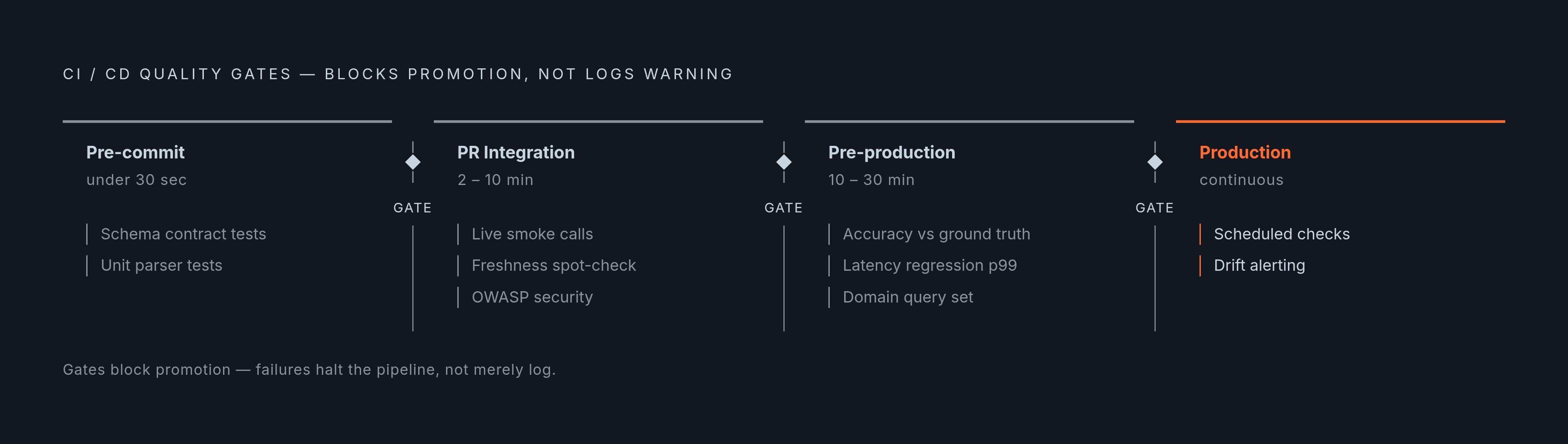
The organizing principle is simple: feedback speed decides placement. The faster a check runs, the earlier it belongs in the pipeline. Slower, more expensive checks run later, but they still have to block promotion, not just log a warning nobody reads. That last part is where most pipelines quietly fail even when they look complete on paper.
Stage 1, pre-commit and pre-merge, under 30 seconds. This is where schema contract tests live: assert the response structure against a pinned provider schema, and fail the pull request immediately if a field the application relies on has changed shape or disappeared. Alongside that sit unit-level parser tests, checking that given a known fixture response, the application's parsing logic still produces the correct output. Fast, deterministic, no live network call required. A gate that only runs generic unit tests here isn't protecting against contract violations or the integration drift search APIs introduce.
Stage 2, the PR integration gate, 2 to 10 minutes. Here the suite makes live smoke calls, a small curated set of real queries against the actual provider endpoint, checking status codes, response shape, and latency against a recorded baseline. A freshness spot-check runs alongside it, using known-current questions to confirm results reference reasonably recent content. Security checks belong here too, not saved for a pre-release penetration test later. OWASP's API Security Top 10 patterns, covering authentication, authorization, and resource consumption limits, apply to search integrations exactly as much as they apply to any other API surface.
Stage 3, post-merge and pre-production, 10 to 30 minutes. This is the full sweep: an accuracy subset scored against ground truth using a factual question set, blocking promotion if accuracy drops below the established baseline by more than a defined threshold. Latency regression gets checked at the tail end of the distribution, matched to the environment-appropriate budget for whichever agent loop the API serves. Domain-specific accuracy runs here too, so a finance integration gets a finance-specific query set, not a generic pass rate that hides where the weakness actually sits.
Stage 4, continuous production monitoring. Continuous monitors run checks on a schedule, independent of any deployment, and alert when API behavior drifts outside expected bounds. This stage matters more for search APIs than for most other integrations, because a provider can degrade behavior with zero code change on the team's own side. Only 35% of businesses have adopted end-to-end API monitoring according to Uptrends' 2025 data, which means most teams are flying blind in the gap between their last pre-deployment test and whatever incident report lands first.
None of this holds if the gates are set to warn instead of block. A gate that logs a failure but lets the pipeline continue teaches the team, implicitly, that the failure was acceptable, and the whole discipline erodes from there. Gates need to block promotion outright, and the suite needs to run fast enough that developers aren't tempted to skip it under deadline pressure.
Building accuracy baselines from benchmark data rather than intuition
A regression test needs something to regress from. For schema and latency, establishing that baseline is fairly mechanical: pin a schema version, record a latency figure, move on. Accuracy is harder, because judging correctness takes more than a single manual spot-check of "does this look right." That kind of check is a guess dressed up as a measurement, and treating it otherwise is where most accuracy regressions slip through unnoticed.
One useful template comes from independent benchmark methodology: run each search API as a tool through its official SDK, score responses against ground truth using a panel of separate models (one published approach uses Gemini 2.5 Pro, Claude Sonnet 4, and GPT-4.1 voting together), then aggregate to a final accuracy rate, correct divided by total, across a handful of domain-specific datasets. A team doesn't need to replicate that exact panel, but the pattern transfers directly: build a query set that represents the actual domain, score the current provider against ground truth, and treat that number as the line future regressions get measured against.
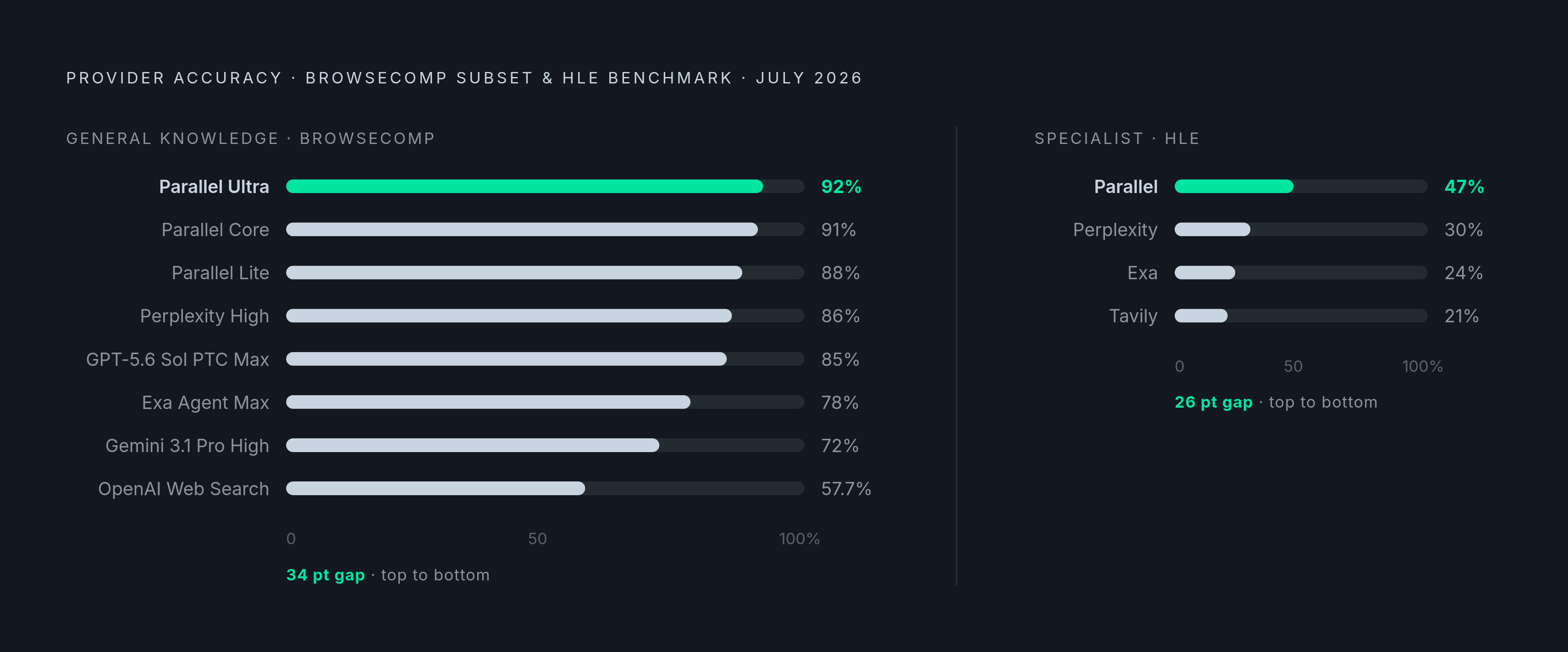
Published benchmark numbers show why this matters, and they also show which assumption to drop first. On a 100-question BrowseComp subset run in July 2026, Parallel Lite scored 88%, Parallel Core 91%, Parallel Ultra 92%, Perplexity High 86%, GPT-5.6 Sol PTC Max 85%, Exa Agent Max 78%, and Gemini 3.1 Pro High 72%. OpenAI Web Search, on that same suite, came in at 57.7%, a 34-point gap between the field's top performer and a widely used option. Anyone assuming the most familiar provider is also the most accurate one is working from brand recognition, not data, and that gap is the argument for setting a real numerical baseline instead of assuming "it's probably fine."
Domain shifts the picture further, and this is where teams get the wrong idea about which provider is actually strong. On the MedAgent benchmark for complex medical queries, run in October 2025, Valyu scored 48%, Google 45%, Exa 44%, and Parallel 42%, numbers meaningfully lower and more tightly clustered than the general-knowledge scores above. On the HLE benchmark, Parallel scored 47%, Perplexity 30%, Exa 24%, and Tavily 21%, a spread wide enough that switching providers without re-baselining could silently cut an agent's real-world accuracy by more than half. A provider that leads on BrowseComp isn't automatically the right pick for a medical or legal query set. Domain matters more than brand, full stop.
A 10-point drop in recall on a finance or medical query set is a signal worth investigating on its own terms. It means the agent is missing filings, missing research papers, missing the exact documents a domain expert would expect it to find, and that's a different kind of failure than a 10-point miss on a trivia benchmark. Baselines belong per domain, not averaged across a general query mix that papers over the weak spots. Glean's 2025 guidance recommends quarterly re-benchmarking at minimum, with immediate re-checks after any major provider model update, interface redesign, or integration change. You.com's Research API holding the top spot on DeepSearchQA, and its Finance Research API ranking first on FinSearchComp's T2 simple historical lookup sub-task, are the kind of publicly verifiable, benchmark-anchored numbers that make a defensible baseline possible instead of an arbitrary one.
Tooling choices that fit a search API regression workflow
The right tool for this job needs to clear four bars: live HTTP calls against real external endpoints (not just mocked servers), custom assertion logic covering schema validation, latency thresholds, and accuracy scoring against ground truth, native integration with GitHub Actions, GitLab CI, or Jenkins, and feedback fast enough at PR time that developers don't route around the gate out of impatience. Most tools clear one or two of those bars. Few clear all four, and that's the actual selection criterion, not brand recognition.
Postman remains the default starting point for a lot of teams, with more than 30 million declared users as of 2025, making it the most widely used API testing environment around. Its Collection Runner and the Newman CLI plug directly into CI pipelines, and environment variables handle API keys and baseline values cleanly. Custom test scripts written in JavaScript support accuracy and latency assertions well beyond a basic status-code check. It fits best for teams already using Postman for day-to-day API development who want to promote existing collections into a formal regression suite without adopting new tooling.
REST Assured is the standard choice for Java shops, offering a fluent DSL for HTTP request and response assertions inside JUnit or TestNG. It runs natively as part of the Maven or Gradle build lifecycle, so mvn test or gradle test picks it up with no extra runner configuration needed. It fits Java-based teams building AI services where the search API call is one layer inside a larger backend system.
testRigor takes an AI-driven approach, letting tests get written in plain English, which lowers the skill floor needed to write and maintain a regression suite over time. Its self-healing test maintenance addresses a real cost: the World Quality Report 2025 estimates that hand-written suites eat up 30 to 40% of QA capacity just staying updated in high-change environments. A free public tier exists with unlimited users and test cases, though it's limited to one parallel test run and public visibility. Best fit: teams with limited QA headcount who need coverage without a maintenance burden that grows with every test added.
Ghost Inspector offers low-code and no-code test creation through a visual editor, with JavaScript available for more complex scenarios. Parallel test execution comes included at no extra cost across all plans (subject to each plan's monthly run limit), which matters for a search regression suite running many query variants at once. It integrates with Slack, Microsoft Teams, and Jira for immediate failure alerts, plus GitHub integration for commit and PR status reporting. Pricing starts at $109 a month for 10,000 test runs and five team members, with a 14-day free trial available.
Katalon Studio covers web, API, mobile, and desktop testing in one environment, with AI-native test creation and maintenance built in. A free version exists for small teams, paid plans start around $1,000 a year per user at the Create tier, and the Enterprise tier runs roughly $2,000 a year per user for full platform access.
Teams building freshness regression suites often pair a public benchmark like FreshQA with real-time production monitoring. You.com, which builds enterprise web-data infrastructure aimed at low latency and citation-backed results, publishes its own freshness metrics openly, giving other teams a concrete reference point for what production-grade temporal accuracy looks like at scale rather than an abstract target.
None of the four dimensions covered here work alone. Schema fidelity, freshness, latency, grounding: a suite that checks the first and skips the second will pass right up until the moment a stale result reaches a customer wrapped in a clean 200 status code. Building all four into the pipeline, staged by how fast each check runs, is what turns a stack of individually reasonable tests into a regression program that actually catches what search APIs are prone to breaking.