Domain-Specific Benchmark Leaderboards for AI Search
Domain-specific benchmarks measure what actually matters in production search systems.
General AI benchmarks have stopped telling anyone much of anything. MMLU is effectively solved, Arena Elo scores from the top labs sit within shouting distance of each other, and the industry's first major leaderboard, Hugging Face's Open LLM Leaderboard, shut down in March 2025. Into that vacuum, domain-specific benchmarks for AI search have started doing the job general tests can't: measuring freshness, citation discipline, retrieval accuracy, and latency under conditions that actually resemble production.
How benchmark methodology failures compound the saturation problem
Saturation would be a survivable problem if the remaining numbers were at least trustworthy. They often aren't. Epoch AI has documented cases where a vendor's claimed score and an independently reproduced one diverge by a wide margin: Claude 3.5 Sonnet was reported at 65% accuracy on GPQA Diamond, but independent evaluators, running the same benchmark multiple times, measured 0.55 ± 0.03. That is not a rounding error. That is a ten-point gap on a test meant to signal graduate-level reasoning ability.
Why does this keep happening? Partly because evaluators frequently omit basic details, like the exact prompt wording or the temperature setting used during the run, which means nobody downstream can reproduce the number even if they wanted to. Stanford HAI's 2026 AI Index found invalid question rates on widely used evaluations running as high as 42%, on GSM8K specifically, with other benchmarks sitting at low single digits by comparison. A benchmark with nearly half its questions malformed measures something other than intelligence. It's measuring how well a model tolerates noise.
The Benchmark Health Index framework put a number on this decay directly. AIME 2025 scores a BHI of 0.5257, dragged down mainly by a weak anti-saturation score of 0.1252, meaning the test still gets used as an entry-level standard even though it no longer separates frontier models from each other. Epoch AI's "Rosetta Stone" paper makes the broader point explicit: without a shared scale that stitches models and benchmarks together, comparing scores across different tests is close to meaningless. Independent validation, not a number pulled from a launch blog post, is what makes a benchmark score usable at all.
Put those pieces together and the practical risk becomes obvious. A developer picking infrastructure off a vendor's press release is choosing based on a figure that may not reproduce, may not reflect the actual workload, and may be measuring a test that's already saturated anyway.
What domain-specific leaderboards measure that general benchmarks cannot
Domain-specific benchmarks ask a different question. Instead of "can this model answer a curated trivia question correctly," they ask whether the system can do the job it's actually being deployed for. In AI search, that means four things general benchmarks routinely skip over: whether the answer draws on current information rather than a frozen training snapshot, whether the synthesis actually reflects what got retrieved, whether every claim traces back to a source someone can check, and whether the whole process finishes fast enough to be useful inside an agent loop.
AssetOpsBench, built by IBM Research with Hugging Face's open evaluation infrastructure, shows what this looks like structurally. Instead of ranking models against each other, it sets an 85-point absolute threshold for deployment readiness, a pass/fail floor rather than a leaderboard position. Across more than 300 agents tested, no frontier model cleared it. GPT-4.1 posted the best planning score at 68.2, LLaMA-4 Maverick came in at 66.0, Mistral-Large at 64.7, and LLaMA-3-70B fell apart under multi-agent coordination, dropping to 52.3. That's a wide spread, and notably, it's a spread that a ranking-only leaderboard would flatten into "here's who's on top" without ever answering the harder question: is any of this safe to actually ship?
PeopleSearchBench runs a similar structural logic, though on a different axis. It scores systems along three separate dimensions, padded nDCG@10 for relevance precision, effective coverage, and information utility, across queries built to reflect real practitioner needs. Rather than reporting a single number, it uses bootstrap resampling across many iterations to produce confidence intervals. The pattern connecting both benchmarks is the same: define the actual task first, then rank the tool against it. General benchmarks tend to do the reverse, defining a scoring metric and letting the task fall out of whatever's convenient to grade.
How AI search benchmarks translate domain-specific principles into measurable criteria
The Artificial Analysis Search Index, with data as of September 8, 2026, is a useful worked example of what a composite domain-specific benchmark looks like once it's built out. It covers 20 Search API products across 10 providers, and instead of relying on one proxy task, it takes an equal-weighted mean across three distinct measures: DeepSearchQA F1, BrowseComp accuracy, and AA-Omniscience accuracy. Speed gets folded in directly too, calculated as the sum of model time and search time on a single benchmark task, with model time itself derived from answer and reasoning tokens divided by output speed. Latency is a central concern here. It's load-bearing.
Google's FACTS Search V2, published on Kaggle, takes a related but distinct approach: it separates the quality of what got retrieved from the quality of how the model reasoned about it, two things a general benchmark collapses into a single undifferentiated score. Parallel AI ran a BrowseComp evaluation across a fixed 100-question subset in July 2026 that reported accuracy and cost per 1,000 queries side by side, forcing the tradeoff between the two into view instead of letting a vendor quote accuracy alone and leave the bill for later.
Scale Labs' methodology adds another layer: private datasets to guard against overfitting, open-source datasets to keep results comparable across providers, and a division of labor where humans design the evaluation criteria while LLMs handle the scaled execution. Taken together, these approaches sketch out what to look for in any search-domain leaderboard worth trusting: an independent evaluator, published raw data and methodology, confidence intervals instead of bare point estimates, multi-dimensional scoring that treats latency as a real metric, and a task set built from actual retrieval workflows rather than a curated trivia set.
What the current AI search leaderboard results actually show
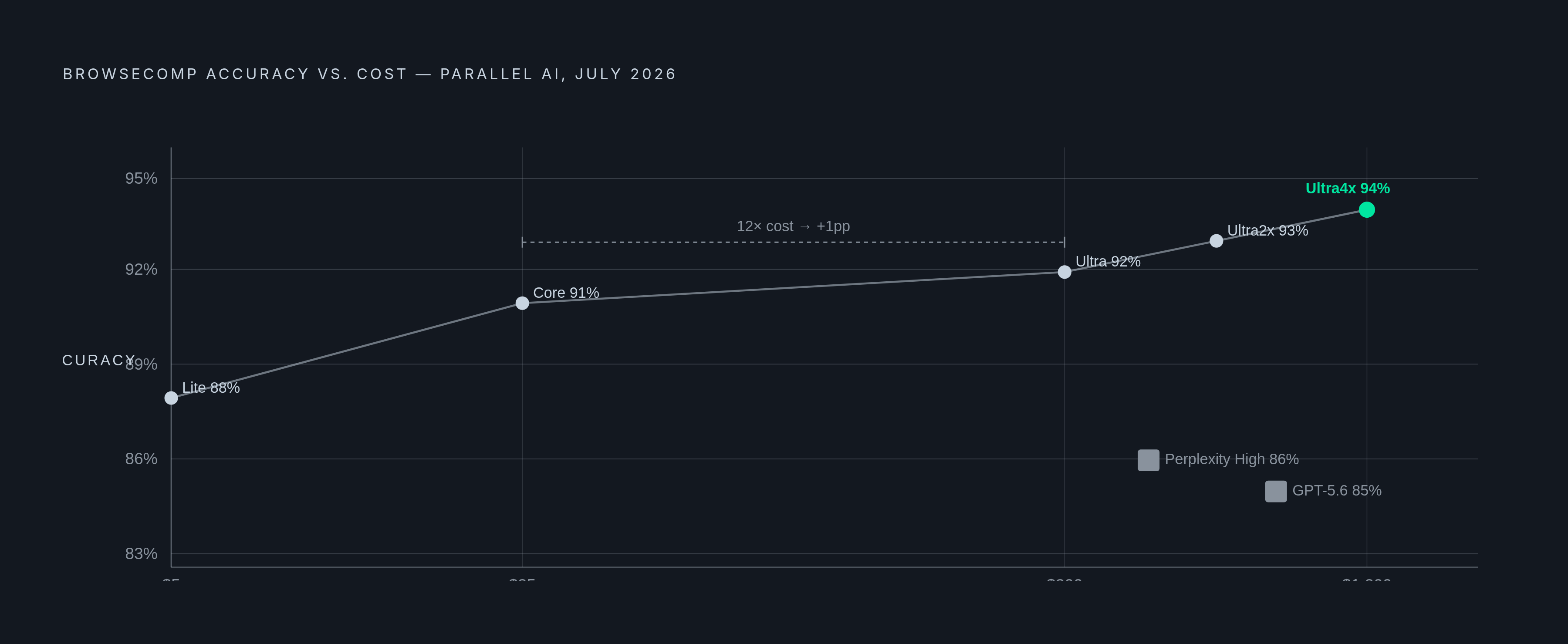
Parallel AI's July 2026 BrowseComp results lay out both a wide accuracy spread and a cost curve that bends in a genuinely strange way. Parallel Lite scored 88% at $5 per 1,000 queries. Parallel Core hit 91% at $25. Parallel Ultra reached 92% at $300, Parallel Ultra2x climbed to 93% at $600, and Parallel Ultra4x topped out at 94% for $1,200. Elsewhere on the same table, Perplexity High scored 86% at $441.50, Gemini 3.1 Pro High came in lower at 72% for $194.40, and GPT-5.6 Sol PTC Max posted 85% at $791.10. OpenAI Web Search scored 57.7% but couldn't even be plotted against the others, because its single search-call latency wasn't available, a small detail that ends up disqualifying an otherwise valid result from the comparison entirely.
Look at what happens between Parallel Core and Parallel Ultra: a 12x jump in spend, from $25 to $300, buys exactly one percentage point of accuracy. Push another 12x beyond that, to Ultra4x's $1,200, and the gain is three points. That's the kind of tradeoff a general benchmark never surfaces, because general benchmarks don't price anything.
On HLE, the spread is even more telling. Parallel AI benchmarks itself at 47%, while Perplexity comes in at 30%, and Tavily lands at 21%, a gap that simply wouldn't register on MMLU, where everyone's clustered near the ceiling. Glean's 2025 benchmark research adds a sobering enterprise data point: even the leading models sit around 70% accuracy on enterprise tool-use benchmarks, well under where most compliance-facing or customer-facing workflows would want their floor set.
Latency deserves attention here too, not as an afterthought but as a genuine cost driver. Search has become a meaningful share of monthly variable spend at AI-agent startups precisely because one user question can fan out into dozens of search calls before an answer gets assembled. A benchmark that skips latency and throughput is mispricing that cost by definition. You.com's Research API, which previously held the top spot on DeepSearchQA at launch, has since been passed by newer entrants there, while its Finance Research API currently ranks first on FinSearchComp's T2 sub-task for simple historical lookups, both of which sit on search-domain leaderboards measuring exactly the dimensions laid out above, making those placements directly comparable to the Parallel AI figures.
Why financial and other high-stakes verticals demand their own benchmark infrastructure
Stanford HAI's 2026 AI Index found that models evaluated across professional domains, tax prep, mortgage processing, corporate finance, legal reasoning, score somewhere between 75 and 87%, with the top 15 models often separated by no more than 3 percentage points. That's a tight cluster, and in a field where a wrong answer carries real financial or legal consequence, three points is not a gap anyone can afford to shrug off.
Scale Labs built a Professional Reasoning Benchmark specifically for Finance and Law, with a Finance-specific leaderboard, because general reasoning tests don't capture what actually matters in these fields: citation discipline, awareness of regulatory context, and the ability to reconcile conflicting sources. A finance-domain benchmark has to measure things a general one skips entirely. Every claim needs to trace back to a document someone can actually pull up and check. Financial data goes stale within hours, so a system pulling from old training data isn't approximately right, it's categorically wrong. And when two sources disagree, the system needs to flag the conflict rather than blend them into a single confident-sounding answer that happens to be false.
You.com's Finance Research API ranking first on FinSearchComp matters for exactly this reason: FinSearchComp is a domain-specific financial search benchmark, so that placement is a statement about citation discipline and source reconciliation, not general question-answering ability. Conductor's 2026 AEO/GEO Benchmarks Report found that Copilot already accounts for a meaningful share of AI traffic within the Financials industry specifically, which means these tools aren't waiting in the wings. They're already inside financial workflows, live, which turns benchmark differentiation from an academic exercise into a procurement decision companies are making now. The underlying principle scales beyond finance too: any vertical where a mistake costs more than a simple retry, legal, medical, regulatory, needs a benchmark that sets a hard floor rather than just a leaderboard that ranks who's ahead this quarter.
How agentic workflows change what search benchmarks need to measure
A 2025 survey on agentic deep research found standard LLMs using basic keyword search scoring below 10% on complex multi-hop research tasks. That single number should reframe how anyone reads a single-shot accuracy benchmark: it's testing the easy version of the problem, not the one that shows up in production.
Real agent workflows loop. A single user question routinely fans out into many separate search calls before the system settles on a final answer, and each of those calls introduces its own point of failure. A wrong result early in the chain poisons the reasoning that follows it. Latency that looked fine for one call becomes a real problem once it's multiplied across a dozen. A citation grabbed during an early retrieval step can drift out of sync with where the final answer actually lands. And long retrieval chains fill up the context window with noise well before the model gets around to assembling a clean answer. None of these failure modes show up in a single-shot benchmark, because a single-shot benchmark never runs the loop.
Stanford HAI's OSWorld data illustrates the scale of the gap between capability and reliability. Agent accuracy on real computer tasks across operating systems climbed from roughly 12% to 66.3%, a genuinely large jump, and one that still means these systems fail close to a third of the time on tasks built to resemble actual use rather than curated Q&A. METR's task-completion time horizon metric approaches the problem from a different angle entirely, measuring how long a task can run while a model still succeeds with 50% probability. It's the only widely used metric that expresses progress as a duration of sustained autonomy rather than a percentage score, which makes it directly relevant to agentic search, where the question isn't "can it get one answer right" but "can it hold together across the whole chain." A search API that scores well on single-shot accuracy but has never been tested under multi-step loop conditions is, for agent deployment purposes, an unknown quantity. Whether a vendor has actually tested for that is something the benchmark's own design either discloses or hides.
How to read a domain-specific leaderboard without being misled by it
Start with who ran the test. A number a vendor published about its own product is marketing copy until someone independent reproduces it, and the Claude 3.5 Sonnet GPQA gap (65% claimed, 0.55 ± 0.03 measured independently) shows exactly why that skepticism applies as much to search API vendors as it does to foundation model labs.
From there, check whether the task set is private, public, or some mix. Scale Labs pairs private datasets, which guard against overfitting, with public ones that keep results comparable across vendors. A leaderboard running only on a public task set carries a built-in overfitting risk, since a determined vendor can tune a model specifically to that public set without improving anything else.
Ask next whether the benchmark reports a confidence interval or just a single point estimate. PeopleSearchBench uses bootstrap resampling to generate 95% confidence intervals precisely because a bare point number implies a level of precision the underlying data usually can't support.
And check the date. Enterprise benchmarks need refreshing on a real cadence, ideally whenever a major model ships or the underlying infrastructure shifts, because a leaderboard last updated before a significant release is describing a market that no longer exists in its current form. Read against those four questions, a domain-specific leaderboard becomes something closer to a diagnostic tool than a scoreboard, and that shift in how the number gets read is, in the end, the entire point of building these benchmarks in the first place.
Sources
- AI Model Leaderboards & Benchmarks
- Technical Performance | The 2026 AI Index Report | Stanford HAI
- Model Benchmarks & Leaderboards | Models & Platforms | AI Technology Radar
- A Rosetta Stone for AI Benchmarks
- Beyond Leaderboards — Domain-Specific AI Benchmarks That Reflect Real-World Deployment Risk - SoftwareSeni
- When AI Benchmarks Plateau: A Systematic Study of Benchmark Saturation
- AI Benchmarks & Capabilities
- conductor.com