Measuring Retrieval Freshness in AI Search Systems
Stale citations in AI answers pose real risks without explicit freshness signals.

Retrieval freshness measures whether the evidence an AI system pulls up actually reflects the world right now, or whether it's quietly serving up the state of things as they stood when the index was last built. That distinction sounds academic until a chatbot cites a repealed regulation, a discontinued product, or a stock price from three quarters ago as if it were current. This piece breaks freshness down into something measurable, not just a vague quality judgment, and walks through the signals, the decay curves, the architecture, and the tooling that determine whether a retrieval pipeline stays honest about time.
Standard RAG (retrieval-augmented generation) ranks documents by semantic proximity in embedding space. That's an atemporal measure. A 2021 article about interest rate policy and a 2026 article covering the same topic can sit nearly on top of each other in vector space if the language is similar enough, even though one of them describes a world that no longer exists. Without a temporal notion of memory, LLM answers are prone to stale evidence, missed updates, and incorrect as-of statements. Layer on top of that the fact that the base model itself has a training cutoff, and there's a real risk that even a retrieval-augmented system leans toward older, more "familiar" content unless freshness gets treated as its own explicit ranking signal, not an afterthought.
Why does this matter outside of a research paper? Because in categories like financial data, product versioning, regulatory compliance, and security advisories, staleness isn't a rounding error, it's the whole failure. And the stakes go up as AI answers increasingly skip the step where a human clicks through to verify. Pew Research Center's March 2025 browsing study found that users clicked a traditional search result in just 8 percent of visits when a Google AI summary appeared, compared to 15 percent when no summary was shown. That means a stale citation baked into a synthesized answer reaches the reader with no real chance for a second opinion.
Freshness isn't a yes-or-no property, either. A document decays along several dimensions at once, at different speeds depending on what kind of content it is: how recently it was indexed, whether the facts inside it are still current, whether other sources still agree with it. Before any of that can be fixed, it helps to know what signals retrieval systems are actually reading when they decide something counts as "recent."
The signals AI retrieval systems use to judge recency
A crawl date is only one input among several, and treating it as the whole story misses most of what's going on. AI retrieval systems typically weigh a layered set of explicit and inferred signals, not a single timestamp stamped at the top of a page.
The explicit ones are the most literal: XML sitemap lastmod values, datePublished and dateModified fields in schema.org structured data, HTTP Last-Modified headers, and the visible "Last Updated" label a lot of sites now put at the top of articles. According to analysis from hashmeta.ai, these function as a primary sorting mechanism whenever multiple sources cover the same topic and a system has to break the tie.
But dates alone don't settle it. Topical corroboration matters too: when several recently published, authoritative sources converge on the same fact, that agreement itself reads as a freshness signal, and a page that contradicts the emerging consensus without explaining why risks getting pushed down in ranking, dated or not. Entity and data freshness works similarly. Content citing outdated statistics, a deprecated software version, or a regulation that's since been superseded gets cross-checked against newer indexed material, and a mismatch drags down its odds of being retrieved at all.
Then there's content velocity, which is a subtler one. Sites that keep updating existing pages, rather than just publishing new ones and walking away, send a sustained signal to crawlers that the content is being maintained. A one-off publication spike with no follow-up tends to decay faster than a page that gets revisited and revised over time.
None of this happens in isolation, though. The Gander AI Analytics Q1 2026 dataset, which tracked visibility decay by publication year, suggests that freshness alone does not explain retrieval prominence, authority remains a factor alongside recency. Freshness compounds with authority; it doesn't substitute for it. A brand-new page from a source with no track record doesn't necessarily outrank an older, well-established one just because it's newer. That interaction is worth sitting with, because it means freshness strategy can't be separated from the broader question of source credibility.
What empirical data shows about how fast retrieval visibility decays
Knowing the signals is one thing. Knowing how quickly they fade is another, and this is where the data gets genuinely useful.
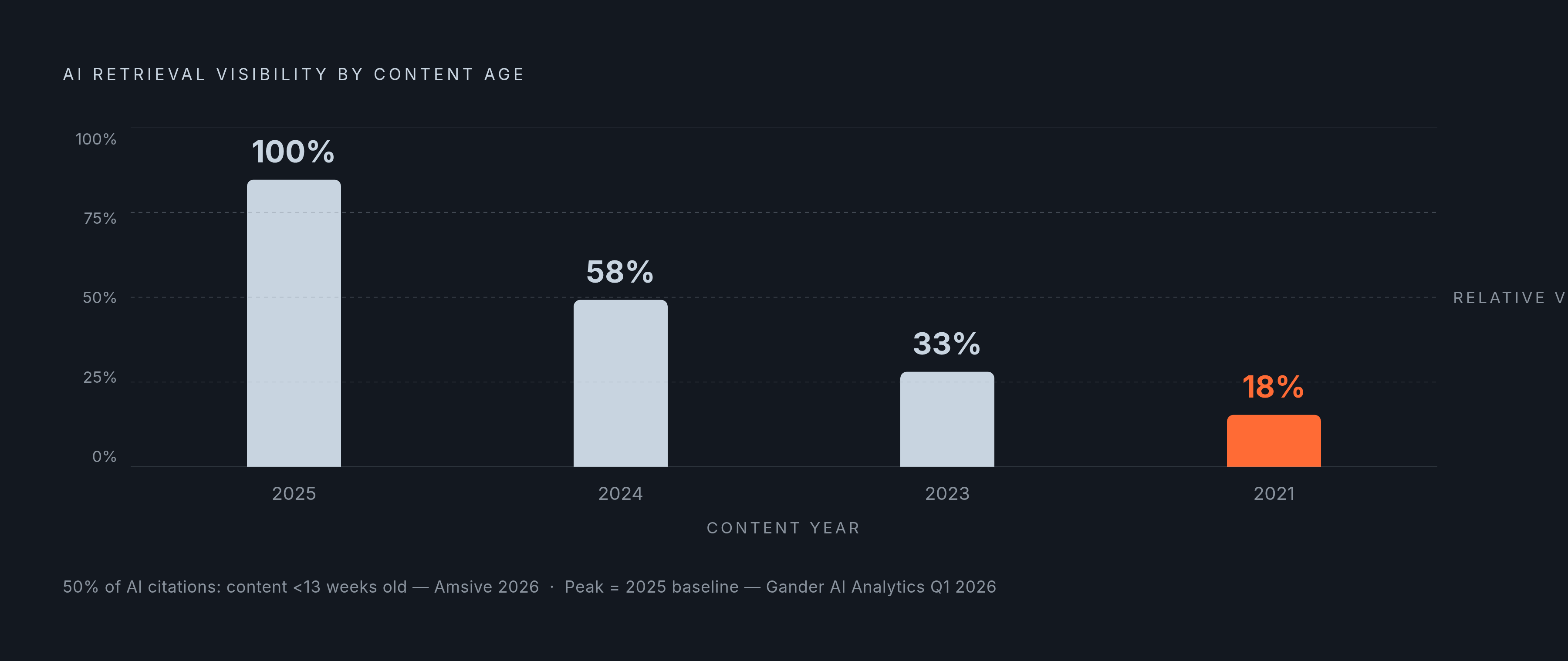
Gander AI Analytics ran a Q1 2026 study on a dataset 13 times larger than its December 2025 pilot, tracking unique URLs pulled into the retrieval layer across a wide sample. Of those URLs, 17.4 percent contained a year somewhere in the path, which let researchers build a year-over-year decay curve. The pattern was steep: content from 2025 saw a 42 percent visibility drop when compared to content from 2024, and dropping back another year, from 2024 to 2023, produced another 43 percent decline. By the time a page reaches 2021, it's operating at roughly 18 percent of its peak visibility. That's a strong empirical approximation of something like a one-year half-life in retrieval prominence, which should reframe how anyone thinks about "evergreen" content. Evergreen, in AI retrieval terms, may not last nearly as long as it did in classic SEO.
Amsive's 2026 citation freshness analysis adds a practical number to this: half of all AI search citations come from content less than 13 weeks old. The implication for anyone maintaining a site is fairly direct. A monthly update cadence on priority pages keeps them inside the strongest freshness window; quarterly or annual refreshes do not.
What about the model itself, separate from the retrieval layer? A Waseda University study presented at ACM SIGIR-AP 2025 tested seven different LLMs by artificially prepending publication dates to passages before feeding them into the models. The results were stark: individual items shifted by as many as 95 rank positions purely from date injection, and pairwise preferences between documents reversed by up to 25 percent depending on which date was attached. Every model tested showed the effect. That's an important distinction: recency bias isn't just something happening in the retrieval index, sitting outside the model, waiting to be filtered out. Some of it is baked into how the LLM itself interprets and weighs dated information.
The downstream consequence shows up at the brand level. AirOps data found that only 30 percent of brands maintain consistent visibility across back-to-back AI responses to similar queries, and freshness decay is a factor behind that volatility. A page can rank well one week and slip the next, not because anything about the underlying business changed, but because the content simply aged out of its freshness window while a competitor's got refreshed.
A working framework for measuring freshness across three dimensions
A single freshness score can't capture what's actually going on here, because different content types decay at wildly different speeds. The capital of a country doesn't need updating for decades. A live sports score is stale within minutes. A regulatory filing might be accurate for a year and then suddenly, completely wrong. Collapsing all of that into one number throws away the distinctions that actually matter for a builder trying to fix the problem.
Index recency is the first and most familiar dimension: how recently was this source crawled and pulled into the index? It's measured through last-crawl timestamps, sitemap lastmod fields, and HTTP headers. The limitation here is obvious once stated: crawl recency isn't the same as content recency. A page can get re-crawled ten times without any meaningful change, or it can be meaningfully rewritten in the hours between two crawl cycles and sit there, silently outdated, until the next pass catches it.
Semantic change detection is the second dimension, and it asks a sharper question: did the content itself change in a way that matters, since the last time it was indexed? OwlerLite, a system described in a paper at ACM Web Conference 2026 (DOI: 10.1145/3774905.3793140) out of the University of Passau, formalizes this idea. Its freshness-aware crawler uses text-level similarity comparisons to detect only the changes that are semantically meaningful, then selectively re-ingests just the affected chunks of text rather than reprocessing the whole document. OwlerLite's retrieval interface also breaks a retrieval score down into semantic, scope, and freshness components separately, which is about as precise as published architecture gets on making freshness an explicit, inspectable part of the pipeline rather than a heuristic bolted on after the fact. The design insight underneath all of it: periodic re-indexing without change detection wastes compute on pages that haven't moved, while still missing critical updates that landed between crawl cycles.
Staleness risk by query class is the third dimension, and it's arguably the most operationally useful one for anyone running a production system. FreshCache, described in arXiv 2607.04281 from researchers at Jeju National University, frames this as a risk-constrained temporal inference problem, sorting queries into five freshness classes based on how quickly their answers go stale. Each class decays at its own rate, and a single one-size-fits-all cache expiration policy wrecks efficiency in the stable classes while still letting stale answers slip through in the volatile ones. FreshCache's accompanying benchmark, FreshCache-Bench, includes 8,072 base queries with ground-truth staleness labels checked at 1, 12, and 24 hours and again at 7 days, expanded to 31,201 queries through paraphrase generation. It's currently the most rigorous public benchmark available for staleness risk broken out by content class.
Measuring across these three dimensions doesn't automatically fix anything on its own, though. It has to feed back into how the pipeline actually behaves, and that's where a lot of systems quietly go wrong. Even benchmarks age. The "Still Fresh?" paper (arXiv 2603.04532), out of a group including researchers at the University of Waterloo, evaluates how IR (information retrieval) benchmarks themselves decay over time, using the FreshStack dataset from the NeurIPS 2025 Datasets Track. The finding is a little uncomfortable: a retrieval system that scores well against a benchmark built a year ago may not actually perform well against content circulating today, because the benchmark itself has gone stale. LongEval, run at CLEF 2025, tackles a similar problem longitudinally, tracking system robustness as web and scientific collections evolve, using metrics designed to capture system robustness as collections evolve over time. Together these give builders an actual vocabulary for tracking freshness degradation over time in a live system, instead of relying on a gut feeling that "something seems off."
Where pipeline architecture introduces or conceals staleness
Most RAG systems retrieve from a fixed corpus that was indexed at some point in the past. As the live web keeps moving, that corpus quietly drifts out of sync with it. No error gets thrown. Nothing breaks in a way that shows up in a log. The answers just start being wrong, one small stale fact at a time, and there's no alarm bell built in by default.
Full re-indexing sounds like the obvious fix, yet it remains an impractical strategy at any real scale. It's slow and resource-heavy for high-volume or fast-updating sources, and worse, it misses everything that happens between cycles: a critical update published two hours after the last full crawl stays invisible until the next one runs, whenever that is. The architectural answer that's emerged instead, is incremental indexing: continuously watching for new or changed content and folding it in without triggering a full rebuild every time.
Semantic caching adds its own hidden risk here, and it's easy to miss because the cache is doing exactly what it's supposed to do. These caches serve up a stored answer to any query that's semantically similar enough to one already answered, which cuts latency and API cost substantially. But an answer that was accurate the moment it got cached might be wrong by the time it's served again. Fixed TTL (time-to-live) policies create a false choice: set the expiration too short and the cache barely helps; set it too long and stale answers keep circulating. FreshCache's response to this is a tiered fallback model. When the staleness risk on a cached answer crosses a set budget, the system falls back to re-fetching the actual content instead of trusting the cached answer, saving on search costs while still producing something current. If that intermediate layer looks risky too, a conditional check verifies whether the underlying pages actually changed before committing to a full, unconditional re-fetch. It's a graceful degradation path rather than an all-or-nothing cache hit.
Chunk size adds one more layer of tension to all this. Smaller chunks sharpen semantic precision during retrieval. Larger chunks, give the generation step more coherent context to work with. That same granularity tradeoff shows up again with freshness: fine-grained chunks make it easier to isolate exactly what changed in a document, but coarse chunks are cheaper to re-index. OwlerLite's selective re-ingestion of only the changed text chunks is one direct answer to that tension, letting a system get precision without paying the cost of reprocessing an entire document for a one-line edit.
None of this works, though, if the system leans only on timestamp heuristics. The temporal RAG systems relying purely on date-based rules can fail on queries where recency, historical validity, and change over time all interact at once, meaning heuristics need to be supplemented, not treated as the whole solution. That raises a real question for anyone building this: once the architecture is mapped and the failure points are named, what infrastructure actually gives a team control over freshness in the moment a query comes in, rather than after the fact?
What real-time web retrieval APIs contribute that static indexes cannot
A static index ages the moment it's built and keeps aging until the next update cycle. A real-time web retrieval API works differently: it resolves a query against the live web at the exact moment the call is made, so the freshness ceiling becomes the crawl latency of the underlying system, not the age of some fixed snapshot sitting in storage.
That distinction matters most in categories where hours-old data isn't just imprecise, it's operationally unusable: financial news, earnings releases, regulatory changes, security advisories. It also enables something quieter but just as important, which is source reconciliation. When live retrieval surfaces the actual document alongside the generated answer, staleness becomes auditable. Someone can check the date on the source instead of just trusting the output.
Demand for this kind of infrastructure is climbing fast. Cloudflare's 2025 crawler analysis found that GPTBot request traffic grew 305 percent between May 2024 and May 2025, and ChatGPT-User traffic grew 2,825 percent over the same window, off a much smaller starting base. Numbers like that turn infrastructure choices into systems-level decisions, not just product features tucked into a roadmap.
You.com's suite in this space, the Web Search API, Answer API, Contents API, Research API, and Finance Research API, is built specifically for this layer: real-time web retrieval with cited sources, so agents and LLMs can ground answers in what's actually on the live web rather than whatever was baked into training data at some earlier point. The Research API is positioned toward the top of the DeepSearchQA benchmark, and the Finance Research API ranks first on FinSearchComp's T2 historical lookup sub-task. Those are public, checkable benchmark results, not just a marketing claim sitting on a page. Because each response comes back with cited sources attached, freshness stops being a black box: a builder can look at the retrieval date and source for each grounding document directly, rather than trusting the system's word for it.
Building a practical freshness measurement practice for production systems
Plenty of teams sense that freshness matters without actually measuring it, and that gap is where problems compound quietly. A Branch survey of enterprise leaders found that 89 percent reported AI-powered search had improved their marketing performance in 2025, yet most were still working out how to measure that impact with any precision. Belief in the value of freshness isn't the same as an instrumented system for tracking it.
The fix starts with instrumenting freshness at every stage of the pipeline, not just checking the final output and calling it done. At the index layer, track the last-crawl timestamp against how often the source actually updates, and flag anything where the gap crosses a threshold set per content class. At the retrieval layer, log the publication or modification date of every document alongside its retrieval score, and watch how the distribution of retrieved-document ages shifts over time, not just at a single snapshot. At the cache layer, apply staleness budgets by class, following something like FreshCache's five-class freshness framework, instead of leaning on one universal TTL, and treat the stale-hit rate as a core cache health metric worth watching on its own.
The answer layer deserves particular attention, and this is where intuition can mislead. FreshCache's LLM-judge evaluation found that only 34.3 percent of detected content changes actually affected answer correctness. That's a meaningful number: a high rate of page changes doesn't automatically translate into a high rate of answer errors. Measuring at the document level alone would overstate the problem; measuring at the answer level shows where it actually bites.
Longitudinal benchmarks help catch the kind of drift that's invisible in any single snapshot. The "Still Fresh?" paper's approach, checking whether an IR benchmark itself has decayed relative to current content, is worth adopting as an ongoing practice rather than a one-time academic exercise. What looked like solid retrieval performance six months ago might be scoring against content that no longer represents what's actually circulating now. Measuring retrieval decay at scale takes infrastructure that treats real-time indexing and freshness tracking as first-class concerns rather than an afterthought bolted onto a semantic search stack, which is the same gap that platforms built around live retrieval, ranking sources by recency alongside relevance, are trying to close.
None of this makes freshness a solved problem. It makes it a measurable one, with named dimensions, published benchmarks, and decay curves that hold up across studies. That's a meaningfully different starting point than treating staleness as an unfortunate, unavoidable cost of doing retrieval at scale.
Sources
- How AI Search Engines Evaluate Content Freshness and Recency
- OwlerLite: Scope- and Freshness-Aware Web Retrieval for LLM Assistants
- Risk-Constrained Freshness-Aware Semantic Caching for Open-Web Retrieval-Augmented LLMs
- takeagander.ai
- Still Fresh? Evaluating Temporal Drift in Retrieval Benchmarks
- The Content Freshness Factor: Why AI Search Rewards Living Knowledge - Virtual Employee
- LongEval at CLEF 2025: Longitudinal Evaluation of IR Systems on Web and Scientific Data
- foglift.io