Open Benchmarks vs Proprietary Benchmarks for Search Infrastructure
Vendors control the test and the score, but open harnesses let buyers verify the results themselves.

The open-versus-proprietary benchmark debate sounds like a familiar argument about AI models, but for search infrastructure it collapses into one narrower question: who controls the evaluation harness, and can anyone outside that organization actually rerun the test and get the same number?
The model benchmark conversation is well documented on its own terms. None of that measures what a search API actually does in production. Search infrastructure has to be judged on live retrieval accuracy, latency under agentic load, and freshness of the underlying index, properties a static model eval was never built to capture. A team that imports model-benchmark reasoning into a search API purchasing decision is making an infrastructure choice on evidence that was never designed to speak to infrastructure.
A conflict of interest connects both conversations, one that the model benchmark debate has at least partly worked through, via independent leaderboards, academic replication, and public provenance labeling, but that search infrastructure evaluation has barely begun to address. The organizations best positioned to benchmark a search API, the ones with the engineering resources, the query volume, and the incentive to publish, are frequently the same organizations selling that API. A vendor-controlled benchmark with no public harness is structurally biased toward its publisher. That is not a suspicion to be argued for, it is a design consequence of who gets to write the test and grade it. The rest of this piece works through what happens when that harness stays hidden, what it looks like when it does not, and what a buyer should demand before trusting any number put in front of them.
Why hidden harnesses make benchmark scores unreliable
Identical model weights can score meaningfully apart depending on which harness evaluates them, and that gap only becomes visible once the harness itself is public enough for someone else to rerun it. This is not a hypothetical risk confined to obscure edge cases. A proprietary benchmark that will not release its question set forecloses that kind of check before it can even start.
The clearest illustration of what happens when self-grading goes unchecked came from Meta in April 2025. The two systems were not the same thing wearing different names. One was built to win a popularity contest with human raters, and the other was the product customers would actually use. That case matters beyond Meta's specific leaderboard result because it demonstrates the logical endpoint of proprietary self-evaluation: a resourceful organization can always field a benchmark-optimized variant that never reaches deployment, and without a public harness, nobody outside the organization has any way to catch the substitution before the headline score circulates.
You can get some progress from minimal transparency standards even without full openness. BenchAlign v5.2 labels each model's position in its rankings with a provenance tag. So how much weight you put on a given ranking depends on that distinction, and this modest labeling scheme, a two-word tag distinguishing verified from self-reported, is still more than most search API vendors give their customers.
Search infrastructure introduces a failure mode with no equivalent at the model layer: search-time contamination. Without access to the vendor's live data pipeline and query log patterns, an independent auditor cannot tell whether a reported accuracy score reflects genuine retrieval capability or an accident of the vendor's own search index surfacing the answer because it happened to be freshly crawled. That is precisely why an open harness matters more for search infrastructure evaluation than it does for model benchmarking: the thing being measured keeps changing underneath the test.
What an open, reproducible search benchmark looks like
A benchmark earns trust only to the degree its methodology is open: public code, a disclosed question set, a held-out scoring mechanism, and results that anyone can independently rerun and check against the published numbers. Those four conditions are not a wish list, they are the minimum bar a claim has to clear before it should move a purchasing decision one inch.
The openbenchmarks.com methodology shows what this looks like when you apply it to search APIs instead of models. An independent, open-code benchmark ran a set of factual questions across more than eleven web search APIs and published the results side by side: accuracy, latency, result token count, and cost per thousand queries. What separates this from a vendor self-report is the held-out scoring set. The system doing the grading never sees the questions in advance, and because the code itself is public, anyone skeptical of the result can run it themselves rather than taking the published chart on faith. That structural difference, between a benchmark a buyer can rerun and one they can only read about, is the entire argument this piece is making, compressed into a single worked case.
Perhaps the most telling data point is the asymmetry itself: proprietary search API providers, as a category, do not publish equivalent head-to-head comparisons of their own accuracy against competitors under a shared methodology. Platforms like Youcom that publish results against third-party, independently reproducible harnesses, rather than self-reporting their own proprietary scores, give teams something closer to a structural guarantee than a marketing claim, the ability to audit the test, rerun it, and treat the output as a verifiable fact rather than a vendor's assertion about itself.
None of this should be mistaken for a complete solution. The evaluation surface for agentic grounding, where an agent decides on its own what to fetch, retrieves live sources, and constructs an answer from whatever it found, is inherently dynamic, and a frozen test set administered once cannot fully characterize a system whose behavior changes with every live query. But what if the honest response to that gap is to build more and better open benchmarks rather than retreat to proprietary ones? A proprietary benchmark that hides its harness cannot be fixed by outsiders because outsiders are never allowed to see what is broken.
Open infrastructure governance and open benchmarking
The push toward open, reproducible benchmarks is not a separate trend running alongside enterprise interest in vendor-neutral infrastructure, it is the same organizational logic applied to a different layer of the stack. Both reduce an enterprise's dependency on taking a single vendor's word for how well its own product performs.
The 2026 Open Data Infrastructure Report, produced by the OpenSearch Software Foundation together with Linux Foundation Research, found that most organizations already run or plan to run AI workloads, and 71% of them prioritize vendor-neutral infrastructure when they make those decisions. Both movements turn on the same question: whose word are we taking for this? An enterprise that insists on vendor-neutral search infrastructure for the same reason it insists on an independently reproducible benchmark, because a single vendor's internal claims about its own system carry no external check.
The structural opposite of that posture is the fully proprietary end-to-end stack, and Google's own infrastructure moves in 2026 illustrate what that looks like concretely. At Google Cloud Next 2026, announced April 22, 2026, Google rebranded Vertex AI as the Gemini Enterprise Agent Platform, absorbing Gemini Enterprise, itself formerly known as Agentspace before an October 2025 rename, into one unified product. When evaluation, grounding, and deployment all sit inside the same vendor's platform, independent benchmark verification becomes close to structurally impossible, because there is no seam left in the stack where an outside auditor could insert a measurement, not because anyone involved is acting in bad faith. Anthropic's Responsible Scaling Policy, which has gone through multiple iterations as a governance framework for self-evaluating frontier model capability, sits in a similar structural position even where its stated intent is responsibility rather than concealment: an internal governance process, however well designed, is still the opposite of open benchmarking in form, because the test, the grader, and the subject all belong to the same organization.
Commonwealth Bank of Australia's July 2026 meta-benchmarking framework shows what you get when a regulated institution builds that alternative on purpose. This example concerns LLM evaluation inside a bank, not search API benchmarking directly, and it should not be read as a one-to-one analogy. Public benchmarks, aggregated through a transparent and published method, gave the bank a defensible and auditable alternative that internal testing alone could not sustain. Even one of the most regulated, highest-stakes buyers in the industry concluded that transparent, aggregated public benchmarks are more governable than proprietary self-reports, which is close to the exact argument this piece is making about search infrastructure specifically.
Compliance pressure and benchmark transparency
For a regulated enterprise, particularly in financial services, benchmark opacity and data-perimeter opacity turn out to be the same underlying problem. Both force you to trust a vendor's claims that nobody outside the vendor can check, and both create exposure that regulators now actively scrutinize instead of quietly tolerating.
Large language models can produce incorrect or fabricated information across a wide range of responses, and this gets worse on complex or domain-specific tasks because these systems rely on static, pre-trained data instead of live, current sources. The driver is not an abstract interest in performance, it is the legal and operational cost of a compliance team acting on a fabricated output. If the search infrastructure grounding that output cannot be independently benchmarked for accuracy, the enterprise has no evidence chain to hand a regulator or an auditor when the question of how a decision was made eventually gets asked.
That question is being asked with increasing frequency. Financial services compliance professionals rate data privacy and AI hallucinations as the top two risks of AI deployment, and nearly 7 in 10 compliance professionals globally say AI is the factor most likely to cause compliance issues in 2026. Regulatory scrutiny around these systems is rising rather than holding steady, which changes the calculus for any infrastructure decision made today. But the shift underway in regulated industries, from synchronous, on-demand AI toward asynchronous, background AI built on precomputation, continuous enrichment, and event-driven pipelines, touches AML, KYC, fraud prevention, and compliance workflows directly, and it changes what a benchmark needs to cover. If a benchmark is built around a synchronous query-response loop, it cannot measure how a system performs inside a background pipeline that enriches data continuously with no human waiting on the other end of each call. Open benchmark code can be adapted and extended to cover that architecture as it becomes standard. A proprietary benchmark, controlled entirely by the vendor that built it, offers no path for an outside institution to extend its coverage.
When a workload cannot leave the enterprise perimeter under data-residency rules, open, self-hostable search infrastructure is increasingly the only path you have, and that constraint determines what the benchmark must support. A proprietary benchmark that requires sending evaluation data to a vendor's own scoring endpoint is incompatible with a data-residency requirement by definition, since the test itself would violate the rule it is meant to help satisfy. Open benchmark code that runs entirely on-premise resolves that conflict. A proprietary benchmark program, no matter how well-intentioned, structurally cannot.
Evaluating a search API benchmark
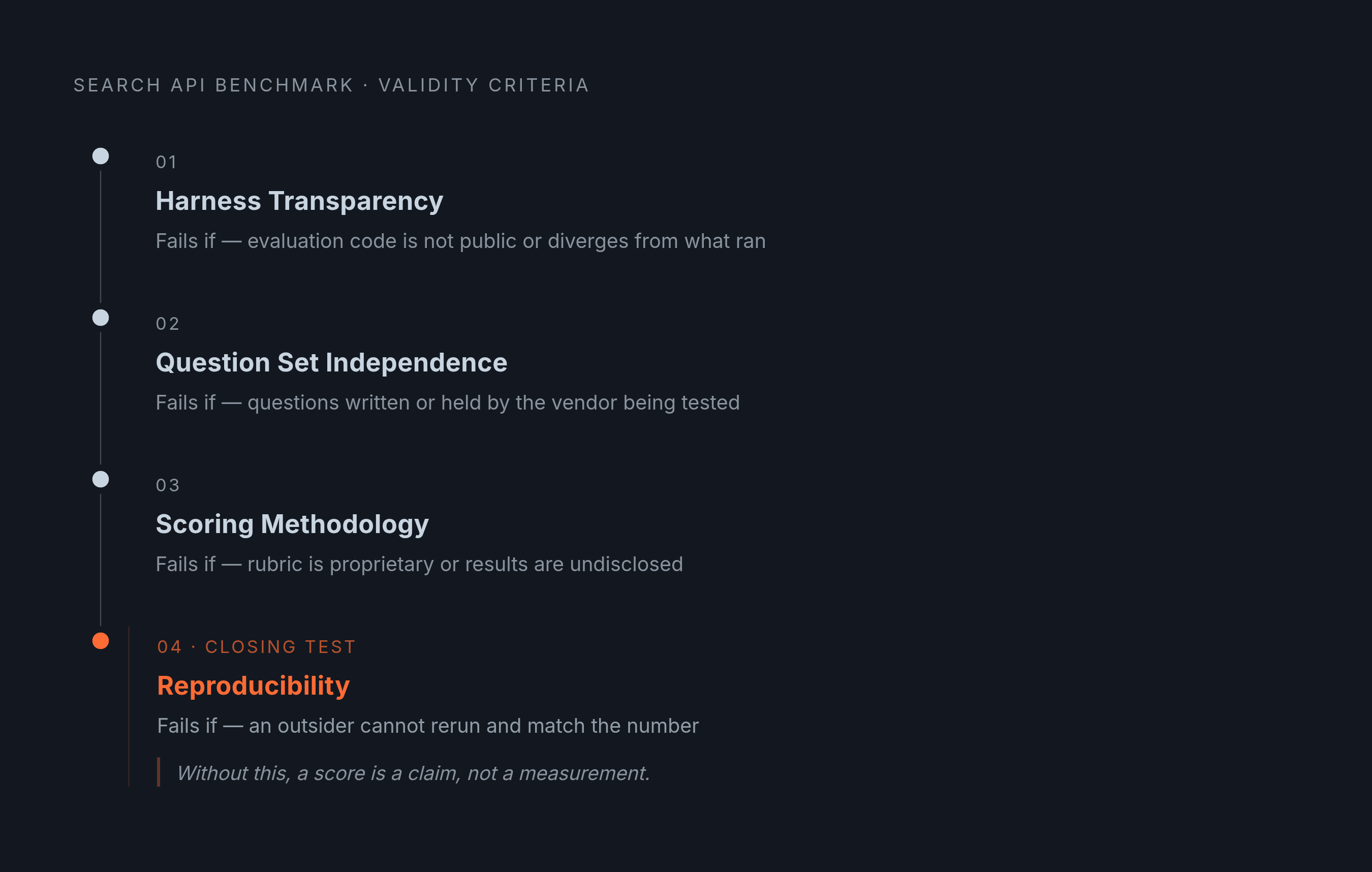
Any benchmark claim, whether it comes from an open methodology or a proprietary one, should be measured against four properties before it influences an infrastructure decision: harness transparency, question set independence, scoring methodology, and reproducibility. That raises an important question for anyone reading a vendor's published chart: which of these four does the claim actually satisfy, and which has it merely implied?
Harness transparency comes first. If the evaluation code behind a published score is not public, scores from different providers cannot be meaningfully compared, because the harness itself may differ between runs in ways nobody outside the vendor can see. Public code is necessary here but not sufficient on its own: the code published has to be the exact code used to produce the published numbers, not a cleaned-up version released afterward that may no longer match what actually ran.
Question set independence matters just as much. Who wrote the questions, and can an outside party inspect them? If a vendor builds the question set used to test itself, even unconsciously optimized toward its own strengths, the result is product marketing wearing a methodology section. A held-out scoring set, of the kind the openbenchmarks.com methodology uses, addresses this directly: the questions exist separately from the system being graded, and the grader cannot have seen them in advance.
Scoring methodology is the third test. A benchmark should tell you how it judges answers correct or incorrect, whether that judgment is automated or human, and whether you can inspect the scoring rubric itself, because a vague or undisclosed scoring process can quietly favor whichever system the benchmark's author most wants to look good.
Reproducibility closes the loop on the other three. A benchmark that cannot be rerun by someone outside the organization that built it is, for practical purposes, a claim rather than a measurement, no matter how rigorous its internal process might genuinely be. A buyer facing a published search API ranking should ask which of these four properties the number in front of them can actually survive. A score that holds up under all four is evidence. A score that holds up under none of them is an advertisement dressed as data, and the structural question this piece opened with decides which one you're looking at: who controls the harness, and can anyone else run it and get the same answer.