Scaling Real-Time Retrieval Pipelines to Enterprise Workloads
Enterprise AI systems fail silently when retrieval infrastructure can't keep pace.

Scaling Real-Time Retrieval Pipelines to Enterprise Workloads.
Why the retrieval layer has become the enterprise AI reliability problem
Scaling a retrieval pipeline to enterprise workloads is an infrastructure engineering problem. The choices that decide whether an AI system holds up in production, how fresh its index stays, how fast it answers, whether dense and sparse retrieval work together, and whether every result can be traced back to a source, all live below the model, in the plumbing most teams still treat as an afterthought.
Retrieval-augmented generation started as a patch job. Bolt a search step onto a language model, cut down on hallucinations, ship it. That framing is gone now. RAG sits underneath internal copilots, financial research assistants, compliance automation, and customer intelligence engines: the retrieval layer, not the model and not the prompt, decides whether outputs can be trusted, checked, and paid for at scale.
For a stretch in early 2026, a competing idea gained real traction: that long-context windows, models that can read hundreds of thousands of tokens at once, would make dedicated retrieval pointless. Just stuff everything into the prompt. The data killed that argument fast. Belief in long-context-as-dominant-architecture ran at 15.5% in January, dropped to 3.5% by February, and only climbed back to 6.7% in March. A brief bounce, not a comeback. Retrieval didn't get replaced. It got confirmed as actually doing the work.
How does this shortfall actually appear inside a company? Usually late, and usually after the celebration. The pilot succeeds because pilots run on curated, well-behaved data. Production runs on everything else. 70% of organizations discover their data infrastructure is fundamentally insufficient only after launching production AI initiatives (the failure typically surfaces six months in, after a successful pilot).
Where single-method RAG breaks at scale, the failure patterns that drive the rebuild
This failure point is concrete and common. When an enterprise attempts to process millions of unstructured documents, synchronous ETL pipelines trigger memory leaks, basic embedding searches return wildly inaccurate context, and legacy reranking models push retrieval latency past the 1.5-second mark. Each of those failures compounds the next one: slow ingestion means stale indexes, stale indexes mean bad candidates, bad candidates mean the reranker has nothing good to work with even if it's fast.
Storage adds its own bill. Billion-vector indices sitting on managed public cloud infrastructure carry real egress costs and cross-tenant exposure risk once multiple business units or customers share the same backend. That's a named failure mode enterprises run into once they cross from thousands of vectors into the billions. It's a named failure mode enterprises run into once they cross from thousands of vectors into the billions.
Freshness might be the quietest failure of all, and arguably the most dangerous one. A retrieval system running hours or days behind the live data source doesn't crash, doesn't throw an error, doesn't fail loudly. It just answers confidently with old information. Evaluation frameworks don't catch it because the retrieval still "works," it returns results, ranks them, hands them to the model. The model still answers confidently with old information from before yesterday's change. That's a silent accuracy regression, and it appears in a compliance audit long after it should have been caught.
One might argue the market hasn't even gotten to the point of hitting these walls yet. So the picture splits: a chunk of the market hasn't started, while the rest is running headfirst into scale-wall failures that only appear once real document volume and real query load hit the system.
Hybrid retrieval as the production architecture: how dense, sparse, and reranking layers work together
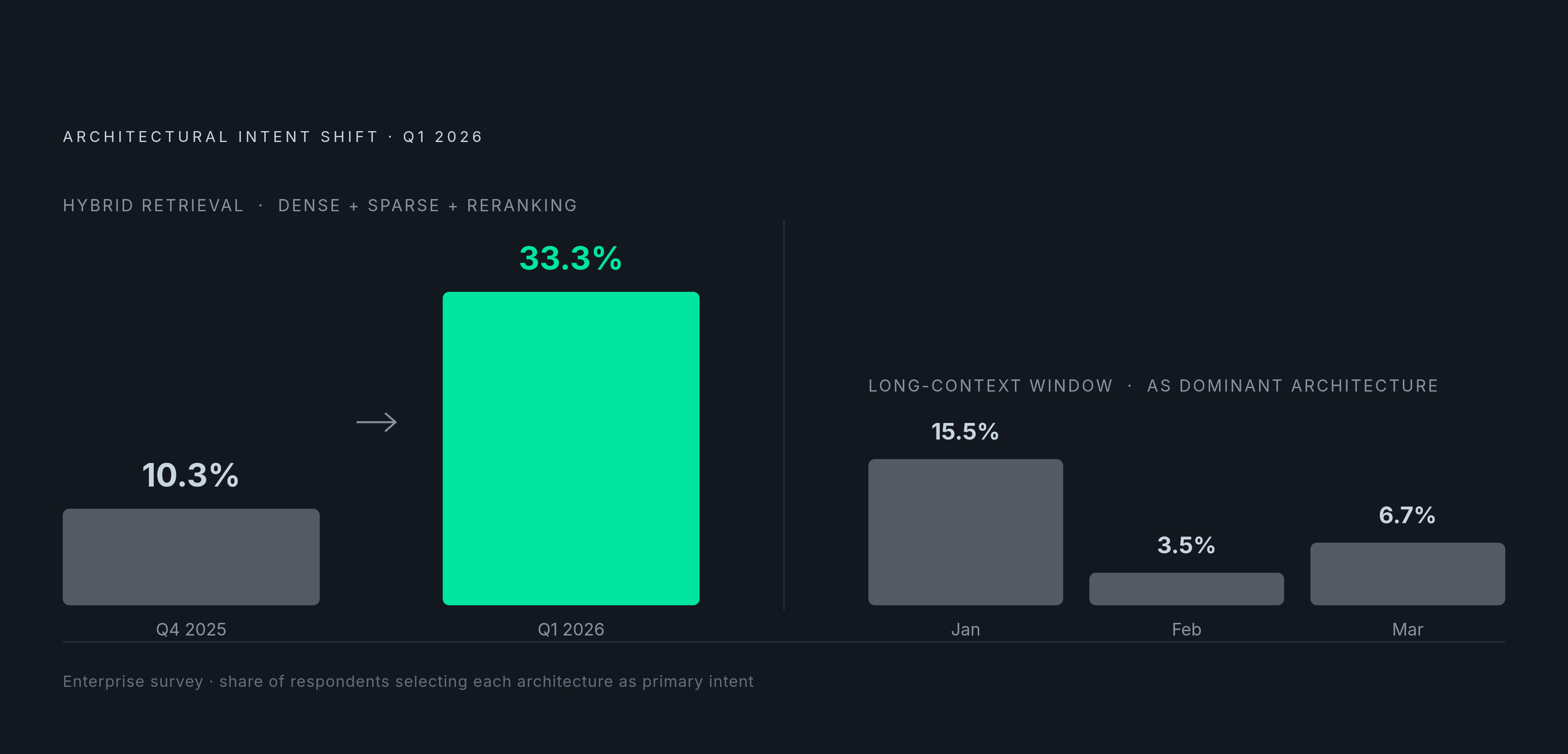
Something shifted hard here in a single quarter. Enterprise intent to adopt hybrid retrieval, meaning dense embeddings and sparse lexical search running together rather than one replacing the other, jumped from 10.3% to 33.3%. That's the sharpest single-quarter move in architectural preference the survey has tracked. Why would an entire market pivot that fast on one design choice?
Because neither method alone holds up under real enterprise query patterns. Dense retrieval, the transformer-embedding approach that measures semantic closeness, is good at catching paraphrase and conceptual overlap, but it stumbles on product codes, part numbers, and anything out-of-vocabulary, the exact kind of query a support agent or a procurement analyst types all day. Sparse retrieval, BM25 and its variants, does the opposite: rock-solid on exact lexical matches, but blind to conceptual relationships and blind to paraphrase. A query like "return policy for damaged goods" and one that says "what happens if the item I bought arrives broken" mean the same thing to a person and nothing alike to BM25.
Weighting dense and sparse scores together produces a blended result that consistently beats either method running solo. The right weighting isn't fixed across companies or use cases. It gets tuned empirically, against real query logs, not copied from a paper.
Merging candidate sets from two retrieval methods still leaves noise, though, so a reranking layer sits after them. Cross-encoder rerankers take the combined candidate pool and re-score it for actual contextual relevance before anything reaches the language model.
Measuring whether any of this is working comes down to two numbers that pull against each other: precision is the share of retrieved documents that are actually relevant, and recall is the share of all relevant documents the system actually found. In finance or healthcare, a 10% drop in recall is not a rounding error. It's a missed regulatory filing or an overlooked update that quietly corrupts everything the agent concludes downstream.
Real-time ingestion pipeline design: keeping the index fresh without collapsing under load
The target is straightforward to state and hard to hit: propagate source changes into embeddings and vector indexes within seconds or minutes, not hours. That gap between batch and streaming is the entire difference between a system that's reliable and one that quietly serves stale answers.
A production pipeline capable of that generally runs on a handful of layers stacked together. Event streaming is the base, Apache Kafka, Apache Pulsar, Amazon Kinesis, or Google Pub/Sub, and Kafka-based setups still dominate at high-scale enterprises mostly because the ecosystem around it, the connectors, the tooling, the operational know-how, is more mature than the alternatives. On top of that sits stream processing: Apache Flink, Apache Spark, or Kafka Streams handling windowed aggregation, anomaly detection, real-time feature computation, and embedding generation as records flow through.
Below that, an online feature store, such as Feast or Tecton, bridges data engineering and ML by ensuring consistency between training and inference, preventing training-serving skew, one of the most common causes of production AI failure. That consistency problem sounds abstract until it isn't: training-serving skew, where the features a model trained on don't match the features it sees in production, is one of the most common ways production AI systems quietly break. And feeding all of it, change data capture handles propagating updates out of transactional systems without triggering a full re-index every time a record changes. Without CDC, every update means reprocessing everything, a synchronous bottleneck that causes the memory leaks and latency spikes described earlier.
AI-native enterprises increasingly favor a Kappa architecture, streaming-first, over the older Lambda approach that ran batch and speed layers side by side. Kappa is simpler to reason about and avoids the duplicated logic that Lambda architectures tend to accumulate between their batch and streaming paths. It's also more scalable, if only because there's one code path to maintain instead of two that have to stay in sync.
None of this runs itself, either. An orchestration layer has to route traffic dynamically, scale pipeline components up and out as load shifts, and resolve bottlenecks automatically rather than waiting for someone to notice a queue backing up. That's adaptive pipeline management, not a static cron schedule, and the distinction matters once ingestion volume becomes unpredictable.
Vector database selection and index architecture at billion-scale
Choosing a vector database at billion-vector scale comes down to a trade-off that doesn't have a universally correct answer: managed cloud databases are operationally convenient but carry the egress costs and multi-tenancy risk mentioned earlier, while bare-metal or dedicated deployments hand back control at the price of real engineering overhead. Which side wins depends on the workload, the compliance requirements, and, frankly, the size of the team maintaining it.
Index type is the first real decision. IVF trades some recall for throughput at scale. Flat indexes still have a place for smaller collections where exhaustive search is affordable, but they don't survive contact with billions of vectors.
Filtering is where a lot of the pain lives, and it doesn't get talked about enough. Metadata filtering can happen before the vector search runs (pre-filtering) or after (post-filtering), and the choice affects recall directly once access control lists come into play.
That leads to the sharper point: permission-aware retrieval has to be enforced at the index level, not bolted on afterward in the application layer⟦c20�ields. Checking permissions after retrieval, late-binding it, risks exposing records a user was never authorized to see in the first place, even briefly, even if the application layer eventually blocks the response. In a regulated environment, "eventually blocked" isn't good enough; the exposure already happened.
Storage footprint deserves its own line of planning, separate from index choice. Permission-aware retrieval requires that ACL inheritance be enforced at the index level, not the application level, since late-binding permission checks after retrieval risk surfacing records users are not authorized to see.
Latency and throughput targets that production systems must hit
Latency requirements are set by the use case sitting on top of the retrieval layer. They're set by the use case sitting on top of the retrieval layer, and treating them as interchangeable is where a lot of SLA violations start. Fraud detection and real-time decisioning need millisecond-level response, full stop, because a slow detection there is functionally a missed one. Customer-facing copilots and knowledge assistants need sub-second retrieval to keep a conversation feeling like a conversation rather than a chatbot that's thinking. Financial research and compliance workflows sit differently: completeness and accuracy take priority over raw speed there, but even in that world, retrieval crossing the 1.5-second mark is treated as a named failure threshold.
What looks fast in a lab often isn't fast in production, and the gap is measurable. A 37% difference exists between benchmark performance and real-world deployment performance: a retrieval system clocking impressive numbers in an isolated evaluation can still blow its SLA the moment concurrent user load hits it for real. Benchmarks run single queries against a warm cache. Production runs hundreds of overlapping queries against a system that also has to keep ingesting new data at the same time.
Latency accumulates in stages, and each one has to be budgeted separately rather than lumped into a single end-to-end number. Embedding a query at request time costs more than serving a pre-computed embedding, so the choice of when embeddings get generated matters. Reranking adds its own cost: cross-encoders are accurate specifically because they're expensive to run, comparing query and document pairs directly rather than just measuring vector distance, and that expense has to be counted against the full retrieval chain, not treated as a rounding error after the ANN search. Network hops between components add up too, and they get worse fast if the vector database, the LLM inference endpoint, and the reranker happen to sit in different regions or different clouds, since every hop between them is a network round trip charged against the latency budget.
Throughput planning follows a similar logic. An organization ingesting a heavy, constant stream of new records every week needs a fundamentally different compute profile than one working off a corpus that barely changes, and the pipeline has to keep embedding new content without ever blocking a query that's trying to run at the same moment.
When to extend retrieval with live web search: the case for external search APIs in enterprise pipelines
Internal indexes, no matter how well built, go stale on anything happening outside the company's own walls. Regulatory changes, market pricing shifts, competitor moves, breaking news, none of that lives in a document management system, and a crawl schedule measured in days is too slow for a use case that depends on knowing what changed an hour ago.
Most traditional SERP APIs return titles, URLs, and short snippets, which forces developers to fetch and parse each URL separately, whereas search APIs built for AI return full page content as clean Markdown alongside the result, so a single API call covers both discovery and extraction. Search APIs built specifically for AI workloads skip that step: they return full page content as clean Markdown alongside the search result itself, so a single API call covers discovery and extraction together.
Selecting one of these for enterprise use comes down to a handful of concrete things to check, not marketing copy. Freshness controls matter first: time filters for past hour, day, or week, and continuous indexing rather than a fixed crawl cycle, are what make the difference for anything tracking news, pricing, or regulatory activity. Zero Data Retention matters just as much for healthcare, legal, financial, and government workflows, where queries and results can't be stored anywhere. This isn't optional in many compliance frameworks, it's a requirement. Native integration with LangChain, LlamaIndex, and MCP servers, plus SDKs in the languages a team already uses, cuts integration time from days down to hours. Latency guarantees, specifically p99 commitments, matter once the web search step sits on the critical path of an agentic pipeline rather than running as a background enrichment task. Structured output, Markdown or JSON extraction that's LLM-ready without an additional parsing pass, saves an entire engineering step that otherwise has to be built and maintained in-house.
Domain-specific coverage is where a general-purpose crawler starts to show its limits, too. A developer-focused index covering tens of millions of developer artifacts, refreshed daily in most cases, serves a coding agent in a way a generic web index doesn't, and a research-focused index covering millions of papers with linked code, extended into life sciences with tens of millions of drug discovery, clinical, and biology papers pulled from sources like PubMed, bioRxiv, and medRxiv, serves a research agent the same way. The specificity of the index ends up mattering as much as its size.
Enterprises weighing whether to build this whole layer in-house or hand it off face a real build-versus-buy decision here. Building continuous web crawling, freshness tracking, and extraction from scratch is its own multi-quarter engineering project, on top of everything already described for the internal retrieval stack. Search APIs built for AI, of the kind traditional SERP APIs are not, exist to cover that gap, returning full page content as clean Markdown alongside the result so a single API call covers both discovery and extraction.
Observability and evaluation: what a production retrieval system must expose to be trusted
Something changed in where enterprises put their money, and it's a useful signal of where the pain actually sits. Retrieval optimization surpassed evaluation as the top enterprise investment priority for the first time in Q1 2026, with investment rising from 19% to 28.9% across the quarter. Enterprises are spending more to fix retrieval than to measure the models sitting on top of it, which says something about where the actual failures were traced to.
Static benchmarks aren't much help here either. MMLU and MMLU-Pro are functionally saturated above 88% for frontier models now, and the score differences left at the top are statistically meaningless for choosing between retrieval systems. Add the 37% gap between benchmark and real-world performance, plus a 50x cost variation between systems hitting similar accuracy numbers, and it becomes clear that a leaderboard score tells a buyer almost nothing about what will happen under production load. Data contamination, benchmark gaming, and annotation error rates running above 50% only compound the problem, since even the benchmark's own labels can't always be trusted.
So what does a retrieval system have to expose instead, to actually earn trust rather than just claim it? Latency needs breaking out stage by stage, ANN search, reranking, context assembly, rather than reported as one end-to-end blur that hides which component is actually slow. Precision and recall need ongoing measurement against sampled query sets, captured continuously rather than as a single number recorded at launch and never revisited. Freshness lag, the gap between when a source updates and when the index reflects it, needs to be tracked continuously rather than assumed away. Embedding drift is its own quiet risk: when the distribution of source data shifts and the embeddings were trained on the older version, retrieval quality degrades without throwing any error at all, which is exactly why drift detection has to run as a standing check, not a one-time audit.
Every retrieved chunk also needs to carry provenance metadata, source, timestamp, document version, so answers can be traced back and audited rather than taken on faith. That citation trail matters for compliance, obviously, but it also matters simply for debugging: when an answer is wrong, provenance is what lets an engineer figure out whether the retrieval was wrong or the model's reasoning over correct retrieval was wrong. And none of this holds still. Prediction logs need to feed back into reranker training and ongoing index quality checks, because a retrieval system tuned once and left alone drifts the same way an untracked embedding does.
One more number reframes what "reliable retrieval" is actually for. Only 30% of brands remain visible from one AI answer to the next. Retrieval isn't just an internal reliability question anymore. The share of respondents holding the position that long-context windows would make dedicated retrieval unnecessary in January 2026 was 15.5% https://venturebeat.com/data/the-retrieval-rebuild-why-hybrid-retrieval-intent-tripled-as-enterprise-rag-programs-hit-the-scale-wall. The share of respondents holding the long-context-as-dominant-architecture position in February 2026 was 3.5% https://venturebeat.com/data/the-retrieval-rebuild-why-hybrid-retrieval-intent-tripled-as-enterprise-rag-programs-hit-the-scale-wall. The share of respondents holding the long-context-as-dominant-architecture position in March 2026, after partial recovery, was 6.7% https://venturebeat.com/data/the-retrieval-rebuild-why-hybrid-retrieval-intent-tripled-as-enterprise-rag-programs-hit-the-scale-wall. The initial share of enterprise intent to adopt hybrid retrieval in early 2026 was 10.3% https://venturebeat.com/data/the-retrieval-rebuild-why-hybrid-retrieval-intent-tripled-as-enterprise-rag-programs-hit-the-scale-wall. The share of enterprise intent to adopt hybrid retrieval, after tripling in a single quarter, was 33.3% https://venturebeat.com/data/the-retrieval-rebuild-why-hybrid-retrieval-intent-tripled-as-enterprise-rag-programs-hit-the-scale-wall. The share of qualified enterprise respondents reported to have no production RAG systems at all was 22% https://venturebeat.com/data/the-retrieval-rebuild-why-hybrid-retrieval-intent-tripled-as-enterprise-rag-programs-hit-the-scale-wall. The share of enterprise investment priority on retrieval optimization at the start of Q1 2026 was 19% https://venturebeat.com/data/context-architecture-is-replacing-rag-as-agentic-ai-pushes-enterprise-retrieval-to-its-limits. The share of enterprise investment priority on retrieval optimization by the end of Q1 2026 was 28.9% https://venturebeat.com/data/context-architecture-is-replacing-rag-as-agentic-ai-pushes-enterprise-retrieval-to-its-limits. The share of practitioners actively tracking AI-related cloud costs in 2024 was 31% https://preesoft.com/insights/legacy-to-api-first-modernizing-enterprise-data-pipelines-for-ai-saas-readiness-2026-guide. The share of practitioners actively tracking AI-related cloud costs in 2026 was 98% https://preesoft.com/insights/legacy-to-api-first-modernizing-enterprise-data-pipelines-for-ai-saas-readiness-2026-guide. The share of delivery time absorbed by the data pipeline layer that turns raw enterprise content into searchable, permission-aware records in many projects is 40% to 60% https://www.glean.com/perspectives/comparing-costs-scaling-ai-search-solutions-in-2026. The share of organizations that find their data infrastructure is fundamentally lacking only after launching ambitious AI initiatives is 70% https://onereach.ai/blog/what-shapes-enterprise-ai-agents-in-the-future/. The saturation level of MMLU and MMLU-Pro benchmarks for frontier AI models is 88% https://kili-technology.com/blog/ai-benchmarks-guide-the-top-evaluations-in-2026-and-why-theyre-not-enough. The gap between lab benchmark scores and real-world deployment performance for enterprise agentic AI systems is 37% https://kili-technology.com/blog/ai-benchmarks-guide-the-top-evaluations-in-2026-and-why-theyre-not-enough. The annotation error rate that undermines the reliability of AI evaluation based on static benchmarks is 50% https://kili-technology.com/blog/ai-benchmarks-guide-the-top-evaluations-in-2026-and-why-theyre-not-enough. The cost variation for similar accuracy in enterprise agentic AI systems is 50x https://kili-technology.com/blog/ai-benchmarks-guide-the-top-evaluations-in-2026-and-why-theyre-not-enough. The share of brands that stay visible from one AI answer to the next is 30% https://www.airops.com/blog/ai-search-metrics. Retrieval optimization budget intent reached 28.9% by March 2026 https://venturebeat.com/data/the-retrieval-rebuild-why-hybrid-retrieval-intent-tripled-as-enterprise-rag-programs-hit-the-scale-wall.