Reducing LLM Hallucination With Live Web Grounding
Connecting LLMs to live web sources cuts hallucination rates dramatically.

Hallucination is the predictable result of how large language models get trained and graded, not a mystery bug hiding inside otherwise trustworthy models. It is the predictable result of how large language models get trained and graded, and live web grounding, the practice of fetching current, citable sources at the moment a query comes in, is the most direct fix developers have for it. This piece walks through why the problem exists, how bad it actually gets in deployed systems, what grounding does mechanically to fix it, and how the fix changes shape once you move from single-turn chat into agentic pipelines.
Start with the two failure modes, because conflating them is how teams end up applying the wrong fix and wondering why nothing improved. Factuality hallucination is when the model's output contradicts reality: it states something false about the world, usually because it's answering from parametric memory it never actually held with confidence. Faithfulness hallucination is different. It happens when the model has the right documents in front of it and still gets it wrong, misreading or ignoring the retrieved context because of uneven attention across a long prompt. One is a memory problem. The other is a reading comprehension problem. They need different interventions, and a lot of production debugging goes sideways because someone throws more retrieval at a faithfulness problem or more prompt engineering at a factuality one.
Why does a model guess instead of admitting it doesn't know? Follow the incentive structure back to pretraining. The core objective, next-token prediction, rewards fluency and plausibility, not truth. Then benchmarks compound the problem: a correct answer scores a point, but an abstention scores zero, the same as a wrong answer. Given that scoring, the rational move for a model is to guess confidently every time, because guessing has a chance of winning and abstaining guarantees a zero. The research paper "Why Language Models Hallucinate" documents this starkly using SimpleQA data: o4-mini abstains on just 1% of queries and hits 24% accuracy, but its error rate is 75%. gpt-5-thinking-mini abstains on 52% of queries and its error rate drops to 26%. The model with the better accuracy leaderboard position is the less reliable one in an actual production system. This inverts the intuition most teams bring to model selection.
Scale doesn't rescue you here either. Bigger models get better at well-documented, high-frequency facts, sure. But on specific, low-frequency, verifiable claims, the hallucination rate barely budges with size. Scale moves the location of the failure, not the frequency of it.
Production failure rates, benchmarks, and business cost
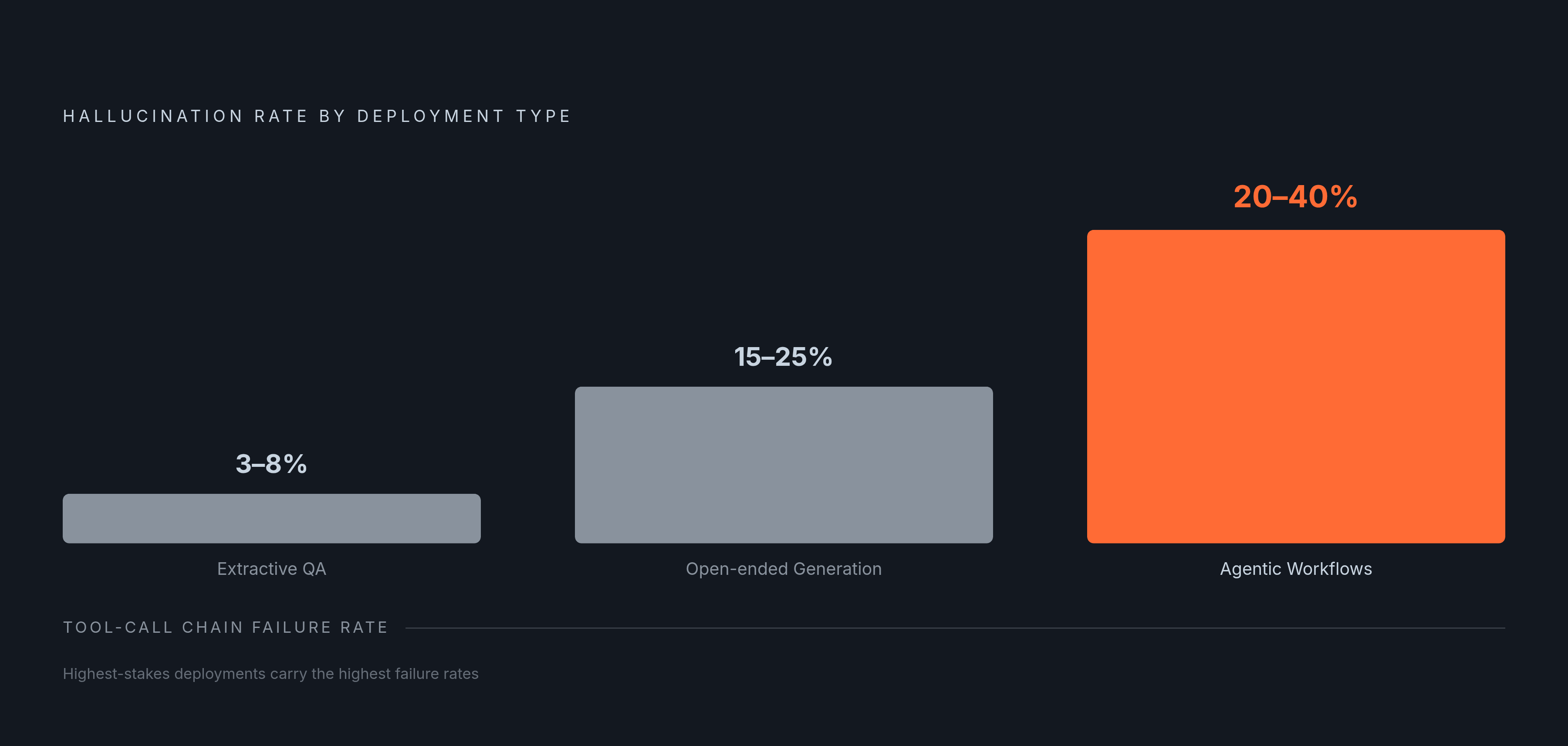
Hallucination rates differ by system type: extractive QA, open-ended generation, and multi-step agent workflows each produce different rates. Extractive QA, where the model pulls an answer from a defined passage, is 3 to 8%. Open-ended generation runs 15 to 25%. Multi-step agent workflows, where the model calls tools and chains results together, run 20 to 40% of tool-call chains. Notice the direction of that curve: the riskiest deployments, the agentic ones that companies are racing to ship, are exactly where the failure rate is highest.
Picking a "smarter" model doesn't reliably solve this either. The Stanford HAI 2026 AI Index Report found hallucination rates spanning 22% to 94% across 26 top models, a spread wide enough that model choice alone can swing outcomes more than any single prompting technique. Part of the mechanism behind that spread is unsettling: models handle a false claim well when it's framed as a third party's belief, but collapse when the identical false claim is framed as the user's own belief. GPT-4o drops from 98.2% to 64.4% accuracy under that framing shift. DeepSeek R1 falls from above 90% down to 14.4%. Same underlying fact, same model, wildly different accuracy depending on whose mouth the falsehood is coming out of.
The AA-Omniscience benchmark adds another layer. Across the field, average accuracy is 45.4%, hallucination rate is 33.3%, and the reliability index is 27.2. The top model on raw accuracy in this benchmark trails on the reliability index, because it guesses rather than abstaining when uncertain. That's the accuracy-first trap in miniature: a model can look like the best choice on a leaderboard and still be the wrong pick for a system where a confident wrong answer costs more than an honest "I don't know."
Frontier models have gotten better. 2026 hallucination rates range from 3.1% to 19.1% depending on model, task, and reasoning configuration, a real improvement over 2024 baselines of 15 to 45%. But "better" isn't "solved," and the remaining gap is exactly where the cost accumulates. Roughly a third of enterprises, 34%, report a customer-facing hallucination incident in the past 12 months, with average remediation costs exceeding $50,000. On the legal side, the Damien Charlotin AI Hallucination Cases database had documented 1,598 cases worldwide as of June 9, 2026, with new cases arriving at a steady clip. These are line items. They're line items.
What grounding does and why the live web is its strongest form
Grounding means constraining the model to answer from evidence it's been handed rather than from whatever it absorbed during training. The retrieved documents get placed directly into the context window, and the model is instructed to answer only from that material, with citations pointing back to specific passages. The role shift affects how failures propagate: the model stops acting like an oracle pulling answers from memory and starts acting like a reader summarizing what's in front of it. That single change in job description is why grounding cuts hallucination more effectively than most prompt-tuning tricks developers reach for first.
Mapping this back to the two failure modes from earlier: factuality hallucination gets fixed primarily by grounding plus permission to abstain, since the model no longer needs to guess when the answer isn't in its retrieved sources. Faithfulness hallucination needs a different lever entirely, tighter retrieval, verification passes, and smaller and cleaner context windows, because grounding alone does nothing if the model still misreads the passage sitting right in front of it.
So which sources you ground against matters as much as whether you ground. Static retrieval-augmented generation, RAG built on a fixed, indexed corpus, works fine for stable content: internal documentation, product manuals, policy documents that don't change week to week. But it carries three inherited limitations. Staleness, since indexed content ages between re-indexing runs. Scope, since the system can only retrieve what someone already ingested. And maintenance, since somebody has to keep curating and updating that corpus indefinitely. Stale retrieval is arguably the more dangerous failure mode of the three, because the output looks sourced and looks correct. It has a citation attached. It just happens to be wrong, and that kind of wrong is much harder to catch than a fabrication with no citation.
Live web grounding is the direct answer to that staleness problem. Every LLM has a training cutoff baked in, and the distance between that cutoff and the present moment only grows. Prices change. Regulations get amended. API changelogs get pushed. Product availability shifts overnight. Fetching data from the live web at query time means the model is reasoning over what's true right now, not a snapshot that was accurate months or years ago and has quietly drifted since.
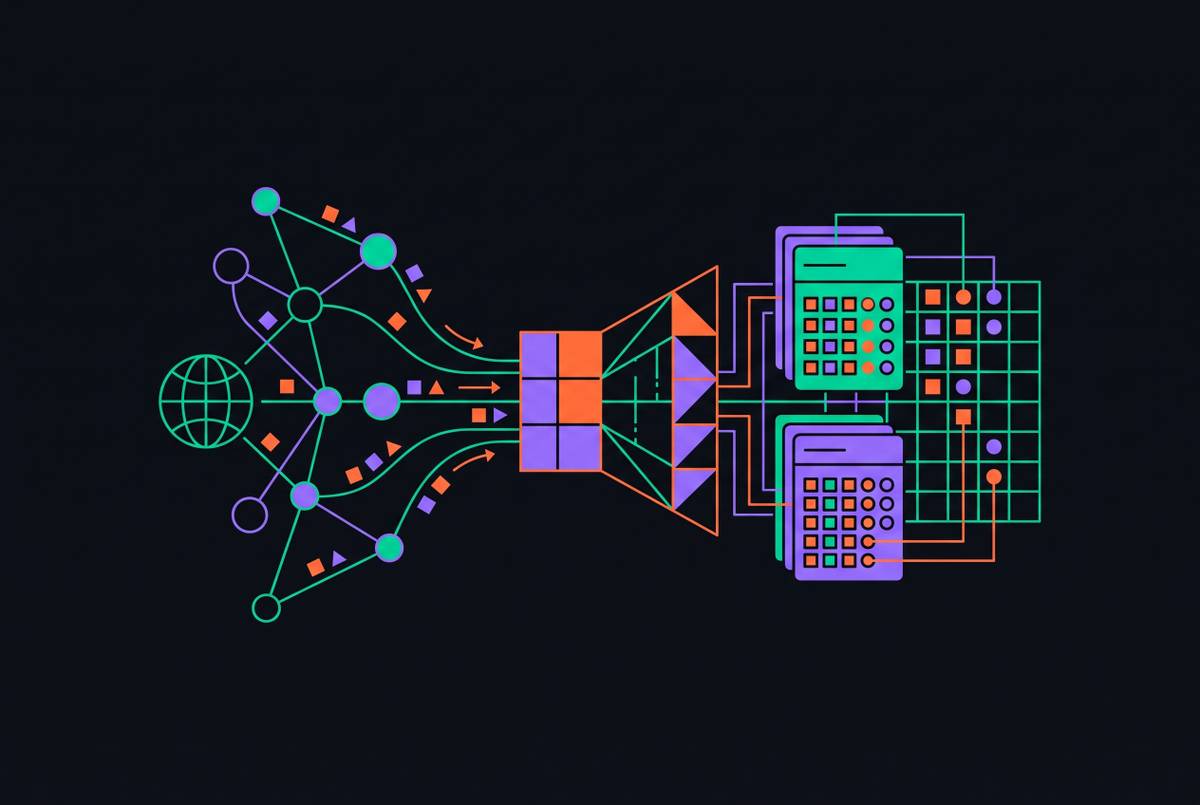
The five-step loop developers run to ground an LLM on live web data
The pattern that's emerged across production systems follows a five-step loop: detect, retrieve, inject with provenance, generate with citations, verify.
Detection comes first because not every query needs live retrieval, and grounding indiscriminately burns latency and tokens for no benefit. A question about a stable historical fact doesn't need a search call. A question containing words like "today," "latest," "current," or "this week" does, as does anything referencing a named entity likely to have recent news, a price, a version number, or a count. A small classifier or even a few-shot prompt can handle this routing cheaply, and it's worth building deliberately rather than grounding everything by default. One observable pattern from production logs: some production systems have been observed routing a single user prompt into multiple distinct grounding queries depending on how volatile the underlying information is.
Retrieval breaks into two moves. First, find the right pages, running a search query against a live endpoint rather than a static index. Second, fetch each page and convert it into clean text the model can actually read. Markdown conversion has become the standard move here, stripping out navigation menus, cookie banners, and markup noise that burns tokens for no informational gain. Converting HTML to Markdown cuts token counts substantially, often by more than half, which matters because bloated context doesn't just cost money, it pushes the model back toward relying on training-data fallback when the useful signal gets buried. Intent-matching search that returns excerpts filtered specifically to the question, rather than dumping whole pages, keeps that context dense and reduces the noise the model has to sort through.
Automated fetching faces an operational wrinkle. Automated fetching faces real friction in 2025 and beyond: Cloudflare began blocking AI crawlers by default across roughly 20% of the web. Vendor benchmark testing shows residential-IP fetch success running 85 to 99% on protected sites, versus 20 to 40% for datacenter IPs. That gap is an infrastructure decision: whether a grounding pipeline actually gets the pages it's trying to retrieve depends on it.
Injection with provenance is the step that turns raw retrieved text into something the model can cite precisely. Each chunk fed into the context should carry a source URL, a publication or retrieval date, and a passage ID the model can reference directly in its answer. Placement inside the prompt isn't a trivial detail either: facts buried in the middle of a long context tend to degrade in influence on the model's output, so the most load-bearing retrieved passages belong at the start or the end of the context window, not sandwiched in the middle where attention is weakest.
Generation with citations and a final verification pass close the loop, checking that the answer actually traces back to what was retrieved rather than drifting into unsupported claims along the way.
How agentic and multi-agent architectures change the grounding requirement
In multi-step agent workflows, this changes from an accuracy nuance into a structural risk because the errors compound across steps. Recall that hallucination rates in these chains run 20 to 40%, and the mechanism is different from a single bad chat response: a fabricated tool argument or an invented ID doesn't just produce one wrong answer, it corrupts every downstream step that depends on it, often silently. Tool argument spoofing, where the model invents a parameter or an ID when calling a tool, is now a recognized failure mode in its own right, and it's particularly nasty precisely because nothing about the output looks obviously wrong until several steps later.
Monolithic agents, a single LLM handling reasoning, routing, and execution all at once, are easy to prototype and genuinely difficult to maintain once something breaks in production. Debugging a single fused system means untangling reasoning failures from routing failures from execution failures with no clean seams between them. A microservices-inspired design, where each agent capability is a discrete and independently deployable unit, gives teams the ability to swap or upgrade one sub-agent as better models come out without tearing down the whole pipeline.
Making that modularity actually work at scale needed a shared interface, which is what the Model Context Protocol (MCP), introduced by Anthropic in late 2024, provides. MCP standardizes how AI agents connect to external tools, systems, and live contextual data, giving models a consistent, dynamic path to real-time information instead of one-off custom integrations for every tool, which solves the static-pretraining limitation directly. An LLM as an isolated reasoning engine works differently from an LLM as part of an adaptive, context-aware system. Adoption has moved fast: as of April 2026, MCP counted roughly 10,000 active servers and a very large number of monthly SDK downloads, and it's become a backbone layered into agentic workflows across OpenAI, Anthropic, and Google ecosystems alike.
Sitting alongside MCP is the Agent-to-Agent (A2A) protocol, governed by the Linux Foundation, which handles communication between agents within a multi-agent pipeline rather than between an agent and a tool. Together, MCP and A2A form a two-layer backbone: one layer standardizing how an agent reaches out to the world for live data, the other standardizing how agents coordinate with each other once that data is in hand. Neither layer eliminates hallucination. But both make the grounding step something that can be engineered, monitored, and improved incrementally, rather than something left to hope and a well-worded prompt.
For teams building production systems on this loop, whether grounding actually closes the staleness gap or just moves it somewhere less visible depends on the retrieval infrastructure underneath the search step. Live search infrastructure built specifically for feeding LLM context windows, matters here because the documents going into that context need to be current, verifiable, and cited by construction, not as an assumption bolted on afterward. That's the whole premise of grounding: the answer is only as good as what got retrieved, and what got retrieved is only as good as the infrastructure fetching it.