Structured Data Extraction From Live Web Sources
Web scraping fails at four distinct layers, not one problem to solve.
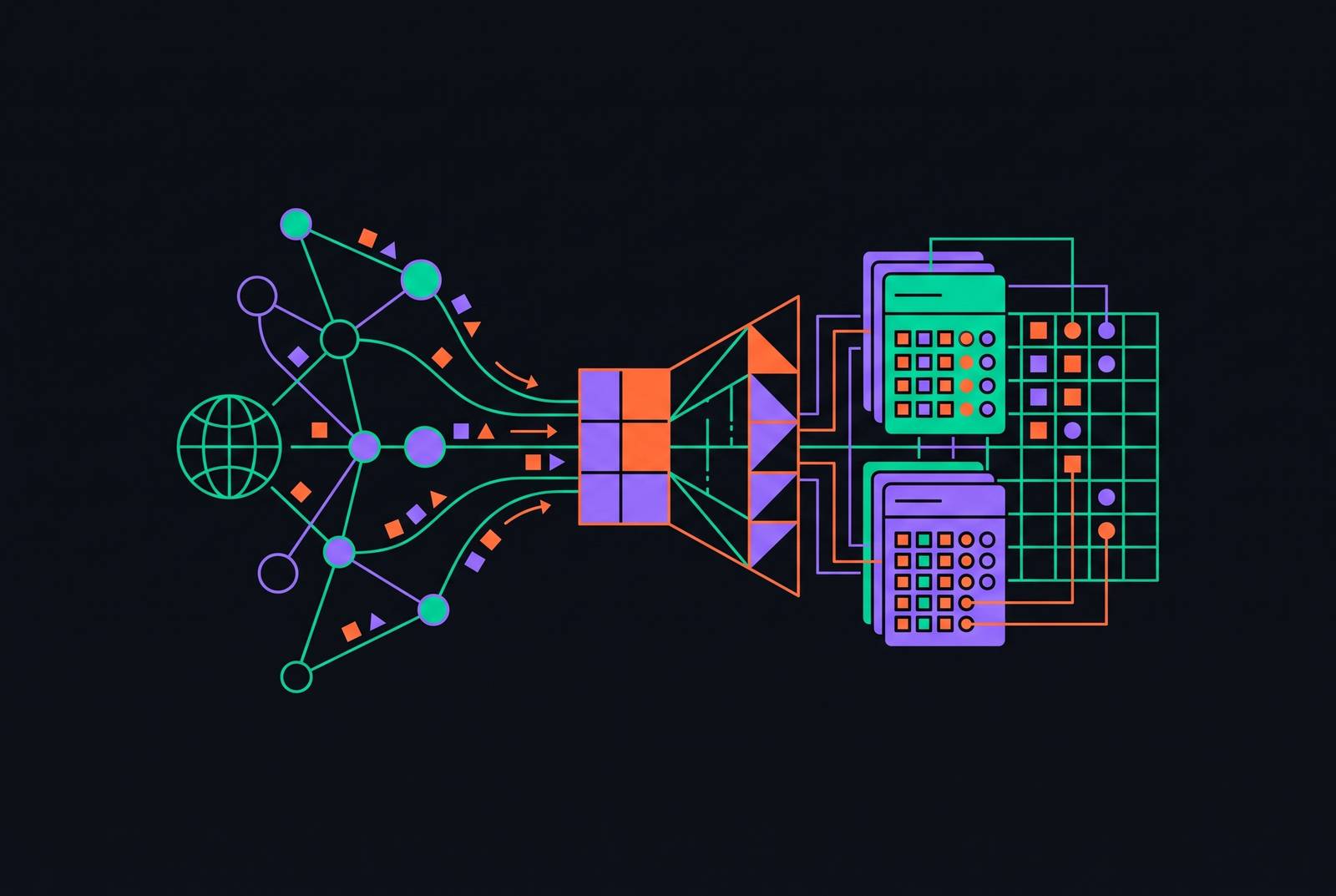
Structured data extraction from live web sources fails in four distinct places, not one. Fetching, parsing, session management, and tool integration each break differently, and treating "agent can't get the data" as a single bug is exactly why so many extraction pipelines stay broken.
Picture the failure sequence, because it happens the same way often enough to be called canonical. An agent picks a URL, calls its fetch tool, and gets back a Cloudflare interstitial. It doesn't know that, though. The tool call returned a successful status, so the agent hands the interstitial to the model as if it were a product page, and the model dutifully tries to extract a price from what is, structurally, a bot-detection screen. It hallucinates a selector, retries, hits a 403 this time, and burns a few thousand tokens chasing a captcha it was never built to solve. Scrapfly's 2026 guide walks through this exact chain, and the conclusion is blunt: the agent didn't fail at reasoning. It failed at the web.
That distinction matters more than it sounds. Web scraping is the load-bearing layer underneath almost everything an agent claims to know about the present moment, not a peripheral utility bolted onto an agent stack. When it cracks, the reasoning on top of it doesn't get a chance to be wrong or right, because it never sees real data in the first place. And live extraction is doing a lot of load-bearing work in 2026: grounding RAG systems so LLMs stop making things up about current events, giving autonomous agents the ability to browse and search on their own, feeding market intelligence pipelines that track competitor pricing and review sentiment as it changes, aggregating research papers and news for analysis, and building fine-tuning datasets out of niche domains that no static corpus covers.
The NEXT-EVAL 2025 benchmark study, cited in a Firecrawl guide, found that LLMs can hit an F1 score of 0.9567 on structured web extraction when the input arrives as flat JSON. That's a strong number. But it comes with a condition attached: the model only gets there when the input is properly formatted to begin with. Flip that around and the finding says something sharper than "models are good at extraction." It says the model was never the bottleneck. The bottleneck is whatever happens before the model ever sees the page.
And even proper formatting isn't the whole guarantee. BAML documented a case where a leading model, given structured outputs, returned "quantity": 1 for a receipt line that actually read 0.46 kg of bananas. The same model, asked in free form, got the decimal right. The JSON validated cleanly both times. The invoice total did not. Schema enforcement guarantees shape. It does not guarantee truth.
So here's the governing frame for what follows. Agent-grade web access breaks into four separate engineering problems, fetching, parsing, session management, and tool integration, and each one fails in its own particular way. Most things that get labeled "an agent problem" turn out to be one of these four layers wearing a disguise. The rest of this piece treats them one at a time, as discrete problems, rather than as a single pipeline to patch all at once.
Layer 1 (Fetching): what stops an agent from seeing the page at all
Start with the most basic failure: the agent never actually sees the page. Anti-bot systems return a 403 or serve up a Cloudflare challenge screen, and the tool call itself still registers as successful. Nothing in the pipeline flags that the "content" retrieved is a bot-detection page rather than a product listing. So the model tries to extract structured fields from a captcha, and it does this with total confidence, because nothing told it otherwise.
JavaScript-rendered content causes a quieter version of the same problem. A human opens DevTools, sees the selectors, sees the data rendered on screen. The agent's fetch call returns raw HTML before any of that JavaScript executes, so the selectors that exist in the browser simply don't exist in what the model receives. The agent concludes the data isn't there and replans around an empty page that, from a human's seat, was never empty at all.
Geography adds another blind spot. An agent running from a datacenter IP in one region asks for prices that a site silently localizes based on where the request appears to come from. The model has no mechanism to notice the mismatch. It just reports a number, and that number happens to be wrong for the market the user actually cares about.
Then there's the friction layer: cookie-consent banners, captcha loops, "accept to continue" gates. An agent loops on these not because it's dumb, but because clicking through a banner was never part of its plan. Reading is what it was built to do. Acting on an interface element is a different capability entirely, and a lot of pipelines never draw that distinction.
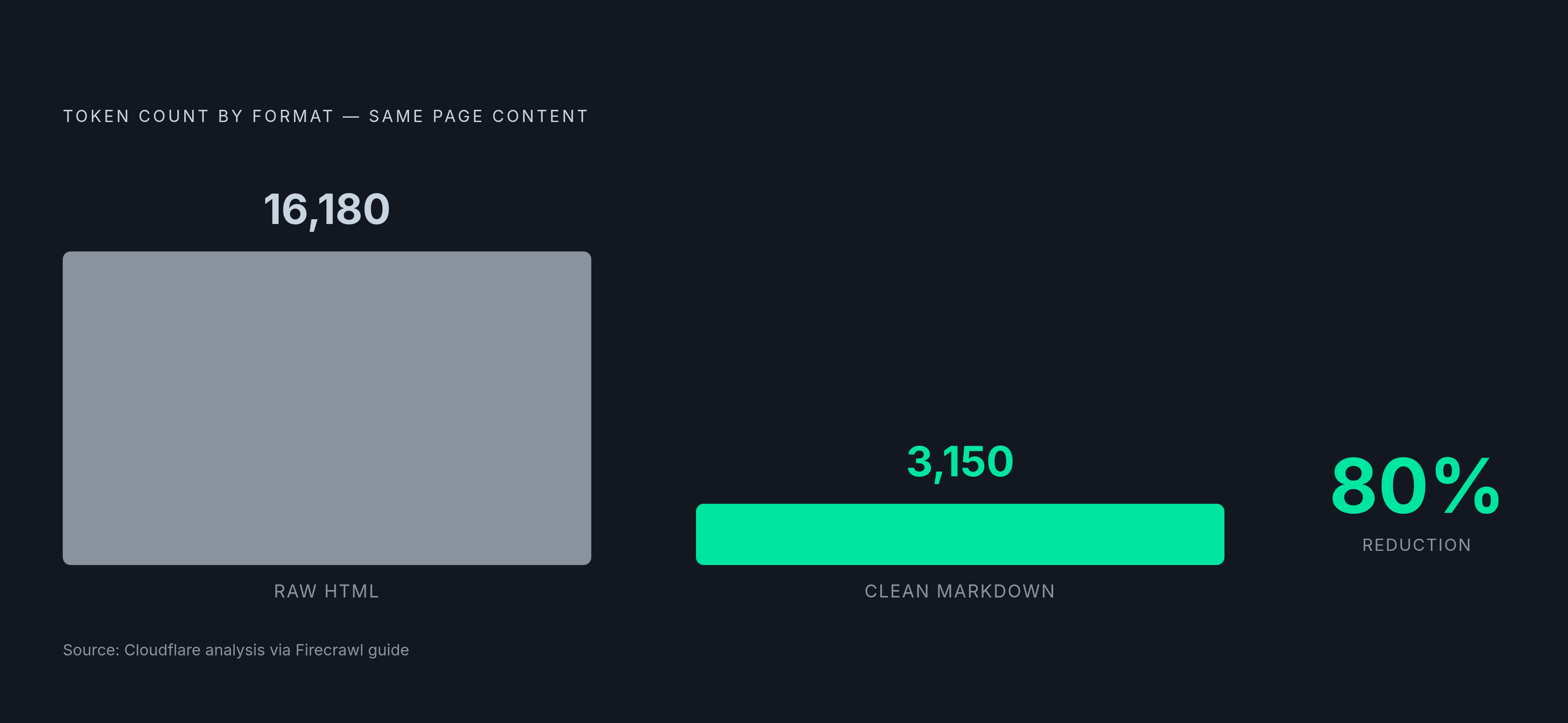
Even when fetching succeeds cleanly, raw HTML is expensive in a way that's easy to underweight. It's packed with navigation chrome, tracking scripts, and cookie-banner markup, none of which the model needs. A Firecrawl guide cites a Cloudflare analysis putting raw HTML at 16,180 tokens against 3,150 for the equivalent markdown, an 80% reduction just from format choice. That's not a rounding error. That's the difference between an extraction call that fits comfortably in context and one that doesn't.
The design rule that falls out of all this is fairly simple to state, even if it's not always simple to build: default to a scraping API with anti-bot handling and JavaScript rendering baked in for anything read-only, and only promote to a full browser session once the agent actually needs to act on the page rather than just read it. Why does this failure mode stay invisible for so long in practice? Because the fetch tool returns a status code, not a content-quality signal. A successful status code tells the pipeline nothing about whether what came back is real content or a bot wall dressed up as one, unless something downstream is explicitly built to check.
Layer 2 (Parsing): turning a retrieved page into typed fields an agent can act on
Assume the fetch succeeded and the agent is holding real page content. The next failure point is turning that content into fields the agent can actually reason over, and this is where DOM mutation quietly wrecks a lot of pipelines. Ask a model to produce a CSS selector and it gives its best guess based on the page structure it saw once. Sites change their markup constantly, sometimes for reasons as small as an A/B test on button placement, and the selector drifts out from under the agent. The result isn't an error message. It's the agent reporting zero results with total confidence, because as far as it knows, the selector still works.
The bananas example from earlier belongs here too, because it's the cleanest illustration available of what schema enforcement actually promises. A receipt line read 0.46 kg of bananas. Under structured outputs, the model returned "quantity": 1. Asked the same question in free form, it got 0.46 right. The JSON was valid both times, in the narrow sense that it parsed and matched the schema. Only one of those two outputs matched reality. BAML's documentation uses this case as the canonical warning, and it's hard to improve on: shape and truth are two different guarantees, and a validated schema only ever proves the first one.
So how does a team evaluate a parsing tool when the caller is an agent rather than a person reading the output? Five things matter, and they don't trade off against each other cleanly. Schema surface asks whether the tool accepts arbitrary JSON Schema or only the fixed types the vendor pre-trained on, since a rigid product schema is dead weight the moment an agent needs one custom field it wasn't designed around. Guarantee mechanism asks how the tool enforces correctness, whether that's grammar-constrained sampling, retry-on-validation-failure, post-hoc parsing, or nothing at all, because each of those fails differently and costs differently when it does. Grounding asks whether the output comes with citations or bounding boxes an agent can check against, since without that, a wrong value and a right one are visually identical. Agent surface asks whether there's a first-party MCP server and real SDKs, or just REST docs and an afternoon of glue code ahead of the team. And cost and caps asks about price per page and the synchronous processing ceiling, because that ceiling decides whether the agent blocks and waits or has to poll for results later.
A February 2026 paper out of Cairo University introduced AXE, an Adaptive X-Path Extractor, and found that even a small-parameter LLM could hit strong extraction performance with it. That's a signal about where this market is headed. Extraction intelligence, the raw capability to pull a field out of messy markup, is commoditizing fast at the model layer. Extraction intelligence, the raw capability to pull a field out of messy markup, is commoditizing fast at the model layer, so the actual differentiator is pipeline architecture and data freshness instead of "can the model do this."
The parsing layer should hand back typed fields, not HTML fragments or prose. Whatever step in the agent loop comes next should be reading a structured field it can act on directly.
Layer 3 (Session management): keeping an agent authenticated and coherent across steps
Session state is where a lot of otherwise well-built pipelines quietly rot. An agent logs in on step one of a multi-step task. By step five, the session cookie has expired, or the proxy IP rotated out from under it, and the site now treats a previously authenticated agent as a brand-new, unauthenticated visitor. The agent tries to reauthenticate mid-task, trips a fraud check because the pattern looks suspicious, and the whole run stalls out.
But what if the failure isn't session loss at all, but the absence of any stop condition? That's arguably the more expensive failure mode: an agent left without any stop condition. Without one, an agent retries a captcha indefinitely, replans on every single 403 it hits, or follows a broken paginator link into a loop that never terminates on its own. Scrapfly's 2026 guide points to this trial-and-error pattern as the single biggest cost driver in agent runs, and it's easy to see why: each failed retry still costs tokens, and an agent with no exit condition doesn't know when to stop paying that cost.
Interaction-gated data adds a structural wrinkle here too. Login walls, search forms, "Load More" buttons, filter dropdowns, these gate a huge share of the data that's actually worth extracting, and none of it is reachable by reading alone. The agent has to click, type, and navigate before there's anything to extract in the first place. That's a fundamentally different capability than parsing a static page, and it needs to be planned for as one.
Session management, then, isn't a browser feature that gets bolted onto a pipeline after the fact. It's a layer that has to be designed in from the start, with session resume, consistent proxy identity, and explicit stop conditions built into the architecture rather than patched in once something breaks in production. The rule for deciding when to promote from a lightweight scraping API to a full persistent browser session comes down to action versus reading: pure read tasks stay at the API layer, and anything that needs login, form submission, or multi-step navigation earns the overhead of a real browser session.
Layer 4 (Tool integration): connecting the extraction pipeline to agents and orchestration frameworks
A pipeline can nail fetching, parsing, and session management and still fail here, and it's an easy layer to underestimate because the failure doesn't look technical. It looks organizational. A team builds a fetch-parse-session stack that works, but calling it from an agent requires hundreds of lines of glue code, manual credential juggling, or a custom protocol adapter nobody wants to own. At that point the team isn't maintaining a capability anymore. It's maintaining an adapter, and adapters rot the moment the underlying API changes shape.
The Model Context Protocol, Anthropic's open standard, is emerging as the fix for exactly this. MCP lets an agent call a tool mid-conversation without the copy-paste choreography that used to sit between a model and an external system. A web extraction MCP server exposes search and retrieval as tools directly to MCP-enabled clients, Claude, Cursor, Windsurf, and others, inside the same session the agent is already running in. No adapter layer, no separate authentication dance.
Worth a caution here, though, because not every MCP in this space is doing real work. Vellum's June 2026 guide flags a pattern: plenty of search MCPs marketed toward AI agents are thin wrappers around existing search indexes. If an agent already has that same index configured elsewhere, bolting on a wrapped MCP just routes the identical results through one more layer of indirection. That's not integration, it's decoration.
A tool that's actually solving this layer tends to show a few concrete traits. A tool that's actually solving this layer includes a first-party MCP server with real tool definitions. SDKs that eliminate request-handling boilerplate rather than a page of REST docs and a "good luck." Compatibility with the orchestration frameworks teams have already standardized on, LangChain, LlamaIndex, CrewAI. And async job support, so a slow crawl doesn't force the agent to sit there blocking on a response it can't do anything with yet.
The stakes here are larger than convenience. MIT Technology Review reported that AI systems have access to an average of only 45% of company data across the organizations surveyed, and that number drops to 30% or lower for organizations the study classifies as "data laggards."" The "data leaders," those ensuring access to more than 70% of their data, showed measurably better agent outcomes. Poor tool integration is one of the structural reasons that gap exists: it doesn't matter how good the extraction pipeline is if the agent can't actually reach it without a custom adapter someone has to build and maintain by hand. That same report found only about half of surveyed organizations trust that their AI agents' decisions are accurate and relevant. Grounding those agents in live, cited, well-integrated data is the direct answer to that trust gap.
How the tool landscape maps onto these four layers
Before comparing tools, one distinction saves a lot of wasted evaluation time. Firecrawl's September 2026 roundup draws it clearly: document AI and OCR tools handle static files, PDFs, scanned forms, invoices, while web-scraping and AI-pipeline APIs pull live data from URLs. Confusing the two is, per that roundup, the most expensive mistake buyers make, largely because structuring cost at the hyperscaler tier runs at a steep premium over OCR-only pricing. Know which problem is actually being solved before picking a vendor for it.
On the web layer, where freshness is the whole point, Firecrawl covers both web and document extraction behind one surface. Its Scrape endpoint accepts an OpenAI-format JSON Schema, a Pydantic model, or a Zod schema, its /parse endpoint handles uploaded files across formats including PDF, DOCX, XLSX, and HTML, and its /interact endpoint supports click, form-fill, and login flows within a single session, with an /agent endpoint that runs autonomous multi-source research from one prompt. It's open source at the core, integrates with MCP, LangChain, LlamaIndex, and CrewAI, and offers a free tier around 1,000 credits a month. Bright Data leans toward pre-built, per-site extractors, well-suited to large structured collection jobs where the schema is fixed and known in advance. Apify works on a per-actor schema model that varies actor to actor, aimed at custom scraping automation rather than a one-size extraction schema. Zyte offers ten fixed typed schemas at an accessible entry tier, a good fit when an agent's needs happen to map cleanly onto Zyte's pre-trained categories. Diffbot specializes in semantic extraction tied to a Knowledge Graph, strongest for entity-level extraction and knowledge-graph use cases, at a higher starting price than the others.
On the search layer, where the input is a query rather than a URL, Tavily is built specifically for language models and agents, returning structured, AI-friendly results instead of a traditional search results page, which cuts down the preprocessing an agent would otherwise need to do on messy search-results data. It suits agents chasing recent news, documentation, or technical references, and it offers a free tier around 1,000 credits a month as well.
On the document layer, for static files rather than live pages, the field splits by grounding capability. Reducto supports arbitrary schemas with citations attached, a real advantage for anyone who needs to trace a value back to its source. LlamaParse handles arbitrary schemas with a large property count and a generous free tier. Mistral OCR adds annotations on top of OCR output at a pay-per-page rate, though Mistral's own announcement is candid that a single aggregate accuracy number can both understate and overstate how the tool performs on any given real document. The hyperscaler options, Google Document AI, AWS Textract, Azure AI Document Intelligence, handle tables and key-value fields well but carry that steep structuring premium mentioned earlier. Docling is MIT-licensed and free, aimed at teams that want to wire up their own schema logic rather than rent someone else's. Landing AI ADE supports arbitrary schemas with grounding built in, and offers free entry-level credits.
This principle produces the same result regardless of vendor: pick a tool by which layer it actually solves first, and only then ask whether the agent needs to prove where a value came from. Grounding and citation support end up mattering most in exactly the domains where being wrong is expensive, finance, medical, legal, anywhere a hallucinated field turns into a real-world decision.
What full-stack live-web intelligence looks like when all four layers are solved
Put all four layers together and the shape of a working system becomes fairly easy to describe, even if building it is not. An agent that reaches the live web reliably has a fetch layer that gets past anti-bot defenses and renders JavaScript before handing content over, a parse layer that returns typed and cited fields instead of raw markup, a session layer that holds state coherently across a multi-step task, and an integration layer that plugs into the agent framework without a pile of custom glue code holding it together.
Handling anti-bot blocking, JavaScript rendering, and geolocation mismatches at real scale takes infrastructure built for exactly this job, not general-purpose scraping bolted on after the fact. Some platforms are built around that specific requirement, returning clean, renderable content instead of raw HTML or a captcha page dressed up as an ordinary successful response, so the agent downstream isn't burning tokens or looping on retries just to see what a human would see instantly.
None of the four layers covered here substitutes for the others. A perfect parser downstream of a blocked fetch never runs. A flawless session layer means nothing if the integration layer forces a team to hand-roll authentication for every new agent framework that comes along. The value of treating extraction as four separate engineering problems, rather than one fuzzy pipeline, is that each failure becomes traceable to a specific layer instead of getting written off as "the model hallucinated" when the model, in a lot of these cases, never had a fair shot at the data to begin with.