Citation and Source Reconciliation in Financial AI Outputs
Financial AI outputs must trace every number to its source or face regulatory liability.
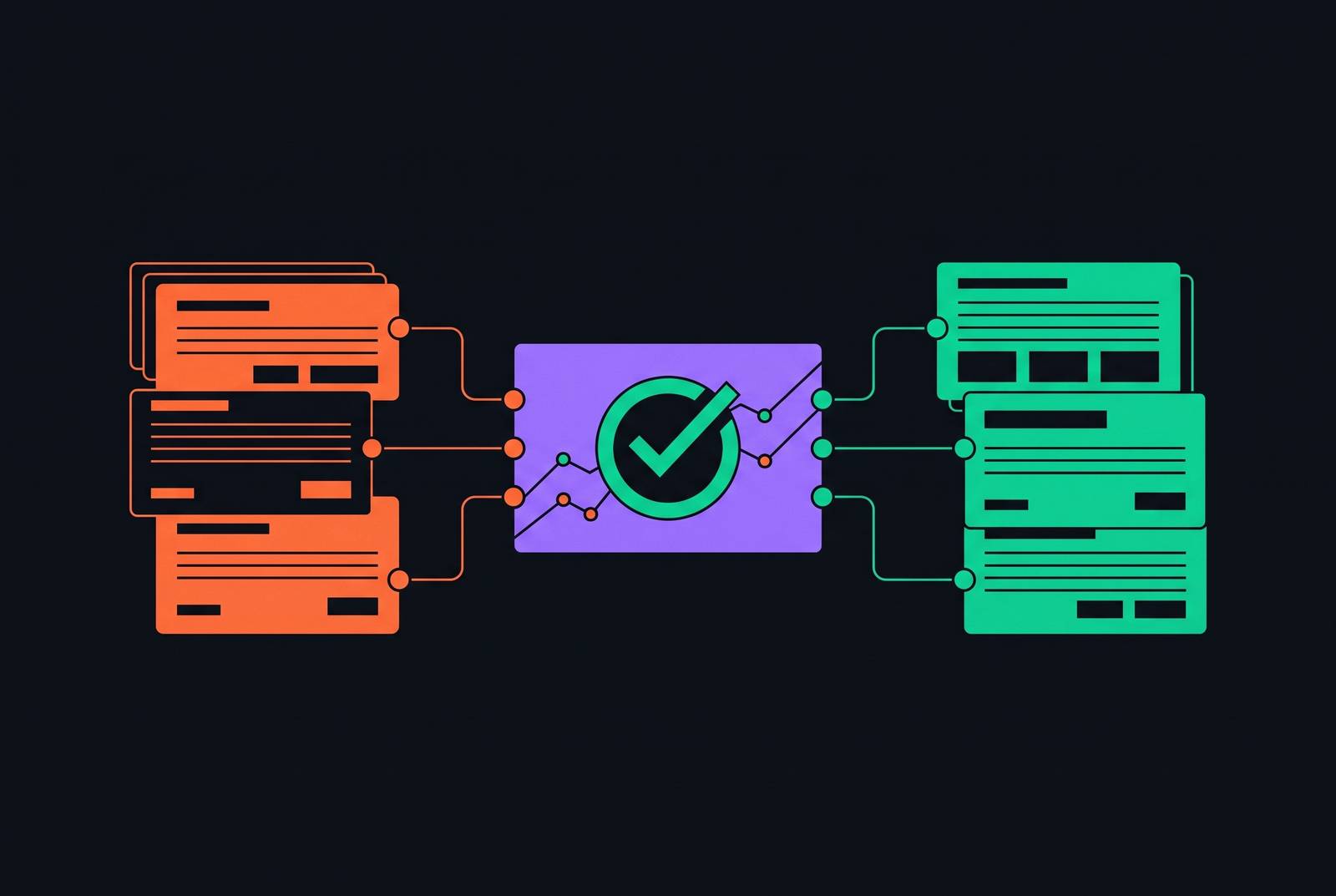
G: A financial AI output that cannot point to where its numbers came from is, by construction, unverifiable, and in a regulated industry, an unverifiable figure is a liability sitting inside a document someone eventually has to sign.
Why financial AI outputs without traceable sources create liability
JurisTech's hallucination benchmark surfaced a finding that should unsettle anyone who evaluates AI output by how it looks on the page. A response that sounds correct and a response that is correct are indistinguishable by appearance alone, and no amount of formatting discipline closes that gap.
M: In finance, that gap carries legal and regulatory weight. C: Large language models generate text by predicting plausible continuations of a prompt rather than retrieving verified facts from a ledger or a filing, and that architecture is what produces this kind of failure. An ungrounded financial output is a hallucination risk by default, no matter how fluent or confident its phrasing.
That risk concentrates in narrative sections of financial documents more than in tables of numbers. M: Regulators have started treating this as a named governance concern. FINRA's 2026 Annual Regulatory Oversight Report named AI hallucination as a specific governance risk, signaling that firms are expected to test for it and manage it, even though the report itself does not create new legal obligations or announce an enforcement posture. The next question follows naturally: if regulators are watching for this failure mode, what exactly does a compliant output have to demonstrate?
H: What financial compliance requires from an AI-generated output
The compliance standard for AI-generated financial content is not a matter of documentation hygiene. Every figure that enters a filed document must be traceable to the specific source data that produced it. P: If a number cannot be traced, it cannot be verified, and an unverifiable number has no place in the document. That chain, traceable to verifiable to permissible, is the logical sequence regulators and auditors actually apply, whether or not a firm has formalized it into policy.
The EU AI Act gives that standard a hard enforcement date. Article 50's transparency requirement became enforceable as of August 2, 2026, and it applies to AI systems that interact directly with people.
What does this look like at the level of an individual output? Every AI-generated figure destined for a disclosure has to be traced back to its source system before it ever enters a draft. That tracing is not an optional add-on; the tool trace itself is part of the answer, not a separate audit artifact filed away for later. A: Timestamps give a reader the information needed to judge how current a figure is: "AAPL is at $X as of 2:14pm ET" is a fundamentally different claim than "AAPL is at $X," because the first lets a reader judge how current the figure is and the second asks for blind trust. Fabricated standards citations, an AI system inventing a nonexistent IFRS standard or an FCA Guidance Note that does not exist, are a documented, high-frequency failure mode in footnote disclosures specifically, and no citation should be accepted as authoritative without checking it against a primary source. That standard is clear enough to state. P: Building a system that actually meets it is a harder problem, starting with how the system retrieves information.
How grounding and retrieval work, and where they fail under financial conditions
Grounding is what separates a model that sounds right from a model that can show its work. A grounded answer is built from evidence retrieved at the moment the question is asked, and it points back to the specific sources that informed it, rather than drawing on the static training data a model memorized up to some fixed cutoff date. Retrieval-augmented grounding is the architecture built to deliver that grounding: the system searches a knowledge base or live data source, pulls relevant material, and feeds it to the model as context before generating a response.
RAG reduces hallucination risk, but it does not eliminate it, and the retrieval layer itself tends to be where enterprise deployments actually break down. None of these failures announce themselves. D: A hallucinated output appears in the same formatting and the same tone as a correct one, the same problem JurisTech's benchmark surfaced from a different angle.
The scale of the gap is measurable. F: Even a top-performing large language model paired with "oracle" retrieval, where the correct evidence pages are handed to the model directly, reaches 85% accuracy on financial questions under FinanceBench's benchmark conditions. P: Run the same kind of system against a realistic enterprise setup with live ledger data instead of curated evidence pages, and performance drops sharply, with the majority of queries failing.
Financial reconciliation work makes retrieval structurally harder, not just quantitatively harder. A system that locates the correct evidence and a system that hallucinates a plausible-sounding answer can land on the same coarse accuracy score, even though only one of them actually did the work.
A separate benchmark, FinToolBench, released in March 2026, tested how LLM agents handle real financial tool use and identified three recurring failure modes. Timeliness failures occur when a question asks for a "current" rate but the agent retrieves a daily snapshot instead, answering a question that was not actually asked. Retrieval that is merely plausible is not the same as retrieval that is correct, current, and authorized, and closing that distance is what the next section turns to.
The silent fallback: why citation alone does not guarantee reconciliation
Citation and reconciliation sound like the same safeguard, but they are not. Citation says a source was consulted. G: Reconciliation confirms that the source actually supports what the output claims, that it was current when retrieved, and that it was the right authority to consult.
The most dangerous failure in agentic finance systems is what might be called the silent fallback. If a tool call fails, or returns an empty result, an agent that quietly falls back on its training data to fill the gap produces an output that looks retrieved even though it was fabricated. No citation attaches to that fabrication, because none exists to attach. The output reads identically to a properly sourced one. What should happen instead is a system that surfaces the failure outright: when retrieval does not return usable data, the agent needs to say so rather than substitute a model-generated estimate in its place, because a visible gap in an output can be audited and a silent substitution cannot.
M: Verifying what an agent did requires more than reading the agent's own account of what it did. LLM-generated rationales and interaction traces are not guaranteed to faithfully represent the model's actual internal decision process. Meaningful auditability depends on grounded, time-stamped tool calls, data snapshots, and execution logs that can be checked independently, not on human-readable prose the model wrote describing its own reasoning after the fact. The IMF's 2026 note on agentic AI in payments frames the underlying tension precisely: core payment infrastructure runs on deterministic logic that requires predictability and legal enforceability at every step, while agentic AI systems run on probabilistic reasoning that can produce different outcomes under conditions that look identical. Citation alone does not resolve that tension between deterministic infrastructure and probabilistic reasoning.
What does resolve it, or at least address it directly, is a reconciliation standard with three specific requirements. All three have to be checked.
What source-reconciled financial AI outputs look like in production
M: Source-reconciled outputs share a recognizable, observable set of properties. Every figure carries both a timestamp and a pointer to the specific source system that produced it. Every tool call gets logged along with its inputs and outputs. Any retrieval failure gets surfaced explicitly in the output rather than patched over with a plausible-sounding substitute. These properties are not abstract design goals: they already describe how some of the largest institutions in finance are deploying AI systems today.
Goldman Sachs is deploying AI agents built on Anthropic's Claude specifically for trade and transaction accounting, including reconciliation work, as well as client vetting, onboarding, and compliance. The deployment is notable less for its scale than for what it implies about how the tool trace is treated: as part of the answer itself, not a separate implementation detail that can be stripped out once the output looks right. Experian launched its Agent Operating System at Money20/20 Europe on June 2, 2026, with ServiceNow as its first deploying partner. Experian's own research into the obstacles organizations face when scaling agentic AI found that nearly half of global organizations say integrating data into AI workflows remains difficult, and a third name poor data lineage specifically as a key barrier. That finding confirms something the earlier sections of this piece have argued from a different direction: the reconciliation problem is architectural, built into how data moves through an organization, not an incidental bug that better prompting fixes.
Granularity matters here, and it matters specifically at the sentence level. Citing a source document at the level of an entire response, "this answer draws on filing X," leaves a reviewer to re-read the whole filing to find the relevant passage. Sentence-level citation, linking each individual claim in an output back to the exact source document and passage that supports it, is the granularity that actually makes an output defensible to an auditor or a regulator. Hebbia's platform builds around sentence-level citation as a core feature, and a substantial share of the largest asset managers by assets under management rely on it for exactly that reason: it turns a wall of AI-generated text into something a human reviewer can actually check, claim by claim.
M: DataSnipper's approach applies the same principle to document comparison. Full traceability, in both of these examples, is built into the workflow from the start rather than bolted on as an afterthought once a draft is already written.
The governance and security layer that citation-complete outputs depend on
A citation is only as trustworthy as the pipeline that produced the data behind it. Reconciliation is only as reliable as the infrastructure retrieving, storing, and transmitting the underlying figures, and that infrastructure has to meet a compliance standard many teams have not yet evaluated for their AI vendors specifically, even as they apply exactly that standard to every other system touching financial data.
SOC 2 Type II certification has become the baseline expectation across regulated industries, and for good reason: it verifies that a vendor's security controls actually operate as described over time, not just at a single audit snapshot. But SOC 2 alone is rarely sufficient for financial AI specifically. Teams deploying these systems need vendors that layer SOC 2 with PCI-DSS where payment data is involved, GDPR where European data subjects are concerned, and emerging AI-specific standards like ISO 42001, rather than treating any single certification as a complete answer.
Data retention is a related and equally concrete question. A cited output is only as private as the system that generated it, and that privacy question sits upstream of any citation the output displays.
The EU AI Act's transparency obligations, enforceable since August 2, 2026, apply broadly to any AI system interacting directly with natural persons, regardless of sector, financial services included. N: Compliance is a present architectural requirement for any system generating cited financial outputs right now, today, for any firm operating in or serving the EU market.
M: Among infrastructure providers building toward this standard, You.com's Finance Research API addresses these requirements as a connected set. Zero data retention, SOC 2 certification, and benchmark-leading performance on FinSearchComp, one open-source basis researchers use for comparing financial AI search and reasoning systems, come packaged together as a coherent stack. For a team building citation-complete financial AI, that combination offers a grounded infrastructure layer to build on rather than a set of separate vendor promises that each have to be verified independently.
Q: Evaluating a financial AI output against the traceable, reconciled standard
A trustworthy financial AI output is not one that looks correct on the page but one that can be independently reconstructed by someone who was not in the room when it was generated. That means every figure in the output needs an identifiable source, and every source needs a timestamp showing when it was current. It means logging every tool call the system made, with its inputs and outputs preserved. And it means that wherever the chain of evidence has a gap, whether from a failed retrieval, a missing document, or an unavailable data feed, that gap has to appear in the output as a visible gap rather than get quietly filled with a plausible-sounding guess. A reviewer applying that test does not need to trust the system's tone, its formatting, or its confidence. All of those, as JurisTech's benchmark demonstrated at the start of this piece, can be present in equal measure whether the underlying figure is accurate or invented. What can be checked is whether the chain from figure to source to timestamp to log actually holds together, end to end, under inspection. That is the standard. Everything else is appearance.