Cited Intelligence vs Unverifiable AI Financial Outputs
AI financial research needs verifiable sources, not just confident-sounding claims.
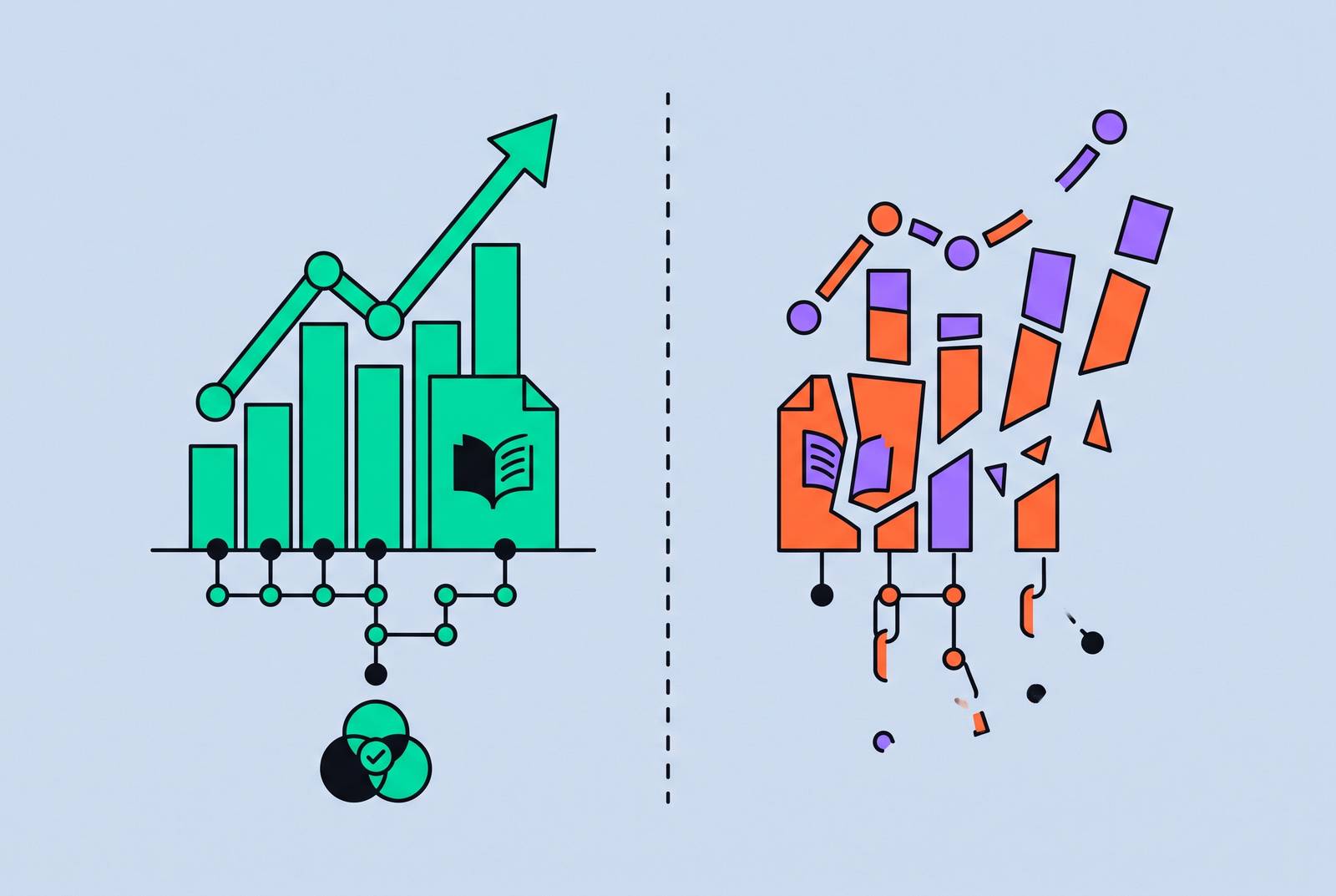
The central risk in AI-powered financial research has little to do with how smart the underlying model is. A large language model can be fluent, well-reasoned, and still produce a claim about market size or covenant structure that nobody can trace back to anything real. A McKinsey analysis of generative AI in private markets found that public LLM reports were systematically more optimistic than research built from expert interviews, diverged from it on core metrics like market size and growth, and missed details that matter most in a live deal: contract structures, unit economics, regulatory hurdles. None of that is a glitch. A model trained to sound right will sound right whether or not it is, and in financial workflows, sounding right is not the bar. A number describing market size, a clause describing a covenant, a threshold describing a regulatory requirement has to trace back to something dateable and authoritative, or it has no business being acted on. The failure mode worth taking seriously is fluent, confident output that passes every internal plausibility check until someone goes and checks the source, at which point there is no source to check.
How static training data makes hallucination a structural feature of ungrounded financial AI
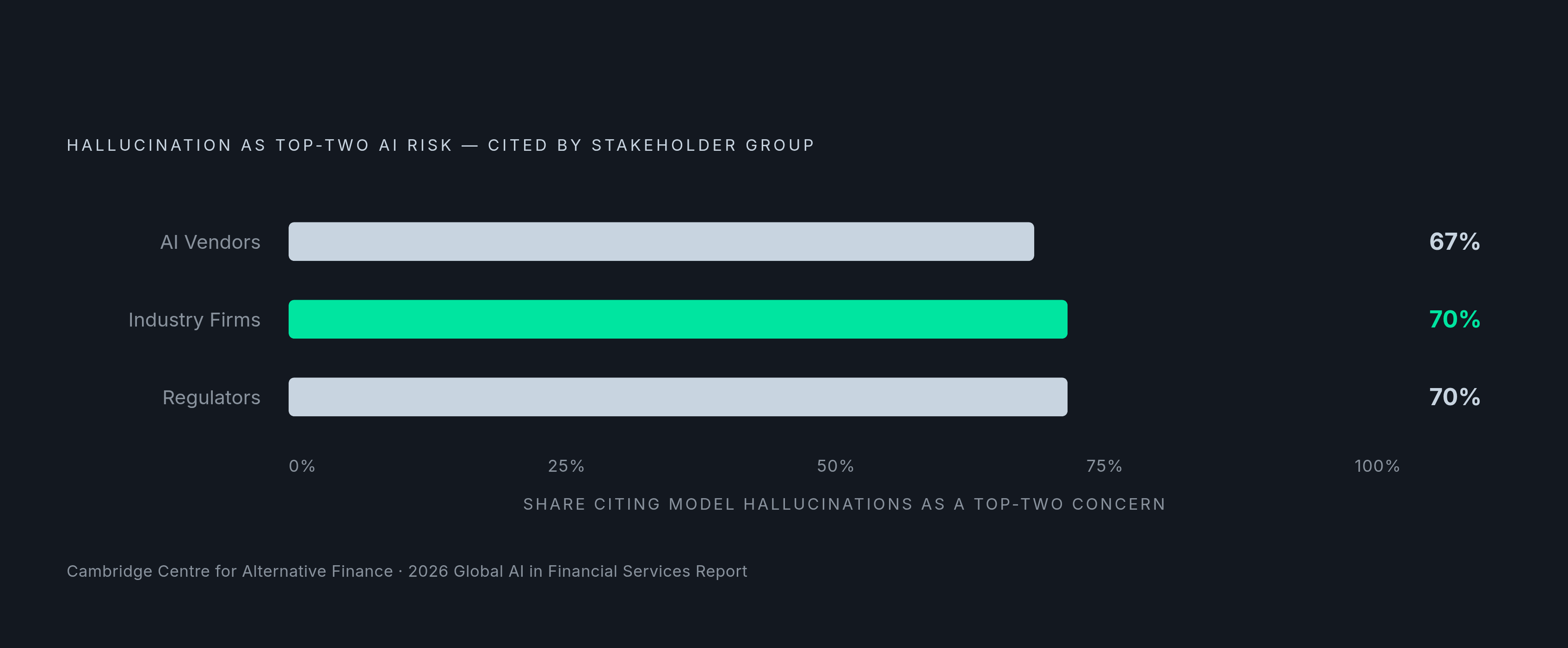
Hallucination in finance is what happens, predictably, when a model answers a time-sensitive question using data that stopped updating on a fixed date. The model was not built to flag that boundary. It was optimized for fluency and confidence, so the output reads the same whether the underlying fact is three years stale or three minutes old. The 2026 Global AI in Financial Services Report, from the Cambridge Centre for Alternative Finance, found model hallucinations and unreliable outputs were cited by 67% of AI vendors, 70% of surveyed industry firms, and 70% of regulators as among the top two AI risks, alongside data privacy and protection. It is near-unanimous agreement across every stakeholder group, skeptical regulators and confident vendors alike, that the output itself cannot be trusted at face value. For developers, the implication is specific: better prompting and a newer model release do not touch this problem, because the problem is the information source the model is drawing from at the moment it answers, and that source has to change.
What "cited intelligence" means as an architectural requirement
Cited intelligence describes a structural commitment, not a cosmetic one: retrieve live, authoritative information before generating a claim, then expose exactly where every piece of that claim came from. A system that answers first and bolts a citation onto the bottom afterward is still hallucinating, just with a reference list attached as decoration. A system that retrieves first and writes only from what it retrieved is a different kind of system altogether, and the distinction is the whole argument. Three properties define the architecture. Finance professionals surveyed on what they actually want from these tools consistently point to one thing above model brand or benchmark score: the ability to verify where an answer came from. That holds with particular force in agentic workflows, where a single research task might involve a dozen retrieval and reasoning steps. Cited intelligence there means every step in the chain is traceable, including the final sentence the user reads.
Exposure to unverifiable AI output across financial subsectors
Not every corner of financial services carries the same exposure when AI output turns out to be wrong, and the gap between how much a subsector relies on AI and how carefully it checks that AI tends to be widest exactly where the damage from a bad answer is largest. Across all three, the variable separating good outcomes from bad ones is whether verification discipline keeps pace with how much the output gets relied upon.
The compliance and governance pressure that makes source traceability a non-negotiable requirement
Regulators are no longer treating unverifiable AI output as a quality issue to be worked out between vendor and customer. They are treating it as an institutional liability, which turns citation architecture into a compliance requirement sitting right alongside the accuracy argument. The 2026 Global AI in Financial Services Report identifies a structural gap between governance intent and governance implementation: regulators and industry firms diverge on where accountability actually sits, and explainability frameworks remain unevenly adopted across the firms that are supposed to be using them. The EU AI Act, formally Regulation (EU) 2024/1689, puts enforcement teeth behind this starting August 2, 2026, when the AI Office and the national authorities of member states take over implementation, supervision, and enforcement. A system that cannot produce a chain of evidence from a generated output back to its originating source is structurally non-compliant, because the regulation requires traceable, auditable AI behavior as a baseline. AIUC-1, developed with Orrick, Stanford, MIT, MITRE, and the Cloud Security Alliance, extends this further by being the first governance standard built specifically around how AI agents behave once they are in production, covering data protection, operational boundaries, and error prevention through independent technical testing. For developers and enterprise teams, the practical consequence is that every agentic financial workflow needs an audit trail it can actually produce on request. Building that audit trail after the fact, once a workflow is already in production, is not a realistic option: it has to be architecturally possible from the retrieval layer up.
How real-time web retrieval at inference time solves the structural problem
The engineering answer to all of the above is retrieval at inference time. An agent that pulls live, authoritative web data before it generates a claim produces traceable output as a natural consequence of how it was built. The pattern looks like this in practice: the agent first determines what data it actually needs, retrieves that data from an authoritative source through a real-time web search API, performs whatever calculations it can deterministically rather than asking a language model to do arithmetic, and only then uses the LLM to interpret and explain what was retrieved. The model's job shifts from generating financial facts to explaining facts someone else already found. But what if the retrieved content itself is compromised? Web poisoning manipulates search results through malicious SEO or dynamically generated pages built to game ranking signals, and it is a live threat against any system that grounds itself in the open web. So developers evaluating a retrieval API need to ask specifically what source quality controls and noise filtering that API applies, because real-time retrieval is not automatically trustworthy retrieval.
Requirements for the Cited-Intelligence Infrastructure Layer
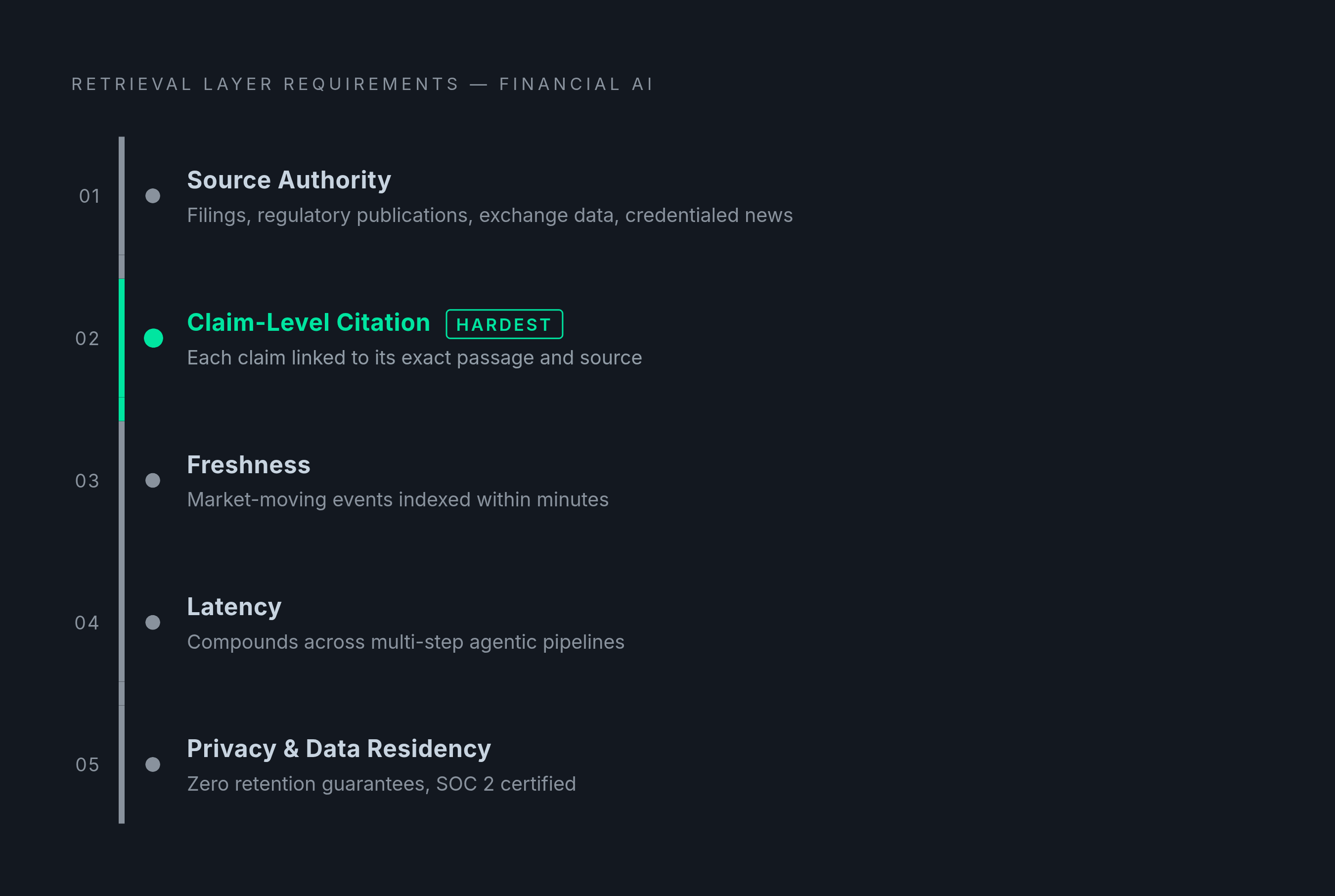
General-purpose search was not built for this job, and financial workflows impose requirements on retrieval infrastructure that go well past what a consumer search engine needs to satisfy. Source authority is the first of these: a financial claim needs to trace to a filing, an official regulatory publication, exchange data, or credentialed news reporting, not a blog aggregator repackaging someone else's summary. The retrieval layer has to be able to filter and rank results by source type, not just by relevance. Claim-level citation is the second requirement, and it is a stricter bar than it sounds: a footer listing "sources: [URLs]" does not satisfy an audit requirement, because an auditor needs to know which specific claim in the output came from which specific passage in which specific source, not just that the document appeared somewhere in the mix. Freshness is the third: market-moving events like earnings releases, rate decisions, covenant triggers, and regulatory actions can happen and become material within minutes, and a retrieval layer running on a stale index fails the workflow at precisely the moment the workflow was supposed to matter most. Latency is the fourth, and it compounds in ways that are easy to underestimate. Privacy and data residency round this out: institutions handling client data or non-public information need zero data retention guarantees and SOC 2 certification at the infrastructure layer as a baseline condition for using the system. These five criteria, source authority, claim-level citation, freshness, latency, and privacy, are the lens worth applying to any retrieval infrastructure under consideration, including the specific options that follow.
How leading cited-intelligence platforms and APIs address these requirements
Measured against those five criteria, the market for cited-intelligence infrastructure has split along a fairly clear line: tools built as retrieval infrastructure that developers embed into their own stack, and platforms built as finished research products for institutional teams to use directly.
You.com's Finance Research API sits in the first category and extends its underlying Research API, which conducts research in multiple steps: planning the query, searching repeatedly, reading full pages rather than snippets, and cross-referencing before producing an answer. Every answer comes grounded in live web retrieval performed at the moment of the query and returned with citations attached at the claim level, the granularity that audit and compliance workflows actually need. On benchmark performance, You.com's Research API previously held the top position on DeepSearchQA, and while other systems have since passed it as of mid-2026, its Finance Research API currently ranks first on FinSearchComp, with both results published openly. The fit is clearest for teams that need a retrieval and research layer they control directly, citation-grounded output meant to feed a downstream LLM for interpretation, integration into agentic pipelines built on LangChain, LlamaIndex, CrewAI, AutoGen, Make.com, or n8n, and enterprise-grade privacy guarantees built into that layer.
AlphaSense occupies the second category: a full cited-intelligence platform rather than a retrieval API, built around a corpus of premium business documents and designed to return fully traceable outputs from within that corpus. It has achieved broad penetration across the S&P 100, which speaks to real enterprise validation at the institutional research level. Its boundary is its own corpus: AlphaSense does not offer open-web retrieval infrastructure that a developer can embed inside a custom-built agent stack, which makes it a strong fit for institutional research teams working within its document set and a less natural fit for teams building their own agentic pipelines from scratch.
Fintool occupies a narrower slice still, with strength concentrated inside a specific document set where it performs reliably, but without coverage of open-web financial intelligence or real-time market events that fall outside regulatory filings.
The choice between these options comes down to a fairly simple question: does the workflow need a research platform to use as-is, or retrieval infrastructure to build an agent stack on top of.
Why citation is necessary but not sufficient (and what governance must add to retrieval)
Citations are the floor, not the ceiling. A cited output pulled from a poisoned source, a misread filing, or an ungoverned agent acting without oversight is still a dangerous output, just one that now comes with a footnote attached to its own error. The strongest objection to the cited-intelligence argument deserves to be stated directly: web grounding transfers the trust problem from the model to the source. A third governance failure that retrieval alone does not touch is data fragmentation: research spans siloed systems, and verifying an AI-generated answer takes just as long as finding the underlying information would have taken.
None of this undermines the case for cited intelligence; it defines what has to sit alongside it. Source quality controls at the retrieval layer need to filter by domain authority, publication date, and document type before content ever reaches the language model. Calculations should happen deterministically wherever possible, with agents computing numerics directly from retrieved data rather than asking the LLM to do arithmetic over figures it just read. Audit trails need to exist at every reasoning step, not only at the final output, a requirement that lines up with frameworks like the U.S. Treasury's February 2026 AI Risk Management Framework. And human review checkpoints still belong in the loop for high-stakes decisions: cited intelligence makes that review faster and more efficient, it does not make it unnecessary. Retrieval plus governance, together, is the complete architecture. Either piece alone leaves a gap the other was built to close.
What the agentic shift demands from financial AI infrastructure
Financial AI is moving from assisted research toward autonomous, multi-step agentic workflows, and that shift raises the stakes on everything argued above. The 2026 CCAF report finds agentic AI already in active adoption among a majority of financial services respondents, with rapid uptake and the clearest growth trajectory of any AI technology category tracked in the research. If autonomy increases without a matching increase in traceability, you do not get a wash. It produces more dangerous output moving at greater speed.
The industry's own language is shifting to match. Firms are moving from treating AI output as impressive to demanding that it be provable, with data lineage, validation, and governance built into every agentic system from the start. Auditability is becoming something firms compete on, not a compliance checkbox filled in after the product ships. For developers building agentic financial research systems, that means the four pillars, real-time retrieval, claim-level citation, source quality controls, and audit trails at every step, need to be part of the design from the first architectural decision, not something retrofitted once an agent is already running in production and something has already gone wrong. You.com's Research API and Finance Research API were built against exactly this requirement: multi-step retrieval, outputs cited at the claim level, enterprise governance controls, and benchmark-verified accuracy, assembled as infrastructure a development team can build an agentic financial workflow on top of.
Sources
- 2026 Global AI in Financial Services Report
- Trustworthy FinAInce: Unpacking How AI-Mediated Financial Advice is Judged
- From Frontier to Shadow AI: A Simmering Threat to Assurance and Security in Critical Infrastructure
- Reading Is Not Using: Retrieval, Judgment, and the Design of AI Financial Research Workflows