Finance Research API Architecture and Data Sourcing
Financial AI requires architecture that verifies data freshness, arithmetic.

Financial AI fails differently than other categories of AI, and that difference starts at the architecture, not the prompt. A general web search API can return text and call the job done. A Finance Research API has to return source-reconciled, cited, structured intelligence, which makes output format part of the architecture rather than something bolted on after the model finishes generating.
This requirement for source-reconciled, cited, structured intelligence forces a different set of guarantees on the infrastructure sitting underneath the API. A general-purpose search API optimizes for relevance and coverage. A Finance Research API has to guarantee real-time freshness, arithmetic verifiability, and traceable sourcing at every layer of the stack, simultaneously, because any one of those failing produces an answer that looks fine and isn't. Those three guarantees map to three distinct architectural layers: data sourcing, reconciliation, and citation delivery. Each layer can fail on its own, so each needs its own deliberate design decisions rather than inheriting correctness from whatever layer sits next to it. The rest of this piece works through those three layers in order, then looks at how they interact, how benchmarks actually measure them, and what governance obligations attach to each.
Data staleness propagation through a financial AI stack
Staleness doesn't arrive at the model. It arrives upstream, in the data pipeline, long before any language model sees a token of context. No amount of model capability fixes that, because the problem was never in the model's reasoning. It was in what the model was handed to reason over.
This matters because it tells builders where to look when things go wrong. What exactly does "first-class property" mean in practice? It means freshness guarantees get designed into the ingestion and serving path from the start, the same way latency or throughput would be, rather than retrofitted when a client notices a stale filing.
In financial AI, the consequences of staleness compound across a chain of calculations, and tracing that chain shows why. A stale price feed corrupts a position calculation. One might argue a single freshness check somewhere in the pipeline should catch this before it propagates. Because staleness compounds across independent calculations rather than surfacing as one clean error, a Finance Research API can't treat freshness as a single toggle flipped on at ingestion. Freshness has to be maintained independently at each layer of the stack. The next three sections treat sourcing, reconciliation, and citation as separate architectural problems.
The data sourcing layer: what real-time retrieval requires for financial content
Real-time financial retrieval is not a faster version of scraping a webpage. It requires managed infrastructure that handles source diversity, access control, anti-bot defenses, and content classification all at once, because financial content doesn't come in one shape. A system built to retrieve one of these well doesn't automatically retrieve the others well.
The web data infrastructure market has been moving in a specific direction in response to this complexity. Instead of businesses assembling browsers, proxies, anti-bot handling, parsers, and retry logic themselves, the winning approach is shifting toward managed infrastructure that hands back reliable, structured, real-time data an AI system can actually use. Raw HTML that still needs downstream parsing is not the deliverable anymore. Structured output is.
That shift appears concretely at the network level. Consider what that means for an AI agent fetching a live SEC filing in real time: it is now classified differently at the network level than a training crawler would be, which changes the reliability and access guarantees a financial API can expect to receive when it reaches out for that filing. So that distinction shapes retry behavior, rate limits, and whether a request even succeeds under load.
Financial content extraction also has to handle more than prose. Structured tables, balance sheets that need to come back as JSON instead of flattened text, and specific document sections such as Item 1A of a 10-K all need extraction logic built for financial document structure. Free-text retrieval alone misses the tabular data that most financial claims actually depend on, and that is the gap the next layer, reconciliation, exists to close.
The reconciliation layer: why source-matching financial claims requires a separate verification step
Retrieval accuracy and computational accuracy are not the same measurement, and conflating them is where a lot of financial AI pipelines quietly break. A system can retrieve exactly the right document, correctly, in real time, and still produce a wrong answer because the arithmetic performed on that document's tables was never checked against the source. Reconciliation is the layer built to catch that specific failure, and it typically works in three stages. The first stage identifies which claims in the retrieved content actually need verification against a primary document, because not every sentence in a research note carries a number worth checking. The third stage generates the answer with inline citations pointing to the exact verified source location.
That middle stage is what separates a Finance Research API from a general-purpose retrieval-augmented pipeline. A standard RAG system retrieves a document and injects it into context, trusting that the model will use it correctly. Reconciliation goes a step further: it verifies that the injected context is arithmetically and factually consistent with the primary source before the model ever generates a response from it. That ordering matters. Verification before generation catches errors a model would otherwise have no way to detect on its own, because the model has no independent way to know a derived ratio is wrong when the source numbers it was given were already correct.
Without that dedicated step, a system can source a document perfectly and still hand the user a hallucinated derivative. The model may correctly retrieve a 10-K, cite it accurately, and still miscalculate a ratio buried in its tables, producing an answer that looks sourced and legitimate at every surface check while carrying an error that only a dedicated arithmetic re-verification would catch. That's the failure mode with the sharpest regulatory edge: the source exists, the citation resolves to a real document, and the number attached to it is simply wrong.
The citation and output layer: how cited delivery changes what downstream systems can do with an answer
Citation in a Finance Research API is a structural output property, not a formatting choice applied for readability. When an API returns an answer with inline citations pointing to verified source locations, downstream systems, compliance tools, audit logs, multi-agent pipelines, can trace the provenance of every claim in that answer without re-querying the original source. That capability only exists because the reconciliation layer already confirmed what those citations point to. A citation attached to an unverified claim is decoration. A citation attached to a reconciled claim is an audit trail.
Without citations built into the output, every downstream consumer of that answer has to independently re-verify the claims it contains, which multiplies latency and cost across the pipeline and opens gaps where a claim can drift from the source it was originally built on. The multi-agent investment research pattern makes this dependency explicit. Frameworks like TradingAgents organize specialized roles, fundamental analysts, sentiment analysts, news analysts, technical analysts, researchers, traders, and risk managers, into a staged pipeline where each agent's output becomes the next agent's input. In that kind of chain, citations function as the handoff mechanism that preserves provenance from one stage to the next. Without citations, a risk manager three stages downstream has no way to check whether the trader's recommendation rests on a reconciled number or a hallucinated one.
Financial intelligence produced by AI has to be source-reconciled and cited to belong in serious research or decision-making workflows. That's a design constraint on the architecture, not a feature preference a team can decide to skip under deadline pressure.
How the three layers interact in production failure modes
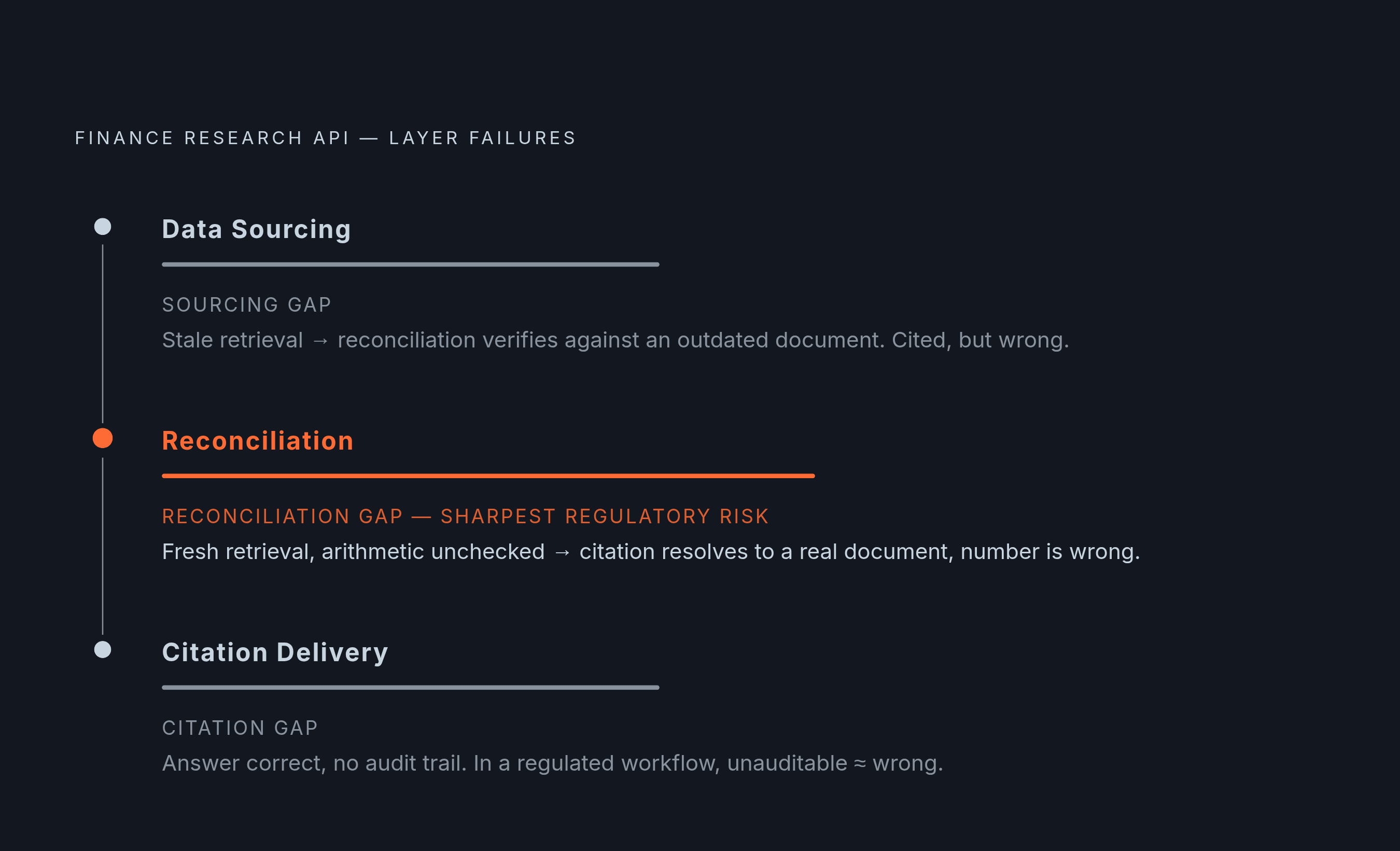
A Finance Research API is only as trustworthy as its weakest layer, and the failure modes that follow from a gap in any single layer tend to stay invisible to whatever application is consuming the API's output. Consider a gap at the sourcing layer first: stale or incomplete retrieval means the reconciliation layer ends up verifying against an outdated primary document. The resulting output looks cited and looks verified, because reconciliation did its job faithfully against what it was given, but the filing itself has already moved on.
Now consider a gap at the reconciliation layer instead, with sourcing held constant. If retrieval is fresh but arithmetic goes unverified, the model receives accurate raw text and may still derive an incorrect figure from it. The citation in the final answer points to a real, current document. The number that citation is attached to can still be wrong, because nothing checked the arithmetic between retrieval and generation.
A gap at the citation layer produces a third, quieter failure. The answer itself is correct. It simply can't be audited, which in a regulated workflow is close to the same problem as being wrong.
These gaps carry a cost beyond the single bad answer, too. An API that returns thin or hallucinated results forces the consuming agent to re-query, and at enterprise volume, millions of queries a month, that retry overhead compounds into a real cost and latency burden independent of whatever the per-query price looks like on a rate card. Two calls at a lower unit price can end up costing more in total than one call at a higher price that returns the verified answer the first time. The retry tax, not the sticker price, is often the largest hidden cost in a financial AI pipeline. The integration bottleneck, rather than model intelligence, is what keeps financial AI systems out of production. The 2026 State of AI Agents Report found that 46% of developers cite integration with existing systems as their primary challenge in deploying agentic workflows, with data access, data quality, and security and compliance concerns close behind. Architectural choices made at the sourcing, reconciliation, and citation layers are what let a financial AI system actually ship. The model chosen to sit on top of that architecture is rarely the deciding factor.
Benchmark performance in Finance Research APIs
A benchmark score is only as informative as its match to the architectural layer it claims to measure. Headline accuracy figures from general web search benchmarks do not predict how a system will perform on financial grounding tasks, because those benchmarks were never built to test reconciliation or citation fidelity. Why does the ranking shift so much depending on the task? Because each task type exercises a different combination of the three architectural layers, and a system tuned for one combination isn't automatically tuned for another.
BrowseComp results illustrate the spread concretely. Agentic-search accuracy across tested web search APIs ranges from roughly 19% at the low end up to far higher figures at the top, which is exactly the kind of spread that makes choosing a search API on headline accuracy alone a mistake if the use case is financial research rather than simple single-hop retrieval. Finance-specific benchmarks close that gap by testing the entire three-layer architecture at once: sourcing freshness, reconciliation accuracy against primary financial documents, and citation quality, rather than general web retrieval accuracy in isolation. Results on those finance-specific evaluations are the signal that matters for anyone building on top of a Finance Research API, more so than a strong general benchmark score earned on an entirely different kind of task.
Top performance on a finance-specific benchmark reflects the architectural properties this piece has walked through layer by layer: real-time sourcing that reaches regulatory filings and structured tables, reconciliation that catches arithmetic errors before generation, and citation delivery that downstream systems can actually audit. A benchmark result built on that foundation lets developers publicly verify AI search infrastructure for themselves rather than taking a vendor's word for it, because the results sit out in the open.
Security and data governance requirements that financial AI architecture must satisfy at the infrastructure layer
Governance in financial AI has to come before the output layer, not after it, because the risk enters the moment sensitive data touches the pipeline, not the moment an answer gets displayed. That ordering has concrete implications for how the three layers described above get built in practice. A significant share of production AI agents today run on shared service accounts, long-lived API keys, and informal ownership structures, which leaves most organizations unable to fully account for what their own agents are accessing or retaining at any given moment. This is a present condition of how many agentic systems are currently deployed.
Organizations now reach for data minimization as the design pattern in response. For a Finance Research API specifically, you need zero data retention and SOC 2 certification as baseline architecture, not as premium features reserved for enterprise tiers. The data flowing through a financial AI pipeline, positions, filings, client-sensitive research, simply cannot sit retained inside a third-party infrastructure layer without creating exposure that no amount of downstream compliance tooling can undo after the fact.
Agent identity governance belongs at the infrastructure layer for the same reason. Agents querying financial data sources need scoped, short-lived credentials rather than shared service accounts that make it impossible to trace which agent accessed what, and when. That enforcement has to live in the API infrastructure itself. If you leave it to the consuming application, you assume every team building on top of the API will implement identity governance correctly and consistently, but shared service accounts and long-lived keys have already shown that assumption doesn't hold across most production deployments.