AI-Powered Financial Research Workflows
AI agents now automate entire financial workflows, not just individual analytical tasks.

An FP&A analyst closing the books on Q3 spends the first two hours of any variance review not analyzing anything, but hunting: pulling actuals from the ERP, headcount data from the HRIS, last quarter's forecast from a shared drive, and a half-dozen approval emails buried in a messaging app. The analysis itself might take twenty minutes. The reconciliation around it eats the morning. That imbalance, not any shortage of analytical tools, is the structural problem financial research workflows face right now, and it is why the function is being reorganized at the operating-model level rather than simply sped up.
Each prior wave of AI in finance, machine learning for anomaly detection, NLP-driven dashboards, generative AI for narrative commentary, improved some slice of the analytical work itself. None of them touched the overhead surrounding it: pulling data from disconnected systems, reconciling mismatched formats, chasing sign-offs, formatting the final output for whoever asked for it. The real shift underway is a move from systems that answer questions to systems that act on goals: an agentic AI system receives an objective, breaks it into sub-tasks, pulls from multiple connected systems, runs the analysis, and returns a structured result without a human directing each intermediate step.
What makes this deployable in 2026 rather than aspirational is the convergence of three conditions. Data infrastructure has matured to the point that most mid-market finance teams now run real-time ERP and HRIS integrations. Model quality has also reached a level where it can reason reliably across the kind of data, structured and semi-structured, that financial workflows actually produce. And governance tooling, audit logs, role-based permissions, human-in-the-loop controls, has caught up to the point where autonomy can be deployed without abandoning oversight.
That still fails if the data underneath it is weak. Most agentic deployments that fail do not fail because the model reasoned poorly. They fail because the pipeline was built on top of native connectors that do not actually connect, a semantic layer that was never built, or data lineage nobody could trace back to its source. Model selection gets the attention in vendor conversations, but the infrastructure underneath decides whether a deployment survives contact with an actual close process.
What separates an agentic pipeline from a smarter chat interface
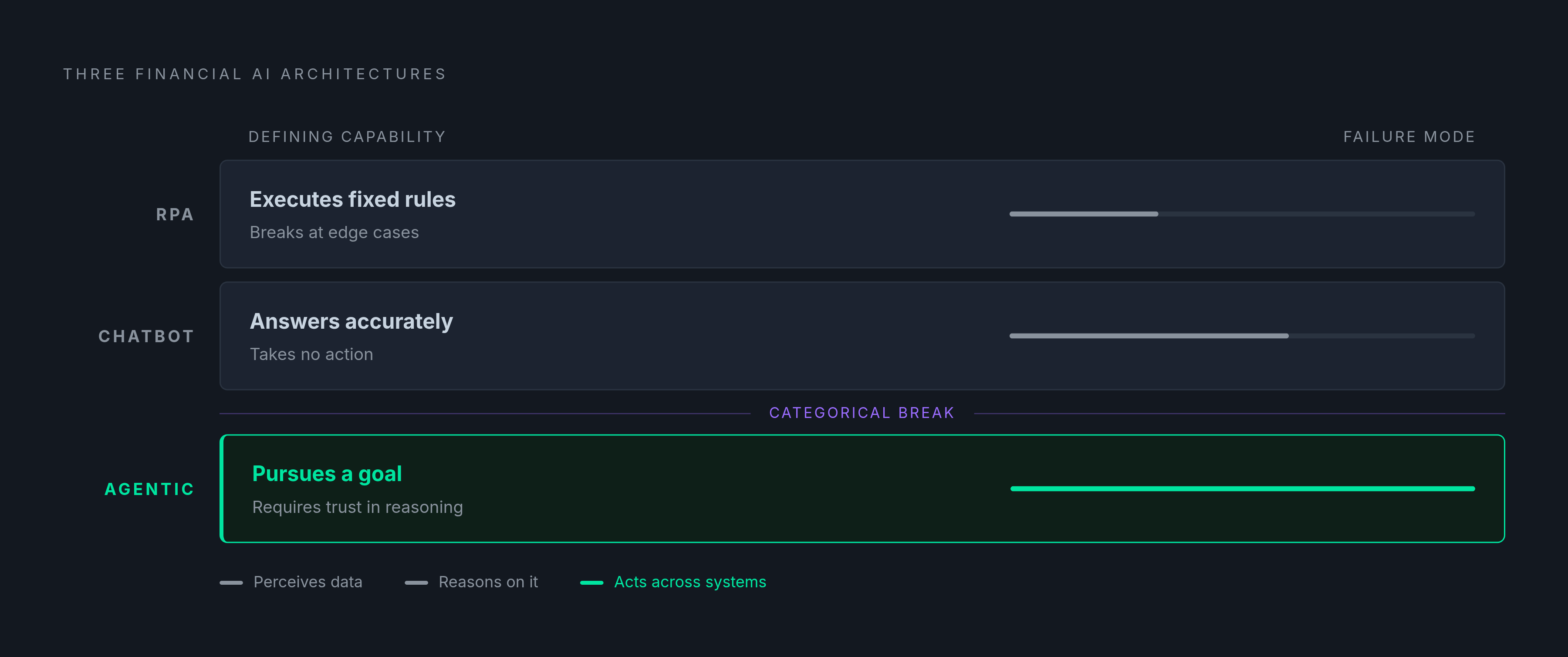
The distinction that matters when evaluating financial AI tools is the category the tool belongs to, not which vendor's model scores higher on a benchmark. AI assistants augment an individual analyst's work. Agentic systems execute entire workflows end to end. Treating the two as points on the same spectrum, just "more AI" versus "less AI," leads finance teams to buy the wrong tool for the problem they actually have.
Three architectures get conflated constantly and they are not the same thing. If a system hits an edge case it was not scripted for, robotic process automation breaks, because it only follows fixed, deterministic rules. A chatbot can answer a question accurately and still do nothing with the answer. Agentic AI perceives data, reasons using financial logic, and acts across connected systems with limited human intervention at each step. These are categorically different architectures, not three points of increasing sophistication on one continuum.
Consider the difference in what each can actually do with a close-season task. An AI assistant can summarize a 10-K competently and quickly. An agentic system can take the instruction "reconcile budget-to-actual for Q3 and flag drivers above threshold," decompose that single sentence into sub-tasks, pull actuals from the ERP and headcount data from the HRIS, run the variance analysis, and return a structured output, all without a human walking it through each stage.
The tools available to finance teams today span that full range, and each tier answers a different kind of problem. General assistants like ChatGPT, Claude, Gemini, and Microsoft Copilot handle open-ended reasoning and drafting. FP&A platforms such as Datarails, Pigment, and Brixx are built for planning and forecasting workflows specifically. Accounting workflow tools like Numeric, Trullion, and Nanonets Flow handle the transactional and compliance layer. Full agentic automation platforms sit above all three, and they orchestrate goal-driven execution across systems. None of these categories makes the others obsolete.
That last category is high-volume and judgment-intensive, with unstructured data and inputs that shift from quarter to quarter, so agentic AI solves a problem there that RPA never could. RPA executes a script. An agent pursues a goal. Whether a system genuinely does the latter comes down to a short, practical test: does it plan multi-step work on its own, does it call tools dynamically based on what it finds, does it maintain state across those steps, and does it adjust its behavior based on feedback along the way? If a system cannot do any of those four things, it is a prompt wrapper wearing agentic branding, whatever the marketing says. Those four capabilities, planning and dynamic tool use especially, also determine how you build a real pipeline; the next section takes up that architecture.
How multi-step agentic pipelines are structured in finance
Production-grade financial AI does not run on one model that answers one prompt. It runs as an orchestrated pipeline, a sequence of specialized agents each handling one stage of work and passing structured output to the next. You need to understand that structure before you evaluate any individual model, because the architecture is what determines whether the whole system holds together under real workloads.
Three retrieval architectures dominate current implementations, and each serves a different workflow need. Search-first pipelines call a search or data API on every single query, and they inject the results right into the prompt, so the model gets real-time context. This mirrors retrieval-augmented generation in spirit, but it swaps out a static vector store for live data. Tool-use setups work differently: the model decides dynamically, query by query, whether it needs external information at all, and it can make multiple calls back to a tool to refine or expand what it is looking for. Agentic loops go a step further still, with the model iteratively reasoning, calling tools, and revising its approach until the task is actually complete, a pattern suited to something like competitive analysis or credit underwriting where one search pass was never going to be enough.
Deep research agents form their own distinct class above these three. They combine search, planning, reasoning, and synthesis inside a single pipeline, because financial research itself is rarely a one-shot task. It runs through evidence collection, forward-looking analysis, and report writing as separate stages, and a single-pass language model falls short of that even when it has search access. Deep research systems use AI-driven planning to break the task apart, so they can choose which sources to pull from for each sub-task, run focused sub-analyses such as EPS forecasting, and then merge the separate outputs into one coherent report.
This same multi-stage logic appears well outside FP&A. Surveys of agentic quantitative trading systems map trading work across five distinct stages, factor mining, signal discovery, portfolio construction, order execution, and risk management, confirming that the pipeline pattern generalizes into investment and trading contexts and does not stay confined to corporate finance. Actuarial work shows the same breadth from a different angle: the SOA Research Institute frames agentic AI as applicable across experience studies, the determination and validation of actuarial assets and liabilities including IBNR, ORSA data compilation, rate development, assumption development, and regulatory reporting. Each of those is its own multi-step workflow with its own data sources and its own governance requirements layered on top.
What every one of these pipelines shares, regardless of domain, is total dependence on the data flowing into it. A deep research agent that plans beautifully and reasons carefully still produces an unreliable report if the information it retrieves is stale, uncited, or pulled from a source it cannot verify. The architecture only works if the data layer underneath it does its job.
Real-Time, Cited Web Data as the Load-Bearing Layer
Grounding means you inject current, external information into a model's output when it generates, instead of relying on what it absorbed during training. In financial workflows, where data changes daily and an unverifiable claim creates real regulatory exposure, grounding is an architectural requirement.
The mechanism is straightforward. An ungrounded model relies entirely on its training data, and that fails the instant a question requires something current: the latest SEC filing, a newly changed rate, a regulatory update issued last week. Grounded production systems hallucinate less and give you more reliable output, because the relevant knowledge gets pulled in at query time through retrieval, instead of sitting baked into the model's weights from months or years earlier.
Fine-tuning and grounding solve this problem in opposite ways. Fine-tuning bakes knowledge into the model's weights. That means retraining every time the underlying data changes. Grounding injects knowledge at the moment of the query instead. If your data changes daily, grounding is almost always the architecturally sound choice, simply because you don't want to retrain a model every time a rate moves.
Freshness windows are an operational discipline, not a setting buried in a config file. Market data and news need a window measured in hours. Documentation can tolerate weeks. If the window is set wrong in either direction, the pipeline either burns money re-fetching information that has not changed, or hallucinates on information that has gone stale.
Citation matters just as much as freshness, and not as a formatting nicety. In finance, under SEC and FINRA scrutiny, an unverifiable citation is a regulatory exposure, not a cosmetic flaw. A pipeline has to be able to trace every factual claim it makes back to a sourced, timestamped document, on demand.
There is an economic dimension to all of this that gets underweighted. A single agentic research session can trigger many search calls back to back as the agent refines its query, checks a claim, and pulls a follow-up source. If you don't build circuit breakers and cost controls into the pipeline, per-query API pricing compounds, and the session can end up costing more than the research was worth. Grounding infrastructure is an economic decision as much as a technical one.
This is the layer You.com's Finance Research API is built for: source-reconciled, cited financial intelligence delivered at latencies that scale with how deep the research goes, up to 120 seconds for Deep mode and up to 300 seconds for Exhaustive mode. In You.com's own internal evaluation, the Finance Research API ranked first on FinSearchComp's T2 sub-tier for Simple Historical Lookup, and that is a public benchmark result, not a marketing claim. The Research API also holds the top position on DeepSearchQA. The broader product suite, Web Search API, Contents API, Answer API, Research API, and Finance Research API, is built around the exact multi-call session pattern that agentic financial pipelines generate, with zero data retention available on request and SOC2 certification addressing the compliance baseline financial institutions cannot waive.
Where AI-generated financial research falls short today
But none of that infrastructure closes the gap between AI-generated research and professional-grade output on its own. Benchmark evidence shows AI-generated financial research reports still fall short of professional standards across three distinct dimensions: qualitative rigor, quantitative forecasting and valuation accuracy, and claim verifiability. The gap is not even across those three dimensions, and that unevenness has direct consequences for how a workflow should be designed.
The Deep FinResearch Bench, submitted in April 2026, tested AI-generated reports against reports written by financial professionals across all three dimensions, and it found that AI output fell short on each one. The benchmark's authors frame this as evidence for the need for domain-specialized deep research agents built specifically for finance, rather than general-purpose research agents adapted after the fact. Until recently, no established benchmark existed for evaluating deep research systems in professional equity research at all, largely because it was hard to construct suitable evaluation metrics and access to professional research data was limited. Deep FinResearch Bench and ICBCBench are among the first systematic attempts to close that gap, with ICBCBench covering a broader swath of financial domains.
A separate line of evidence comes from a natural experiment around FactSet's 2023 integration of generative AI tools. Analyst reports associated with FactSet after that integration became measurably richer: more distinct information sources, broader topical coverage, more analytical methods applied per report. But when analysts faced greater information-processing demands, their relative forecast accuracy declined, even as the reports themselves grew more comprehensive. A machine-learning benchmark processed those same inputs and showed no equivalent decline, so this points to a human attention constraint, not any deterioration in the underlying information available to analysts.
GenAI relaxes the constraint on acquiring information while tightening the constraint on a human's ability to process all of it. That changes the design question for any financial AI workflow. The question is not how much of the process can be automated. It is where human attention actually adds the most value once the volume of available information stops being the bottleneck. That question is exactly where governance architecture has to start.
Building Governance, Auditability, and Human Oversight into the Pipeline
Governance cannot be bolted onto a financial AI pipeline after it is built. It has to be part of the architecture from the first design decision, because the same autonomy that makes an agentic system valuable in finance is precisely what turns an uncontrolled deployment into a regulatory and reputational liability.
Agentic AI in financial services operates inside a dense regulatory environment: SOX, GDPR, MiFID II, and the EU AI Act each impose specific requirements on traceability, explainability, and human accountability. Those requirements have to be satisfied by the pipeline's design, not patched in through documentation written after the system is already running.
The implementation pattern that has emerged as dominant is Crawl-Walk-Run: pilot a single workflow under full governance controls, then expand the system's autonomy only once audit logs and human-in-the-loop checkpoints are proven to work at that small scale. This is not about limiting ambition. The governance infrastructure needs to be tested where mistakes are cheap before autonomous execution gets extended to workflows where mistakes are not.
Actuarial applications show what a fully specified governance blueprint looks like in practice. The SOA Research Institute specifies that an agentic governance and risk framework must cover model risk management, ongoing monitoring, human-in-the-loop controls, documentation standards, and bias and impact assessment. The fuller scope of work extends to audit trails covering prompts, code, parameters, data versions, and decision logs, alongside role-based access controls with de-identification built in for PHI and PII.
Legacy financial infrastructure sets a hard constraint on all of this. Decades of layered systems and piled-up regulatory requirements were never built for continuous, real-time, governed AI workflows. Agentic AI functions reliably only when governance, data lineage, and observability are designed into the full lifecycle of the system from the start, not retrofitted onto a pipeline that was built for something else.
Human-in-the-loop design should follow directly from where the FactSet research points: human attention is the binding constraint once information access stops being scarce. Calibrating oversight to where human judgment adds the most value, rather than spreading it evenly across every step a pipeline takes, is the design principle that ties the governance layer back to the capability gaps the benchmarks already describe.