Benchmarking Finance-Specific AI Research APIs
Finance APIs need their own benchmarks, not generic ones.

Finance API evaluation is not a variant of general API benchmarking: it is a different discipline with different failure modes, and the industry's benchmark tools are only now catching up. This piece lays out the four dimensions a finance-specific benchmark has to measure, surveys what the active 2026 benchmark programs actually cover, and reads the gaps between API scores as evidence of architecture rather than noise, before explaining why enterprise teams end up running several APIs at once instead of picking one.
Why general-purpose benchmarks fail finance API evaluation
FINOS's evaluation framework initiative names the mismatch directly: domain-specific correctness in finance depends on alignment with financial ontologies and standards such as CDM and DORA, evaluation has to happen at the level of the whole system (the workflow, the agent orchestration, not just the model generating text), and metrics for bias, robustness, and explainability function as regulatory necessities rather than nice-to-have quality signals. The same initiative states that benchmarks built for consumer apps will not hold up in a world of derivatives, compliance obligations, and systemic risk. A team that scores a candidate API against a generic web-search benchmark and treats a strong result as a green light is measuring something that has little bearing on any task the agent will run in production. That mismatch is the reason a finance-specific evaluation layer had to emerge on its own terms rather than borrowing from the existing playbook, and it sets up the question the rest of this piece works through: once general benchmarks are off the table, what should replace them?
The four dimensions a finance benchmark must measure
A benchmark built for this domain has to cover four distinct dimensions, each one aimed at a different way a finance agent can fail. The first is source attribution accuracy: whether each claim a system produces is grounded to an identified, verifiable primary source at the level of the specific passage, not a generic URL tacked onto the end of a paragraph. Without that field-level link between claim and document, a response cannot be audited, which makes it unusable in any setting where compliance matters. The second is structured data retrieval fidelity: can the system return a specific numeric value, say Apple's Q3 2024 revenue, as a verified figure pulled from a structured database, rather than a paraphrase lifted from a secondary news article. This dimension went untested until FinRetrieval, released in January 2026 by Daloopa, built the first benchmark aimed squarely at it, using 500 questions targeting numeric values with ground-truth answers checked against source documents.
The third dimension is real-time freshness: whether the data coming back reflects the current state of the world or a snapshot that could be hours, days, or weeks old. Stale data in a financial context can actively mislead a pricing decision, a filing interpretation, or a risk calculation, which raises the stakes well past the ordinary cost of an out-of-date answer. The fourth is end-to-end agentic workflow performance: whether the system can run a full research pipeline, problem analysis, iterative retrieval, synthesis across multiple sources, and a structured report at the end, rather than answering one query and stopping. ICBCBench captures this with a dual-track design that pairs objective tasks with verifiable answers against subjective evaluation of long-form reports, specifically so it can measure both retrieval-reasoning accuracy and the quality of the finished research product. HERCULEAN pushes the same idea further by testing agents across four professional financial workflows, Trading, Hedging, Market Insights, and Auditing, each one built as a standardized MCP-based skill environment with its own tools, interaction patterns, constraints, and success criteria. Its finding that agents handle Trading and Market Insights relatively well but struggle on Hedging and Auditing, where long-horizon coordination, state consistency, and structured verification matter most, is a result that only a workflow-level benchmark could have surfaced in the first place. Each of these four dimensions catches something the others miss: attribution catches hallucination, fidelity catches numeric error, freshness catches staleness, and workflow performance catches breakdowns in coordination. A benchmark that tests only one of them hands a team a partial picture, and a partial picture leads to a bad API selection.
What the active benchmark programs test in 2026
The number of finance-specific benchmark programs that appeared across 2025 and 2026 reflects the field working its way toward those four dimensions, piece by piece, rather than any single group solving the whole problem at once.
FinRetrieval, released in January 2026, built its 500 retrieval questions with ground-truth answers and ran 14 agent configurations across Anthropic, OpenAI, and Google, releasing the complete tool-call execution traces alongside the results. Its focus sits almost entirely on structured data retrieval fidelity, the dimension no earlier benchmark had actually addressed. ICBCBench, which followed in June 2026, came out of a consortium with domain experts drawn from a wide range of institutions and academic bodies, and its dual-track design, covering both objective verifiable tasks and long-form report evaluation, measures expert alignment, citation consistency, and source quality. That makes it strong on attribution accuracy and end-to-end quality, though its center of gravity is deep research report generation rather than pulling a single structured number. HERCULEAN, built around four MCP-based workflow environments spanning Trading, Hedging, Market Insights, and Auditing, is the only one of these testing workflow-level coordination failures rather than single-answer correctness, and its finding that frontier agents handle discrete tasks well but break down on multi-step workflows requiring state consistency is specific to that design.
The FINOS AI Evaluation Framework takes a different shape entirely: community-driven and taxonomy-first, with piloting scheduled for the first quarter of 2026 and industry-wide expansion planned for the second quarter. Its distinguishing feature is folding in trust, compliance, bias, robustness, and explainability, dimensions that pure retrieval-accuracy benchmarks skip over entirely, and it is built to function as a set of guardrails and repeatable test datasets rather than a leaderboard. Beyond these, 2026 produced a cluster of adjacent efforts: FinResearchBench II, a deep research benchmark using consensus-derived gold rubrics to distinguish financial report quality; FORCE-Bench, a benchmark, dataset, and evaluation harness built for agentic AI in enterprise finance; FinDeepResearch, aimed at evaluating deep research agents on rigorous financial analysis; the Vals AI Finance Agent Benchmark v2, updated September 29, 2026, which tests models on finance tasks; and the Vals AI Web Search Index, updated July 16, 2026, which compares native provider search against independent web-search tools on legal research and finance analysis tasks. Put side by side, these programs leave a collective gap: nothing on the list covers numeric retrieval fidelity, citation-level attribution, real-time freshness, and multi-step workflow performance all at once. A team selecting an API has to triangulate across several of these benchmarks rather than leaning on any one score.
What measured gaps between APIs reveal about their architectures
The gaps between APIs on these benchmarks are large enough, and consistent enough across different dimensions, to rule out ordinary tuning variance as the explanation. They point instead to real differences in how each system is built, and those differences carry forward into what each API can be trusted to do in a live finance agent stack.
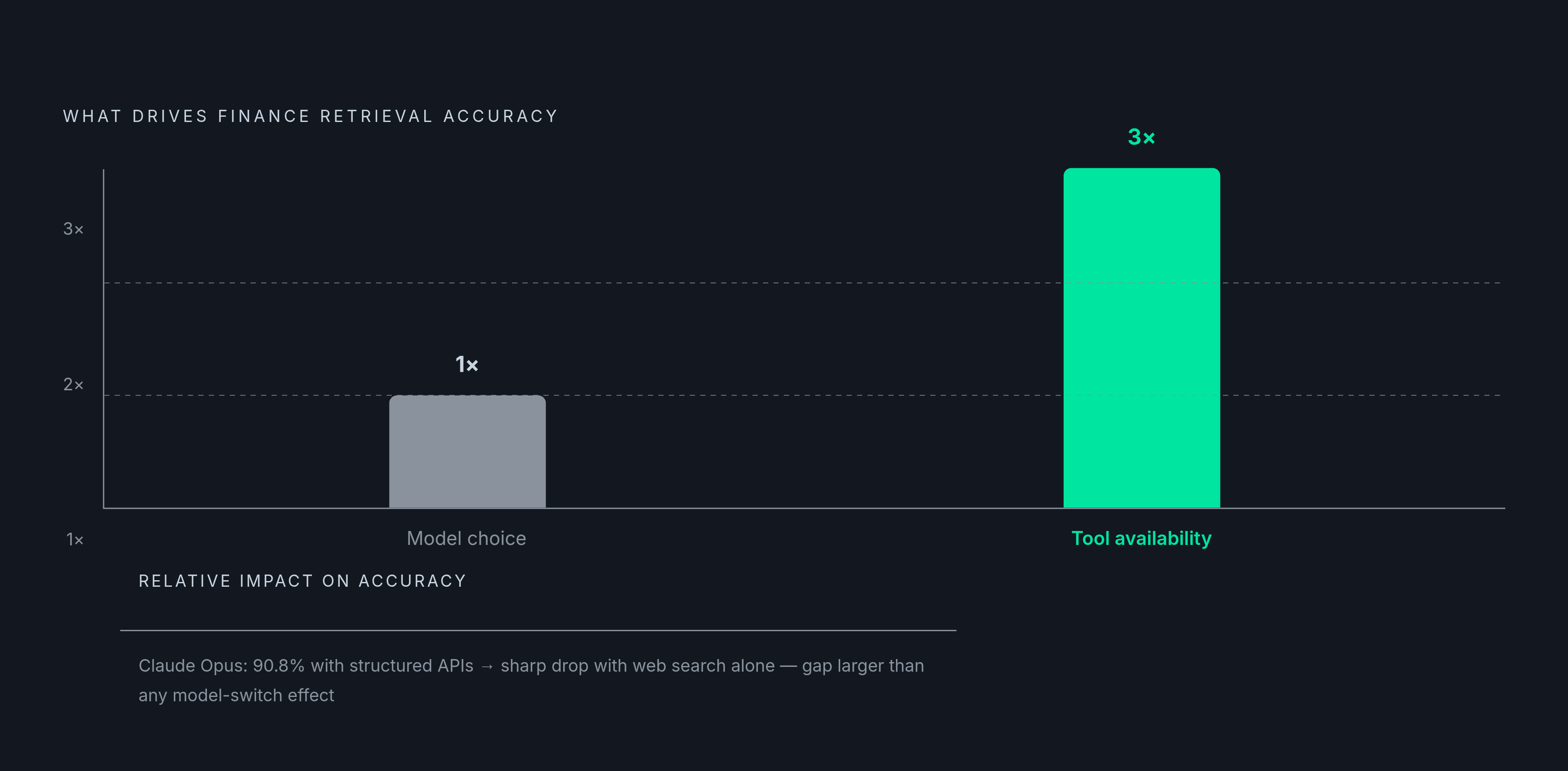
The clearest example comes from FinRetrieval's structured data retrieval fidelity results. Claude Opus reaches 90.8% accuracy when paired with structured data APIs, but its accuracy with web search alone drops sharply, by a margin several times larger than the equivalent gap for other providers. That gap is architectural rather than incidental: tool availability has over 3× the impact on finance retrieval performance that model choice does. An API routing finance queries through web search instead of a structured database will miss the numeric retrieval task no matter which underlying model it runs on. Google's equivalent gap between structured and web-search conditions is far smaller, which points to its web index carrying stronger structured data coverage already built in, a difference in architecture rather than a difference in model quality.
A parallel pattern appears in long-form research quality, measured on the DRACO benchmark. The gap observed between Valyu and a lower-cost competitor does not track with spending, since the cheaper system is dramatically cheaper and still trails, which suggests the gap traces back to index architecture, domain-grounded data sources against general web-ranked results, rather than how much compute either system throws at the problem. Freshness scores tell a related story. Valyu scores well on FreshQA, while a comparable web-search-oriented competitor's documented FreshQA number stays low, consistent with a known weakness on time-sensitive queries. For any finance task that depends on current prices, a filing from this week, or a live regulatory update, a low FreshQA score functions as a structural disqualifier rather than a minor shortcoming worth working around.
The workflow dimension, measured by HERCULEAN, shows the same underlying logic from a different angle. That is a tool-interface problem: whether the API's tool interface can support the multi-step interaction a workflow like Hedging actually requires, a dimension that a single-turn benchmark would never expose in the first place. You.com's Research API leading on DeepSearchQA and its Finance Research API leading on FinSearchComp fit into this same picture as evidence that measurable, independently checkable benchmark performance, not positioning in a sales deck, is the right basis for judging architecture. The Finance Research API's top rank on FinSearchComp speaks directly to the source-attributed, structured-output demands this section has been tracing back to architecture all along.
Enterprise finance stacks that combine multiple APIs
None of this adds up to a single winner. Once the four-dimension framework from earlier in this piece is in view, that pattern stops looking like a compromise and starts looking like the only coherent response to how the benchmarks actually score these systems. A benchmark score was never going to crown a single winner; it was always going to describe which layer of a stack a given API belongs in.
The specific APIs documented in enterprise finance agent stacks each carry their own strengths and limits, reflecting performance gaps large and consistent enough across dimensions to expose genuine architectural differences with direct consequences for what each API can and cannot do reliably. Polygon and Massive are built for market data, strong on institutional tick data and aggregates, though priced for institutional scale and limited to market data alone. Financial Modeling Prep handles fundamentals well, covering statements, ratios, and DCF inputs, though its coverage gets uneven on small caps and it does not provide filing text. Tiingo combines market and fundamentals data, offering clean end-of-day prices and news, though real-time access requires a paid tier and its coverage runs narrower than some alternatives.
That stacking pattern follows directly from what the benchmark gaps in the previous section revealed. If tool availability has more than three times the impact of model choice on retrieval fidelity, and if a low FreshQA score disqualifies a system from time-sensitive work regardless of how well it performs elsewhere, then no single API was ever going to clear all four bars at once, because each bar rewards a different kind of architecture. A system built to index domain-grounded financial filings is not built the same way as a system built to serve institutional tick data at scale, and asking either one to cover the other's job is asking it to work against its own design. That is the real lesson the 2026 benchmark landscape offers a team doing API selection: the question is not which API wins outright, but which dimension of the four-part framework each candidate actually satisfies, and how its strengths slot into a stack built the way enterprise finance teams are already building them.
Sources
- ICBCBench: An Industry Consortium Benchmark for Financial Deep Research
- Herculean: An Agentic Benchmark for Financial Intelligence
- FinRetrieval: A Benchmark for Financial Data Retrieval by AI Agents
- Building a Shared Benchmarking Framework for AI in Financial Services
- AI Benchmark Leaderboards
- FORCE-Bench: A Benchmark, Dataset, and Evaluation Harness for Agentic AI in Enterprise Finance
- Deep FinResearch Bench: Evaluating AI’s Ability to Conduct Professional Financial Investment Research
- FinResearchBench II: A Deep Research Benchmark with Consensus-Derived Gold Rubrics for Distinguishing Financial Report Quality