Caching Strategies for Real-Time Web Data in LLM Applications
Freshness, not just hit rates, becomes the bottleneck for LLM caching at web scale.

Web-grounded LLM agents cache data that changes underneath them, which makes the standard playbook for caching LLM responses insufficient on its own. This piece walks through why freshness turns caching into a three-layer problem instead of a single tuning exercise, how each layer works, where staleness enters the system, and what determines the ceiling on the whole architecture regardless of how well it's built.
Caching web data for LLMs differs from caching LLM responses
The standard caching playbook for LLM applications assumes a fact that was true yesterday is still true today. Web-grounded agents can't make that assumption. Data pulled from a live search result is correct at the moment it's retrieved and can be wrong minutes later, which makes the underlying caching problem structurally different from anything a stable knowledge source would require.
Exact-match and semantic caches, the two workhorses of standard LLM response caching, were built to cut token cost and latency. Neither one has a built-in way to know when the fact underneath a cached response has changed. They'll happily serve a response that was accurate an hour ago with the same confidence they'd serve one from five minutes ago, because nothing in their design distinguishes the two.
Retrieval itself has gotten more sophisticated in ways that make this tension sharper, not softer. Pipelines that convert raw HTML into clean, structured Markdown before it ever reaches the model cut token consumption per page substantially, and caching that cleaned-up output is an obvious next step for saving cost. But every efficiency gained by caching that output comes with an equal increase in the cost of serving it stale, since a cheaper, more compact retrieval result is still a snapshot of a fact that keeps moving.
The UC Berkeley HOTNETS '24 paper on cache freshness gives this tension a formal name. Time-to-live, the default mechanism nearly every caching system leans on, becomes impractical once the required freshness window shrinks to real-time scale. At that point, engineers are choosing between the benefit of caching at all and the freshness their application actually needs.
Layered onto that is a second wrinkle specific to agentic systems: workloads built from chains of sub-tasks, where the same underlying data gets touched by multiple steps in a pipeline. Research from the University of Minnesota on workload-aware caching shows these systems have structural reuse patterns, shared sub-tasks across a directed graph of related queries, that generic caching policies simply don't account for. A cache built to optimize a single query in isolation misses the fact that related queries might all depend on the same underlying node.
None of this is solved by tuning a single cache harder. It's solved by recognizing that freshness, cost, and reuse are three separate problems, and building a layered architecture where each layer takes on the one it's suited for.
The three caching layers and the cost driver each one targets
Production systems that handle web-grounded LLM queries typically rely on three caching layers, and each one addresses a distinct cost driver at a distinct point in the stack. Treating them as interchangeable, or investing in only one because it's the most familiar, is how teams end up under-provisioned for the failure mode that actually costs them money.
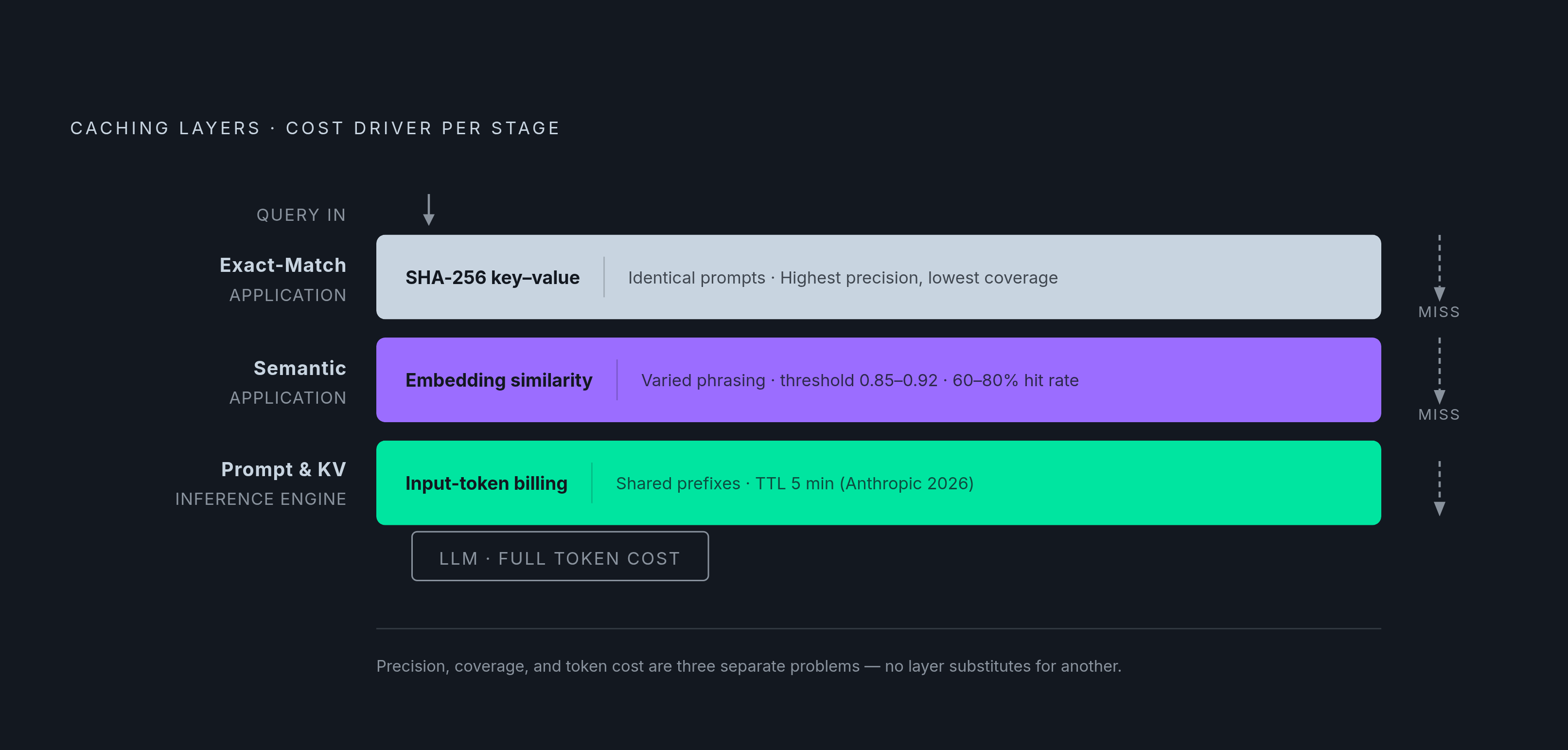
Exact-match caching is the simplest of the three: a deterministic key-value lookup where an identical prompt, hashed into a cache key, returns an identical stored response. It has the highest hit precision because there's no ambiguity in a match, but its coverage is the lowest, since it only fires when a user's phrasing is identical to something already seen. The key itself typically includes the model, the temperature setting, and the prompt text together, because a prompt run at a different temperature is functionally a different request and shouldn't share a cache entry with one run at a different setting. This layer suits FAQ systems, documentation search, and predefined conversation flows well, where the phrasing space is narrow and repetition is common.
Semantic caching widens coverage beyond what exact-match can reach. That flexibility widens the net considerably. A customer support chatbot, where phrasing varies but intent repeats, often sees hit rates in the 60 to 80 percent range, while FAQ chatbots run somewhat lower and general-purpose assistants with high query diversity lower still. A Percona post from February 2026 demonstrates this approach with a Redis/Valkey vector index built using sentence-transformers and the COSINE distance metric.
Prompt and KV caching is the third layer, and it operates somewhere neither of the first two touches: inside the inference engine itself, not the application layer. Anthropic's own default cut its prompt cache TTL from one hour down to five minutes in early 2026, which pushed high-traffic deployments toward batching requests just to keep hit rates strong under the shorter window. This layer targets a cost driver the other two don't: the input-token billing on repeated system prompts and shared context prefixes, rather than the cost of regenerating a full query response.
Put the three side by side: exact-match buys precision on repeated phrasing. Semantic buys coverage on varied phrasing with the same intent. Prompt and KV caching addresses the input-token cost of tokens an application resends on every call regardless of what the user asked. None substitutes for the other.
Exact-match and semantic layers in practice, and the similarity threshold as the most consequential tuning decision
Building an exact-match cache is largely a matter of discipline: hash the right fields into the key, store the response, serve it back on a match. A SHA256-keyed pattern built on Redis, documented in OneUptime's implementation guide from January 2026, is a common baseline for this layer. Semantic caching asks more of an engineering team, and the similarity threshold decides whether it works or backfires.
Setting that threshold too low, say around 0.85, causes queries that aren't actually asking the same thing to start sharing responses. A hallucinated or outdated answer generated for one query gets served with full confidence to a wider population of unrelated ones. Set it too high, pushing toward 1.0, and semantic caching behaves like exact-match with extra steps, so coverage collapses back down and the whole point of embedding-based matching evaporates.
Where that threshold should sit depends heavily on domain. A support bot working within a controlled, narrow vocabulary can tolerate a lower threshold, since the range of things users actually ask about is limited and semantically close phrasings are more likely to mean the same thing. A general research agent can't take that risk, since subtle differences in phrasing there often carry real differences in meaning. Percona's implementation guidance notes that support bots with domain-specific vocabularies often land in that 60 to 80 percent hit rate range because the vocabulary constraint makes a lower threshold safe. OneUptime's guide uses 0.92 as a starting point, and Percona's implementation sets a higher floor within that same range.
There's a structural risk buried in this setup that's easy to overlook until it happens: embedding model versioning. Upgrade the embedding model and the new vectors are numerically incompatible with everything already stored. A similarity score computed against the old model means something different from one computed against the new one, so the entire semantic cache needs a full invalidation the moment the embedding model changes, not a gradual phase-out.
One more failure mode belongs here, and it's less about tuning than about traffic pattern: the cache stampede. When many users send semantically identical queries within the same short window, before any of them has resolved and been cached, the system doesn't know to wait. It fires off a separate LLM API call for each one, meaning as many calls as concurrent users for a query that should have cost exactly one. The fix is request coalescing, a coordination layer sitting in front of the LLM API client that recognizes duplicate in-flight requests and holds them until the first one resolves, then serves the same result to all of them.
Staleness in a web-grounded cache versus a wrong LLM answer
When a web-grounded agent serves a stale answer, the model itself usually did nothing wrong. It reasoned correctly over the data it was given. The failure sits upstream, in the data infrastructure that fed it, which makes this a fundamentally different kind of problem to diagnose than a model producing a bad answer from good information.
An agent that answers a question about March with an index built in January is reasoning over a snapshot of the world that expired before the query arrived, because nothing in the pipeline flagged the change.
The ChurnBench paper, published in September 2026, gives this distinction formal structure. It separates staleness errors, where a cached object no longer reflects ground truth, from reasoning errors, which require different remediation. Fixing a reasoning error means improving the model's inference. Fixing a staleness error means fixing the cache's relationship to time, an entirely separate engineering problem. ChurnBench operationalizes the distinction by generating a four-source enterprise data fabric laid out as a timeline, computing gold answers from an append-only ground-truth ledger, and labeling any answer that was correct at retrieval time but wrong by the time it's evaluated as a freshness error rather than a reasoning failure.
What makes this worse in a semantic cache specifically is how the error propagates. An exact-match cache serving a stale answer affects only the exact query that triggered it. A semantic cache doesn't contain the damage that neatly: a wrong response cached once gets served to every future query that lands within the similarity threshold of the original. The error doesn't decay on its own. It spreads across an entire cluster of related queries until something explicitly invalidates it.
Some domains make the stakes of this concrete rather than abstract. A service providing stock information needs data fresh enough to support decisions made in real time, not decisions made against a snapshot from an hour ago. The HOTNETS '24 paper cites Databricks' Unity Catalog as a production system that requires metadata freshness on the order of seconds, a timescale at which standard TTLs simply can't keep up.
Adaptive invalidation addresses the freshness constraint static TTLs cannot
A fixed TTL isn't wrong as an idea. It fails because a single timer applied uniformly can't account for data that changes at wildly different rates depending on what it is. Financial data might be stale in seconds. A reference document might stay accurate for weeks. Adaptive policies, which respond to write events as they happen rather than counting down a fixed clock, turn out to be more efficient once freshness requirements approach real time.
The HOTNETS '24 paper makes this case analytically rather than just intuitively. At real-time timescales, deciding freshness in response to incoming writes beats a TTL-based policy on efficiency grounds, and the paper proposes an adaptive algorithm that adjusts based on the read and write ratio of each individual object moving through the system. An object read constantly but written rarely can hold a longer effective freshness window. One written frequently needs the opposite treatment, regardless of what a blanket TTL setting says.
In practice, production systems rarely rely on adaptive TTL alone. Most combine three strategies at once: TTL ranges tied to how volatile the underlying content is (short windows for financial data, longer ones for stable reference material), versioned cache keys that auto-invalidate the moment a system prompt or model version changes, and a manual purge endpoint held in reserve for emergencies. The combination matters because no single mechanism covers every kind of change a live system will encounter, some gradual, some sudden, some triggered by an external event rather than the passage of time.
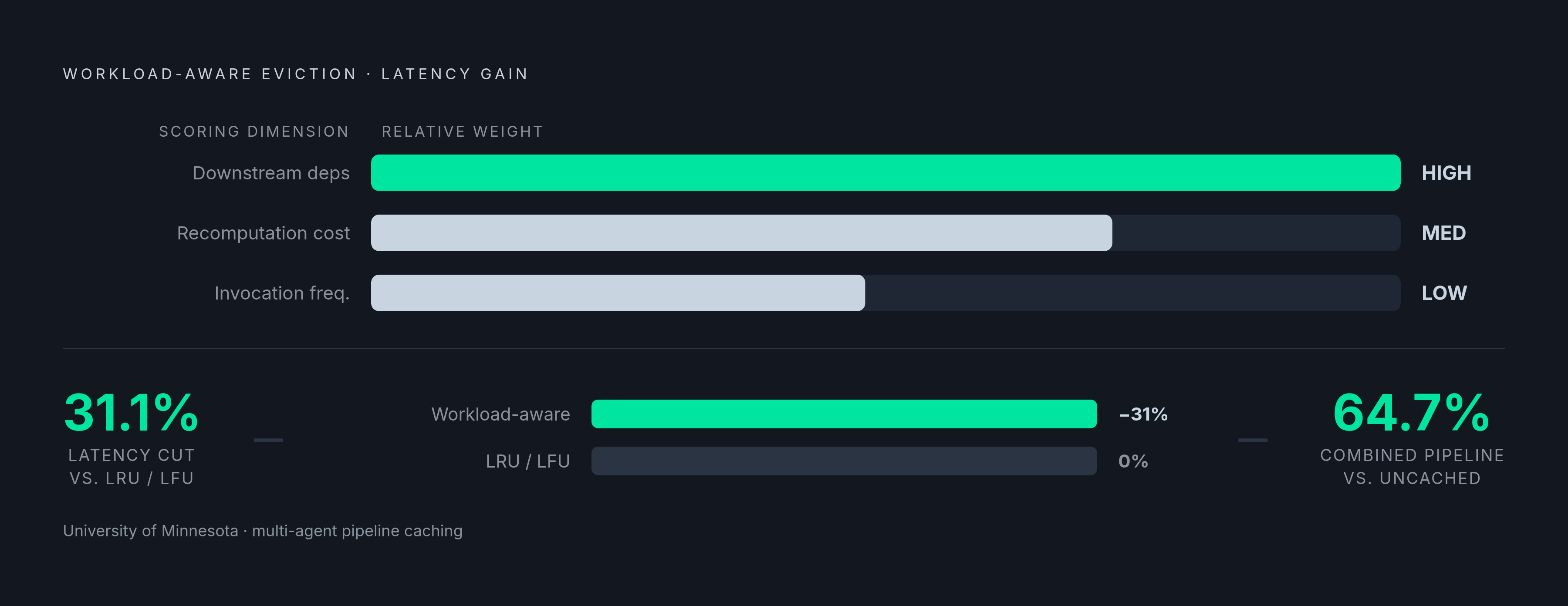
Adaptive invalidation also extends past timing alone once agentic pipelines with multiple dependent steps enter the picture. The University of Minnesota's workload-aware caching research found that standard eviction policies like LRU and LFU routinely discard structurally important nodes, ones that feed many downstream agents and are expensive to recompute, in favor of recently accessed ones in multi-agent workloads. They evict nodes based on recency of access, but a node that feeds many downstream agents and is expensive to recompute might not have been accessed recently at all. A scoring function that weighs recomputation cost, the number of downstream dependencies, and invocation frequency together, rather than recency alone, keeps the entries that actually matter, and the paper found this approach delivered an average 31.1 percent latency reduction over the next best finite-capacity baseline. Adaptive, in other words, applies to structural importance in a pipeline just as much as it applies to elapsed time.
How the three layers interact and where the seams between them create risk
Caching alone cannot guarantee freshness. That's strictly worse than a cache miss, since a miss at least forces a fresh retrieval.
The practical flow in a well-built system checks exact-match first, since it's cheapest and most precise. A miss there triggers a semantic similarity check. A miss at both layers forces a live web retrieval call, and the result of that call gets written into both caches simultaneously with an invalidation policy scaled to how volatile that particular data actually is.
The seam between semantic caching and live retrieval is where staleness actually enters the system. A semantic cache can serve a response built from a retrieval result that was accurate the moment it was generated but has since gone stale, and without some adaptive signal telling it otherwise, the semantic cache has no way to know the ground underneath its answer has shifted.
The workload-aware caching research bears this out at a broader architectural level too. Content caching at the node level within a pipeline complements plan-level caching and parallel agent execution rather than replacing either, since each targets a distinct bottleneck, and the combined approach cut latency by up to 64.7 percent relative to an uncached baseline. The same logic that applies across those pipeline-level strategies applies across the three application-layer caching strategies discussed here: exact-match, semantic, and prompt or KV caching each solve a piece of the problem, and stacking them deliberately is what produces the gain.
Two coordination points deserve particular attention because they're where systems tend to break in production rather than in testing. Upgrading an embedding model invalidates the entire semantic cache at once, since every stored vector becomes numerically meaningless against the new model, so that flush and the resulting cold-start period need to be planned for in advance rather than discovered when hit rates suddenly collapse.
The quality of the web data being cached sets the ceiling of the whole architecture
A layered caching system can only preserve the quality of what flows into it. Building the most carefully tuned three-layer architecture on top of poor retrieval data doesn't fix that data. It stores the error and serves it faster.
FinRetrieval, a benchmark released in January 2026 by Daloopa covering 500 financial retrieval questions, makes this concrete. Across the benchmark, tool availability dominated performance more than anything about the model itself: the same model produced vastly different accuracy depending on whether it had access to structured data APIs or only general web search, with the gap exceeding other providers by several times. That result reframes the whole caching conversation. What gets cached matters as much as how it gets cached.
Format decisions upstream of the cache determine both cost and quality: raw HTML fed directly into an LLM causes context bloat and drives token costs up. Pipelines that convert that HTML into clean, structured Markdown cut token consumption per page substantially, and since the cache stores whatever the retrieval layer hands it, those format decisions directly determine both what the cache holds and what it costs to serve on every hit.
Measuring retrieval quality independent of the model on top of it is its own discipline. The Artificial Analysis Search Index, with data current as of September 22, 2026, evaluates Search API providers against benchmarks like DeepSearchQA, BrowseComp, and AA-Omniscience, holding the candidate answer model, harness, and settings constant so the only variable left is the search provider itself. That framework is what allows retrieval quality to be assessed on its own terms, separate from how good the model consuming it happens to be.
On that leaderboard, You.com's Research API ranks fifth overall, while Perplexity Search and Parallel Advanced lead the DeepSearchQA sub-benchmark specifically, and You.com's Finance Research API ranks first on FinSearchComp's T2 simple historical lookup sub-task. That combination of rankings is a reasonable way to establish, on the numbers rather than on claims, what a retrieval layer is actually delivering into whatever cache sits above it. Infrastructure built specifically to deliver fresh web data at low latency, of the kind You.com's real-time search APIs are designed around, pushes freshness upstream into the data layer itself and changes what the caching architecture on top of it needs to solve for. Microsoft Web IQ, launched at Microsoft Build 2026 on June 2, 2026, introduces a conversational cache of its own into this layer.
The lesson across all three layers, and across the invalidation strategies built to keep them honest, is that no caching architecture, no matter how well-tuned its thresholds or how adaptive its TTLs, can outperform the quality of the retrieval feeding it, and the cache is a multiplier, not a source of truth.
Sources
- Workload-Aware Caching for Multi-Agent Systems
- How to Build LLM Caching Strategies
- Semantic Caching for LLM Apps: Reduce Costs by 40-80% and Speed up by 250x Semantic Caching for LLM apps: reduce costs by 40-80% and speed up by 250x
- Revisiting Cache Freshness for Emerging Real-Time Applications
- Caching for LLM Applications: From Semantic Caching to the Stampede Problem
- Grounding at scale: Engineering the retrieval system for the agentic web - Command Line