Web Search APIs Purpose-Built for AI Systems vs. General-Purpose Search APIs
AI agents need search APIs architected for machine consumption, not human browsing.
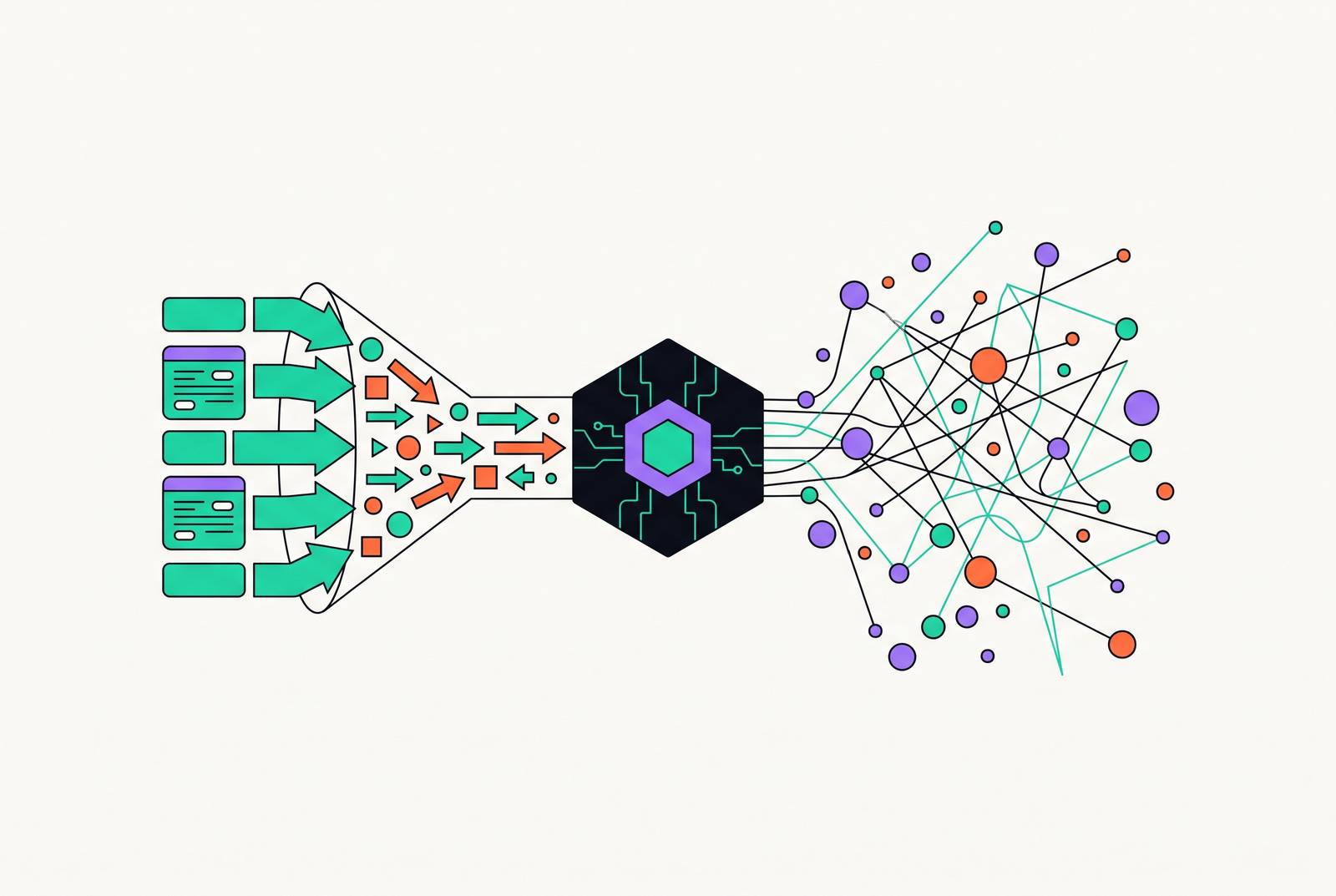
Search APIs now split into two camps: general-purpose services built for human browsing, and purpose-built systems designed from the ground up for AI agents to consume. That split did not happen by accident, and understanding why it happened explains almost everything about how developers should choose between them.
How search APIs split into two categories
Most of the web search infrastructure in use today traces back to systems designed for a specific consumer: a person sitting in front of a browser, scanning a results page, deciding which blue link to click. The APIs that developers wrapped around that infrastructure inherited its assumptions wholesale.
That worked fine for a long time because the consumer of the API was, functionally, still a human, just one step removed. A developer building a price comparison tool or a research aggregator was going to display those results to a person anyway, so the format matched the need.
Then large language models started making calls to these APIs directly, and the mismatch appeared in how those APIs handled machine-generated queries. LLM-powered applications need something structurally different from what a browsing-era index was built to deliver: content that arrives already extracted and structured, freshness measured in minutes rather than days, latency that behaves the same way every time, and metadata a machine can use to trace a claim back to its source. None of that was a design failure in the original systems. It just was not the job they were built for, and the gap between the two only mattered once something other than a person started asking the questions. Early developer APIs, the kind that exposed search results via a key and a query string, were convenience layers over this human-facing index, inheriting all the same assumptions.
AI agent requirements for a search API versus browser-style queries
What does an agent actually need that a person does not? Four things, and they are structural rather than incidental: freshness, latency, output format, and call volume.
Freshness matters differently to a model than it does to a person. A human doing casual research will not usually notice if a result is two weeks stale. An agent doing financial analysis or fact-checking a breaking news claim will, because a stale input does not just produce a worse answer, it produces a wrong one that reads as confident. Latency compounds in a way that browser latency never did, either.
Output format is where the difference becomes almost philosophical. A person reading a search results page tolerates, even expects, a ranked list of links with a line or two of context under each. A model fed the same list has to guess at structure that was never there, and guessing is exactly the behavior a grounded system exists to prevent. Clean, extracted text with the source attached is essential for an LLM. Reasoning over content produces grounded answers; hallucinating around a snippet does not.
Then there is volume and programmability. Agentic systems do not issue one query and wait. They issue many, often in parallel, across a single task, and they need the plumbing around that (rate limits, error handling, response schemas that do not shift) to behave predictably every time. A search API built for sporadic, human-paced traffic was never tuned for that pattern.
Provenance closes the loop. The API has to carry the source metadata alongside the content itself, or the model downstream has nothing solid to cite. Latency is a real constraint because a human tolerates a few seconds of load time, but an agent embedded in a multi-step pipeline cannot, since each API call compounds, so high p99 latency degrades the entire workflow, not just one hop.
Shortfalls of general-purpose search APIs when AI systems drive the queries
None of what follows is a knock on how general-purpose APIs were built. They were built correctly for the job they were given, which was serving human-facing search products, and the failure mode is visible when the assumptions embedded in that design run into a machine consumer that needs something else entirely.
Take result format. A list of titles, snippets, and URLs looks perfectly reasonable on a results page. Handing that same list to an AI pipeline turns every one of those URLs into a separate fetch, a separate parse, a separate place for something to break. What was one API call turns into one call plus N page loads, each with its own latency, its own chance of a malformed page, its own maintenance burden.
Snippet length compounds the problem. Too short, and the model either works from a fragment or makes a second call to get the rest, which defeats the point of calling a "search" API in the first place.
Freshness lag is worst in time-sensitive domains. General-purpose indexes are built for broad coverage, not for continuous refresh, and that tradeoff is invisible to a person browsing casually but corrosive to an agent doing financial research or tracking a live news story off a days-old crawl.
Then there is the extraction burden itself. That is a scraping pipeline, a cleaning pipeline, a maintenance burden that has nothing to do with the actual application being built, and it belongs in the API layer, not bolted onto every project that consumes it.
The attribution gap is the one that matters most once an answer actually reaches a user. Without source metadata riding along with the content, the model has nothing to point to when it makes a claim, and an ungrounded citation undermines every answer built on top of it, not just the one query that produced it. Snippet length and quality present a problem, as snippets sized for a human reading a results page are too short and context-free for an LLM to reason from, so the model either truncates important content or must make a secondary fetch. There is no structured extraction, since page content arrives as raw HTML or a shallow snippet, requiring developers to build and maintain their own extraction pipeline, work that belongs in the API layer, not the application layer.
Redesigning a search API from the ground up for machine consumers
Fixing these problems is not a matter of adding a few new fields to an existing response. It means rethinking indexing, extraction, formatting, and delivery as a connected system built around a machine consumer from the start, rather than retrofitting a system built around a human one.
Real-time indexing is the foundation. Instead of a periodic crawl that gets refreshed on some schedule, a purpose-built system keeps its index continuously updated, so freshness is a property of the architecture rather than a hope.
Extraction moves inside the API itself. Clean, structured, readable text comes back directly, ready to drop into a model's context window, with no scraping layer standing between the API response and the prompt. That single change removes an entire category of engineering work from every application built on top of it.
Provenance becomes a first-class field rather than an afterthought bolted on. Source URL, publication date, and the extracted body text all travel together as part of the same response, so attribution is something the API contract guarantees rather than something a developer has to reconstruct by cross-referencing a separate call.
Latency gets treated as a hard design constraint from day one, with strict p99 targets, because the consumer on the other end is a pipeline that cannot tolerate a slow outlier the way a person waiting on a page load can. Call volume gets the same treatment: rate limits, SDKs, retry logic, and quota management are built assuming high-frequency, programmatic traffic rather than occasional human queries.
Once that foundation exists, specialized surfaces stop being separate products and start becoming natural extensions of the same infrastructure. Financial data, deep research synthesis, whatever the domain, these become composable modules on top of a machine-first core rather than entirely new systems built from scratch.
Structure of purpose-built AI search APIs in practice: the product layer
Principle is one thing. What does this actually look like once it ships? Purpose-built AI search infrastructure tends to break into distinct, composable API surfaces, because different tasks an agent performs put different demands on the same underlying index.
A Web Search API sits at the retrieval layer: ranked, real-time results with clean metadata, built for the moment an agent needs to know what currently exists on the live web. A Contents API goes a step further and returns the extracted page text alongside the result, which removes the fetch-and-parse step entirely and hands the application something already shaped for a model's context window.
Research APIs are a different layer altogether. Instead of returning results to sort through, they synthesize across multiple sources into a single structured, cited response, which matters for agents doing multi-hop reasoning or producing answers that need to be auditable after the fact. You.com's Research API currently holds the top position on the DeepSearchQA benchmark, an independent measure rather than a self-reported number, which is a meaningfully different kind of evidence than a marketing claim.
Finance extends the same idea into a domain where getting it wrong has real consequences. Source reconciliation and citation are not optional polish in financial research, they are the requirement, and You.com's Finance Research API ranks first on the FinSearchComp benchmark, which is built specifically to test financial search and reasoning.
What makes this arrangement useful in practice is that the pieces compose. A developer can use the Web Search API for breadth, the Contents API for depth, and the Research API for synthesis, without switching infrastructure providers or managing different latency contracts. That is a meaningfully different experience from managing separate SLAs and separate authentication schemes across providers. You.com's client list, which includes DuckDuckGo, Harvey AI, Windsurf, and Databricks, suggests this architecture is running at production scale rather than sitting in pilot programs.
Benchmarks as the only honest way to compare AI search infrastructure
How is a developer actually supposed to tell these systems apart? Not from a demo. Infrastructure quality is not visible in a demo; it is visible under the conditions that actually matter: latency at scale, accuracy on hard queries, freshness on time-sensitive topics.
Terms like "real-time" or "AI-native" or "enterprise-grade" are marketing language that cannot be checked against anything. They are marketing language, and marketing language is not falsifiable. That is why it is a poor basis for a procurement decision. What can be checked is performance on a standardized task: accuracy on factual queries, the quality of citations and how well provenance holds up, latency at the p99 mark under realistic load, and how far behind a recently published piece of content lags in the index.
This is where benchmarks like DeepSearchQA and FinSearchComp earn their relevance: they measure something closer to what an agent actually needs (accurate answers on hard factual and research questions) rather than a satisfaction score built for human browsing behavior. FinSearchComp in particular is scoped to financial search and reasoning specifically, so it is not the right benchmark to reach for outside that domain.
The practical advice for a developer evaluating options is straightforward, if often skipped: look for benchmark results that are published and reproducible rather than numbers a vendor states in a blog post, and test latency against the query volume the application will actually generate rather than the volume a vendor happens to demo well under. And the willingness to publish at all is itself a signal. A provider that puts its numbers in front of independent evaluation is making a claim that can be checked, which is a different posture entirely from one whose evidence never leaves the sales deck.
Security, privacy, and compliance requirements that change when an API serves AI pipelines
There is a dimension to this decision that has nothing to do with accuracy or speed. Once a search API sits inside an enterprise AI pipeline rather than a consumer app, that shift changes the data handling contract in ways that matter to legal and procurement teams as much as to engineers.
Query logs are the obvious risk. An agent operating inside a company's workflow may be passing internal documents, customer records, or financial figures through every search call it makes, and none of that is something an enterprise can afford to have retained or used to train a third-party model. Zero data retention, at this layer, is table stakes. It is closer to table stakes, matching what enterprises already expect from every other vendor touching their infrastructure.
SOC 2 attestation matters here for a related but distinct reason: it gives legal and procurement teams an independently audited baseline to point to, rather than a vendor's own word about its security posture. General-purpose search APIs were designed around consumer-scale anonymous queries and were not necessarily engineered around enterprise data handling requirements, so purpose-built AI APIs that serve enterprise pipelines need to treat this as a first-class architectural concern. Anyone building in finance, healthcare, or legal work has an added obligation here too: the API layer has to satisfy not just internal engineering standards, but whatever a customer's own compliance team and regulator require as well.
Deciding which API type fits a given AI application
None of this points toward a single right answer. The choice comes down to where in an agent's workflow the search call happens and what the model is going to do with whatever comes back.
A general-purpose API still makes sense in plenty of cases: exploratory work, low-stakes applications, situations where freshness barely matters and query volume is low enough that a team can afford to build its own extraction and parsing layer on top. That is a real, defensible choice for teams making it deliberately.
A purpose-built Web Search or Contents API earns its place once an agent needs live, extracted content with provenance attached, delivered at predictable latency, because at that point the structuring work genuinely should not live inside the application. A Research or synthesis API is the right layer when the task is producing a cited, multi-source answer rather than sorting through raw results, since that is where the reasoning scaffolding belongs in the API rather than in application code. And a domain-specific API, finance being the clearest example, earns its keep wherever source credibility and citation traceability are requirements of the output itself, since general results introduce noise that only compounds the further downstream it travels.
At enterprise scale, the calculus adds a few more variables: latency SLAs, security certifications, how rate limits are architected, what support actually looks like when something breaks. These carry as much weight as raw query quality once a system is running in production, and they deserve the same scrutiny. Purpose-built APIs like You.com's Research and Web Search products make a case for this shift concretely: structured, cited content and deterministic low latency are treated as core features rather than extras, and this design lets a developer skip extraction and attribution work and let the model reason directly over fresh, grounded data.
The framework, in the end, is not complicated even if the decision sometimes feels like it. Map what each part of an agent's workflow actually requires, whether that is retrieval, extraction, synthesis, or domain-specific grounding, and match that requirement to the API surface built to handle it natively. The gap between what an API returns and what an application needs is either closed at the infrastructure layer or rebuilt, badly, inside every project that depends on it. That is the choice, and it belongs to the developer making it.
Sources
- Why Web Search APIs Are Becoming Core Infrastructure for AI
- Best Web Search APIs for AI Agents in 2026: Honest Comparison | Parallel
- Best Web Search APIs & MCPs for AI Agents 2026 - Vellum
- Essential APIs Every AI Agent Needs in 2026 for Search and Research | Parallel
- Best AI Search for Agents: 6 APIs Benchmarked (2026) | Parallel