Compliance Considerations for AI in Financial Research
Firms must design multi-agent systems where governance happens at every step, not just at output.
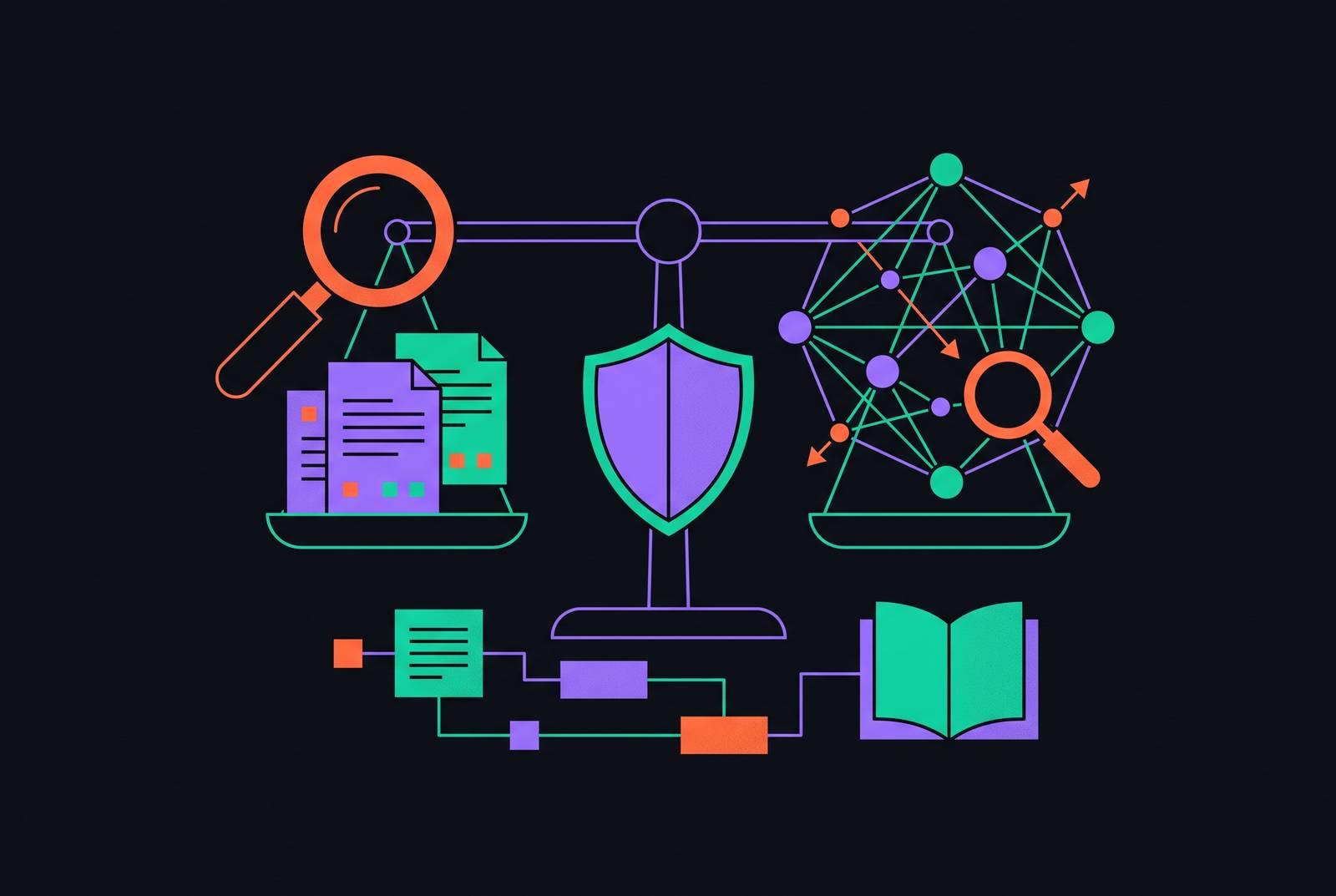
A model that scores credit risk can be governed at one point: model validation, sign-off, done. An agent that retrieves documents, synthesizes findings, updates a risk score, and triggers a payment approval has to be governed at every single step along that chain, because each step is a place where something can go wrong. That difference is the whole subject of this piece: what compliance means for financial research once AI stops producing text and starts taking action, and what firms actually have to build to meet that moment.
What compliance means for AI agents that act
Picture the actual mechanics of an agentic research workflow in a bank or asset manager in 2026. One sub-agent pulls filings and contracts. A fourth checks the whole output against policy before anything gets passed to a human or, increasingly, straight into a downstream system. That is the defining shape of financial AI this year: the multi-agent system, where retrieval, verification, synthesis, and governance happen in sequence through specialized sub-agents. No single model output is the thing to govern anymore. The chain is.
Each agent in that chain carries its own service account permissions and makes calls that are not predictable in advance. Traditional software follows the same path every time it runs. AI agents don't work that way. They execute generated code, move through permissions dynamically, and can behave differently on two runs of what looks like the same task. Static policy controls, the kind written once into a configuration file and left alone, cannot keep pace with a system that doesn't take the same path twice.
What follows from that is simple to state and hard to build: traceability, real-time source citation, a working structure for human oversight, and evidence that holds up under audit are not upgrades layered on top of existing model governance. They are the floor. Everything in the sections that follow, the regulations, the oversight design, the tendency of models to generate false or unsupported outputs, the infrastructure, the privacy obligations, the audit trail itself, traces back to this one shift. Once an AI system can act, compliance has to follow it through every action, not just check its output at the end.
The regulatory obligations financial teams must now meet: EU AI Act, U.S. FS AI RMF, and FINRA's 2026 agentic framing
Three frameworks landed within months of each other in 2026, and together they set the compliance floor for agentic AI in financial research.
The EU AI Act was due to bring its high-risk AI obligations into force on August 2, 2026. The Digital Omnibus on AI, which entered into force on July 27, 2026, pushed that deadline to December 2, 2027. Under the Act, credit scoring and other automated financial decisions, including creditworthiness assessment and insurance underwriting, are classified as high risk and must meet requirements for explainability, human oversight, audit readiness, and documented risk management. The sensible move is to map both assessments into one process rather than running them twice, since the same system traits that trigger one tend to trigger the other.
On the U.S. side, the Treasury's Financial Services AI Risk Management Framework, released in February 2026, gives banks and financial firms a risk-based governance structure built specifically for this sector, the first framework of its kind aimed squarely at financial services AI. It sits alongside SR 26-2, issued by the Federal Reserve and OCC, which replaced the long-standing SR 11-7 in April 2026. SR 26-2 is now the foundational model risk management framework for U.S. banking, and it still demands the same discipline SR 11-7 did: rigorous documentation of how a model was built, independent validation before it goes live, and ongoing monitoring once it does.
None of this arrives alone. GLBA, PCI DSS, NYDFS Part 500, DORA, and GDPR all apply at the same time to many financial firms, and each one has its own standard for what counts as evidence and its own enforcement mechanism. A firm doesn't pick which framework to satisfy. It has to satisfy all of them, simultaneously, with a single underlying system.
That brings the regulatory picture to FINRA's 2026 Annual Regulatory Oversight Report, which introduced the first dedicated framing for agentic AI in financial services. The report draws a clear line: once a system can take action rather than just generate content, a firm's supervisory, recordkeeping, and governance obligations change. That line is where the next question starts. What does a firm actually have to build to satisfy it?
What "human oversight architecture" requires in an agentic workflow
Every framework above uses some version of the phrase "human oversight," and none of them specify what it looks like in practice. For an agentic system, that gap is where firms have to do real design work, because getting it wrong has direct consequences.
Start with the distinction that matters most: oversight as a single checkpoint versus oversight as a structure built into the workflow itself. A human signing off at the end of a five-agent research chain does not satisfy anything if nobody can go back and see what each of those five agents actually did along the way. An agent investigates at each step, makes judgment calls about ambiguous matches or incomplete documents, and flags what it isn't sure about, all within boundaries someone set in advance. The compliance requirement that follows is direct: every one of those judgment calls has to be logged as something a person can review later, not buried inside a process nobody can open back up.
Four things make that possible in practice. And prior research needs to persist as context for future reviews without that history standing in for fresh validation each time.
One structural answer to this is a governance agent built into the multi-agent chain, a sub-agent whose job is to check the rest of the system against regulatory policy as it runs. A KYC agent checking identities against government watchlists carries different obligations than a document-processing agent reading contracts, and treating them the same way reproduces the exact permission sprawl that per-agent risk profiles exist to prevent.
Proving, after the fact, why a decision came out the way it did is one operational problem underlying all of this. A system built for oversight makes that review possible. A system not built for it asks a regulator to take the result on faith, and that's a request regulators are built not to grant.
Hallucination as a compliance failure, not just an accuracy problem
An AI output that looks polished but contains a fabricated citation or a miscalculated figure is not a rough edge to smooth out later. In financial research, it is a compliance event, because every framework described above requires that an output be traceable back to something real and defensible on demand.
An output's formatting quality tells almost nothing about whether its facts are correct. A clean, well-organized table can be full of numbers nobody can trace to a real source. A human glancing at a polished-looking output and judging it trustworthy on sight is not a compliance control at all; it's a false sense of safety.
Run that forward against the EU AI Act's explainability requirement and FINRA's recordkeeping obligations. Once the chain is broken, the output fails on its face, regardless of whether the rest of the analysis happens to be right.
The fix is structural. Large language models need to be kept out of the job of deterministic computation in financial workflows, with that work handled instead by neuro-symbolic approaches built on deterministic fact ledgers, or by pipelines that verify a claim before they ever present it as grounded. Hebbia's platform is a working example of what citation architecture looks like at scale: every output carries a citation pointing back to its exact source, across more than a billion pages of financial documents the platform has processed. That's the shape the next section builds out in full: what infrastructure has to do to make outputs defensible from the moment they're generated.
The infrastructure choices that make AI outputs audit-ready: real-time grounding, source citation, and traceable pipelines
Audit-readiness is a result of decisions made at the pipeline level, particularly about how and when retrieval happens and how sources get kept once they're pulled. Institutions that have adopted AI agents report compliance reporting running 75% faster, a number that reflects what the infrastructure does, not a policy anyone wrote.
The mechanism carrying most of that weight is real-time retrieval-augmented generation. Whether an answer ends up grounded or made up often comes down to this one design choice, made long before anyone sees the output.
Agentic RAG takes that a step further, turning a single retrieval pass into a multi-step loop run by specialized sub-agents: one explores and gathers material, one checks the claims the material supports, one synthesizes everything into a coherent answer, and one checks the whole thing against regulatory policy.
Most financial firms run hundreds of applications with limited ability to talk to each other, and that's the practical wall a compliant pipeline has to get over: it needs to pull from vector databases, SQL systems, web APIs, and regulatory filings at the same time, while keeping track of exactly where every piece of information came from. Citations have to be built in at the moment of generation, not stitched on afterward, because a citation added after the fact can't actually prove the output came from what it claims to cite.
Real-time web retrieval matters for a specific reason in this domain: regulatory filings, market disclosures, and earnings figures change constantly, and a system grounded only in a fixed knowledge base will produce answers that are out of date almost as soon as they're generated. The EU AI Act's transparency obligations under Article 50 don't actually set a freshness requirement. Other regulatory and audit frameworks can still treat a stale answer as a flaw, even where the AI Act itself stays silent on the point.
Data privacy and security obligations that run alongside AI Act compliance
Any financial AI system touching personal data picks up privacy obligations that exist independently of the AI Act, even though in practice the two sets of requirements are impossible to separate. Firms that treat them as one-after-the-other, satisfy the AI Act first and handle privacy later, tend to find gaps in what they've built. 66% of CFOs name privacy and ethical risk as their top worry about AI agents.
Using a third-party model means doing real diligence on that provider's own compliance, because large language models rarely achieve true anonymization of the data they touch. That means the relationship with the model provider is itself a data processor relationship under GDPR, carrying its own set of obligations regardless of what the AI Act separately requires. The FRIA and DPIA assessments mentioned earlier overlap enough that they're worth running as one combined process, since a system that triggers the need for one will very often trigger the need for the other.
In the U.S., the picture is more fragmented: twenty states now have comprehensive privacy laws of their own, so a financial AI system running nationally has to satisfy a patchwork of notification rules, impact assessments, and data retention requirements that differ by state. What makes financial agents a distinct risk category is how fast harm can compound. Security controls built for that reality have to operate at the level of individual agent functions, not at the level of a container or a process, because by the time a process-level control reacts, the damage is already done.
Zero data retention and SOC 2 certification belong in the baseline, not on a list of premium add-ons to negotiate later. Any API or platform touching financial data inside an agentic pipeline has to clear that bar as a condition of being used. None of this sits apart from the infrastructure choices in the prior section. The same pipeline decisions that log each retrieval step and track provenance across sources also make the data moving through that pipeline traceable and handled in a way regulators would recognize as sound.
The audit trail as the operational unit of compliance: what defensible evidence looks like
Set the EU AI Act, SR 11-7's successor SR 26-2, FINRA's agentic guidance, and GDPR side by side, and they all reduce to the same practical test: can a firm produce, on demand, a full and readable record of how an AI system reached a conclusion and what a human did with that conclusion once it arrived?
An audit-ready output from a KYC check or a piece of financial research needs to hold onto more than its final answer. A high-quality answer coming out of a pipeline nobody can see into fails an audit exactly as a weak answer would, because what the audit tests is whether the derivation can be reconstructed, not whether the answer happens to be good.
Continuous monitoring turns this from a record kept at one point in time into something that keeps growing. The audit trail expands at the same rate the system keeps working. The infrastructure supporting it has to be built to handle that growth from day one, not patched in once volume becomes a problem.
That brings the argument back to where it started. The shift from static models to agents that act forced traceability, oversight, citation, and auditable evidence to become the baseline. The compliance posture this era demands is achievable. It just has to be built in from the start, not reconstructed after the fact.