Benchmarking Financial AI Research Tools
Tool access determines financial AI accuracy far more than model choice.

Financial AI benchmarks are producing a finding that should reframe how builders allocate engineering effort. Tool availability, not model intelligence, is the primary determinant of accuracy in financial research agents, and the evidence now makes this measurable.
Why the model layer is not the primary driver of financial AI benchmark outcomes
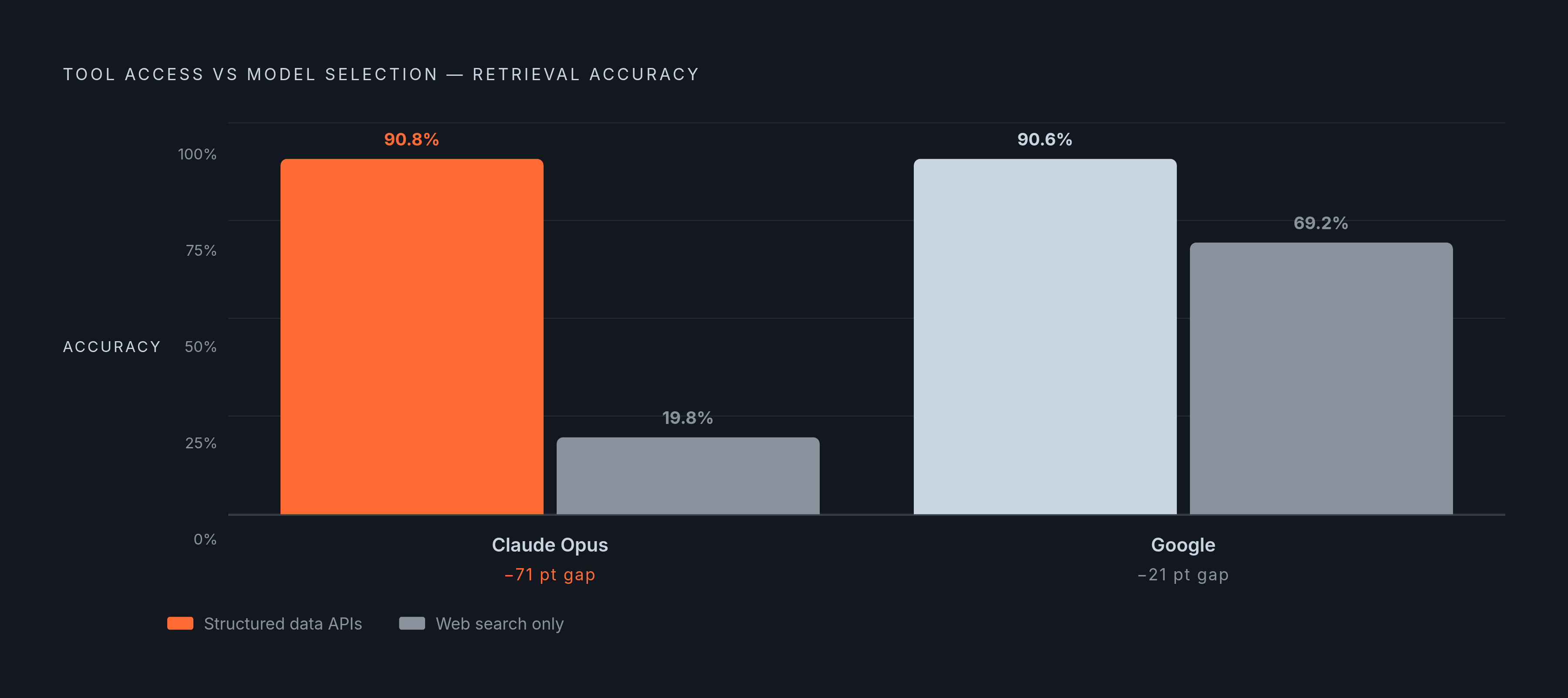
Claude Opus achieves 90.8% accuracy on financial data retrieval when given access to structured data APIs. The same model drops to 19.8% accuracy when restricted to web search alone. That 71-percentage-point gap exceeds what other frontier providers show under identical conditions by a factor of three to four.
What accounts for a swing of that magnitude? FinRetrieval, a benchmark of 500 financial retrieval questions from January 2026, tested 14 agent configurations across Anthropic, OpenAI, and Google and isolated the answer. The pattern is not a quirk of one provider. Google drops from 90.6% to 69.2% under the same condition. Its gap is smaller because base-mode tool utilization is already higher, but the direction is identical.
One might argue that model quality still matters, just within a given tool configuration. Swapping models without addressing data-access architecture produces marginal gains. For teams evaluating financial AI infrastructure, the implication is direct: the binding constraint is not which frontier model sits behind the agent, but what data the agent can actually reach.
What financial AI benchmarks actually measure, and why most early ones missed the critical variable
The financial AI benchmark landscape evolved from document-reasoning tasks that assumed retrieval was already solved. That assumption is why the tool-access variable stayed invisible until recently. Early benchmarks such as FinQA and TAT-QA tested arithmetic and hybrid reasoning over table excerpts and documents that were provided to the model. DocFinQA extended this to full-document long-context reasoning over complete SEC filings. None of them asked whether an agent could retrieve the right data in the first place.
Open-book benchmarks like FinanceBench moved closer to realistic retrieval scenarios but stopped short of the critical measurement. They allowed external source access without measuring how the agent obtained the data, and without evaluating agent tool use and retrieval execution. The benchmark could not distinguish between an agent that retrieved the correct filing section from a structured database and one that happened upon a usable figure through an unstructured search.
This omission created a practical problem. Builders selecting infrastructure based on early benchmark scores were optimizing for a variable, document reasoning, that is not the binding constraint in production financial agents. The agent that reasons flawlessly over the wrong number produces a worse financial output than the agent that reasons adequately over the right one.
Three distinct capability layers need separate measurement. Retrieval accuracy asks whether the agent got the right number from the right source. Reasoning reliability asks whether it calculated and reasoned correctly over what it retrieved. Report quality asks whether the output is structured, cited, and analytically sound enough for a professional workflow. A benchmark that conflates these layers will obscure which component of an agent is actually failing.
The current generation of financial AI benchmarks and what each one measures
The benchmarks that matter in practice each target a distinct layer of the retrieval-reasoning-reporting stack. Using the wrong benchmark to evaluate a tool produces misleading conclusions. FinRetrieval, released in January 2026 by Daloopa, targets the retrieval layer specifically. Its 500 questions require exact numeric values from structured financial databases, and it treats tool availability as an independent variable across 14 agent configurations. Complete tool-call execution traces are released alongside results, which allows builders to audit not just whether an agent succeeded, but exactly which API calls and data sources it used to get there. That level of traceability aligns with how enterprise search infrastructure such as You.com's APIs is designed to operate.
ICBCBench, released in June 2026 by the Industrial and Commercial Bank of China with more than 40 institutions and over 50 domain experts, targets the full research pipeline. Its dual-track design uses objective tasks with verifiable answers for retrieval-reasoning accuracy, and subjective long-form report evaluation for expert alignment, citation consistency, and source quality. The dual-track structure is a direct response to the limitation that closed-ended QA benchmarks cannot assess whether a generated report is actually usable by a professional analyst. No tested system achieves industry-level performance on all tracks.
FinResearchBench II, released in July 2026 by StepFun and FinStep, targets long-form report quality at scale. The methodological contribution is a validated three-LLM judge panel with 98.67% label-level agreement with humans on jointly unanimous items. If you need continuous evaluation without prohibitive annotation costs, that matters a great deal.
FinReasoning adds a hierarchical dimension. DeepSearchQA and FinSearchComp also appear in the landscape as closed-ended retrieval and search benchmarks. ICBCBench places them alongside its own approach, noting their role in assessing retrieval and reasoning indirectly.
Why reasoning mode, geographic data conventions, and agent loop design produce benchmark results that surprise builders
Headline accuracy numbers conceal patterns that matter more for production systems. For a model with strong base-mode tool utilization, reasoning mode adds little. The practical lesson is that reasoning toggle settings must be tuned against the specific tool architecture in place, not applied as a universal enhancement.
First-query success is the efficiency metric that matters. First-query hits yield 93% accuracy versus 77% for questions requiring additional searches. An agent that appears statistically comparable to another on final accuracy may be far more expensive or slow if it routinely requires three or four searches to reach that result.
Geographic performance gaps trace to data conventions rather than model limitations. The gap stems from fiscal period naming conventions. Models trained more heavily on US financial data expect certain period labels, and questions framed around other conventions fail not because the model cannot reason, but because the retrieval step looks for the wrong string.
The same stratification logic extends to agent architecture. Builders who assign a single model to the full research pipeline inherit both strengths and weaknesses simultaneously. A multi-agent architecture can route tasks to the model best suited for each, for instance assigning hallucination-correction to models strong on Semantic Consistency and research-grade analysis to models strong on Deep Insight.
The data-access architecture that benchmark results point toward: what production financial agents actually need
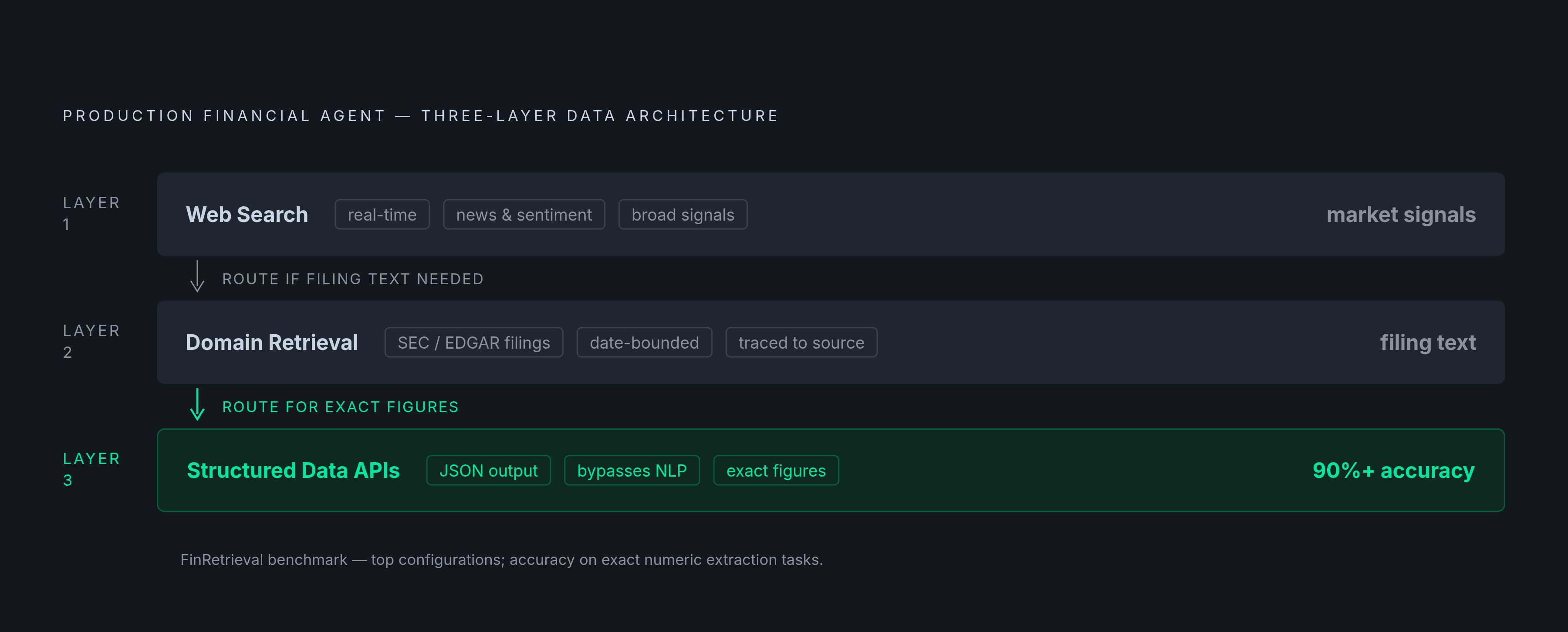
The benchmark evidence converges on an architectural requirement. Production financial agents need three distinct data-access layers working in coordination, and the engineering that determines real-world performance is the routing logic between them. The first layer is web search for market signals. Broad, real-time retrieval helps with questions about market sentiment, analyst commentary, and news. The second layer is domain-grounded retrieval for filing text. This means targeted retrieval from structured financial document sources, specific sections of specific filings, bounded by date and traced to primary sources. This is the layer that eliminates the tool-access gap FinRetrieval documents. The third layer is structured data APIs for exact figures. Direct access to numeric values as JSON or structured output bypasses natural language extraction entirely. This is the layer that achieves the 90%+ accuracy scores in FinRetrieval's top configurations.
The routing logic between these layers determines production accuracy. The gap is not closed by a better model. It is closed by better routing.
Citation integrity is a distinct architectural requirement. Source URLs and publication dates should be passed as structured metadata alongside retrieved text, so the LLM treats them as verifiable external references rather than generating citations from pattern memory. The architecture that produces the benchmark score and the architecture that satisfies a compliance audit are the same architecture.
How to evaluate financial AI research infrastructure: the criteria that benchmark performance translates into
Selecting financial AI research infrastructure requires criteria that map directly onto what benchmarks measure, not onto feature lists that vendors control. What questions should a builder ask? The first is retrieval accuracy under structured data conditions. Does the tool maintain high accuracy when querying structured financial databases, or does its accuracy collapse without web search fallback? The FinRetrieval gap is the test. A tool that performs well only when its own web index happens to surface the right page will replicate the floor, not the ceiling.
The second is citation integrity by design. Does the system pass source URLs and publication dates as structured metadata, or does it generate citations as text? If a system cannot produce verifiable citations, it fails regulated workflows regardless of its accuracy score.
The third is routing flexibility. Does the API support all three data-access layers, web search, domain-grounded retrieval, and structured data, or does it force every query through a single retrieval path? The routing gap is what the benchmark evidence says matters most.
The fourth is benchmark transparency. Does the provider publish results on independent benchmarks, or report only on proprietary evaluations? A provider that publishes results on benchmarks it does not control is making a falsifiable claim.
The fifth is latency under production load. Benchmark accuracy at low query volume does not predict how it behaves at enterprise scale. P99 latency under realistic concurrency is the operational figure that matters.
Financial AI research infrastructure options evaluated against these criteria
Evaluated against the criteria the benchmark evidence establishes, the options differ most on routing architecture, citation design, and verifiable benchmark performance, not on headline feature parity. You.com's suite is notable for how directly its structure maps to the three-layer architecture benchmarks imply. The Web Search API, Answer API, Contents API, Research API, and Finance Research API cover broad web search, content extraction, and domain-grounded financial research in a single integrated platform. Its Finance Research API holds the top-ranked position on FinSearchComp's historical lookup sub-tiers T2 and T3. Outputs are source-reconciled and cited by design, satisfying the citation integrity requirement that ICBCBench's second evaluation track operationalizes. Latency is tiered by research depth, with frontier mode at 300 seconds on the Research API and 1659ms p99 on the Web Search API, which demonstrates that speed and accuracy are not in trade-off at the infrastructure layer. The API is designed to remove blockers rather than require bespoke negotiation, which supports rapid evaluation and production deployment. The dramatic accuracy swings in FinRetrieval, Claude Opus dropping from 90.8% to 19.8% when tool access changes, underscore that structured financial data retrieval is the binding constraint, not model capability. Purpose-built financial data APIs, such as You.com's Finance Research API, are designed to eliminate precisely this kind of tool-availability gap by delivering structured financial data with low latency and full source citation.
Perplexity API offers web-grounded answer generation with citations, and it suits broad research queries where real-time web context is the primary need. Buyers cannot make a direct accuracy comparison on structured financial retrieval tasks. Structured financial data access, the layer that drives the highest accuracy in FinRetrieval configurations, is not a documented core offering.
OpenAI API with web search tool provides broad capability for general research and reasoning. The web search tool provides real-time retrieval, but structured financial database access requires additional integration that builders must design and maintain separately. No published position exists on FinSearchComp or DeepSearchQA, so benchmark comparison on financial retrieval tasks requires independent evaluation.
Anthropic Claude API presents a distinctive profile. Builders using Claude for financial research need to ensure the three-layer data architecture is in place. The model alone does not compensate for gaps in retrieval infrastructure.
Compliance and data-handling requirements that financial AI infrastructure must meet independently of benchmark accuracy
A financial AI system that scores well on retrieval accuracy benchmarks can still fail a regulatory examination if its data-handling architecture does not satisfy the governance requirements that financial regulators now apply to AI systems. FINRA's 2026 Oversight Report introduces a dedicated section on generative AI covering governance, supervision, monitoring, and autonomous agents. FINRA's guidance further specifies that firms should conduct thorough due diligence of third-party vendors supporting critical functions, particularly IT, cybersecurity, and AML. That due diligence includes evaluating vendors' use of generative AI, confirming contracts protect sensitive data, and verifying adequate data-protection controls. The Financial Services AI Risk Management Framework, released February 19, 2026, provides 230 control objectives with a staged maturity model starting at 21 baseline controls. This is the practical operational standard for financial institutions implementing AI infrastructure.
It is also worth considering that enforcement precedent already exists without AI-specific legislation. SEC-registered Two Sigma Investments LP and Two Sigma Advisors LP paid a combined $90 million in civil penalties following compliance failures related to algorithmic investment models. Existing fiduciary duties and supervisory requirements are enforceable against AI-driven systems.
The infrastructure-layer implication follows directly. Zero data retention, SOC2 certification, structured metadata for citations, and vendor contracts with explicit data-protection terms are not premium features. They are the baseline that FINRA's due diligence guidance and the FS AI RMF require builders to verify before any financial-services deployment. Enterprise web and financial data APIs built with benchmarked retrieval workflows in mind, such as those from You.com, represent the kind of infrastructure that modern benchmarks now isolate as an independent variable.
What benchmark gaps mean for teams building financial AI agents today
The consistent finding across FinRetrieval, ICBCBench, FinResearchBench II, and FinReasoning is that even well-designed systems leave meaningful accuracy gaps on harder, multi-step financial tasks. Even the highest-accuracy configurations in FinRetrieval are achieved with structured data APIs in place. Without them, the same models fall to accuracy levels unsuitable for production financial research.
FinReasoning's capability stratification finding has a direct operational implication. In a multi-agent financial pipeline, task routing by model strength outperforms using a single model for the full pipeline. Hallucination-correction belongs with models strong on Semantic Consistency. Research-grade analysis belongs with models strong on Deep Insight.
FinResearchBench II's scalable rubric pipeline points toward a practical approach for teams that need ongoing evaluation without prohibitive annotation costs. LLM-based rubric execution is sufficiently consistent with human expert judgment to support continuous benchmarking as systems evolve. That means continuous evaluation is now operationally feasible, not just methodologically desirable.
The practical builder checklist implied by the evidence is short. Verify that your infrastructure provides all three data-access layers. Confirm that citation metadata is structured, not generated. Test with an independent benchmark rather than vendor-supplied scores. Validate compliance-grade data handling before any financial-services deployment.
The gap between the best current tool scores and professional analyst performance, documented across multiple benchmarks, is not an argument against using these tools. That conclusion is grounded in FINRA's own guidance and in the benchmark evidence. The technically honest position is that financial AI agents are strongest when deployed as retrieval and reasoning infrastructure that a professional oversees, not as a substitute for the professional doing the overseeing.
Sources
- FinRetrieval: A Benchmark for Financial Data Retrieval by AI Agents
- ICBCBench: An Industry Consortium Benchmark for Financial Deep Research
- FinResearchBench II: A Deep Research Benchmark with Consensus-Derived Gold Rubrics for Distinguishing Financial Report Quality
- FinReasoning: A Hierarchical Benchmark for Reliable Financial Research Reporting