Building Sector-Specific Research Agents Beyond Finance
Four design principles make research agents work across healthcare, legal, and supply chain.
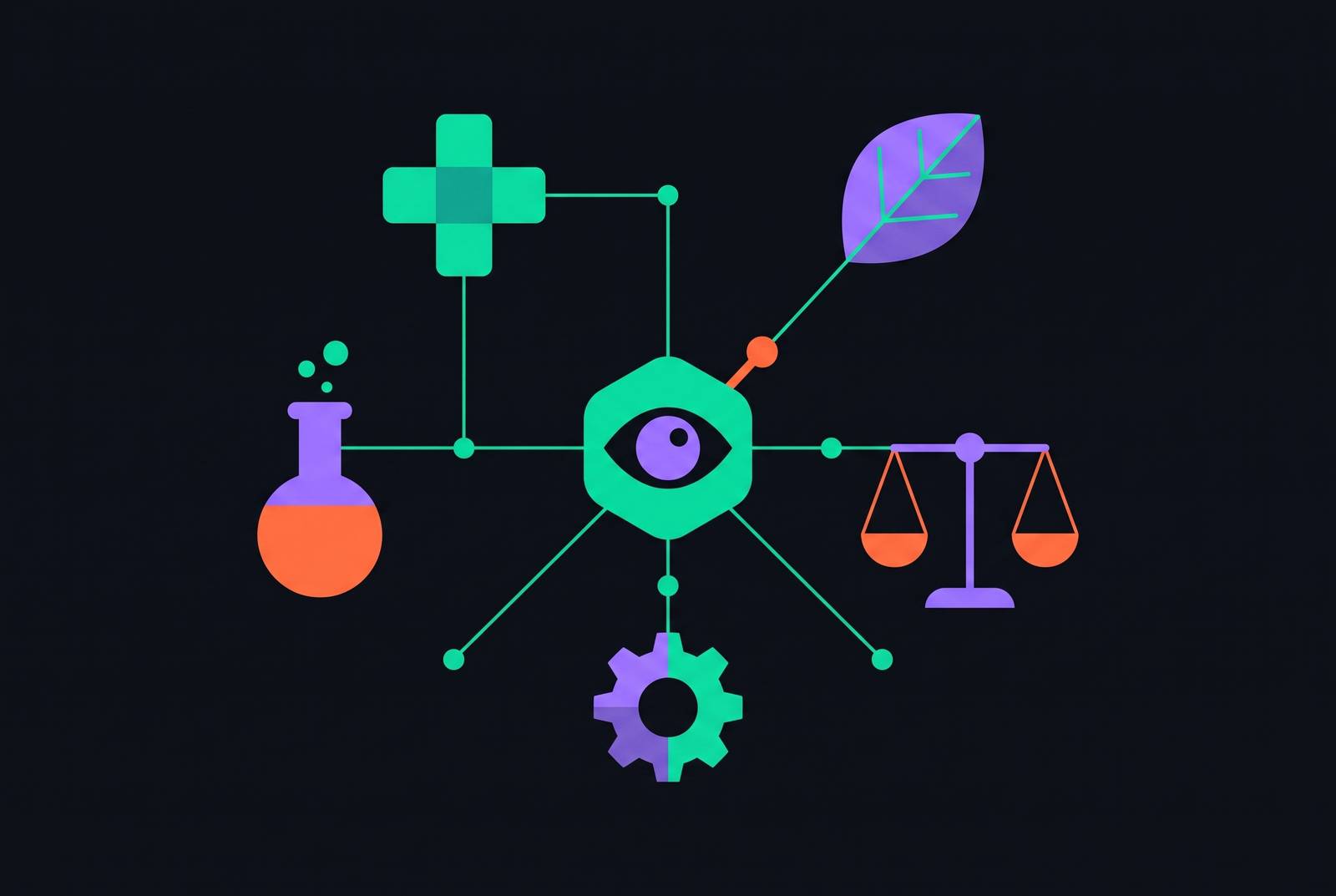
Healthcare, legal, supply chain, and policy agents share a foundation of live grounding, traceable evidence, and domain-aware retrieval. The central design task is to adapt that foundation to each sector’s tolerance for stale information, its standards of proof, and the decisions that must remain with a human.
Why research agents are spreading from finance into other sectors
The 2026 State of AI Agents Report puts research and reporting at the front of planned near-term adoption, at 56% of organizations, followed by supply chain optimization, product development, and financial planning. The same report says more than half of surveyed organizations already deploy agents for multi-stage workflows, with a substantial fraction running processes across teams. That breadth makes agent infrastructure an enterprise-wide concern, even when individual workflows need specialized knowledge.
Finance provides a useful reference point because its research demands combine current information with auditable conclusions. Mint-Agent requires finance-native models to use grounded evidence and research that can be traced back to its sources. Developers can preserve the underlying architecture while changing the evidence, retrieval rules, and review checkpoints that make its output usable in another sector.
The architectural core that all sector research agents share
The first decision is how to ground the agent in current information. A model trained on static data cannot reliably establish what is true now in a changing domain. Live retrieval supplies that missing evidence, while orchestration can separate retrieval, validation, policy checks, and response evaluation. Those stages serve different purposes, so retrieving a current page is not itself proof that the answer is supported. Without grounding, even strong reasoning can start from a premise that is out of date.
The second decision is how to preserve attribution throughout the reasoning chain. An answer must carry a traceable route from its claims to the evidence supporting them, rather than acquire citations as a reporting afterthought. In regulated work, correctness without verifiability is insufficient because the reviewer cannot establish why the conclusion deserves trust. Clinical evidence must be citable, legal claims must point to documents, and regulatory analysis must identify the governing text. The evidence trail is part of the output’s utility.
The third decision is how to make retrieval domain-aware. Developers must configure which sources take priority, how recency ranks against authority, and what the system excludes. A general search ranking cannot substitute for those rules because relevance to a consumer query does not establish authority for a professional decision. A better model on its own cannot fill in missing source metadata, semantic context, or query validation. These three decisions remain constant across sectors, but their settings change with the work.
Healthcare: where data freshness is clinical and hallucination is a compliance event
Healthcare makes freshness a clinical requirement because guidelines, drug interactions, and payer policies update continuously. An agent relying only on training data can include superseded evidence in its output, with consequences extending beyond a mistaken answer. A hallucinated clinical output can become both a patient-safety and a compliance event. Retrieval should therefore give recency high weight while prioritizing peer-reviewed literature databases, regulatory filings, and official clinical guideline bodies. General web results need explicit demotion below clinical sources or exclusion.
Attribution must support verification before information reaches a patient. Every clinical claim should point to a journal, guideline body, or regulatory filing that a clinician can inspect. The EU AI Act’s Article 10 data-documentation requirements also apply to what goes into high-risk AI systems as well as their final response. A governed context delivery layer must preserve lineage from source to agent so that data governance covers what the system consumed. A monitoring agent that checks other agents for policy violations can place that control before outputs surface.
AtlantiCare, a health system based in Egg Harbor Township, New Jersey, used Oracle Health’s Clinical AI Agent for ambient documentation and freed an average of 66 minutes per clinician per day. Radiology evidence from 2024–2025 shows diagnostic accuracy improvements from agentic AI, but the methods remain computationally demanding and lack comprehensive clinical validation. The distinction determines the oversight design. Clinical research outputs must remain decision support with mandatory human review.
Legal: where source authority and document-level precision determine whether the output is usable
In legal research, humans still make the decisions, but retrieval has a different job to do. The agent must find the right version of the right document, extract the relevant clause, and surface the deviation. A lawyer should be able to verify the flag using the agent’s underlying research. Ungrounded legal LLMs have produced hallucinated case citations in production, so verified primary-source grounding is the architectural response.
Statutes, regulations, and court decisions should outrank commentary and summaries, while jurisdiction specificity must be encoded in retrieval. Version currency also needs explicit weight because an authoritative but superseded text cannot answer a question about the current requirement. Legal documents may change less frequently than clinical evidence, but a relevant amendment must displace the old version immediately. A confident citation to an obsolete regulation is less useful than an honest “not found.”
Legal reasoning also requires more than a precise single lookup. A contract clause may trigger a regulatory requirement that creates a disclosure obligation, requiring chained retrieval across the supporting documents. The orchestration layer must preserve that chain so the lawyer can inspect the basis for the conclusion. The lawyer retains the consequential decision while the agent does the research needed to make that review efficient.
Supply chain: where real-time signal volume and decision speed define the retrieval architecture
Supply chain shifts the binding constraint from regulatory precision toward signal volume and decision speed. General Mills deployed an AI-driven supply chain optimization system that assesses daily shipments, evaluates routing, timing, and vendor performance, and surfaces recommendations to a human-in-the-loop. The large majority of suggestions were accepted without requiring a person to initiate each query. Retrieval must keep up with a steady flow of decisions without waiting for someone to make each research request. Freshness becomes useful only when the result arrives in time to act.
That flow draws on heterogeneous sources, including logistics APIs, weather feeds, tariff databases, and vendor portals. Retrieval must normalize and rank their signals without discarding provenance. Attribution lets a team audit its work by tracing which signal led to a wrong replenishment decision. The orchestrator-plus-specialist pattern separates retrieval, validation, routing optimization, and exception flagging so that a single agent does not carry the whole workload. MCP and A2A interoperability protocols, active in 2026, reduce the integration cost of composing specialists across vendor tools.
Latency must be budgeted across that entire pipeline, including the search endpoint. A routing recommendation that arrives after the routing window closes has no value for that decision, however accurate its analysis. Retrieval and reasoning must both finish in time for the team to act. This is a different optimization problem from maximizing the completeness of a research report. Policy research sits at the opposite end of the decision-speed spectrum, where response times usually allow for deeper reasoning.
Policy and regulatory research: where depth of reasoning and version control of sources matter most
Policy research requires agents to follow how a rule change propagates through dependent frameworks. A new EU regulation may amend a directive, override a member-state transposition, and change an operator’s compliance obligation. At each step, the agent must retrieve another document and reason through what it says. The EU AI Act’s Article 10 illustrates why the version of a requirement matters to the governance framework built around it. Reasoning over pre-amendment text can produce a coherent analysis of requirements that no longer apply.
Retrieval must keep the versions current across the whole chain, which takes more than finding a recently published page. An output must cite the specific article, paragraph, and version supporting its position. Without that precision, an analyst must reconstruct the research before using it. Official regulatory repositories should be indexed with high-frequency refresh rather than the continuous streaming appropriate to supply chain signals. Documents may change infrequently, but a relevant update must propagate immediately.
This combination calls for the deepest retrieval and reasoning configuration among the sectors discussed. The system must retrieve, contextualize, and reason across documents in sequence while keeping the source versions aligned. Its output should be a structured evidence package containing retrieved documents, extracted clauses, and synthesized positions. The agent accelerates the research, while the analyst owns the conclusion.
Cross-sector decisions: governance, compliance framing, and where the architecture diverges
The sector differences resolve into three further configuration decisions, beginning with governance enforcement. The first is whether a policy check must occur before an output reaches downstream use, and which rules it must enforce. That checkpoint matters in healthcare because clinical evidence and data lineage affect patient-safety and compliance. Supply chain gives provenance a more operational role, tracing the signals behind decisions and exceptions. Singapore’s IMDA published its Model AI Governance Framework for Agentic AI in January 2026, while the EU AI Act’s Article 10 supplies another reference point for mapping governed data use to regulated workflows.
The second decision is whether every consequential output needs human approval or whether review can operate at exception thresholds. Healthcare and legal require review before consequential downstream action. Supply chain can use autonomous execution within the normal range and human review for exceptions, while policy agents prepare evidence for analyst judgment. The WEF AI Playbook for Financial Services frames human-AI partnership as the deployment model for high-stakes agentic systems.
The third decision is how much multi-agent cost a task can justify, and whether that cost is observable before scaling. Chained calls and growing context multiply token use, requiring cost monitoring as part of operational telemetry from the outset. Narrow, verifiable tasks provide a starting point where outputs can be checked before they are trusted. Oversight and audit trails belong in that initial design because adding them after deployment is harder. This also means redesigning the workflow around evidence and review, rather than layering an agent onto a process that was not built to use its output.
Choosing the retrieval infrastructure layer for sector-specific agents
The minimum requirements are real-time web indexing rather than cached results, per-result attribution that passes into the reasoning chain, and latency that fits the multi-agent pipeline’s budget. Developers also need control over source priority, recency, authority, and exclusions. Those controls allow the same retrieval foundation to serve clinical evidence, legal documents, operational signals, and regulatory texts without treating them as interchangeable. Compliance depends on how that layer is governed as well as what it retrieves.
Orchestration frameworks supply a different part of the system. Google ADK provides hierarchical agent tree models and Google Search grounding, while LangGraph, CrewAI, and Microsoft Agent Framework, AutoGen’s successor, provide other orchestration approaches. Retrieval infrastructure integrates with those frameworks as the live-web grounding layer. MCP and A2A support makes that layer composable across multi-vendor stacks without custom integration work. The choice is therefore not simply which agent framework to adopt, but which evidence service will support its decisions.
Youcom’s Research API is one option for this layer, providing real-time freshness and cited outputs for domain-aware research, and it holds the leading position on DeepSearchQA. That benchmark position supports its relevance to multi-hop retrieval, but it does not replace evaluation against the target sector’s requirements. Start with a narrow, verifiable task and instrument retrieval latency and citation coverage from day one. Accuracy should then be validated against domain-specific benchmarks before the agent’s scope expands.