Structured Output Formats for AI Financial Responses
Financial AI needs schemas with validation and citations, not just formatted JSON.

Structured output formats for AI financial responses are a correctness requirement. A trustworthy response needs more than valid JSON. It needs a schema that preserves source links, deterministic validation that checks the numbers, and citations that let a person or system reconcile each claim with its evidence. These three layers turn a generated answer into something a financial pipeline can hold to account.
Why financial data needs schema contracts, not just formatting conventions
At 3 AM, a pipeline receives broken JSON where it expects a financial record. The parser fails, but that visible failure is not the only concern. A well-formed response can pass a wrong number to a risk model or surface an unverifiable figure to an analyst. Finance therefore raises the stakes beyond whether an application can read the response. It matters whether the application can establish what the response means and what supports it.
Finding a number in a filing does not settle whether that number is correct. Verification may require linking the reported fact to an accounting concept, following calculation relations, and reconstructing an expected value from related facts. Free-form prose does not give downstream systems a dependable contract for doing that work. A schema makes the required evidence explicit, so that a number cannot stand alone without its period, unit, and origin. The contract gives verification a precise set of fields to check, though it cannot by itself prove that they are correct.
What XBRL numerical consistency verification reveals about the depth of the problem
AuditFlow, by Yan Wang et al. at The Fin AI, shows how this works through XBRL numerical consistency verification. Its framework connects a reusable US-GAAP taxonomy graph with filing-specific XBRL evidence. Typed tools retrieve facts, traverse relations, perform calculations, and evaluate rules. Two specialized junior auditors investigate constraints and filing evidence, while a senior auditor coordinates refinement when they disagree. Structured reports then feed an evidential aggregation process that produces final decisions.
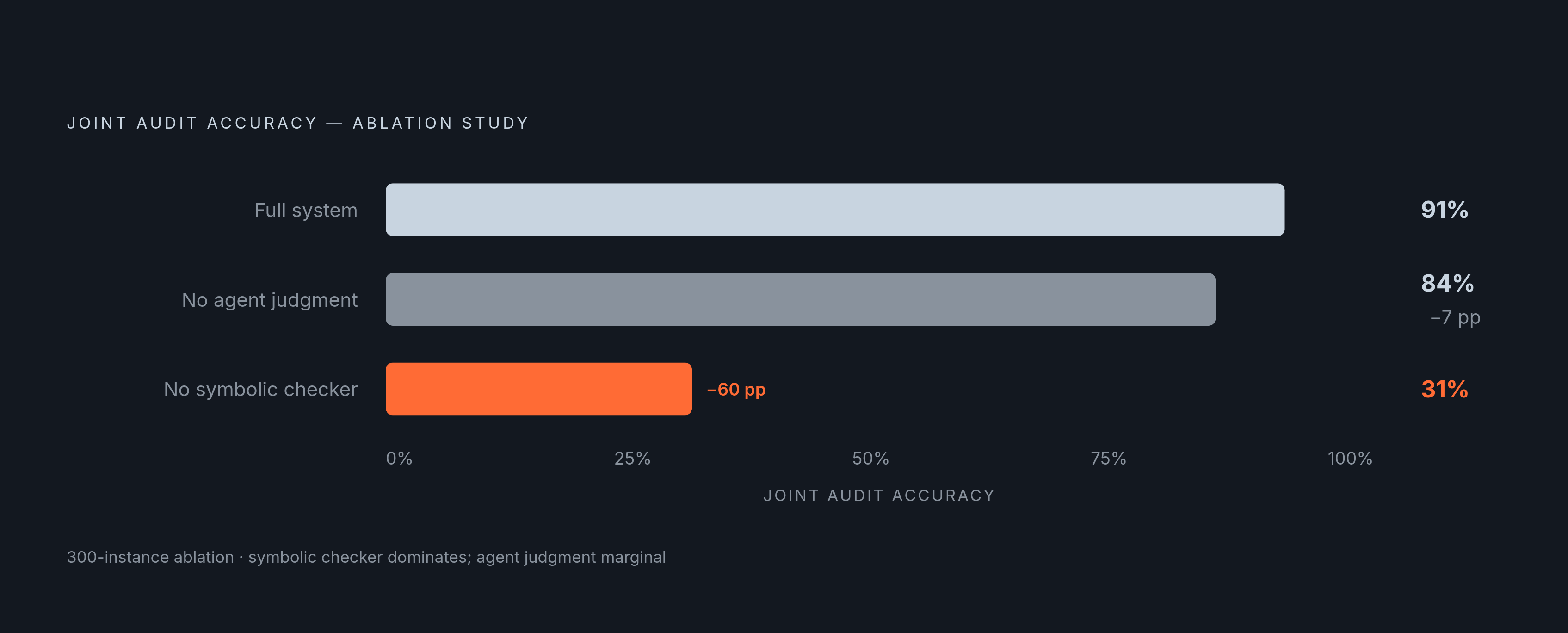
AuditFlow reports high accuracy with one model, but its ablation is more revealing than that headline result. Removing the deterministic symbolic checker drops joint audit accuracy by roughly 60 percentage points on another model in a 300-instance ablation and sharply raises invalid outputs. Agent judgment adds modest further gains, and for some backbones it can hurt when overrides misfire. The result argues against treating a model’s explanation as a substitute for an executable check.
The reasonable objection is that XBRL provides unusually structured evidence. Narrative disclosures and filings in non-XBRL jurisdictions may not offer the same taxonomy relations or calculation rules. That limits how directly the implementation transfers, but not the underlying requirement. A pipeline still needs to trace a number to its source and reconstruct any calculation it claims to have performed.
How provider-level structured output mechanisms differ and where each fits financial pipelines
Provider mechanisms determine how much of that contract is enforced during generation. The main approaches include constrained decoding, strict tool arguments, and schema settings in generation configuration. These are not wholly separate categories, because a provider can use constrained decoding behind more than one interface. The important distinction is whether the system restricts generation to the supported schema or merely asks the model to follow it. An instruction is not the same guarantee as an enforced constraint.
OpenAI uses constrained decoding to enforce schema-valid output at the token level. Anthropic’s native Structured Outputs feature, generally available since early 2026, also uses constrained decoding, with output_config.format for JSON outputs and strict: true for tool use. Google Gemini constrains structure and enums but silently ignores some JSON Schema keywords, including pattern and maxLength. Its guarantee therefore covers only part of what a supplied schema may appear to require. Financial developers need to distinguish the schema they write from the constraints a provider actually enforces.
xAI’s structured outputs documentation describes strict enforcement of tool-call arguments against the tool’s input JSON Schema, regardless of whether response_format is also set. It supports JSON Schema Draft 2020-12 and Draft-07, including typed formats, enums, nested objects, and non-circular references. Provider limits also affect design, with maximum schema depth of 10 levels on OpenAI and 5 levels on Azure OpenAI. Gemini publishes no numeric nesting ceiling. Application-layer validation is still needed to check what the financial data means and enforce constraints the provider does not cover.
Designing the schema to enforce financial correctness rather than just shape
Consider a simple response with a single reported earnings figure. Its schema requires a value with an explicit numeric representation, a unit, a reporting period, a filing identifier, a section reference, and a citations array. The citation holds a source identifier, retrieval timestamp, and supporting excerpt. This is a worked design rather than a complete schema, but it establishes the essential contract. The earnings value is inseparable from the information needed to interpret and locate it.
Numeric fields need declared types, such as an integer or a decimal represented to fixed precision. Units need explicit values, including a currency code, share count, or percentage, with enums where appropriate. Period fields likewise need typed dates rather than free-text labels that obscure whether two figures cover the same interval. In XBRL-grounded output, the schema also preserves the accounting concept and context attached to the fact. Flattening those relationships into a summary would discard evidence needed later.
A derived earnings metric requires more than the minimal reported figure. Its record must carry the constituent inputs and operator so that a validator can reconstruct the result. Governed connectors should populate these fields with typed, source-traced data. Anthropic’s finance agent templates illustrate that distinction through connectors that provide governed, real-time access to provider data. Where nesting limits force a flatter design, display fields can be collapsed, but provenance links must remain intact.
Validation patterns that catch errors the schema alone cannot prevent
A schema-valid response can still contain a total assets figure that differs from the sum of its components. It can also cite a document that reports a different number. Validation must therefore establish more than successful parsing. Its purpose is to produce an auditable account of which numerical and evidential conditions the output satisfies. “This passed validation” means only as much as the checks that were performed.
Calculation closure checks recompute an aggregate from its declared inputs and compare the result with the reported value under a defined tolerance. AuditFlow uses the DQC.US.0126 rule class to test calculation-tree consistency, so it checks the numbers in a separate symbolic operation. Period alignment checks test whether the inputs cover the period needed for the calculation or comparison. A mixture of fiscal-year and trailing-twelve-months figures cannot become sound merely because both period fields are valid. Unit consistency checks do the same for currencies, shares, or percentages.
Citation coverage checks test whether there is content to back each factual claim, since a filled citations array alone proves nothing. Freshness checks compare retrieval timestamps with configured staleness thresholds suited to the data, including intraday market data and quarterly filing data. Chandra Irugalbandara’s Meaning Typed Prompting approach offers a complementary way to express field meaning within type definitions at prompt time. Clearer meanings can reduce dependence on post-hoc correction, but they do not replace application-layer verification.
Citation structures that make AI financial outputs source-reconcilable
A response that says “according to the 10-K” names a source without making its evidence resolvable. A typed citation object gives a downstream system a document ID, filing accession number, or canonical URL that it can use. It also carries the specific passage, data point, or table cell supporting the claim. Without that excerpt, a reference to a 200-page filing is a pointer to a haystack.
Each citation also needs a typed retrieval timestamp and a source type enum. Distinguishing an SEC filing from an earnings transcript, real-time market feed, regulatory document, or proprietary data source lets downstream systems apply different trust and staleness rules. Claim linkage then connects the citation to the particular field it supports. A flat response-level array cannot establish that connection on its own.
Anthropic’s finance agent architecture illustrates why citations should mirror connector provenance. Its named partners include Financial Modeling Prep, Fiscal AI, and Dun & Bradstreet, whose data have distinct provenance characteristics. Answering financial questions in multiple languages requires jurisdiction and language metadata in the schema, as illustrated by FinMMEval 2026 Task 2. Hatzesberger and Nonneman’s actuarial work similarly describes extracting and structuring information from insurers’ annual reports for market comparisons. Across these settings, a citations array that a compliance team can reconcile is categorically different from one that is decorative.
Compliance and data governance constraints that shape schema decisions
Governance shapes the contract before generation begins. It determines what fields must be present, which data must not enter a given service, and what provenance must survive the response. An output cannot demonstrate traceability if its schema has already discarded the source relationships. Good citations also cannot fix how an input was handled.
Developers need to check which AI systems a model-risk framework covers before claiming it applies to all of them. The OCC, Federal Reserve, and FDIC replaced SR 11-7 with SR 26-2 / OCC Bulletin 2026-13 on April 17, 2026. That guidance explicitly excludes generative and agentic AI from scope, with a separate request for information on AI model risk forthcoming. With that exclusion, developers should take care not to read an older framework as a full account of what they must do. Auditable outputs remain a technical requirement, but a schema alone cannot establish regulatory compliance.
Material non-public information introduces a separate routing constraint. Unannounced earnings figures, M&A data, and regulatory examinations in progress cannot be sent to systems where providers could potentially access or train on that data. A typed data classification enum in the request schema can route sensitive requests away from standard API endpoints and through compliant infrastructure. Enterprise data isolation, including zero data retention and private cloud inference, changes which infrastructure can be used for such requests. Zero data retention and SOC 2 Type 2 certification should be baseline procurement requirements for serious financial pipelines alongside sound schema design.
Putting it together as a pipeline that enforces all three layers
The pipeline starts with bounded grounding before any LLM reasoning begins. A typed request to a real-time search or research API specifies the date range, source type, and required data fields. This narrows the task to a verifiable answer with freshness, evidence, and lineage. Bounded queries are testable, cacheable, and reproducible. An unbounded request makes it harder to establish what evidence would count as a complete answer, regardless of the output format.
The model then writes its response to fit a schema that calls for numeric types, periods, source links, and citations. Constrained decoding enforces the supported structural contract, while downstream schema validation covers requirements that generation does not enforce. A deterministic checker next recomputes aggregates, checks period and unit alignment, tests citation coverage, and flags freshness violations before downstream use. Citation objects preserve the evidence relationships throughout that sequence. The three layers work together, but none can perform the others’ job.
This pattern is not limited to taxonomy-tagged filings. Hatzesberger and Nonneman’s work on extracting data from annual reports shows why insurance market comparisons also need structured source evidence, even when the data is retrieved in a different way. Add recomputation where totals have types but no checks, claim linkage where citations are only listed, and source fields where values stand alone. The cost of adding a missing layer is low compared with downstream errors or audit failures, and AuditFlow shows how sharply accuracy can fall when the deterministic layer is removed.
Sources
- AUDITFLOW: Executable Symbolic Environments for Structured Financial Reporting Verification
- Overview of FinMMEval 2026 Task 2: Multilingual Financial Short-Answer Question Answering
- Advanced Applications of Generative AI in Actuarial Science: Case Studies Beyond ChatGPT
- Meaning Typed Prompting: A Technique for Efficient, Reliable Structured Output Generation
- Agents for financial services \ Anthropic