Real-Time Market Data Integration in LLM Research Tools
Building market-aware AI systems requires a retrieval layer, not better models.

At bottom, real-time market data integration in LLM research tools is an infrastructure problem, not a model problem. What a model learned during training and what is true in the market right now can diverge, so a purpose-built retrieval layer sitting between the live web and the model has to supply current information, and its construction shapes whether a trading desk or a compliance officer can actually use the output.
Static training data is structurally incompatible with market-dependent reasoning
If a language model trains on a fixed snapshot of text, it cannot reliably answer questions whose correct answer changes after that snapshot was taken. A model trained months or years earlier has no way to know what happened since.
What makes this failure mode harder to catch than ordinary hallucination is that the model is not malfunctioning in any obvious way. The problem is that the information itself is old, so the output is internally consistent and still wrong.
So once a use case depends on current conditions, training on static data stops being sufficient, no matter how large or recent the training set is. A retrieval system designed for that purpose does; the rest of this piece treats the problem as one of architecture, not of model selection.
The retrieval layer and its place in the stack
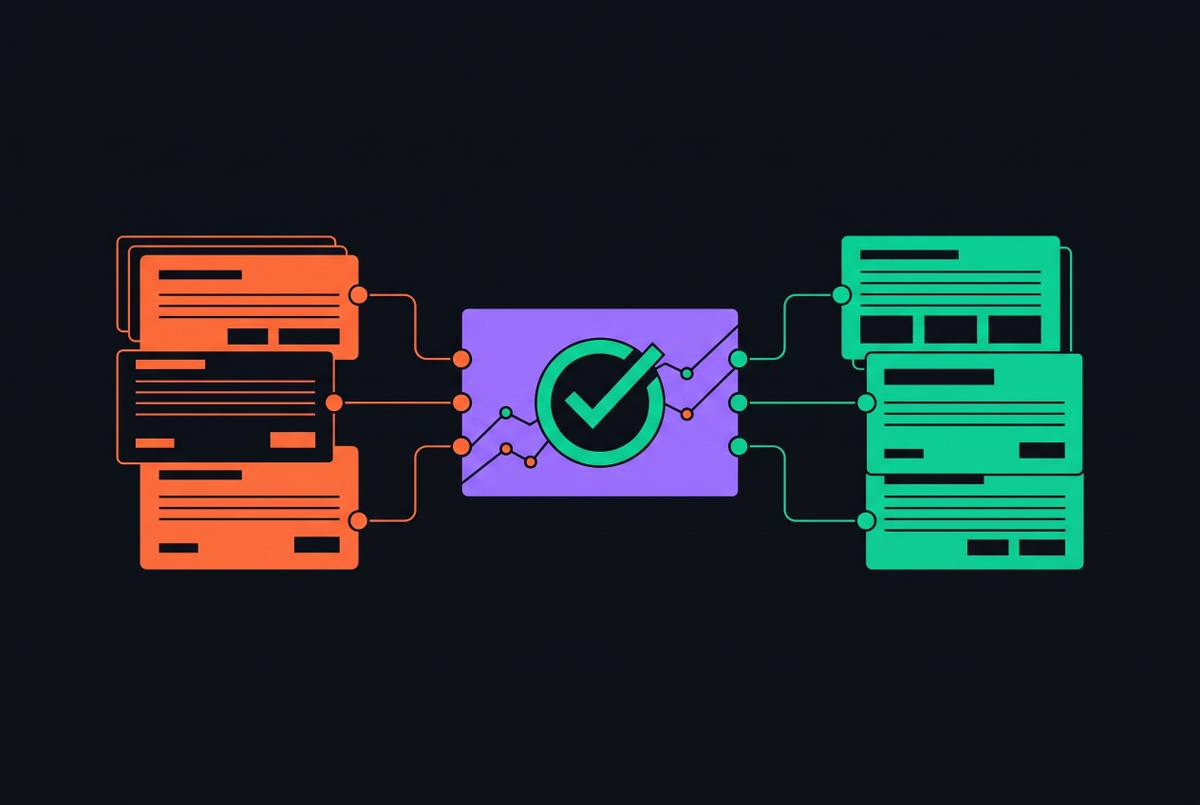
To close the freshness gap you need a distinct piece of infrastructure, not a longer context window and not another round of fine-tuning. The retrieval layer is software that sits between the live web and the model and fetches what the model needs at the exact moment the model needs it. Treat the live web as a queryable database, one that a well-governed system can pull structured, current answers from on demand, and the retrieval layer is what makes that treatment possible at the scale production systems require.
Just-in-time retrieval is the architectural shift here: data gets fetched when a query is actually made, rather than baked into the model's weights ahead of time. Queries go in from the agent at the top of this stack, and structured, current, analysis-ready data comes back out, all within the time it takes to answer one inference call.
Whether an agent has access to live, structured, real-world data, or is working from whatever stale or unstructured text happened to be lying around, is usually what separates a prototype from something that can be trusted in production. Live data access is a core component of AI agent infrastructure in its own right, not a bonus feature bolted onto a chatbot. It's a prerequisite for building anything that touches markets.
How the data pipeline components deliver freshness
No single piece of technology delivers freshness on its own. A production-grade retrieval layer is a pipeline made of several components working together, and the system as a whole is only as fresh as its slowest part. Four functional layers do the work: the transactional databases holding the raw source data, a streaming layer that keeps derived views of that data up to date, a serving layer the agent actually queries, and a vector layer for semantic retrieval across unstructured text.
Batch-refresh warehouses, the kind that update on an hourly schedule or slower, simply cannot support agents making decisions that touch real money, real inventory, or a real customer sitting on the other end of a chat window. IBM's announced acquisition of streaming provider Confluent, at an $11 billion valuation, is a useful signal of how seriously large enterprise vendors now take this gap: a major incumbent chose to buy its way into real-time pipeline capability.
Discovery and access also needed standardizing, and that is the job the Model Context Protocol does. Anthropic created MCP, and it gives agents a common way to find and query external data sources, so teams no longer write bespoke integration code separately for every data source. Alongside MCP, vector search tools such as OpenSearch handle the unstructured side of the problem, letting an agent search across documents, filings, and transcripts semantically instead of needing an exact string match to find the right passage.
One design choice near the end of this pipeline carries more weight than it first appears to: whether the system returns structured JSON or hands back raw text snippets. Structured output removes a layer of parsing logic the engineering team would otherwise have to build and maintain, and it cuts down on the extra model calls needed just to pull a usable number or date out of a wall of text. That single choice, structured versus unstructured, is also the first criterion to apply when judging any retrieval API.
Why compliant retrieval infrastructure has become a non-negotiable requirement
Compliance is no longer a policy question you handle after the engineering is done. Major web infrastructure providers recently changed how they classify AI traffic, and that turned compliant retrieval into a hard requirement: a system either meets it or fails, with no middle ground. Cloudflare's new defaults, effective September 15, 2026, treat AI search, AI agents, and AI training crawlers as three separate categories, each handled differently. Akamai has drawn a similar line, splitting AI traffic into training crawlers, search crawlers, and fetchers and agents, and enforcing against each category on its own terms.
These two enforcement regimes mean an engineering team has to pick retrieval infrastructure that falls cleanly into the right bucket. Financial services carries an added layer on top of that: the EU AI Act classifies credit scoring and insurance underwriting as high-risk AI applications. Conformity assessments and human oversight are legal requirements, not best practices. If you send sensitive customer or portfolio data out to an external model provider just to get access to a powerful model, you take on regulatory exposure, and that is pushing institutions toward retrieval architectures that can be deployed privately or that offer a genuine zero data-retention guarantee.
In a regulated industry, SOC 2 certification and a documented zero data-retention policy are the floor, not a premium add-on a vendor charges extra for. That baseline turns the vague instinct to "pick a good API" into a concrete, checkable list of requirements for the next section.
Evaluating a search API for real-time market intelligence work
Picking a retrieval API for market intelligence means weighing accuracy, latency, freshness, output structure, and compliance posture all at once.
Latency under load, not average latency measured in a quiet test environment, is the number that affects whether the system holds up in production. Output structure carries its own cost: an API returning structured, cited JSON saves a team from writing parsing logic and cuts the number of extra model calls needed just to extract a usable field out of a paragraph of prose.
Freshness needs a real number attached to it, not a marketing label. Compliance posture can also be checked rather than taken on faith: zero data retention, SOC 2 certification, and correct classification under the Cloudflare and Akamai enforcement regimes. Integration flexibility matters too, developer-accessible pricing, documented rate limits, and no sales call standing between evaluation and production, since a team that has to negotiate its way into an API before it can even test it has already lost time it didn't need to lose.
Three layers do the practical work: data collection, extraction from the web and from APIs; the data pipeline itself, cleaning, routing, and syncing; and AI connectivity, getting the data to the model in real time. And once all these criteria are on the table, the most honest way to compare providers is to look at where each one lands on a public, reproducible benchmark, because a benchmark score can be checked by anyone, while a vendor's own claim about accuracy cannot.
Retrieval and research APIs for the market intelligence use case
The market for retrieval and research APIs has narrowed to a handful of providers that can actually clear the accuracy, freshness, latency, and compliance bar that production market intelligence work demands, and they tend to separate from each other exactly on the criteria laid out above.
You.com is built specifically as search infrastructure for AI agents and language models. Its Research API used to hold the top spot on the DeepSearchQA benchmark; as of late 2026 it no longer leads that leaderboard, but its Finance Research API now ranks first on FinSearchComp's T2 sub-task for simple historical lookup. The broader product suite breaks into four pieces that can be used independently: the Web Search API for real-time web retrieval, the Contents API for structured content extraction, the Research API for deep cited research, and the Finance Research API for financial intelligence with citation, giving a team the freedom to compose exactly the layer it needs. SOC 2 certification comes standard, while Zero Data Retention is available as an enterprise add-on under a separate agreement, relevant for financial services teams working through GDPR, various US state privacy laws, and EU AI Act conformity requirements. The Web Search API runs at a sub-500ms median latency and still leads its category on accuracy, so speed and accuracy don't have to trade off against each other at the infrastructure level. MCP connectivity is supported as well, so You.com plugs into agent stacks through the same standardized discovery and query protocol described earlier.
Bright Data takes a different position in the landscape, built around enterprise web data infrastructure: a large proxy network, more than 17 billion records, real-time data capability, and GDPR compliance, with pricing starting at $1.50 per thousand records. It is strongest as a data collection and extraction layer, proxy infrastructure and scraping at real scale, rather than as a research API delivering structured, cited output, which makes it a better fit for a team that has the in-house engineering capacity to build its own pipeline on top.
Parallel Web Systems sits closer to enterprise research automation and ongoing monitoring workflows than to a low-latency developer API you would call directly inside an agent loop.
Bloomberg Terminal remains the institutional standard for terminal-based financial research, pulling together real-time news from more than 1,000 global providers, analysis from over 1,500 expert sources, and live market data in one interface. It is not built as an API-first developer tool, so wiring it into a custom agent workflow takes additional engineering work, and its pricing and scope are built around institutional users rather than developer teams assembling their own retrieval layer.
LSEG Workspace, the successor to Refinitiv Eikon, combines exclusive Reuters News with more than 10,000 other authoritative sources, including Dow Jones and the Wall Street Journal, backed by over 70 years of time-series data across 175 countries. It is strongest where historical depth and time-series analysis matter most, and like Bloomberg Terminal, it is a platform a person uses directly rather than a composable API an engineer builds an agent around.
What production deployments reveal about the retrieval layer
The data infrastructure underneath an AI research tool, not the choice of model or the interface sitting on top, is what makes it produce something a team can act on.
JPMorgan Chase deployed its Connect Coach tool to give advisors a faster path to information specifically during periods of market volatility, a moment where stale data doesn't just produce a slightly imprecise answer but a categorically wrong one. Keyhole Software built an AI-powered claims platform for an automotive insurance technology client, and it analyzes accident photos and generates repair estimates, with a large share of claims approved automatically. That deployment is scoped and high-ROI, and its production dependency sits in the retrieval and extraction layer handling document and image data, not in open-web search, so retrieval takes different shapes depending on what kind of data an agent actually needs.
Financial services as a sector shows one of the fastest projected growth rates for agentic AI adoption, spanning risk assessment, fraud detection, and advisory work, which suggests the demand for grounded, real-time output is structural. Saifr's Arindam Paul describes a related shift: a move from synchronous, on-demand AI invoked at the moment of a decision toward asynchronous, background AI that runs on precomputation, continuous enrichment, and event-driven pipelines. If that shift holds, the retrieval layer has to do more than answer a single query well. It has to support continuous monitoring and enrichment running in the background, not just a fast answer when someone happens to ask a question.
Architecting a retrieval layer that produces outputs worth acting on
Everything above points toward one practical conclusion: a retrieval layer worth trusting combines real-time web access, structured and cited output, compliance-safe data handling, and low-latency delivery, and the teams that build this well treat retrieval as a core piece of engineering, not something to patch in after the model is chosen.
The three conceptual layers discussed earlier, data collection, data pipeline, and AI connectivity, map onto five practical categories a team actually builds or buys: data collection tools, data pipeline tools, orchestration and agent frameworks, vector databases and RAG infrastructure, and MCP or enterprise connectivity. For market intelligence work specifically, the AI connectivity layer is the single highest-leverage place to invest, because it decides whether the model receives current, structured, cited data at the moment of inference or stale, unstructured text it has to guess its way through.
Cited output is not a convenience in financial research. Source attribution and confidence scoring are what separate an answer that survives a leadership review from one that creates liability the moment someone asks where a number came from. Continuous monitoring, delivered through webhooks or event-driven pipelines, matters as much as answering a single query well, since markets keep moving between one query and the next, and a system built only around request-response retrieval misses the asynchronous enrichment pattern Arindam Paul describes as the direction production workflows are already heading.
You.com's suite, the Web Search API, Contents API, Research API, and Finance Research API, is built to be composed exactly this way, with each API addressing one specific layer of retrieval rather than trying to be everything at once, and its benchmark standing on DeepSearchQA and FinSearchComp gives the accuracy claim a reproducible basis instead of leaving it as an assertion in a sales deck.
A system that clears all four is a system built for the problem this piece opened with, the gap between what a model learned once and what is true in the market right now.