How Financial AI Agents Stay Current When Markets Move Faster Than Crawl Cycles
Real-time data feeds and layered architecture replace crawlers to keep financial AI current.

Financial AI agents need architecture as well as model knowledge to stay current. When markets move faster than crawl cycles, live API calls, web search, and event-driven feeds must connect data perception to reasoning, strategy, and controlled execution. An agent's retrieved information must stay timely, traceable, and usable all the way to a financial decision.
Why financial AI agents fail without real-time data infrastructure
Markets move continuously, while crawlers move periodically. Market data can change in seconds, but crawl-dependent pipelines may refresh only after hours or days. During that interval, an agent can produce a fluent answer about a financial situation that no longer exists. This is an architecture problem before it is a model problem, because stronger inference cannot recover an event that never entered the context.
The difficulty is that financial information has no single clock. Market feeds update thousands of times per second, earnings filings arrive quarterly, and regulatory guidance changes unpredictably. A financial agent must handle all three without treating their refresh requirements as interchangeable. What does “current” mean for a credit assessment that combines a stock price, an earnings release, and regulatory guidance? Each input needs to show the latest state that matters to the assessment, even though each changes at a different rate.
Freshness therefore belongs inside the definition of correctness. A historically accurate price is still the wrong answer to a question about the current price, and a superseded filing can invalidate otherwise careful analysis. Financial Datasets makes that connection explicit through data “updated seconds after companies report,” with each data point manually confirmed against the source document. An agent that cannot establish the relevant state may be less useful than one that abstains.
The four-layer architecture that financial AI agents are converging on
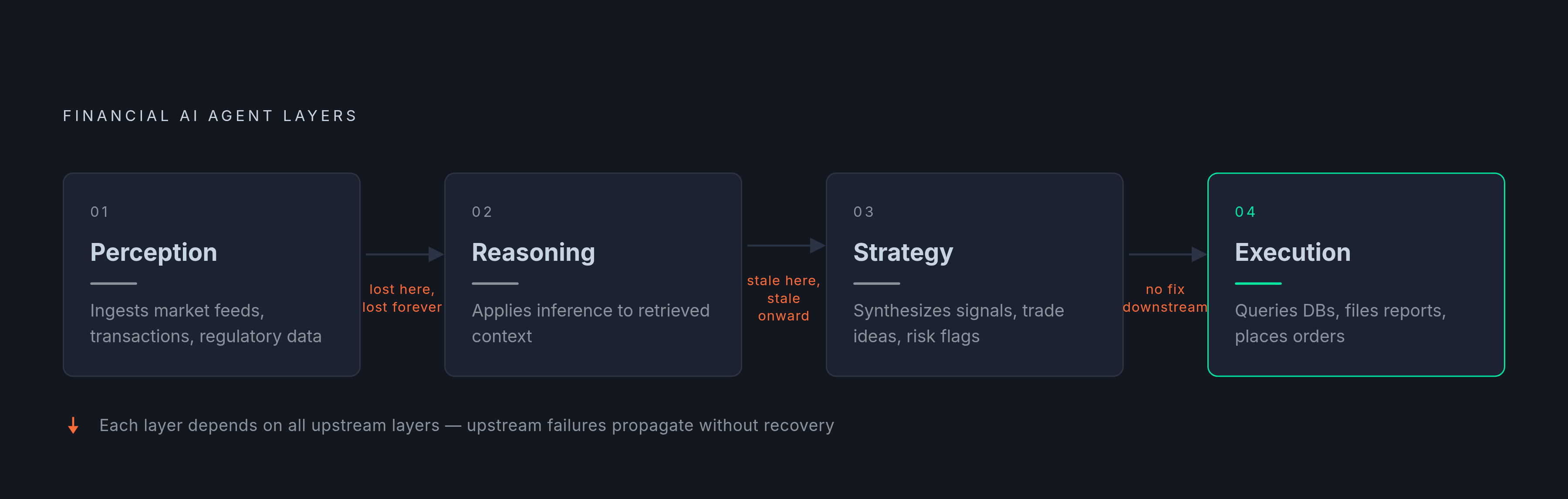
The four-layer design has a separate layer for data perception, reasoning, strategy generation, and execution with control. Perception ingests market feeds, transaction records, regulatory databases, and external content. Reasoning applies inference to that retrieved context, while strategy turns the resulting analysis into recommendations, trade signals, risk flags, or compliance actions. Execution then queries databases, files reports, routes alerts, or places orders within pre-approved parameters.
These layers form a chain of dependencies. Strategy cannot fix reasoning based on out-of-date evidence, and execution cannot recover provenance that was lost during retrieval. AI Agents in Financial Markets: Architecture, Applications, and Systemic Implications formalizes this design and connects agent architecture to efficiency, liquidity resilience, volatility, and systemic risk. The next four sections follow the chain, examining how each layer preserves freshness and what can break at its boundary.
The perception layer: where live web search and event-driven feeds replace crawlers
An event-driven perception layer retrieves information because something happened. A filing, a news publication, or a price threshold breach can trigger that work. When earnings arrive, rates move, or a sanctions list changes, waiting for the next crawl creates a gap between the financial environment and the agent's representation of it.
Structured feeds solve only part of that problem. Prices come through market feeds, but regulatory language, news sentiment, and what analysts say also come as unstructured text. Live web search provides an on-demand route to that material at query time. The architecture must therefore support web search and a market feed in supplying the different evidence a decision needs.
Retrieval-augmented generation, or RAG, bridges those inputs and the model. A vector database retrieves relevant context supplied by live feeds and internal systems, so an assessment of today's commodity shock can use today's evidence. Retrieval alone does not establish that the context is current. Financial Datasets shows what the data needs through field names that are the same across companies, checks against source documents in SEC EDGAR or earnings releases, and updates within seconds after companies report.
Anthropic's finance agents, announced in May 2026, connect to FactSet, S&P Capital IQ, MSCI, PitchBook, Morningstar, Chronograph, LSEG, and Daloopa through governed access controls. Connectors and MCP apps give agents access to provider data without relying on raw API scraping. Together, these patterns distinguish three requirements that a crawler alone cannot meet, namely timely access, usable data structure, and controlled entry into enterprise sources.
The reasoning layer: why grounded retrieval changes what LLMs can conclude
An ungrounded model asked about a company's credit risk reasons from what its training captured. That knowledge may predate a covenant breach, a leadership change, or a sector shock. The answer can be coherent and still backward-looking. A grounded model gets retrieved evidence before inference, so the same model weights can support different conclusions when the facts they are based on have changed.
If a new filing changes the company's position, the model needs that filing to assess the present risk. Yet giving the model current, relevant evidence does not ensure that it draws the right conclusions from it.
Citations make that distinction inspectable in financial workflows. A claim linked to a timestamped source document can be assessed against its evidence, while an unsupported claim offers no equivalent audit path. Citation grounding is needed to check the reasoning as well as to present the answer. Anthropic's finance agents embed source links for every claim, making analysis that “normally takes hours” usable within workflows that require review.
How should that capability be evaluated? What Current AI Benchmarks Leave Unmeasured: Modality, Search, Citations, and Implications (for Safety Evaluations) examines accuracy, response consistency, citation grounding, and abstention across interfaces and search configurations. The study shows why an aggregate score cannot describe the whole reasoning system. For financial use, retrieval quality must support defensible conclusions, including the ability to withhold a conclusion when the evidence does not support it.
The strategy layer: synthesizing live signals into financial decisions without hallucination
The strategy layer introduces a harder problem than retrieving an individual fact. Parallel agents may scan alternative data, model factor exposures, and stress-test positions before an orchestrator combines their results. Each thread can appear reasonable in isolation. Their combined recommendation, however, depends on whether they describe a compatible state of the world.
Temporal consistency is the hidden constraint in that synthesis. An agent using current market data and another using stale regulatory context can produce a strategically coherent but temporally inconsistent view. More parallel analysis does not remove that conflict. Satellite imagery, real-time consumer sentiment, and supply chain signals add useful perspectives only when their retrieval and grounding make them relevant to the decision being assembled.
This is where production-grade synthesis differs from a convincing demonstration. The task is not merely to combine plausible statements, but to build a recommendation from evidence whose timing and scope fit together. Anthropic's Market Researcher agent illustrates the intended pattern. It accepts tickers, queries FactSet or S&P Global for fresh fundamentals through integrated MCP partners including MT Newswires, and produces a daily report flagging new news, estimated price impact, and relevant calendar events.
AIG CEO Peter Zaffino reported that incorporating Claude dramatically compressed review timelines in early rollouts while improving data accuracy. That outcome concerns the quality and speed of a decision workflow, rather than the fluency of generated text. Its architecture relies on reasoning over current underwriting data in place of knowledge from past training.
The execution layer: auditability, compliance, and human-in-the-loop controls
Filing a report, routing a compliance alert, generating a SAR, or releasing a credit decision requires more than a plausible recommendation. The workflow must preserve what the agent retrieved, when it retrieved it, and where it came from. Provenance becomes a legal question as well as a question of analytical quality.
Human review supplies the mechanism for retaining accountability. Users review, iterate on, and approve outputs before those outputs reach clients, are filed, or are acted on. That control is not separate from the architecture's information requirements, because a reviewer needs evidence to assess the proposed action. An unexplained verdict remains difficult to review even if it was generated from live data.
Anthropic's Claude Managed Agents framework, introduced in April 2026, has several controls built into execution. It provides long-running sessions with per-tool permissions, managed credential vaults, and a full audit log in the Claude Console. Compliance and engineering teams can inspect tool calls and decisions. FIS's AML deployment anchors the practical benefit, using an agent built with Anthropic to compress investigations from hours to minutes while producing documented, reviewable outputs.
External access also expands the security boundary. When an agent calls live APIs and search endpoints during execution, each call can create an attack surface. Freshness infrastructure therefore cannot be assessed only by how quickly it returns evidence. Deployment in financial services also depends on zero data retention and an enterprise security posture, making the choice of API connection a control decision as well as a technical one.
What the architecture requires from the API layer connecting agents to live data
A developer assembling this stack faces two connected questions. What should the agent connect to, and how can that connection be assessed under production load? Structured feeds address prices and filings, while live search supplies unstructured web evidence. The API layer must make those sources available with the latency, accuracy, and compliance properties that downstream work requires.
Retrieval delays propagate through the whole decision path. A slow perception call postpones reasoning, which postpones strategy synthesis and execution. For a time-sensitive financial workflow, that delay is a business constraint. The useful unit of evaluation is therefore not just an isolated API response, but its contribution to the time required for the agent's decision.
Integration friction imposes a separate constraint on builders. Long waits for procurement, talks over rate limits, and complex authentication can slow development before any financial query runs. Financial Datasets illustrates a developer-first approach on the structured side through consistent company fields, Python and TypeScript SDK options, and a no-contract entry path. The same practical question applies to unstructured retrieval, where access must be immediately integrable.
Ease of integration cannot substitute for evidence of performance. Builders need to examine accuracy, citation grounding, response consistency, and abstention rather than select infrastructure from a headline score alone. A fast interface that inconsistently supports its claims creates downstream review work. A highly accurate interface can still be unsuitable if its data is stale for the intended task. Those trade-offs need to be tested when choosing infrastructure, before it is deployed.
Measuring whether the architecture is actually working in production
Production evaluation needs to separate retrieval quality, grounding fidelity, and execution accuracy. A general benchmark can conceal repeated failures on earnings updates, regulatory filings, or intraday price moves. These tests ask whether an agent responds correctly to information whose usefulness depends on when it became available.
AgentSearchBench (2026), covering thousands of real-world agents, identifies a substantial semantic–performance gap. Textual similarity metrics often miss the agents that perform best, while current retrieval approaches can capture only part of what agents can do during execution. Tests must cover how well the application retrieves evidence and takes action, as well as the wording of its answers.
Citation grounding offers a measurable diagnostic at the reasoning layer. A citation can expose the source and its timing, but its presence alone does not establish freshness or support for the claim. The benchmark study's interface comparisons reinforce the need to test grounding, consistency, and abstention separately. At the strategy layer, the corresponding question is whether sub-agents contribute temporally compatible evidence, while execution evaluation asks whether the resulting action is accurate, documented, and reviewable.
Development speed is another production dimension, though it is distinct from answer quality. FactSet's partnership with Anthropic brings Claude into client workflows, while its separate firm-wide internal Claude Code adoption accelerates capability delivery across engineering.
For developers and AI engineers, the practical action is to measure retrieval latency and freshness, source support, consistency, abstention, cross-agent temporal alignment, and execution accuracy against their own query distribution. Public benchmarks provide a starting point for comparison. The decisive test is whether the architecture preserves current, defensible evidence through the particular decisions it is expected to support.