Freshness vs Relevance Trade-Offs in RAG Systems
Balancing document freshness and semantic relevance determines retrieval accuracy.
Freshness vs relevance in RAG systems is a choice about which evidence is valid for the question. Static indexes need measured refresh cycles and temporal scoring, while live web retrieval through infrastructure such as Youcom closes gaps that local indexing cannot. The right balance depends on how quickly truth changes, which time the query concerns, and what a stale answer costs.
Why standard RAG has no sense of time
Vector similarity measures semantic proximity. Embeddings capture meaning at a frozen point in time, and nearest-neighbor search has no temporal axis unless the pipeline adds one. A deprecated document can therefore compete with its replacement on equal terms. Grofsky et al. describe this atemporal ranking as adequate for timeless facts but insufficient when recency, historical validity, or change matters.
For example, an API authentication query can retrieve an OAuth 1.0 document with a 0.92 similarity score after migration to OAuth 2.0. The document still matches the subject, but its instructions no longer match the system. The same mechanism retrieves an old policy after revision, last quarter’s prices after a pricing change, or a deprecated endpoint after its removal from documentation.
Why staleness degrades silently and reaches users before teams notice
Because stale documents remain semantically relevant, retrieval can deteriorate without latency spikes or error logs. Old vectors do not query more slowly than fresh ones, and their similarity scores can remain high. Each answer may look right even as accuracy falls across the workload.
Fixed-ground-truth evaluations compound that invisibility. Faithfulness measures whether an answer follows its evidence. A system can therefore pass standard checks while faithfully repeating information superseded for weeks. When a meaningful share of the corpus has passed its useful lifespan, the problem is no longer one bad document but a maintenance failure.
The blind spot is wider when the index cannot detect changes at the source. Infrastructure that draws from live web sources, including Youcom’s real-time web-data APIs, can get changed information from its source instead of relying on a local snapshot that stays the same. That addresses source drift, but it does not replace measurement of what the system actually retrieves.
Three distinct sources of staleness, each requiring a different fix
Source document drift occurs when real-world information changes but the vector index does not. The embedding may faithfully represent an earlier document while that document no longer describes what is true. Nothing has to fail inside the embedding model for retrieval to become wrong. This is a data engineering problem that ordinary similarity checks can miss.
Embedding model drift has a different cause. Changing models shifts the geometry of the vector space, so vectors from different models cannot be meaningfully compared through cosine similarity. Partial re-embedding is especially dangerous because it leaves old and new representations in the same store. Unlike a complete model swap, that mixed-generation index may not announce itself as a major operational change.
Chunk boundary drift comes from changes to preprocessing. Chunk sizes, overlap, HTML stripping, and Unicode normalization affect the token sequence supplied to the embedding model. When new rules apply only to incoming documents, old and new groups of documents represent the same content in different ways. Thus, saying that an index is stale does not yet identify which mechanism needs attention.
How to measure freshness before users become the detection system
Teams commonly track faithfulness without tracking freshness lag. That lag is the interval between an external source change and the system’s re-indexing of it. Measurement needs to follow the source category because news, product documentation, and legal text have different change rates. One corpus-wide average can conceal the category where outdated evidence matters most.
Embedding cosine distance over time provides one diagnostic signal. Re-embedding stable reference documents from time to time and comparing them with the indexed versions shows how their representation has changed. Nearest-neighbor stability supplies another by comparing the top-k document IDs returned for canonical queries against a baseline each week. Overlap below 70% shows that quality is falling even when similarity scores still look healthy.
Freshness distribution adds the missing view of document age and verification. Ingestion timestamps and last-verified dates make it possible to track retrieved chunks against category-specific thresholds and alert when the expired share spikes. Together with faithfulness, precision, and citation accuracy, these signals let teams make clear commitments such as recall@10 and a P95 freshness lag target. TEMPO introduces temporal-specific retrieval metrics, but temporal evaluation is not yet mainstream, making that operational panel important in its own right.
Update strategies for static indexes — incremental, delta, and full rebuild
The available strategies include full reindexing, delta updates, hierarchical updates, content-aware updates, and hybrid approaches. Full reindexing keeps data fresh but uses a lot of resources, while delta updates do less work by focusing on what has changed. Hybrid approaches combine freshness with availability. The choice depends on how large the corpus is, how often sources change, and whether the embedding model stays the same.
For large corpora, incremental re-indexing is the viable default. The sequence is to detect changes, re-embed modified chunks, update their vectors, and invalidate caches. A typical document update can complete in seconds. Full rebuilds are reserved for model upgrades, chunking changes, or recovery from accumulated embedding drift.
In that sequence, timestamp polling is simple for files and databases but can miss hard deletes. Transaction log mining with tools such as Debezium catches deletions without adding to the work needed for writes. Webhooks suit third-party sources but require dead-letter handling, while web crawls should compare content hashes because HTTP Last-Modified headers are unreliable.
Treat rebuilds like schema migrations, with dual-index serving, gradual traffic shifts, or a maintenance window matched to the SLA. Rebuilding content that has stayed the same uses resources for embedding, preprocessing, and building the index each time, while its meaning stays the same. That limit on spending makes it important to update only what needs changing, but both strategies leave open which available version a query should favor.
Adding a temporal scoring layer to existing RAG pipelines
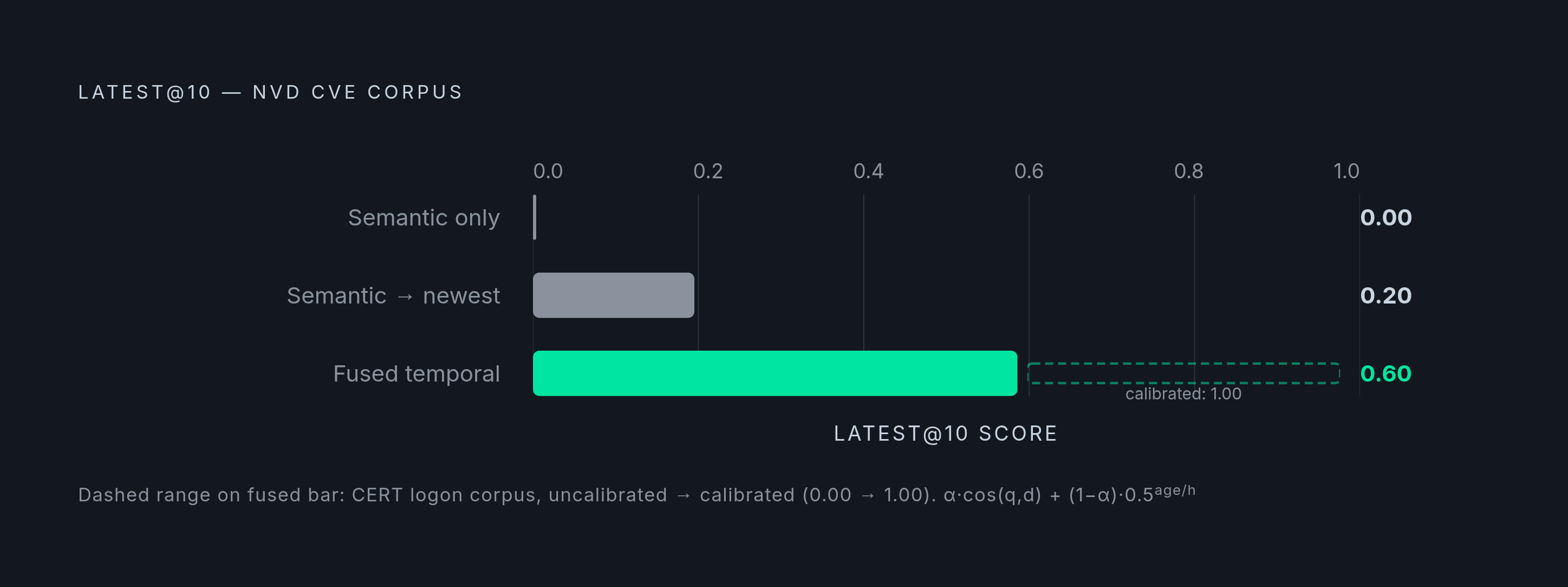
Grofsky et al. use the fused function score(q,d,t) = α·cos(q,d) + (1−α)·0.5^(age_days(t)/h) to combine semantic similarity with a half-life recency prior. It re-ranks candidates so a recent, relevant document can outrank an older near-duplicate without model retraining. On a topically diverse corpus of NVD CVE descriptions, the method lifted Latest@10 from 0.00 to 0.60, compared with 0.20 for a semantic-then-newest baseline.
The CERT logon corpus provides an immediate warning against treating those results as portable defaults. Grofsky et al. report 0.00 under parameters tuned for the synthetic corpus, recovering to 1.00 only with corpus-specific recency weighting. Both α and the half-life h therefore need domain calibration. A setting with a half-life of approximately two weeks is a starting point.
Candidate selection imposes another constraint. A narrow top-K cosine cutoff can discard the newest relevant document before temporal scoring begins, so a broad or time-aware candidate pool is necessary. TempRALM modifies retriever scoring directly, while TA-RAG introduces specialized temporal models across the pipeline, at greater integration complexity. With any of these choices, tracking topic evolution still goes beyond point freshness and is harder than ranking recent evidence.
When to prioritize recency vs. when semantic relevance should dominate
The query’s tolerance for temporal error should guide the weighting of recency and semantic relevance. In cybersecurity, an attack vector observed today can be more urgent than the same vector observed a year ago, so recent evidence deserves more weight. Financial data and documentation for software that is actively being shipped also change fast enough for old answers to have real costs. Requests that ask for the latest version or current policy give more weight to that preference.
Legal versioning exposes the opposite boundary. The applicable version may be the one valid at a historical date. Historical analysis, foundational technical concepts, and literature reviews likewise need semantic depth when an older source remains authoritative.
A temporal intent classifier can make this distinction at query time. Signals including “current”, “latest”, “as of”, and “changed” identify temporal intent, but the system should favor recency for requests concerning the present and historical applicability for requests concerning the past. The classifier can lower α for current-information queries while preserving semantic dominance for archival or analytical work. Reliable timestamps and last-verified dates are prerequisites for making that routing more than a heuristic.
Why static indexes have a structural ceiling that update strategies cannot fix
Even a well-maintained vector store remains a snapshot. There is always an interval between a source changing and its updated representation becoming available locally. Delta updates shorten that interval but cannot eliminate it. For breaking news, live market data, and active CVE disclosures, a gap measured in minutes can already exceed the product’s tolerance.
Agentic retrieval amplifies the consequence. An outdated result in an early step can propagate through later reasoning, enlarging the error surface as the task continues. Corrective loops can grade chunks, rewrite queries, retrieve again, and eventually fall back or refuse. But rewriting a query cannot make a stale index contain evidence it has never ingested. The ceiling lies in the available evidence.
Live web retrieval as the architectural response to indexing latency
When a query cannot tolerate the local indexing gap, retrieval must reach beyond that snapshot at inference time. Live web retrieval gets current information from the source without waiting for the application’s next index run. This changes where the system obtains evidence when local freshness is insufficient, with the need to assess relevance, source fidelity, or temporal validity remaining.
Three grounding architectures offer different levels of control. Search-first retrieval sends the query to a web search API and injects the results into context, providing the simplest path for open-domain questions. Tool use lets the model decide when to search and suits agentic workflows. Full retrieve-grade-rewrite loops add corrective behavior, but demand more complexity and a larger latency budget.
Youcom provides this infrastructure through its Web Search API, Answer API, Contents API, Research API, and Finance Research API. Its Web Search and Research APIs offer live results with configurable recency filtering per request, allowing authentication queries to distinguish current standards from deprecated ones without post-retrieval recency filtering. The suite reports 1659ms p99 latency, zero data retention, and SOC2 certification. For time-sensitive public-web workloads, it is a good option to consider before trying to close the gap by rebuilding the local index more often.
Financial research needs source reconciliation as well as recency. Youcom’s Finance Research API provides source-cited outputs and supports a modular research pattern involving query reformulation, sub-query decomposition, and cross-encoder reranking over live cited sources. More generally, reliable web grounding needs typed context packets, trust signals, coverage checks, fallback routing, and observability. Without those checks, live retrieval can fail in ways that also go unnoticed.
Enterprise readiness remains a gate for systems using live data. Agents accessing external enterprise APIs through MCP use OAuth 2.0 to respect the human user’s directory permissions, and retrieval-layer ACL enforcement remains essential. PII redaction, access controls, and secure storage also remain pipeline responsibilities. Zero data retention and SOC2 certification address infrastructure concerns without replacing the broader requirements of HIPAA or GDPR compliance.
Putting it together — a decision framework for the freshness-relevance trade-off
For minutes-to-hours workloads, route to live web retrieval at inference time. For days-to-weeks workloads, delta updates and temporal scoring can keep a static index viable. For stable material, periodic refresh with low recency weighting is proportionate.
Cybersecurity, financial compliance, and legal versioning justify stronger freshness infrastructure because confidently wrong answers carry asymmetric harm. Standard retrieval with less monitoring can work for reference content that stays the same and for lower-risk FAQ systems. The investment should follow the consequence.
Use temporal intent classification to give recency more weight when requests ask for current information, while keeping semantic dominance for analytical work. Historical questions need evidence applicable to their requested time. Store timestamps and last-verified dates so these distinctions can be executed.
Large corpora favor incremental updates with hash-based change detection, reserving rebuilds for model changes, chunking changes, or drift recovery. A hybrid approach can use live retrieval for queries that outpace the index. Across every branch, commit to nearest-neighbor stability, freshness distribution, faithfulness, and citation accuracy, with freshness lag treated as a first-class SLA and tracked before users encounter it.