Hybrid Retrieval Combining Vector Search and Live Web Data
Routing queries to the right source matters more than choosing between them.

Hybrid retrieval brings vector search and live web data together, but its value comes from how it routes queries between them. A reliable agent needs an architecture that distinguishes stable knowledge from time-sensitive evidence, calls the right source, and evaluates what comes back. The central decision is not which retrieval method wins, but which one fits the query.
Why the vector-vs-live-web framing is the wrong question
Choosing between a vector store and live web search turns a choice of sources into a contest between products. The choice looks straightforward only while the agent’s questions remain undifferentiated. Once those questions cover both internal historical records and current regulatory changes, one source no longer fits them all. The sources answer different kinds of questions because they operate over different evidence. A pre-built corpus snapshot and the public web at query time are not interchangeable.
A static index goes stale when ingestion stops, while live retrieval adds latency and can return unfiltered noise. The agent still needs a decision about when freshness matters, when the answer must come from a bounded corpus, and when retrieved evidence is insufficient.
What a vector index actually solves, and where it stops working
Vector retrieval earns its place when the evidence is stable, proprietary, and unavailable publicly. This includes internal documentation, historical transaction records, and curated domain knowledge. For these corpora, the index gives the agent access to material it cannot reach through live web retrieval. Its limitation is that the snapshot must contain and expose the evidence required to answer the question.
Even when evidence is present, its description can make it hard to find. Terrenzi et al. identify vocabulary mismatch as a systematic problem in sparse metadata environments. A query for “COVID hospitalization rates by county” can return nothing against a dataset titled “US Health Statistics 2020, County-Level Hospital Admissions”. Semantic retrieval does not automatically repair every gap between user language and provider-authored metadata. Offline preparation remains part of retrieval quality.
The gap between semantic chunking and naive fixed chunking can outweigh many model-swapping decisions. Staleness imposes a different constraint, since tuning cannot supply a price or regulatory change absent from the indexed corpus. Even with well-tuned hybrid BM25 retrieval over financial documents, achieved recall can fall well short of oracle-context performance on hard numerical questions.
What live web retrieval solves, and what it cannot replace
Live web retrieval supplies the freshness that a stored snapshot cannot promise. Prices, news, regulatory updates, and competitive intelligence can require evidence available at query time. Temporal qualifiers such as “current,” “today,” and “latest” make that requirement explicit. For this query class, a well-tuned index can still be the wrong source.
A live fetch adds round-trip time, while a precomputed index is still faster at petabyte scale or when service-level constraints leave little time. Public results can also have noise and gaps in what they cover. Specialized hardware security verification, financial compliance, and proprietary internal workflows may require evidence that public pages do not provide at the necessary depth. The web’s breadth therefore cannot stand in for a curated corpus.
VeriChat illustrates why the two capabilities can belong in one system. The conversational assistant specializes in hardware security verification and uses both a curated internal knowledge base of thousands of hardware security papers and real-time web retrieval. Its workload calls for both specialized depth and current threat intelligence. Neither source alone satisfies that combination, but their usefulness differs by query. Classification must identify which evidence requirement a question places on the system before its retrieval path is chosen.
How an orchestration layer routes queries between the two sources
An orchestration layer turns that classification into a controlled retrieval process. It classifies the query, selects a source, evaluates the result, and escalates when the evidence is insufficient. Freshness signals include price references, news events, and temporal qualifiers. Low-confidence index results can also trigger a live fetch, although public coverage still limits what that escalation can recover. The router makes these decisions part of the normal path rather than treating freshness as an exceptional case.
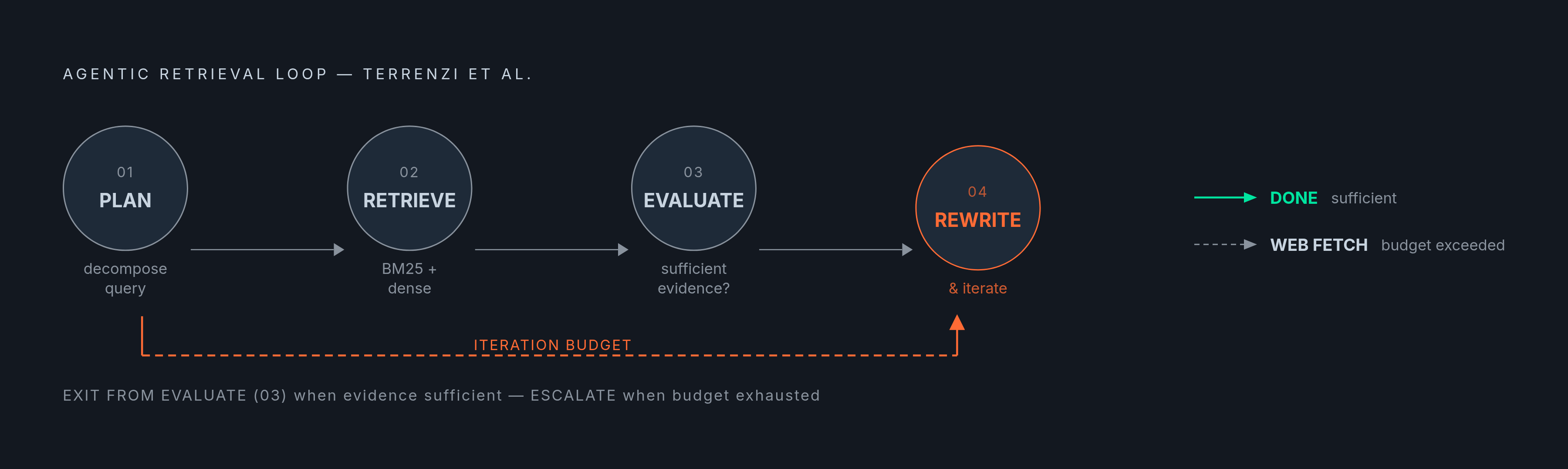
Terrenzi et al. formalize a Plan–Retrieve–Evaluate loop for agentic hybrid dataset retrieval. An LLM agent decomposes the query, coordinates BM25 and dense retrieval, evaluates sufficiency, and rewrites the query within an explicit iteration budget. The budget bounds nondeterministic behavior and makes the process more observable and reproducible. Its role is governance as well as cost control.
Reciprocal rank fusion, or RRF, combines ranked lists without requiring score normalization across heterogeneous retrieval methods, making it a practical default for merging BM25 and dense candidates. A cross-encoder reranking pass should determine which candidates the model actually receives. Cloudflare’s AI Search, formerly AutoRAG, illustrates the supporting namespace-per-agent pattern through per-agent and per-customer namespaces that run semantic and keyword search. Its ai_search_namespaces Workers binding and dynamically created instances cut the work of managing indexes, while the architecture still has to handle source routing.
Query classification as the upstream decision that determines retrieval quality
A retrieval method can perform well and still answer the wrong evidence requirement. High recall within an old corpus does not satisfy a question about today, just as a relevant public page does not establish an internal historical fact. Routing accuracy measures whether the agent selected the right source before assessing how well that source returned results.
AIM Research’s AIM-Agentic RAG Benchmark in September 2026 tests database routing explicitly. It found leading models reaching routing accuracy on hard questions in the low-to-mid nineties on a percentage basis. Terrenzi et al. address a related upstream problem by generating pseudo-queries for dataset records offline. This metadata augmentation enriches the indexes with the language users might employ, reducing first-pass failures caused by provider-authored descriptions.
Meta’s SuperIntelligent Retrieval Agent, or SIRA, pushes the same reasoning toward more discriminative queries. Rather than accumulating exploratory rounds, it predicts vocabulary that separates the target evidence from corpus-level confusers. Its training-free approach compresses that exploration into a single retrieval action and outperforms multi-round agents on hard benchmark-derived queries.
When agentic tool-driven search replaces the index entirely
The strongest objection to hybrid retrieval is that some workloads do not need a vector store at all. Amazon Science presented a paper at AAAI 2026 that reported 94.5% RAG faithfulness with zero vector store. Its result gives agentic keyword search genuine weight for evolving code corpora and exact-match workloads. SIRA also shows that a single corpus-discriminative BM25 call with vocabulary expansion can outperform multi-round dense retrieval on multiple BEIR benchmarks and BrowseComp-Wikipedia. These findings weaken the assumption that semantic questions automatically require dense vectors.
Tool-driven search needs a corpus that is public or otherwise reachable through tool calls at query time. A private corpus reachable through an internal tool is therefore different from proprietary knowledge that exists nowhere on the live web. The decision concerns both how evidence is searched and whether the chosen tool can reach it.
Scale further complicates a wholesale replacement. At petabyte scale, a precomputed index still has a latency advantage, making agentic search within an agent-selected slice of a larger indexed corpus a practical pattern. An organization with both proprietary internal knowledge and freshness-sensitive questions still needs access to both evidence classes. That does not mean every internal lookup must use dense retrieval. The agent still needs to route queries between evidence sources even when keyword tools replace the vector layer for part of the workload.
What the infrastructure layer must provide to make hybrid retrieval production-ready
Production infrastructure must preserve the distinction the router is designed to make. If a freshness-sensitive query reaches an API that returns a crawl several days old, the escalation path has not delivered its intended benefit. API selection must therefore establish whether results, including those served from a provider’s cache, are current at query time.
Latency must be assessed across the whole evidence path. Embedding and reranking already consume time before a live fetch adds its round trip. The web layer must be fast enough for the whole path to meet the agent’s service-level agreement. The infrastructure must meet the requirements for speed and accuracy together.
Compliance has the same end-to-end character. A query that passes through an LLM agent, an internal index, and an external search API crosses multiple data processors with separate retention and logging policies. A model-layer guarantee does not establish the policy of the retrieval API. Organizations that need zero data retention must get that guarantee at the API layer too, with clear terms for any plan conditions. These criteria make freshness, total latency, and data handling concrete selection requirements rather than general assurances about production readiness.
How to decide which pattern fits your agent's actual query distribution
Characterize how much of the workload depends on private evidence, current public information, and exact-match access. An internal index or managed hybrid search namespace gives access to proprietary internal corpora that are never publicly indexed and that public search cannot reach. For a meaningful share of freshness-sensitive questions, a live retrieval layer and a freshness-escalation path are required. When the corpus is public, code-like, or exact-match dominant, evaluate vocabulary-enriched BM25 and agentic tool-driven search before defaulting to embedding pipelines.
The next decision concerns how much control the workload requires. Terrenzi et al. describe specialized agents that work together through typed contracts under feedback control and perform better than a single ReAct agent, with clearer lines of responsibility but more work needed to modify them. That decomposition fits strict governance and observability requirements, rather than being an automatic upgrade for every system. Gartner predicts that over 40% of agentic AI projects will be canceled before end of 2027, with architectural complexity and absent routing measurements among the cited contributors. Instrumenting the router and publishing recall metrics internally makes retrieval quality available for governance review.
Hybrid retrieval is useful when the workload requires complementary sources. Treating it as architecture is what allows an agent to remain accurate on stable knowledge and fresh on time-sensitive questions.