Deep Research Agent Design and Architecture

The foundational intuition is straightforward: decompose the research task into specialized roles so that each component can be optimized, replaced, or scaled independently. In practice, this produces a canonical four-part division, though calling it "canonical" risks flattering what is still an evolving and contested architecture.
The planner agent handles task decomposition and subgoal scheduling. It decides what needs to be known and in what order. The query agent translates those subgoals into diversified, contextually appropriate search queries, a more nuanced job than it sounds; effective query generation requires different phrasings, different angles, and deliberate variation, a practice known as query diversification, to avoid retrieval blind spots. The retriever agent executes those queries against external tools: web search APIs, relational databases, vector stores. The writer agent synthesizes retrieved evidence into structured output with citations.
Modularity produces a practical benefit beyond architectural cleanliness. Each agent can be swapped, retrained, or scaled without disturbing the others. Multiple retriever agents can run concurrent searches on different subquestions while the planner is still decomposing later stages, compressing wall-clock time on complex tasks.
Systems that operationalize this pattern include AgentRxiv, AI Scientist, and OpenResearcher. SciAgent implements a hierarchical Coordinator-Worker-Subagents framework for scientific problem-solving. ResearStudio inserts a human-intervenable layer, making the pipeline controllable in contexts where fully autonomous operation is unacceptable.
The cost of this modularity is not purely theoretical. More agents mean more coordination overhead and more failure points. The planner's decomposition quality becomes the ceiling for the entire system: a planner that over-decomposes wastes retrieval cycles on redundant subquestions; one that under-decomposes leaves meaningful gaps in the evidence base. Neither failure is recoverable downstream, and neither is easy to diagnose from the final output alone. Teams that invest heavily in model selection while treating the planner as a prompt engineering afterthought tend to discover this mismatch at the worst possible moment, which is during a demonstration to someone who matters.
How Reinforcement Learning Trains Agents to Reason Iteratively Rather Than Retrieve Once
The RL framing for deep research agents is "think, search, rethink," repeated under sparse reward signals, a delayed-feedback regime common in long-horizon RL, until the agent converges on a sufficient answer. Research tasks map naturally onto this approach for a structural reason: the process is long-horizon and multi-step, with no single correct intermediate action to supervise against. The agent receives a quality signal only at the end, after synthesis, when the final report either answers the question accurately or it does not. It must learn, through accumulated experience, when to keep searching, when to change query strategy, and when it has gathered enough.
DeepResearcher is the clearest illustration of how far this approach has been taken. It is the first system trained via end-to-end reinforcement learning in a real, dynamic web environment for deep information retrieval and integration. Rather than a simulation or a cached corpus, the agent interacts with actual web infrastructure during training, which forces it to handle noise, irrelevance, and retrieval failures as part of the learning signal. A system trained only against clean corpora does not know what to do when the real web returns a 403 error or a page that is 90 percent advertisement. The distinction between training environment quality and deployment environment messiness is one of the more consistently underappreciated gaps I have seen separating research prototypes from production systems.
The field currently pursues three optimization approaches in parallel. Contrastive learning teaches the agent to distinguish high-quality evidence from low-quality evidence through paired examples. RL, as in DeepResearcher, optimizes directly for end-task quality under sparse rewards. Curriculum training introduces progressively harder research tasks, developing robust reasoning without catastrophic failure on early complex inputs.
The unresolved design question is controllability. RL-trained agents develop emergent query strategies that planned pipeline agents do not. Those strategies are often more effective precisely because they were not hand-engineered, and they are also harder to inspect, debug, and constrain. ResearStudio's controllable framework is one serious attempt to address this, inserting human intervention points into what would otherwise be a fully autonomous loop. Whether the field moves toward more control or more autonomy will depend less on technical preference and more on where these systems are actually deployed and who is legally accountable for what they produce.
The Iterative Retrieval Loop and What Happens Inside a Single Research Cycle
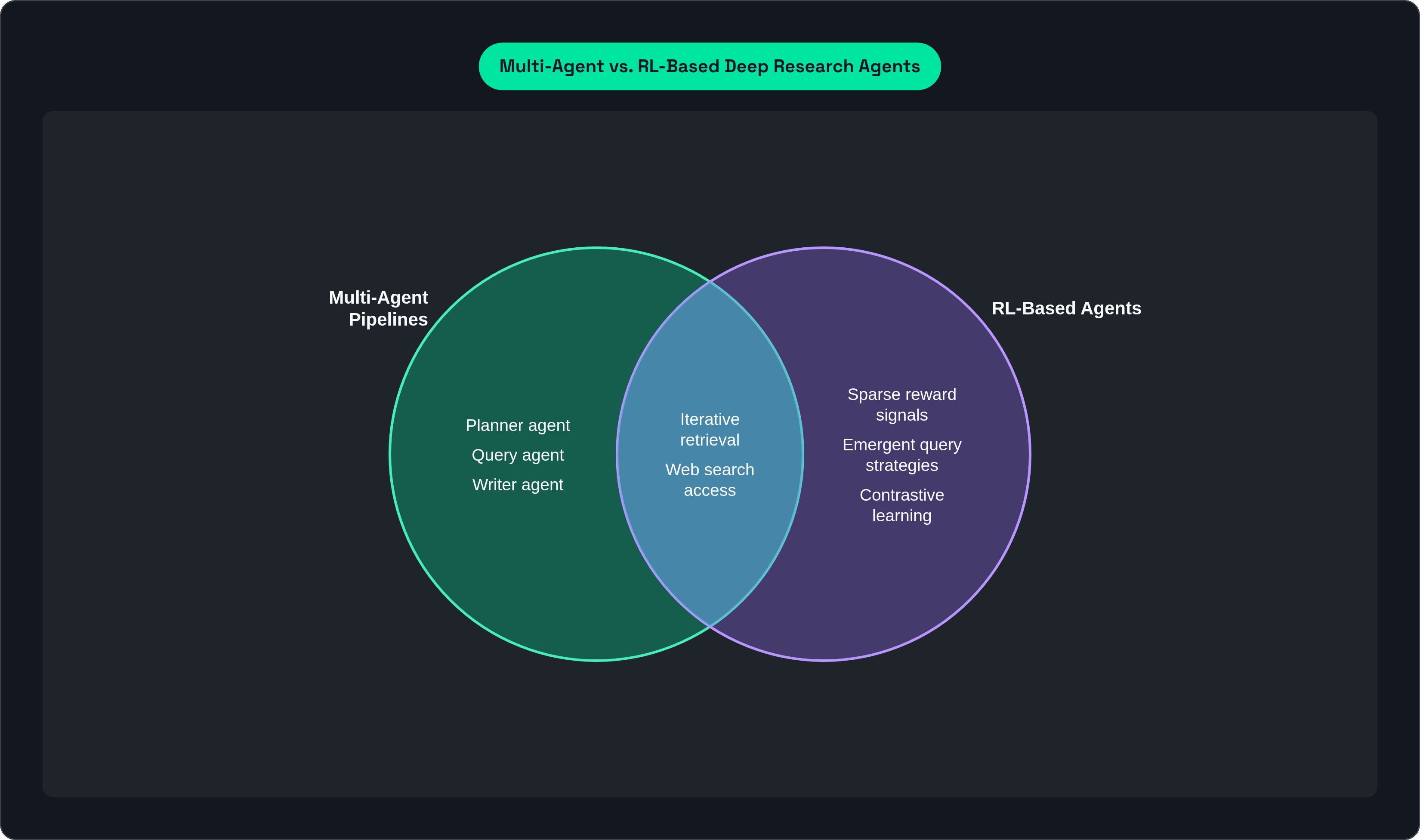
Both multi-agent pipelines and RL agents share a common runtime pattern at the level of a single cycle: formulate a query, retrieve results, evaluate the evidence, then decide whether to refine and re-query, branch to a new subgoal, or pass evidence to synthesis. That cycle is where systems degrade. Understanding exactly how is more useful than any high-level architectural diagram.
Query formulation is where diversity strategies matter. The agent must translate a subgoal or identified uncertainty into a specific search query, and a single phrasing rarely surfaces the full range of relevant sources. Different angles on the same question, different terminology, different assumed contexts: these are deliberate strategies, not redundancy.
The retrieval step returns ranked results from a web search API or content extraction tool. Evidence evaluation then determines whether retrieved content resolves the subgoal or reveals a new gap. Stale data causes compounding failures here specifically. An agent operating on outdated content may evaluate a gap as closed when it is not, propagating the error forward into synthesis.
Doubao Deep Research's design choice is instructive. By integrating Chain-of-Thought (CoT) tightly with search invocation, the system allows the agent's reasoning trace and its retrieval calls to happen in the same pass, driving query generation mid-thought rather than treating reasoning and retrieval as sequential phases. SFR-DeepResearch offers a useful minimal counterpoint: a single-agent design with minimal web crawling and Python tool integration, demonstrating that the iterative loop can be implemented without full multi-agent orchestration.
The loop breaks in predictable places in production. Retrieval latency compounds across cycles; response times above three seconds correlate with a 21% higher agent failure rate across multi-step pipelines. Raw web pages are between 60 and 80 percent boilerplate; without HTML-to-Markdown conversion and extraction, the agent burns token budget on navigation chrome and footer links rather than substantive content. Rate limiting and scraper brittleness are persistent operational burdens, and teams maintaining their own extraction scripts routinely spend more engineering time on infrastructure than on agent logic. That last ratio tends to surprise people until they are the ones managing it.
Where Real-Time Web Access Fits in the Stack and Why Static Training Data Alone Fails
An LLM's training data has a cutoff date. A deep research agent's job is to answer questions about the world as it currently exists. That asymmetry is not a minor inconvenience; for the domains deep research agents are built to serve, it is a correctness problem.
Legal filings change. Market positions shift within hours. Scientific preprints are superseded. Regulatory interpretations are revised. Currency in these domains is not a quality preference; it is a correctness requirement. A system that retrieves authoritative information about a regulatory environment as it existed eighteen months ago may produce a response that is confidently, coherently, and catastrophically wrong about the present.
Retrieval-augmented generation (RAG) remains the primary grounding mechanism for addressing this. At query time: convert the question to an embedding, search a vector store or live web, retrieve the top documents, pass them as context to the LLM, generate a grounded response with citations. The quality differential between well-grounded and ungrounded generation is substantial and measurable.
The retrieval infrastructure is, in most production deployments I have encountered, the most underinvested layer. Most agent failures trace back to what the agent cannot see, not what the model cannot reason about. According to Browsercat's industry analysis, 65% of enterprises now use web scraping to feed AI and machine learning projects. That figure signals demand. It says nothing about the quality, freshness, or structure of what those scrapers are actually delivering, and in my experience those two things diverge considerably.
A deep research agent's retrieval layer requires structured, machine-readable output; real-time freshness; citation provenance. Teams that build on scraper scripts accumulate scraper debt. The point at which managing that debt consumes more engineering capacity than it would cost to replace the approach is not a hypothetical threshold. It is a moment teams tend to recognize only after they have passed it.
What the Retrieval Infrastructure Layer Must Actually Deliver for Agents to Function Reliably
Latency is a first-order constraint. Each retrieval cycle adds wall-clock time to a multi-step pipeline, and the compounding is significant at scale. Industry benchmarks target between 1.5 and 2.5 seconds per search call. Per Proxyway's 2026 search API report, the fastest index-based APIs deliver results in under 0.4 seconds, while real-time crawling APIs average between 0.6 and 0.7 seconds. These differences matter not in isolation but in aggregate, across the dozens of retrieval cycles a single deep research task may require.
Precision and recall present different failure modes, both consequential. Precision measures what proportion of retrieved documents are actually relevant: too low, and the agent wastes context budget on noise. Recall measures what proportion of all relevant documents are retrieved: in finance or medicine, a meaningful drop in recall could mean missing a critical regulatory filing or a pivotal research paper. Standard keyword search APIs optimize for neither in the way agentic systems require. Semantic and neural retrieval APIs, which power semantic search, match by meaning rather than exact term overlap, which matters when users phrase queries differently from how relevant documents are authored.
Extraction quality determines whether the agent receives content it can actually reason about. HTML-to-Markdown conversion strips boilerplate so the LLM receives substantive passage text rather than navigation menus. Enterprise-grade APIs provide extended excerpts, between 500 and 2,000 characters of substantive passage rather than two-sentence snippets, giving the reasoning layer enough context to evaluate evidence rather than merely acknowledge a source's existence.
Enterprise deployment requirements extend beyond performance. Zero data retention policies prevent search providers from retaining queries or results, a baseline requirement for healthcare, legal, and financial deployments. SLAs with uptime commitments and dedicated support are not available from scraper scripts or consumer search wrappers. SOC 2 certification and support for Data Processing Agreements are standard expectations in regulated industries, not differentiators.
The practical difference between AI-native search APIs and traditional keyword APIs comes down to format. AI-native APIs format results for machine consumption: structured arrays that feed directly into tool-calling loops, native framework integrations with LangChain, LlamaIndex, and MCP server support, and standardized tool use interfaces that reduce integration overhead from weeks to hours. That reduction matters because the retrieval layer that stays in a backlog provides exactly as much value as no retrieval layer at all.
How Evaluation Frameworks Measure Whether a Deep Research Agent Is Actually Working
Generic LLM benchmarks do not transfer to deep research agents. Standard benchmarks measure single-turn accuracy. Deep research agents succeed or fail across a multi-step process where intermediate decisions compound. A system that decomposes tasks well but retrieves poorly will fail differently than one that retrieves well but synthesizes incoherently, and a single accuracy score obscures that distinction entirely.
DeepResearch Bench and DeepResearchGym are built to cover the full pipeline: planning quality, subtask decomposition, retrieval strategy, evidence integration, synthesis coherence, and citation accuracy. These frameworks make it possible to isolate where in the pipeline a system degrades rather than simply observing that it does. That diagnostic capacity is the point. It is also, in production deployments, substantially underused, which means teams are often optimizing against the wrong signal entirely.
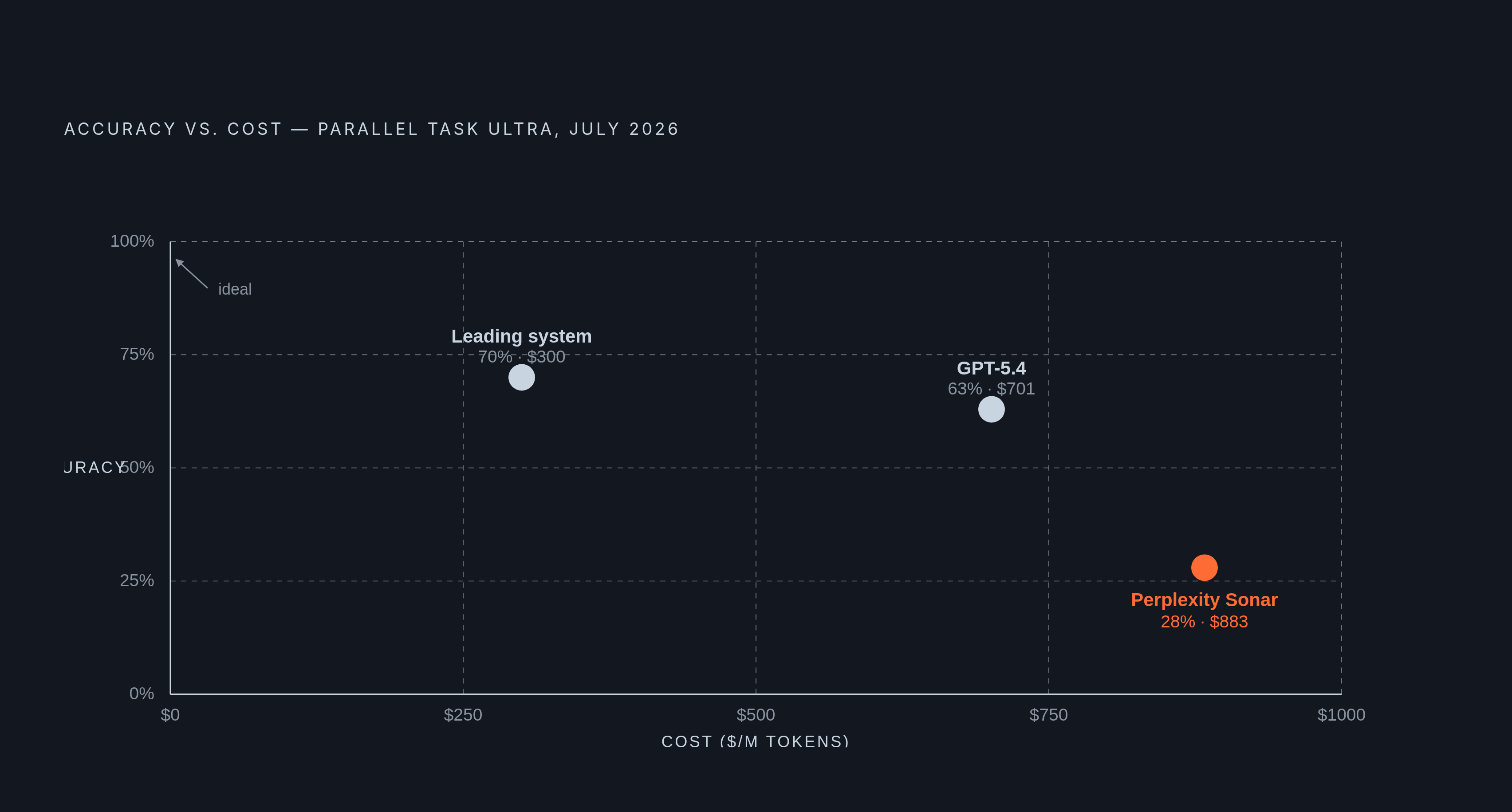
Benchmark results provide a concrete reference for what current systems actually achieve. On the Parallel Task Ultra benchmark, evaluated in July 2026, one leading system reached 70% accuracy at $300 per million context tokens. GPT-5.4 with code execution reached 63% accuracy at $701 per million context tokens. Perplexity Sonar Deep Research reached 28% accuracy at $883 per million context tokens. Performance and cost are both dimensions in production decisions, and neither can be evaluated in isolation from the other. The Perplexity figure is worth sitting with for a moment: that is a significant expenditure for an outcome that, in some domains, would not clear an acceptable accuracy threshold regardless of cost.
Citation quality evaluation tests something more demanding than simple attribution. It tests whether the cited source actually supports the specific claim it is attached to. Source reconciliation, confirming that a citation does what it is alleged to do, is verifiable in evaluation in a way that inspection alone cannot establish.
Teams should run their deep research agent against a domain-specific evaluation dataset before production. General-purpose LLM benchmarks will tell you almost nothing about how the system behaves on the research tasks it is actually deployed against.
Special Considerations When Building Deep Research Agents for Financial Intelligence
Financial intelligence exposes design weaknesses that less exacting domains might tolerate, and it does so in ways that carry consequences beyond a degraded user experience.
The data environment in finance is unusually hostile to static retrieval. Earnings releases, SEC filings, central bank communications, credit rating actions, and analyst revisions all arrive continuously and carry immediate material implications. A research agent operating on a knowledge base that is even modestly out of date can construct analysis that is internally coherent and factually wrong about the present state of markets or regulatory obligations. The currency requirement here is not about user experience; it is about the basic validity of the output.
Precision-recall trade-offs take on a different character in this context. In general-purpose research, missing a source is an inconvenience. In financial intelligence, missing a material disclosure, a counterparty filing, a regulatory guidance document, or a reference to material non-public information can carry legal and fiduciary consequences. Recall is not a secondary metric. Infrastructure choices that sacrifice recall for latency need to be evaluated against that specific risk profile, not against a generic performance target.
Source provenance is also more consequential in finance than in most other domains. Financial research has an audience: compliance officers, portfolio managers, analysts, regulators. Every claim in an output may need to be traced back to a verifiable primary source. Citation quality evaluation becomes less of a benchmark exercise and more of a production requirement when that audience can act on, or be held accountable for, what the system produces.
The controllability question raised by RL-trained agents becomes particularly acute here. Emergent query strategies are valuable precisely because they surface information a hand-engineered pipeline might miss. They are also difficult to audit when a compliance team needs to understand why the system retrieved what it retrieved and how it weighted conflicting evidence. One might argue that the performance gains from autonomous reasoning outweigh the auditing burden. That argument is harder to sustain when the audit is not optional, when it is required by a regulator or triggered by a material loss. This is a deployment constraint that shapes architectural decisions from the outset, not a philosophical concern to revisit later.
The enterprise infrastructure requirements described in the retrieval section, including zero data retention, SOC 2 certification, Data Processing Agreements, and dedicated SLAs, apply with full force in finance and carry contractual weight. These are prerequisites for procurement, not features on a roadmap. Teams building financial deep research agents that defer infrastructure decisions until after the architecture is otherwise complete will find themselves retrofitting constraints that should have shaped the original design, at a cost that is rarely just financial.